Operating rates of China silicon plants fell to 4-year low as COVID-19 disrupted raw materials supply

Published: Mar 10, 2020 14:03 (GMT+8)
In early February, raw materials shortage due to suspended logistics and disrupted operations at mines weighed on production at silicon mills in Xinjiang, Sichuan, Guizhou and Heilongjiang. This outweighed ramped-up production in Fujian, Guangxi and Chongqing and accounted for the declines in overall operating rates in February.

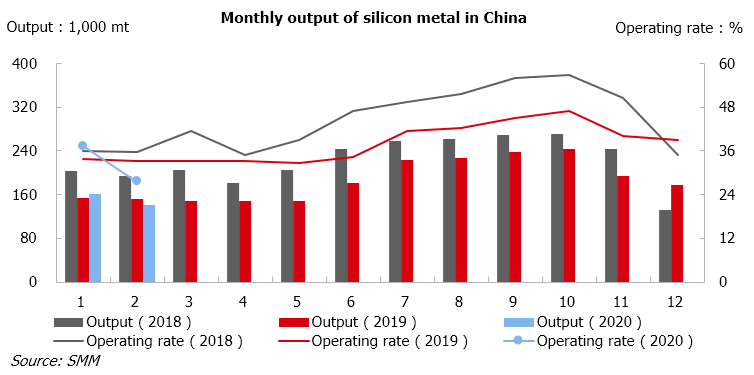
SHANGHAI, Mar 10 (SMM) – Operating rates across Chinese silicon metal producers fell to the lowest level since April 2016, standing at 27.5% in February, down 9.8 percentage points from a month ago and down 5.8 percentage points from a year ago, showed the latest SMM survey.


In early February, raw materials shortage due to suspended logistics and disrupted operations at mines weighed on production at silicon mills in Xinjiang, Sichuan, Guizhou and Heilongjiang. This outweighed ramped-up production in Fujian, Guangxi and Chongqing and accounted for the declines in overall operating rates in February.


Supply tightness of feedstock such as petroleum coke and coal, which was caused by the suspension of logistics, has eased as of March 9. However, silica and coal supply in Xinjiang and silica supply in Hubei have not improved, which could restrict the resumption of silicon production in Xinjiang and Sichuan in the near term. Silicon plants in Xinjiang cannot restart production immediately even as local mining of silica and coal resumes, as it requires some time for restarting a suspended submerged-arc furnace and the coronavirus (COVID-19) outbreak continued to affect the supply of explosives and the return of workers.


Some silicon producers in Nujiang, Yunnan province usually resume production in early March each year, but the epidemic and desulphurisation issues kept them shut as of March 9. These plants are expected to reopen in late-March if they obtain approvals from the environmental authorities. SMM expects the operating rates of silicon metal producers in China to remain at around 27% in March.


SMM data showed that China’s production of silicon metal stood at 141,000 mt in February, down 7.6% on a yearly basis. Silicon metal output in January-February shrank 1.6% on the year to 301,000 mt.

 

Data Source Statement: Except for publicly available information, all other data are processed by SMM based on publicly available information, market communication, and relying on SMM's internal database model. They are for reference only and do not constitute decision-making recommendations.

For any inquiries or for more information, please contact: lemonzhao@smm.cn
For more information on how to access our research reports, please contact:service.en@smm.cn
Related News
Understanding SMM Tantalum Ore Price Points: Quotation Units, Conversion Formulas, and Use Cases [SMM Analysis]
18 hours ago
Understanding SMM Tantalum Ore Price Points: Quotation Units, Conversion Formulas, and Use Cases [SMM Analysis]
Read More
Understanding SMM Tantalum Ore Price Points: Quotation Units, Conversion Formulas, and Use Cases [SMM Analysis]
[SMM Analysis: Understanding SMM Tantalum Ore Price Points: Quotation Units, Conversion Formulas, and Use Cases] AI computing power is boosting tantalum capacitor consumption, making tantalum a "computing metal." Eighty percent of global tantalum ore is concentrated in three African countries. In early 2026, the suspension of operations at the Rubaya mine caused an interruption of about 15% of supply, and tantalum prices doubled within two months. SMM has launched a tantalum ore FOB (East Africa) price point, forming a dual anchor of "FOB – CIF" together with China's landed prices.
18 hours ago
Review of Tantalum and Niobium Markets — 13 November 2026
19 hours ago
Review of Tantalum and Niobium Markets — 13 November 2026
Read More
Review of Tantalum and Niobium Markets — 13 November 2026
China Market: SMM’s assessment for 30% tantalum ore CIF China on 13 November stands at US$227–232/lb, averaging US$229.50/lb. The average is down US$3/lb, or 1.29%, from the previous assessment. It is also US$13/lb below the US$242.50/lb reference recorded on 3 November, showing a further softening in China’s assessed import price. African Market: The DRC Ministry of Foreign Trade’s publication on 9 November lists a tantalum concentrate reference of US$37,240 per tonne for 9–14 November, up 30.54% from US$28,526.82 per tonne. Its separate tantalum reference remains unchanged at US$760/kg. The concentrate’s grade, delivery terms and valuation methodology are unspecified, preventing a direct comparison with regional ore assessments. Separately, ReelActu reported on 8 November that Goma coltan traders were seeking greater freedom to choose buyers. Traders cited US$2.50/kg per degree in Goma against a potential resale level of US$4.50/kg per degree in Kigali—equivalent to US$100/kg and US$180/kg respectively for material grading 40% Ta₂O₅. The report highlights concerns about buyer access and pricing transparency rather than establishing a regional export benchmark. East Africa FOB Tantalum Ore: SMM’s latest weekly assessment, dated 12 November, is US$4.30–4.50/kg per 1% Ta₂O₅, averaging US$4.40. This compares with US$4.50–4.60, averaging US$4.55, on 5 November. The average has fallen US$0.15, or 3.30%, marking a second consecutive weekly decline. Both ends of the assessed range moved lower this week. Market Outlook: China’s daily decline and East Africa’s lower weekly assessment point to continued downward pressure on tantalum ore prices. The available evidence supports a cautious outlook, without establishing the pace of further declines or a change in physical supply.
19 hours ago
[ADC12 Price Daily Commentary] Environmental protection-related controls in multiple regions disrupt supply; ADC12 prices remain stable amid a wait-and-see stance
Nov 13, 2026 11:41 (GMT+8)
[ADC12 Price Daily Commentary] Environmental protection-related controls in multiple regions disrupt supply; ADC12 prices remain stable amid a wait-and-see stance
Read More
[ADC12 Price Daily Commentary] Environmental protection-related controls in multiple regions disrupt supply; ADC12 prices remain stable amid a wait-and-see stance
[ADC12 Price Daily Commentary] Environmental protection-related controls in multiple regions disrupt supply; ADC12 prices remain stable amid a wait-and-see stance
[ADC12 Price Daily Review: Environmental Protection-Related Controls in Multiple Regions Disrupt Supply, ADC12 Prices Hold Steady Amid Wait-and-See Sentiment] In the short term, stabilizing costs and supply-side disruptions provide some support for ADC12 prices, but downstream restocking willingness remains insufficient, and supply-demand resonance has yet to materialize. The strength of future price support will still depend on the actual scale of production cuts, the recovery of raw material arrivals, and changes in downstream orders.
Nov 13, 2026 11:41 (GMT+8)