
According to SMM data, China's primary aluminium ingot social inventory in major consuming regions stood at 549,000 mt as of October 29, down 89,000 mt from end-September's 638,000 mt and down 137,000 mt from the post-holiday peak of 686,000 mt recorded on October 8. Inventory has now fallen to its lowest level for this time of year in nearly four years.
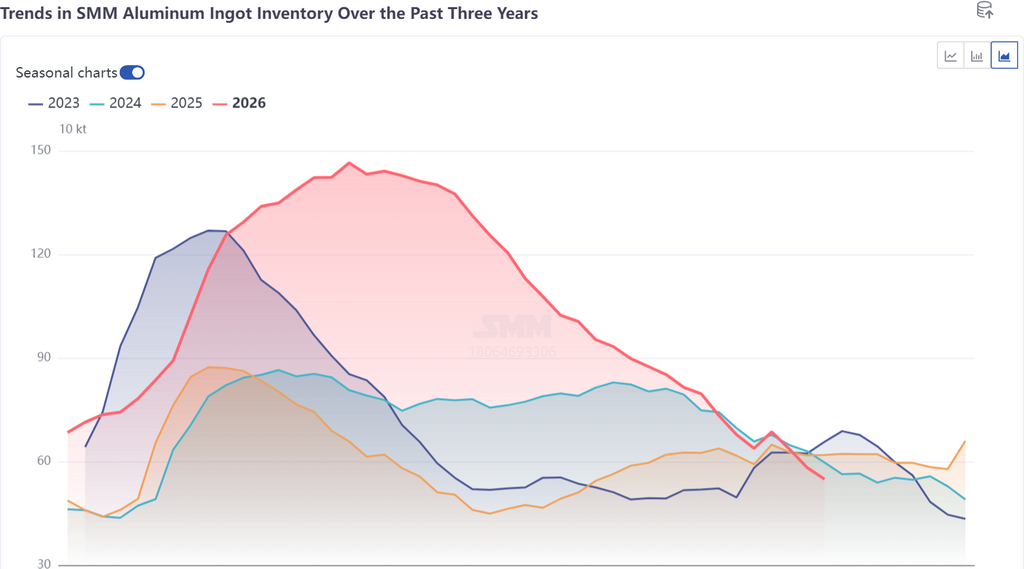
October's inventory trajectory fell into three distinct phases. A modest build of 48,000 mt over the National Day holiday came in below pre-holiday expectations; destocking then accelerated sharply as outbound volumes rebounded, with cumulative draws of 84,000 mt over the three weeks to October 26; and the pace slowed visibly late in the month, with only 4,000 mt drawn between October 26 and 29. Overall, the destocking trend held throughout October, though signs of marginal slowdown emerged by month-end.
Supply side: molten aluminium ratio falls for a second month, casting volume jumps 7.0% MoM
SMM data show China's October primary aluminium output (31 days) at 3.879 million mt, up 2.1% YoY and 3.5% MoM. As the closing month of the traditional "Silver October" peak season, October saw downstream demand weaken sequentially. Although aluminium billet processing fees improved mid-month and some southern billet producers restored operating rates, the trend toward higher casting volumes could not be reversed. The molten aluminium ratio fell 0.7 percentage points MoM to 77.5%, below expectations held at the start of the month. Based on SMM's molten aluminium ratio estimates, October casting volume reached approximately 873,000 mt, up 3.1% YoY and 7.0% MoM.
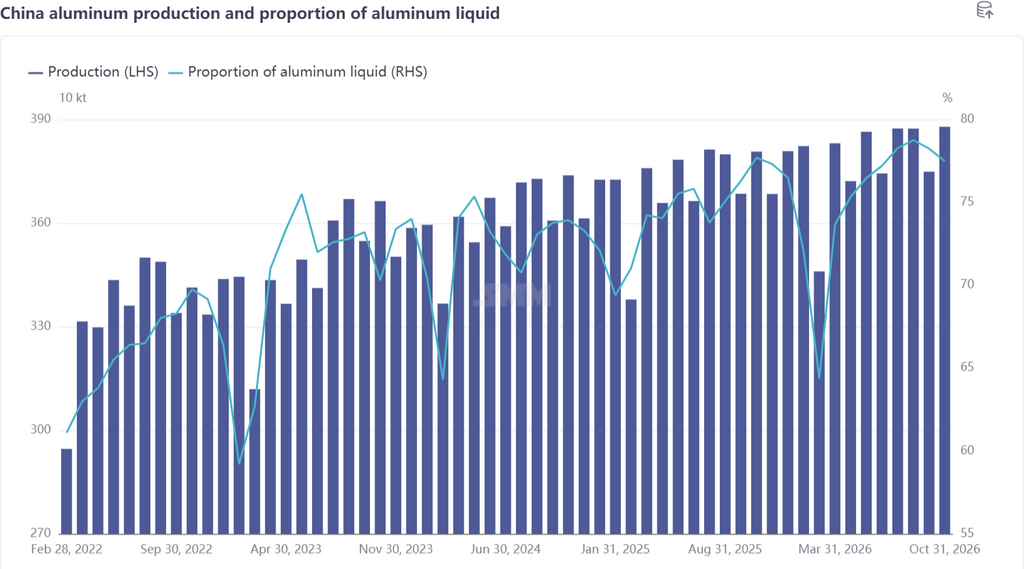
On capacity, SMM puts China's installed primary aluminium capacity at roughly 46.4887 million mt as of end-October, slightly higher MoM, mainly because several capacity replacement projects were completed. Once the corresponding older capacity is retired following the replacement process, national installed capacity is expected to edge lower.
Logistics: smelter inventory up 13.8% MoM — delayed arrivals, not vanished supply
Notably, while casting volumes rose sharply MoM, social inventory in consuming regions drew down at an accelerating pace, with the "gap" between the two largely absorbed at the smelter level. SMM data show total aluminium ingot inventory held at smelters at 78,900 mt at end-October, up 13.8% from 69,300 mt at end-September — the incremental cast metal did not translate into arrivals in consuming regions. The unresolved shortage of rail containers in Xinjiang, compounded by transport disruptions in the southwest, effectively offset a concentrated release of additional cast ingots. This stands as the core technical reason behind October's stronger-than-expected destocking.
That said, logistics constraints represent a delay rather than a reduction. By region, smelter inventory in Xinjiang fell from 18,500 mt at end-September to 13,400 mt at end-October, indicating some easing in Xinjiang shipments. As transport efficiency improves at the margin, ingots previously held at smelters face the prospect of concentrated arrivals ahead, meaning the marginal contribution of a key October destocking driver will weaken materially in November.
Demand side: outbound volumes off their high but still above September levels — a shift in procurement timing, not a demand contraction
The late-month slowdown in destocking calls for separating appearance from substance. SMM data show weekly outbound volumes of aluminium ingots in major consuming regions falling from a high of 168,400 mt in the week of October 12 to 144,600 mt in the week of October 19 and 141,400 mt in the week of October 26, a cumulative decline of roughly 16%. On a comparative basis, however, 141,400 mt remains clearly above September's weekly average of 128,200 mt. The absolute intensity of consumption has not dropped below the pre-peak-season range; the current pullback reflects the fading of a post-holiday restocking pulse and a return to normal procurement cadence, rather than a genuine deterioration in demand.
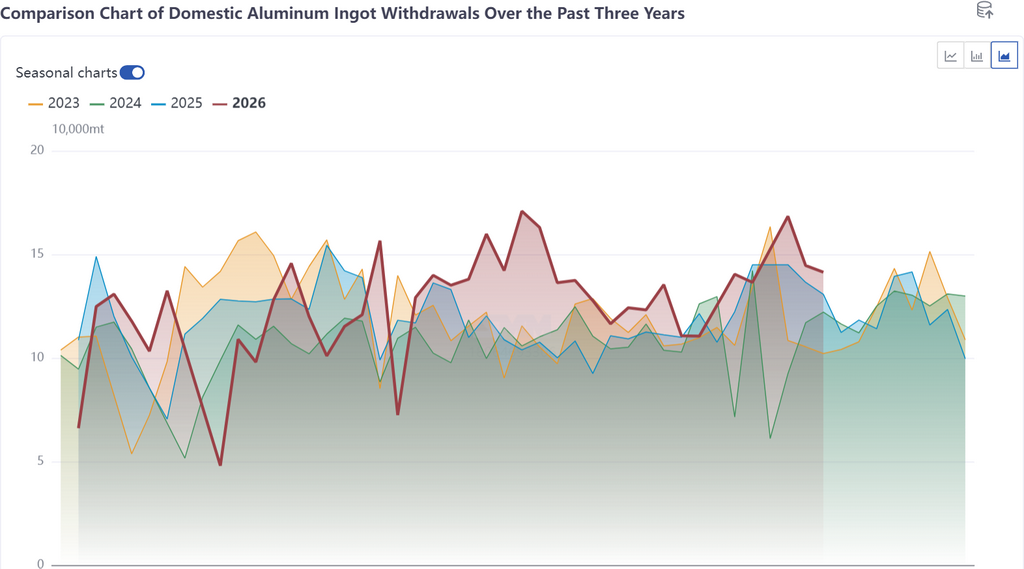
Mechanically, the slowdown stems largely from short-term adjustments in cargo circulation structure and procurement timing. First, the rebound in aluminium prices pushed spot prices above the monthly average, reducing the cost-effectiveness of restocking; combined with the month-end long-term contract settlement cycle, this depressed purchasing activity among downstream users and traders. Second, changes in the futures inter-month spread raised position-rolling costs for some cargo holders, prompting them to sell physical metal and close out by buying futures, which temporarily increased the pool of circulating spot supply. With aluminium prices recently pulling back, transactions for the following month have shown signs of recovery, indicating that procurement timing is being pushed back rather than demand disappearing.
Conditions in the processing segment corroborate demand resilience. Domestic aluminium billet processing fees improved mid-month, some southern billet producers restored operating rates, and primary processed products maintained healthy production and sales. Social inventory of aluminium ingots reflects supply-demand conditions in the primary metal circulation chain, while operating rates and processing fees in the processing segment map more directly to downstream orders and actual consumption. Taken together, downstream demand remains supported.
Shrinking buffer: tighter availability of circulating supply under a low-inventory regime
With absolute inventory at its lowest level for this time of year in nearly four years, its market impact extends beyond the headline number. As destocking continues, the volume of circulating supply shrinks in tandem, and availability is becoming an increasingly important factor in near-term supply-demand dynamics. The further inventory falls, the less room remains to buffer short-term fluctuations in arrivals. This means that any marginal change on either side in November — whether concentrated arrivals or weakening outbound volumes — could be amplified into a temporary reversal in inventory, making it difficult for destocking to sustain the linear pace seen in October.
November outlook: destocking to continue, but slower and with setbacks
China's aluminium ingot inventory will remain on a downward path in November, but all three pillars that supported destocking are weakening. The pace is likely to slow, with the possibility of intermittent restocking during the month — October's linear decline is unlikely to be repeated.
First, casting pressure continues to build. The end of the peak season is expected to pull downstream operating rates lower sequentially, weighing on molten aluminium demand. SMM expects the molten aluminium ratio to fall another 0.7 percentage points to 76.8% in November. While fewer calendar days will partly offset any increase in output, the higher casting share means absolute casting volumes will remain elevated at around 870,000 mt.
Second, a short-term easing of logistics constraints will bring a catch-up in arrivals. The short-term improvement in Xinjiang shipments and the short-term recovery of southwest transport will release ingots previously held at smelters in batches, with arrivals in consuming regions expected to increase intermittently rather than on a steady basis.
Third, seasonal demand weakness and import variables overlap. Lower downstream operating rates will weigh on outbound volumes. Meanwhile, as import profit/loss dynamics repair quickly, bonded-zone inventory remains elevated, standing at 117,400 mt as of October 29 and having accumulated further from 113,400 mt in early August. However, the Shanghai Futures Exchange announced on October 29 that it will suspend bonded delivery for aluminium futures with immediate effect. The route for bonded-zone metal to replenish the domestic market has therefore shifted from bonded delivery to customs clearance followed by warrant registration or direct entry into the spot market, raising both the speed and cost of replenishment. This weakens, to some extent, the immediacy of any import supply shock, and the pace at which elevated bonded-zone inventory flows into the domestic market is expected to be relatively moderate.
On balance, SMM expects China's aluminium ingot inventory to continue declining in November, but in a volatile manner, with repeated setbacks along the way and the possibility of small weekly builds in individual weeks. The inventory centre of gravity is expected to shift down to around 500,000 mt, with inventory likely to dip briefly below 500,000 mt at the low point. Four indicators warrant close monitoring: whether weekly outbound volumes in major consuming regions hold above 140,000 mt; the pace of smelter inventory destocking; whether bonded-zone inventory begins flowing into the domestic market in a material way; and the tightness of circulating supply under a low-inventory regime.