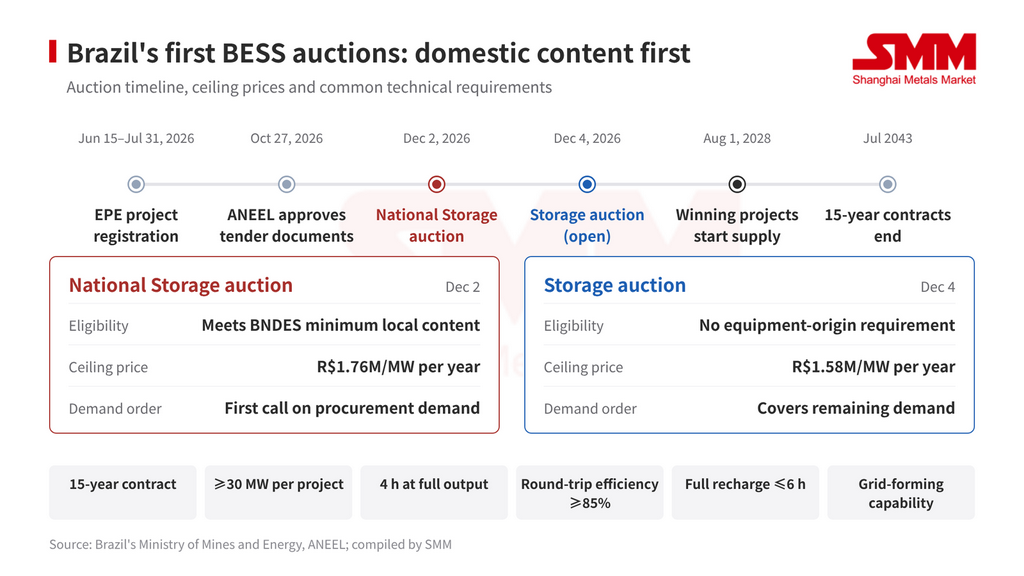
On October 27, Brazil's National Electric Energy Agency (ANEEL) unanimously approved the tender documents for two battery storage capacity reserve auctions, to be held on December 2 and 4. They will be Brazil's first centralized procurement of battery energy storage. A day earlier, the Brazilian Photovoltaic Solar Energy Association (ABSOLAR) submitted its 2027–2030 energy agenda to the re-elected Lula government, proposing 8 GW of utility-scale storage by 2030 and an annual, technology-neutral capacity auction mechanism, with the two December auctions as its starting point.
SMM believes the first auctions matter mainly because they will set price and contract benchmarks for utility-scale storage in Brazil, while near-term equipment demand depends on the procurement volume ultimately announced by the Ministry of Mines and Energy (MME). Because the domestic-content auction takes priority and the open auction fills the remainder, imported systems will still need to cover whatever local capacity cannot supply. Chinese storage suppliers will enter the market through two routes: local partnerships and the open auction.
Two Auctions: Domestic Content First, Open Auction Fills the Gap
Both auctions procure reserve capacity from new electrochemical storage projects connected to Brazil's National Interconnected System (SIN). The December 2 "National Storage" auction is limited to projects that meet the minimum local-content requirements of the Brazilian Development Bank (BNDES) and has priority in meeting the procurement demand set by the MME. The December 4 "Storage" auction has no equipment-origin requirement. The MME has set ceiling prices of R$1.76 million/MW per year and R$1.58 million/MW per year, respectively, putting the domestic-content auction about 11.4% higher.
Winning projects will sign 15-year contracts and begin supplying capacity on August 1, 2028. They will receive a fixed annual payment for available capacity, paid in 12 monthly installments regardless of dispatch, with deductions for underperformance. Each project must be at least 30 MW, sustain maximum output for four hours, run no more than two cycles a day and 366 cycles a year, fully recharge within six hours, achieve round-trip efficiency of at least 85%, and provide grid-forming capability. Projects connecting at critical grid nodes receive a locational bonus in the bidding.
Over 6,000 Projects Registered, Far Exceeding Any Likely Procurement Volume
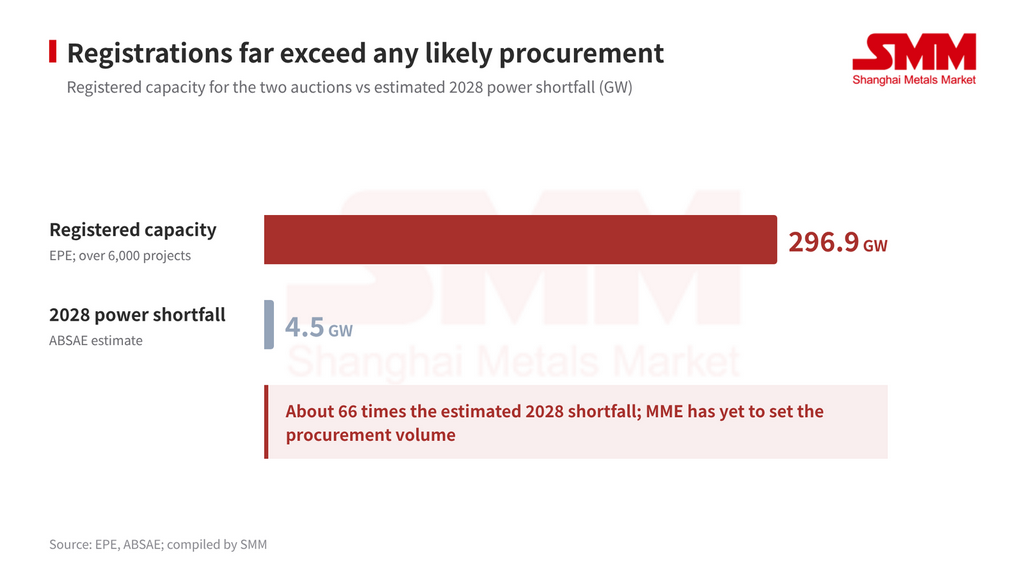
According to Brazil's Energy Research Office (EPE), more than 6,000 projects totaling 296.9 GW registered for the two auctions. The MME has yet to announce the procurement volume. The Brazilian Association of Energy Storage Solutions (ABSAE) estimates Brazil's 2028 power shortfall at about 4.5 GW, putting registered capacity at roughly 66 times that gap.
Registration did not require environmental licenses, so the bar was low and registered capacity should not be read as effective supply. ANEEL has set the bid bond at R$60,000/MW, and both the performance bond and the minimum net-worth requirement at R$600,000/MW. Developers bear grid-connection risk, and delays in connection facilities will not automatically postpone the supply start date. Financial strength, grid access, and equipment delivery capability will be the main filters for projects.
Local-Content Threshold: Domestic Capacity Cannot Cover All Demand
In the first phase, which runs through the end of 2027, BNDES divides a storage system into eight components, four of which are classed as strategic. A qualifying system must combine at least three components, including at least one strategic component, and reach a national-content index of at least 15% by value. BNDES has so far accredited BYD, Gotion High-Tech, Moura, TBEA, Trina Storage, SecPower, WEG, and You.On as storage system suppliers.
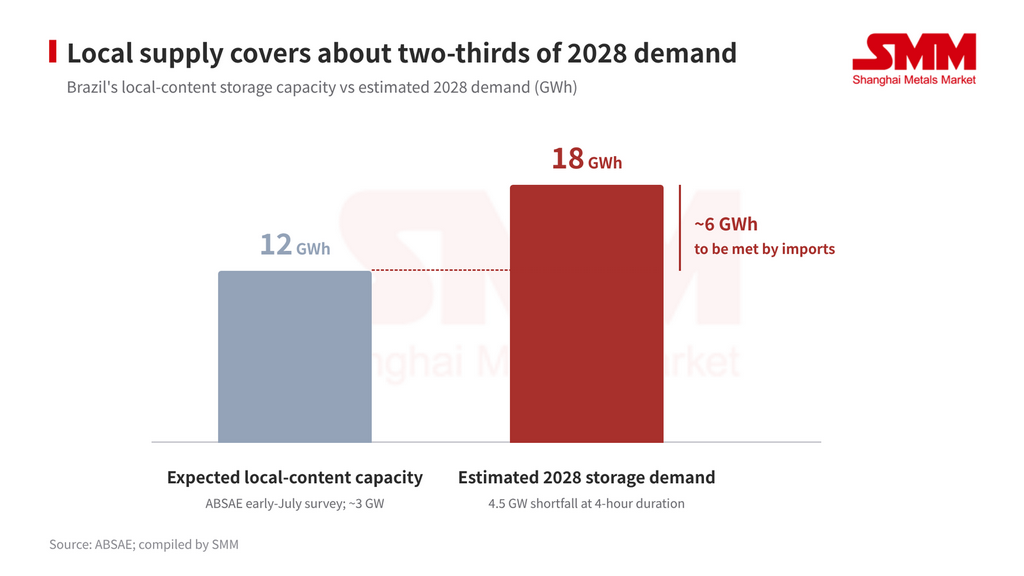
Supply capacity remains the main constraint. ABSAE's early-July survey put expected domestic capacity under existing localization routes at about 12 GWh, or roughly 3 GW. If the 2028 shortfall of 4.5 GW were met entirely with four-hour batteries, storage demand would be about 18 GWh, so domestic capacity could cover only about two-thirds. The remainder would still have to come from imported systems in the open auction.
The cost gap is equally pronounced. Based on SMM research, initial quotes for localized systems were 40%–50% higher than for fully imported systems, although they have since eased. On a 15-year contract basis, and with BNDES financing and low-cost Climate Fund loans, a localized system can approach the project returns of an imported one if its premium is held to around 25%. The domestic-content auction's ceiling price is only about 11.4% above the open auction's, well below the equipment premium. Because capacity revenue must cover the full cost of equipment, construction, grid connection, and financing, whether domestic-content projects can win within the ceiling price depends largely on how much of the equipment premium low-cost financing can offset.
Unresolved Issues: Procurement Volume and Cost Allocation
The biggest uncertainties are the procurement volume and who pays. The MME has not yet published demand for either auction. Under current rules, capacity procurement costs are allocated entirely to generators, an arrangement ANEEL kept in its latest review. Some generators argue that this conflicts with technology neutrality and had earlier called for the auctions to be postponed, while a bill in Congress proposes shifting the cost to electricity consumers. ABSOLAR's agenda again calls for the relevant rules to be amended.
ABSOLAR's Agenda: An 8 GW Target, Annual Auctions, and Battery Tax Cuts
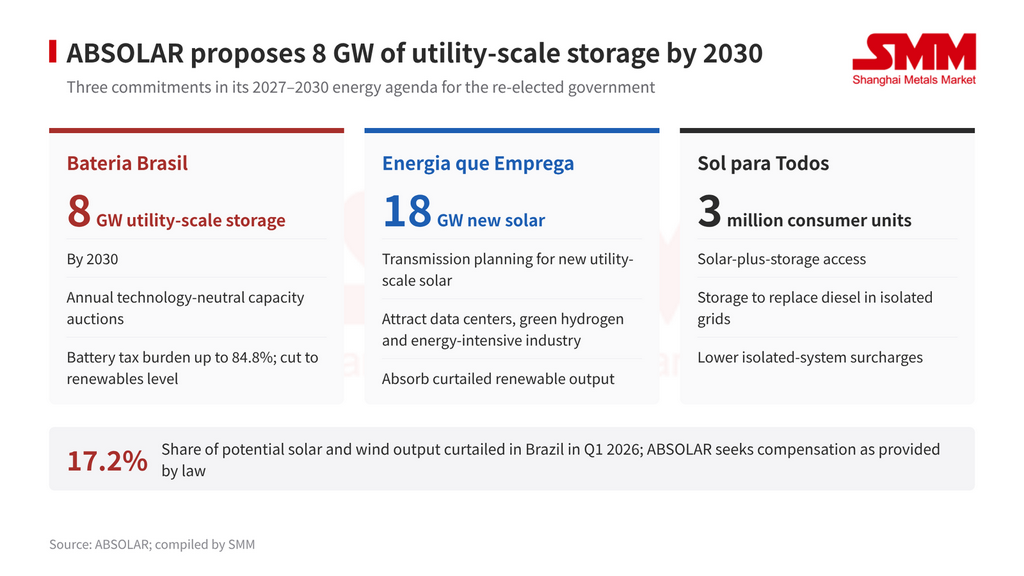
ABSOLAR's agenda comprises three commitments. Bateria Brasil (Battery Brazil) proposes 8 GW of utility-scale storage by 2030, annual technology-neutral capacity auctions, and cutting battery taxes to the level applied to renewables. ABSOLAR says the combined tax burden on batteries can reach 84.8%, more than double that on renewables. Energia que Emprega (Energy That Creates Jobs) proposes transmission planning for 18 GW of new utility-scale solar and attracting data centers, green hydrogen, and energy-intensive industries to absorb curtailed renewable output. Sol para Todos (Solar for All) proposes extending solar-plus-storage systems to 3 million consumer units and replacing diesel generators in isolated grids with storage.
According to ABSOLAR, curtailment removed 17.2% of potential solar and wind output in Brazil in the first quarter of 2026. The association calls for curtailed plants to be compensated as provided by law and for storage to be added at existing and new solar plants. High curtailment, combined with a heavy tax burden on storage, is the industry's main case for regular storage procurement.
SMM View: First Auctions Set the Benchmark, an Annual Mechanism Sets the Market Size
SMM believes the two December auctions will provide Brazil's first price and contract benchmarks for utility-scale storage. Their actual impact on equipment demand, however, depends on the procurement volume the MME announces and on whether winning projects can complete financing, construction, and grid connection by August 2028. If ABSOLAR's proposed annual auction mechanism is adopted, Brazil could establish a predictable storage procurement cycle; assuming four-hour systems, the 8 GW target for 2030 implies about 32 GWh of storage demand.
For Chinese storage suppliers, the routes into the market are diverging. BYD, Gotion High-Tech, TBEA, and Trina Storage are already on the BNDES accreditation list, while CATL has partnered with Moura, Jinko ESS with UCB, and Hyperstrong with YOU.ON. These arrangements allow them to compete in the domestic-content auction through local assembly and preferential financing. The open auction is the main window for fully imported systems, where competition will center on cost per unit of capacity, delivery lead times, and grid-forming performance.
Key milestones to watch: first, the procurement volume the MME announces and how it is split between the two auctions; second, the number of projects that pass technical qualification; third, clearing prices in both auctions and the actual premium in the domestic-content auction; fourth, whether cost-allocation rules change; and fifth, whether the re-elected government adopts annual auctions and battery tax cuts as policy. SMM will continue to track the auctions.
Source: SMM
Written by:
Ryan Tey Tze Yang | SMM PV+ESS Analyst
+60 127179370 | ryan.tey@metal.com