SMM, October 20:
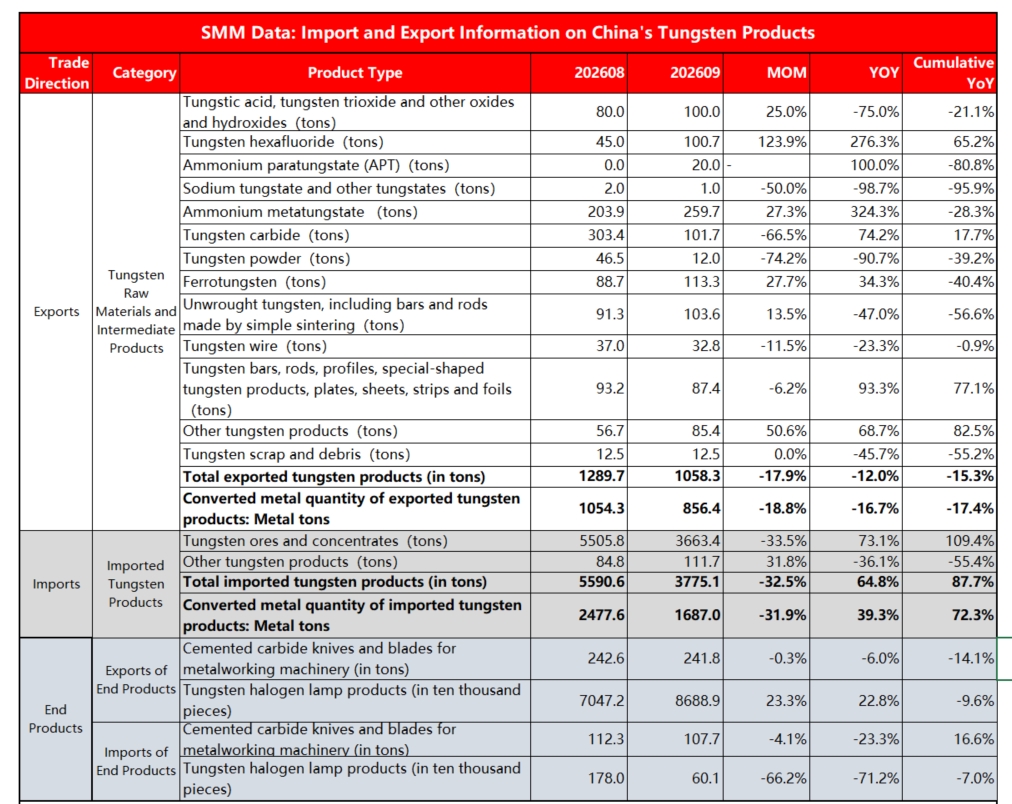
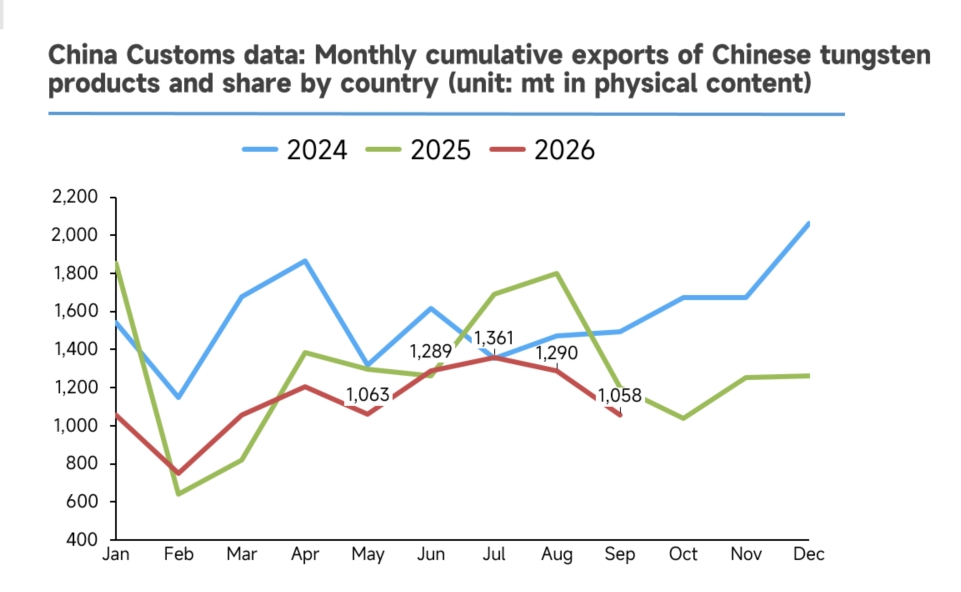
September tungsten market import and export customs data has been released. A comparison of the data shows that in September, the tungsten market continued the trend of rising imports and falling exports YoY. On a MoM basis, imports and exports of tungsten raw materials and intermediate products both weakened in September. According to the latest customs data, total exports of tungsten raw materials and intermediate products in September were 1,058.3 mt, down 17.9% MoM and down 12.0% YoY; in metal content terms, this was 856.4 mt, down 18.8% MoM and down 16.7% YoY. Cumulative exports were 10,129.2 mt and 8,287.4 mt in metal content, down 15.3% and 17.4% YoY respectively. On the import side: total imports of tungsten concentrates and some intermediate products in September were 3,775.1 mt, down 32.5% MoM and up 64.8% YoY; in metal content terms, this was 1,687.0 mt, down 31.9% MoM and up 39.3% YoY. Cumulative imports of tungsten concentrates and tungsten intermediate products totaled 29,614.6 mt and 14,704.5 mt in metal content, up 87.7% and 72.3% YoY. Please refer to the table below for detailed data:
September data highlights: tungsten concentrate imports fell in volume while prices rose, with the weak Chinese market suppressing import volumes:
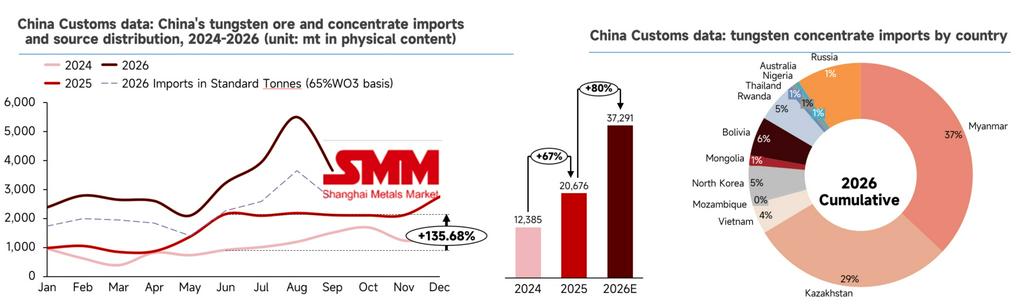
SMM customs data shows that in September 2026, China's physical tungsten concentrate imports reached 3,663 mt, down 33.5% MoM and up 73% YoY. Based on the grades of tungsten concentrates from various countries, total tungsten concentrate imports in September were equivalent to approximately 2,408 standard tonnes, down about 34% MoM. However, total import value in September reached USD 92.17 million, up 26% MoM. A rough calculation puts the average import unit price of tungsten concentrates in China in September at approximately 258,000 yuan/standard tonne (VAT-exclusive). In early October, tungsten prices in the Chinese market plunged, with some spot tungsten concentrate deals touching 260,000 yuan/standard tonne. Factoring in VAT, September import suppliers faced significant profit risk, which will further dampen the willingness of ore traders to import going forward.
In January-September 2026, China's total tungsten product imports were approximately 28,700 mt, up 109.4% YoY. Based on SMM's calculations using the actual grades of tungsten concentrates imported from various countries, China's cumulative tungsten concentrate imports in 2026 totaled approximately 19,900 standard tonnes, an increase of 9,800 standard tonnes YoY.
Export market: Export market performance was mediocre, with no growth in exports of dual-use items and a sharp MoM decline in tungsten carbide exports.
In September, total exports of tungsten raw materials and intermediate products were 1,058.3 mt, down 17.9% MoM and down 12.0% YoY, with cumulative YoY decline of 15.3%; in metal content terms, this was 856.4 mt, down 18.8% MoM and down 16.7% YoY. In September, dual-use item products tungsten trioxide and APT both saw small export volumes, but all were exported under processing trade with imported materials.
- Items with sharp declines: Price spreads between individual orders were large, likely due to differences in contract signing times and approval completion times.
- Tungsten carbide: 101.7 mt in September, -66.5% MoM; although +74.2% YoY, monthly shipments pulled back sharply, making it the largest drag on total exports. By export unit price, the average export price of tungsten carbide powder in September was approximately $187.8/kg, down 5.5% MoM, with South Korea as the main destination.
- Tungsten powder: only 12 mt in September, -74.2% MoM and -90.7% YoY, with exports extremely sluggish. The export unit price of tungsten powder in September was approximately $188.7/kg, down about 22% MoM.
- Highlight items:
- Tungsten hexafluoride: 100.7 mt in September versus 45 mt in August, +123.9% MoM and +276.3% YoY. Upstream semiconductor demand continued to grow strongly, and tungsten hexafluoride exports increased notably. The September export unit price rose 3.8% MoM to $250.8/kg.
- Ammonium metatungstate: 259.7 mt, +27.3% MoM and +324.3% YoY. APT recovered to 20 mt in September (0 in August), but cumulative APT volume remained -80.8% YoY, still at a low level overall.
- Tungsten bars/profiles and other tungsten products posted strong positive YoY growth; ferrotungsten and unwrought tungsten maintained a slight MoM uptrend.
End-user divergence: External demand for cemented carbide cutting tools was weak, while imports of high-end tools remained resilient; halogen tungsten lamp exports recovered. In September, domestic imports of cemented carbide inserts pulled back slightly MoM. With persistently high overseas raw material costs, imported tool costs stayed elevated, suppressing domestic imports. In Q4, tool imports and exports are expected to show export growth and import decline.
Overall, although September tungsten product trade data did not show wild swings, the direction was largely in line with expectations. First, the domestic tungsten market remained persistently weak from September to October, making it difficult for ore traders and importers to lock in prices, increasing profit risks and likely pushing imports down further, which reduced the impact on domestic supply. Second, exports of non-dual-use items such as tungsten hexafluoride continued to grow, as overseas buyers kept seeking more low-priced Chinese tungsten resources. Entering Q4, the tungsten trade landscape is likely to continue along the main theme of ore imports under pressure, basic tungsten product exports constrained by controls, and structural strength in high-value-added specialty tungsten products, with supply-demand, profits, policy, and overseas demand jointly driving the pace of change. The core variable in Q4 import and export data has shifted from "ex-China ore supply" to China's tungsten price trends and trade margins. The reduction in tungsten concentrate imports will ease the domestic raw material supply pressure caused by the earlier influx of large volumes of imported ore, providing some support to tungsten prices. On the export side, growth remains concentrated in specialty tungsten chemicals for the semiconductor sector, while traditional tungsten smelting products are unlikely to improve under the dual constraints of export controls and weak external demand. Two risk points warrant attention: first, if overseas manufacturing rebounds more than expected, orders for traditional powders such as tungsten carbide and tungsten powder could recover; second, if China's tungsten prices rebound quickly and restore ore trade margins, tungsten concentrate port arrivals could rise again, altering the loose supply landscape.