SMM News, October 19:
On October 19, gold, silver, platinum, and palladium rebounded across the board, and the A-share precious metals sector moved higher. This was mainly because Fed Chairman Walsh stated at the IMF annual meeting that he would not prejudge the outcome of the October rate-setting meeting, prompting the market to lower the probability of a rate hike this month. In addition, after earlier sharp declines in precious metals prices, short covering emerged, while Middle East geopolitics and U.S. Treasury fiscal risks provided safe-haven support. Platinum and palladium also benefited from improved expectations for automotive catalysts and the hydrogen energy industry. As of 13:59 on October 19, COMEX gold rose 0.57% to $4,204.9/oz; the most-traded SHFE gold contract gained 0.42% to 902.56 yuan/g; COMEX silver climbed 0.99% to $57.875/oz; the most-traded SHFE silver contract increased 1.09% to 14,040 yuan/kg; and silver T+D rose 0.68% to 13,998 yuan/kg. In addition, the most-traded platinum futures contract rose 1.92% to 405.85 yuan/g, and the most-traded palladium contract gained 0.28% to 269.8 yuan/g.
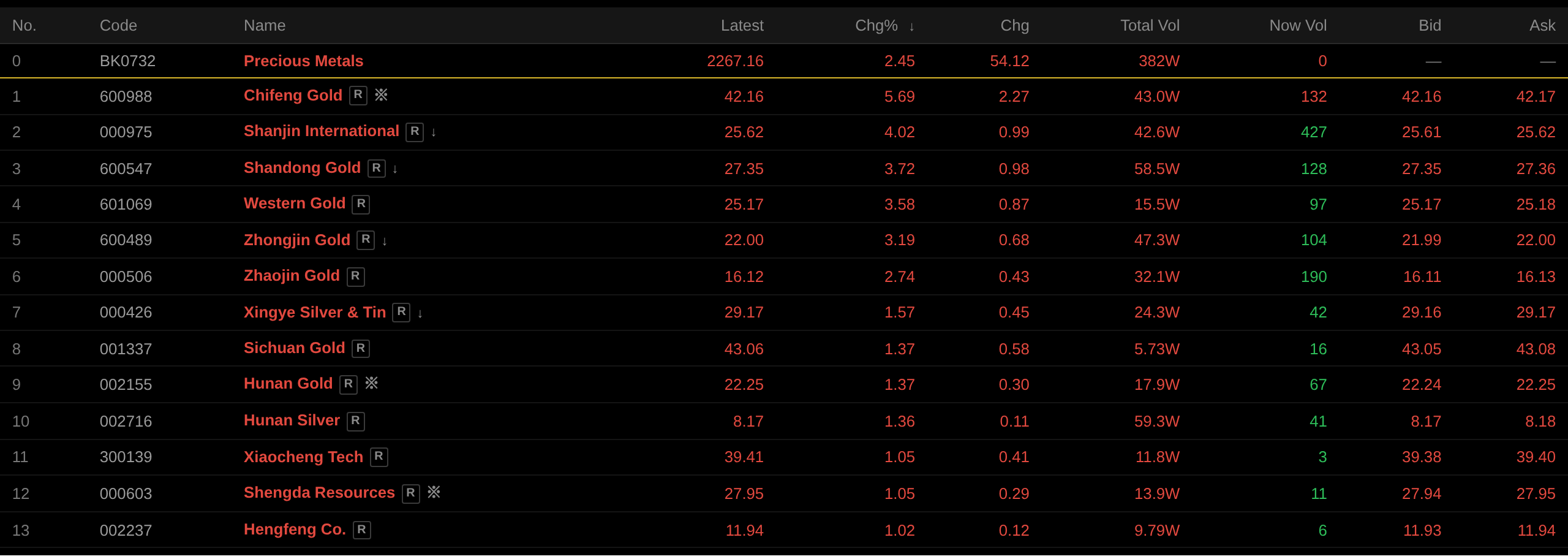
Equities: As of 14:01 on October 19, the precious metals sector was up 2.45%. Among individual stocks, Chifeng Jilong Gold led the gains with an increase of more than 5%, while Shanjin International, Shandong Gold, Western Gold, Zhongjin Gold, and Zhaojin Mining were also among the top gainers.

Spot market
On October 19, the SMM 1# silver morning ex-works reference average price edged up from the previous trading day.
In the spot market, trading sentiment was weak today. On the one hand, end-users’ overall purchasing sentiment was subdued. After silver prices stabilized following last week’s sharp decline, large-scale transactions were largely released in the latter half of mid-week. With silver prices rebounding slightly today, downstream buyers mostly shifted to a wait-and-see stance. On the other hand, in early trading, the basis between T+D and the SHFE2612 contract widened slightly, fluctuating in the 35-45 yuan/kg range. Suppliers’ offers were relatively high, with early-morning offers in Shanghai concentrated at a discount of 30 yuan/kg against the SHFE2612 contract, and a strong tendency to hold back from selling. The gap between buyers and sellers in quotations and psychological price levels was wide, resulting in weak actual transactions, mainly concentrated near parity for T+D, with some national-standard cargoes at slight discounts.
Overall, macro bullish drivers were limited, and futures lacked momentum for a rebound. In the spot market, end-users’ wait-and-see sentiment was strong, and the tug-of-war between suppliers holding prices firm and downstream buyers pushing for lower prices intensified, leaving overall trading sluggish.
On October 19, spot platinum extended the previous trading day’s uptrend and continued to edge up.
In the spot market, suppliers’ mainstream quotations for platinum were around parity to a premium of 1 yuan/g against the PT2612 contract. As available platinum ingot supply in the market remained tight, suppliers widened their quoted price spreads. Meanwhile, the price difference between platinum ingots and platinum powder was relatively large. Some suppliers reported that platinum ingot transactions were generally done at slight spot premiums against GFEX contracts, and downstream acceptance of spot premium quotations for platinum ingots improved, while transactions for platinum powder near parity met resistance. Overall, the platinum spot market showed clear divergence today, with overall trading volumes normal.
Views from various parties
Regarding the future trend of precious metals, some institutions hold the following views:
Tim Waterer, chief market analyst at KCM Trade, said: "Gold prices edged up at the start of this week. From an inflation perspective, softer oil prices have had a positive impact on gold prices. In the short term, if oil prices fall steadily, or if yields show a more pronounced decline, that would be the most favorable catalyst for gold prices, as both would ease market concerns about inflation and rate hikes." (Jin10 Data APP)
Hamad Hussain, climate and commodities economist at Capital Economics, judged on October 16 that gold prices may trend lower for the rest of the year. He cited two reasons: the US Fed continuing to raise rates, and concerns about the end of the AI boom ultimately proving temporary. This means his view on gold prices involves both interest rates and the outlook for the AI boom. Bart Melek, global head of commodity strategy at TD Securities, said gold remains rangebound and biased toward the lower end of the support zone, mainly because there is still considerable uncertainty about the US Fed's next move. (Jin10 Data APP)
CITIC Securities research report noted that on gold prices, first, ETF and central bank gold purchases may have already lifted the bottom of gold prices; second, the outlook for gold prices still has positive conditions. If the US-Iran conflict eases before the US midterm elections, improved oil price expectations will create a foreseeable window for easing market tightening expectations, and the rise in US Treasury yields may moderate. From both the liquidity perspective (reduced futures selling) and the liquidity expectations perspective (continued ETF buying), this would be conducive to a recovery in gold prices. On the gold sector, looking downward, referencing the bottom gold price of $4,000/oz at end-June 2026, we estimate the gold sector PE bottomed at around 15x. At the current assumption of $4,200/oz, the sector's 2026/2027 PE is 15x/12x, and the valuation bottom is expected to be verified again. Looking upward, gold stocks usually rebound ahead of gold prices, similar to the July period when gold prices consolidated at lows, but the CITIC Gold Index has already rebounded more than 20% from its bottom, so if current gold prices stabilize, that would be an important signal for a rebound in the gold sector.
Sharon Ding, head of China basic materials research at UBS, said most of the bad news facing gold has already been priced in by the market. She said that since early September, gold prices have fallen about 5% as persistent inflation concerns reignited expectations of further US Fed rate hikes. However, she believes gold prices now already reflect a significant hawkish repricing. She noted that this headwind may begin to ease as market expectations for a US Fed rate hike in October diminish. "If upcoming data no longer support further upward revisions to the expected policy path, we believe there is more room for gold prices to stabilize," she added. She also said that a continued pullback in US Treasury yields could strengthen the case for a gold recovery. (Jin10 Data APP)
Strategists at State Street Global Advisors said in a report that the structural factors driving the gold bull market appear to remain intact. These factors include record government debt levels, strong physical gold demand from central banks and China's retail market, and heightened geopolitical and economic uncertainty. The strategists said rising interest rates could further increase debt servicing costs for major economies, exacerbating fiscal imbalances. This year, the premium on domestic gold prices in China has surged sharply; despite higher gold prices, consumer gold imports in the first eight months still hit a record high of 1,141 mt. The strategists maintained their previous base-case forecast, expecting gold prices to reach $4,750-5,500/oz by the end of Q1 2027.
Saxo Bank analysts said: "Gold price action underscores the ongoing tug-of-war between macro traders and technical traders. On one hand, traders are selling gold due to rising funding costs and a stronger US dollar; on the other hand, investors are seeking to hedge against the fiscal risks that rising debt and borrowing costs may bring." (Jin10 Data APP)
The World Gold Council reported that global gold ETFs attracted $10 billion of inflows in September, pushing Q3 inflows to a record $31 billion, led by funds listed in Europe and North America. Despite lower gold prices, global gold holdings still increased by 67 mt to a record 4,256 mt, while total assets under management fell 7% QoQ to $574 billion. At the country and regional level, record Q3 inflows were led by the US, followed by strong contributions from UK-listed funds. The UK recorded its strongest quarter ever, helping Europe reach the same milestone at the regional level.
Warren Patterson and Ewa Manthey, heads of the commodities team at ING, said gold prices edged up on Tuesday. Lower oil prices and a stronger bond market eased inflation concerns and reduced market expectations for further rate hikes. Meanwhile, continued central bank gold buying provided support for gold prices. World Gold Council data shows that central banks are still net buyers of gold, with long-term reserve diversification remaining the main driver. Data show that central banks globally continued to be net buyers of gold in August, adding 39 mt, bringing total purchases so far this year to 170 mt. Poland and Uzbekistan each added 8 mt. Türkiye returned to being a net gold buyer in August, buying 3 mt after three consecutive months of net selling. Other buyers included Kazakhstan, the Czech Republic, Bolivia, and Ghana. Russia reduced its gold holdings by 6 mt. The latest data show that despite high gold prices, official-sector gold demand remains resilient. Central banks' continued gold purchases are driven mainly by long-term reserve diversification goals rather than short-term market fluctuations. With Poland and several emerging-market central banks continuing to add gold, official-sector demand is likely to remain an important support for the gold market in the coming months.
HSBC previously lowered its gold price forecast, citing expectations of further US interest-rate hikes and the possibility that rising oil prices could pressure gold in the near term. However, the bank believes the long-term factors supporting gold prices remain intact. HSBC now expects gold to average $4,490/oz in 2026, down from its previous forecast of $4,560, and has cut its 2027 average gold price forecast to $4,825/oz from $4,925/oz. HSBC said market expectations of further US rate hikes and higher bond yields will continue to weigh on gold prices, as this reduces the appeal of non-yielding gold. The bank's economists expect the US Fed to raise rates again in December this year.
Gold prices have pulled back notably recently, pressured by rising US Treasury yields, but Morgan Stanley has not changed its bullish 12-month view. The bank's strategists believe $4,000 is a "fairly strong floor." Gold has pulled back sharply recently, but this has not shaken its long-term allocation logic. That is the view from Morgan Stanley. Amy Gower, the bank's head of metals and mining strategy, said three factors could support gold prices in the coming months. Gower noted that physical gold demand remains strong, especially with active central-bank buying. Gower said global market concerns about long-term public debt and fiscal sustainability continue to grow, but rising bond yields remain the main challenge for gold. Gold itself generates no interest, so when bond yields rise, its relative appeal tends to be suppressed. Oil price trends are also an important variable for gold. With US and Iranian officials reportedly engaging through intermediaries, there is potential for easing in the Middle East conflict that has lasted for months.
Recommended Reading: