SMM October 17 news:
In the metals market:
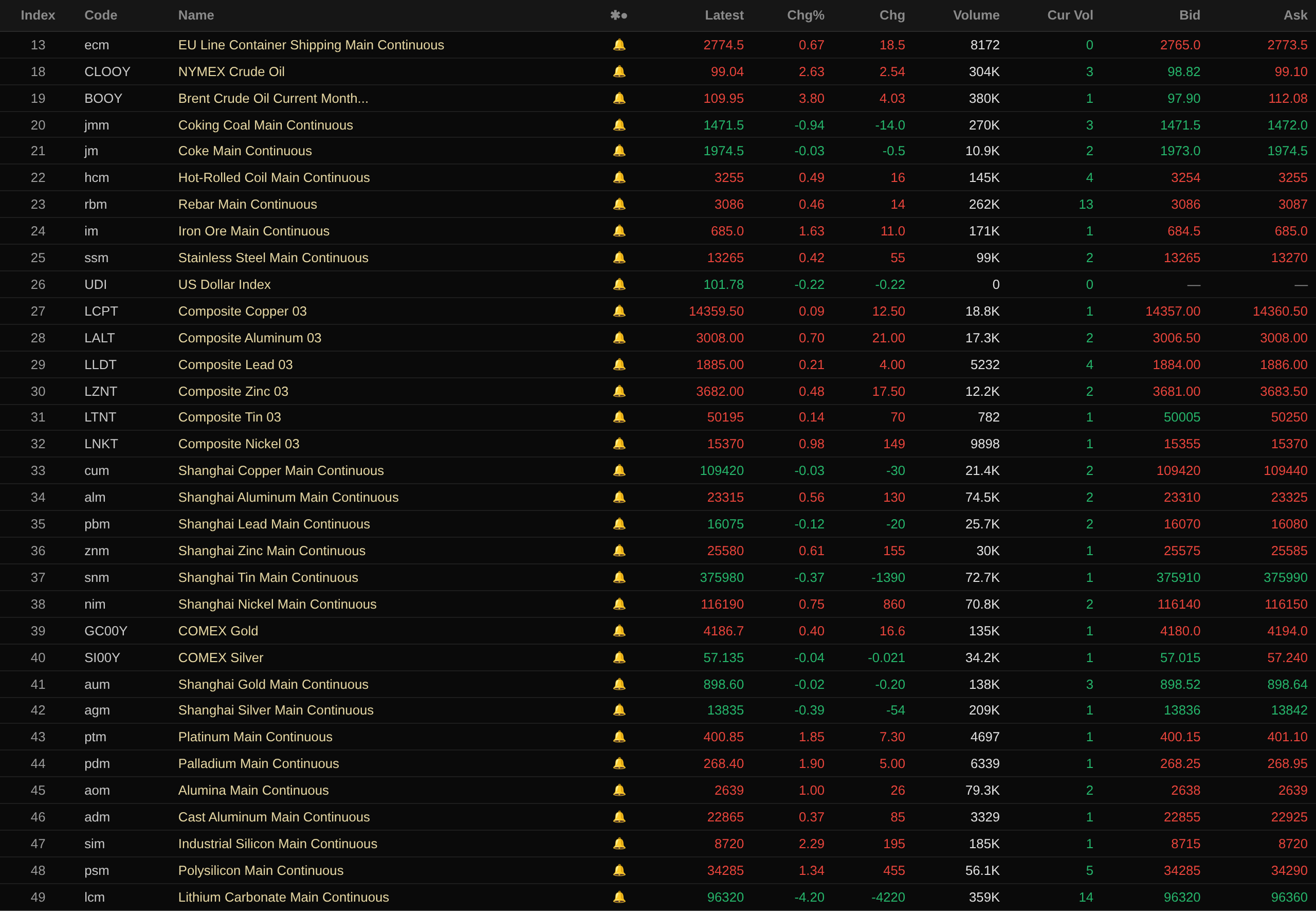
Last Friday overnight, base metals on both domestic and overseas markets generally rose, with only SHFE copper, SHFE lead, and SHFE tin falling together. SHFE copper fell 0.03%, SHFE lead fell 0.12%, and SHFE tin fell 0.37%. LME nickel led the gains with a 0.98% increase, SHFE nickel rose 0.75%, and LME aluminum rose 0.7%. Changes for other metals were relatively small. Alumina main contract rose 1%, and cast aluminum main contract rose 0.37%.
Last Friday overnight, ferrous metals generally rose, with iron ore leading the gains at 1.63%. HRC, rebar, and stainless steel all rose around 0.4%. For coking coal and coke, coking coal fell 0.94%, and coke fell 0.03%.
Last Friday overnight, in precious metals, COMEX gold rose 0.4%, and COMEX silver fell 0.04%. On the weekly chart, COMEX gold fell 0.7%, and COMEX silver fell 6.41%. In China, SHFE gold fell 0.02% last Friday overnight, and SHFE silver fell 0.39%. On the weekly chart, SHFE gold rose 0.3%, and SHFE silver fell 3.35%.
As of 8:57 on October 17, last Friday's overnight closing prices:
Macro front
In China:
[Two ministries: Plan to prohibit and restrict the export of 40 technologies in AI, biomedicine, and PV] The Ministry of Commerce and the Ministry of Science and Technology announced on the 16th that they plan to revise China's Catalogue of Technologies Prohibited and Restricted from Export, adding certain AI, biomedicine, and PV technologies. Upon approval, public comments are now being solicited, and pre-export registration management will be implemented for the relevant technologies. This public consultation covers 40 technologies in AI, biomedicine, and PV. The AI sector includes 23 technologies related to large models, intelligent agents, computing clusters, and information processing; technologies that have entered the public domain through open source, academic publications, or other means are not subject to management. The biomedicine sector includes 5 technologies related to cell and gene therapy, small nucleic acid drugs, and pathogenic microorganisms; for out-licensing models that do not involve ownership transfer, facilitation measures such as automatic licensing apply. The PV sector includes 12 technologies related to polysilicon manufacturing, silicon wafer manufacturing, and battery manufacturing; the scope of technology management also includes key and core equipment carrying the relevant technologies.
[Four ministries: Organized discussions with over 30 automakers to strengthen management of automotive product R&D testing and validation] According to the Ministry of Industry and Information Technology, the Ministry of Industry and Information Technology, the Ministry of Public Security, the Ministry of Ecology and Environment, and the State Administration for Market Regulation organized discussions with more than 30 key automobile producers to strengthen the management of innovative design, R&D testing, and validation of automotive products. It is understood that automobile producers should implement the requirements of the special action for quality improvement, resolutely resist irrational competition, strengthen innovative design of automotive products and R&D testing and verification management, and firmly uphold the bottom line of product safety. Next, efforts will be accelerated to advance the revision of relevant standards, further raise safety baseline requirements, continuously carry out supervision and inspection of key automobile producers, seriously deal with producers with problems in accordance with laws and regulations, publicly expose them, urge automobile producers to strengthen automotive product testing and verification, firmly uphold the bottom line of product safety, and promote the high-quality development of the automotive industry. (CCTV News) (Jin10 Data APP)
On the US dollar front:
As of last Friday's overnight close, the US dollar index fell 0.19% to 101.78, with a weekly decline of 0.44%. Fed Chairman Walsh's remarks failed to boost the US dollar, ending its previous four-week winning streak. Speaking Friday morning at the IMF annual meeting in Bangkok, Walsh made no comments on monetary policy or the US economy, prompting investors to scale back bets on a Fed rate hike later this month. This was Walsh's last chance to signal his policy stance before the Fed entered its quiet period on Saturday ahead of the October policy meeting. Noah Buffam, a strategist at CIBC Capital Markets, said: "Walsh offered no policy guidance. While that was expected at this stage, the market interpreted it as a signal that the Fed may not raise rates at its October meeting." (Jin10 Data APP)
The energy shock is beginning to spill over into all areas of the US economy: enterprises are passing rising costs downstream, making the Fed's task of stabilizing inflation more complicated. Two reports this week showed that prices in categories such as airfares, express delivery services, and freight rose sharply in September; the main driver was the surge in oil prices caused by overseas wars. Investors expect the Fed to wait and see how inflationary pressures evolve, holding steady at its October meeting after raising rates in September (the first time in more than three years). (From Wall Street CN APP)
After this week's inflation data came in higher than expected, economists at Barclays added a January rate hike to their Fed forecast. Economists led by Mark Giannoni wrote in a report on Friday: "The September CPI and PPI reports prompted us to raise our inflation outlook, as several risks we have highlighted for some time—including the pass-through of energy prices to core prices, the continued resilience of consumer spending, and AI-related price pressures—are increasingly showing up in the data." The team now expects the Fed to raise rates by 25 basis points each in December and next January, followed by keeping the federal funds target rate range "at 4.25%–4.50% for an extended period."They previously expected the Fed to make a final 25bp rate hike in December, then hold rates steady for most of next year until a 25bp cut in December 2027. (from Wallstreetcn APP)
According to CME "Fed Watch": the probability of the Fed keeping rates unchanged through October is 71.8%, and the probability of a cumulative 25bp hike is 28.2%. The probability of the Fed keeping rates unchanged through December is 7.2%, the probability of a cumulative 25bp hike is 67.4%, and the probability of a cumulative 50bp hike is 25.4%. (from Jin10 Data APP)
Other currencies:
BOJ Governor Kazuo Ueda: has been watching the impact of yen weakness and the Middle East situation on inflation. Will continue to adjust the degree of easing. Stabilising inflation at 2% is becoming increasingly important. Will monitor the impact of exchange rates, AI, and the Middle East situation on price trends. Has not spoken with US Treasury Secretary Bessent since Asheville. Will focus on consolidating the 2% inflation target going forward. Cannot tolerate underlying inflation rising further above 2%. Underlying inflation is already quite close to 2%, marking a policy shift. Exchanged views with Fed Chairman Warsh on a range of issues. There is no evidence that the neutral rate is near any particular level. (Wallstreetcn)
Two key economic data releases on Monday may determine whether the Bank of Canada hikes rates later this month. Statistics Canada will release September inflation data at 8:30 a.m. Ottawa time, followed by the Bank of Canada's latest business and consumer outlook surveys. These will be the last two important inputs before the October 28 rate decision for policymakers to assess how the Canadian economy is coping with oil-price-driven inflation risks and escalating trade tensions. The Bank of Canada has kept its benchmark rate unchanged at 2.25% for seven consecutive meetings. However, policymakers have warned that the longer gasoline prices stay high, the more likely businesses are to raise prices for other goods and services. Analysts leaning toward easing note that September jobs data showed employment losses and a rising unemployment rate in Canada. But if Monday's data show persistent price pressures and a stabilising economy, weak jobs data may still not be enough to stop the central bank from hiking rates. (Jin10 Data APP)
Data-wise:
This week in China, releases will include China's Q3 GDP YoY, China's September total retail sales of consumer goods YoY, China's September industrial value added above designated size YoY, China's one-year loan prime rate as of October 20, China's installed power generation capacity year-to-date in September (TBD), China's installed power generation capacity YoY year-to-date in September (TBD), and China's September share of Swift RMB in global payments. In the US, releases will include the US October NAHB housing market index, US weekly change in ADP employment for the week ending October 3, US September annualised housing starts, US September building permits total, US September pending home sales index MoM, US initial jobless claims for the week ending October 17, Eurozone October consumer confidence index preliminary, US October S&P Global manufacturing PMI preliminary, US October S&P Global services PMI preliminary, US October University of Michigan consumer sentiment index final, and US October one-year inflation expectations final. In the UK, releases will include UK August three-month ILO unemployment rate, UK September unemployment rate, UK September claimant count change, UK September public sector net borrowing, UK September retail price index MoM, UK October CBI industrial order balance, UK October GfK consumer confidence index, UK September seasonally adjusted retail sales MoM, UK October manufacturing PMI preliminary, and UK October services PMI preliminary. In the Eurozone, releases will include Eurozone August seasonally adjusted current account, Eurozone October ZEW economic sentiment index, Eurozone October consumer confidence index preliminary, and Eurozone October manufacturing PMI preliminary. In Germany, releases will include Germany September PPI MoM, Germany October ZEW economic sentiment index, and Germany October manufacturing PMI preliminary. Canada September CPI MoM, Canada August retail sales MoM, Switzerland September trade balance, France October manufacturing PMI preliminary, and Japan September core CPI YoY will also be released.
In addition, the National Bureau of Statistics (NBS) released the monthly report on residential selling prices in 70 large and medium-sized cities; the State Council Information Office held a press conference on national economic performance; the 2026 Financial Street Forum Annual Conference opened in Beijing, with events running through October 22 (tentative); the 2026 Financial Street Forum Annual Conference will be held (tentative); the 33rd Asia-Pacific Economic Cooperation (APEC) Finance Ministers’ Meeting will be held in Hong Kong, China, from October 20 to 21 (tentative); the 2026 Financial Street Forum Annual Conference will be held (tentative); Bank of England Governor Bailey delivered remarks; and European Central Bank President Lagarde delivered remarks
Notably, 10 19, China -Hong Kong Exchanges was closed for one day due to the Double Ninth Festival, and southbound and northbound trading were suspended.On October 21, NYMEX New York crude oil November futures were affected by contract rollover; the last on-floor trade was completed at 2:30 on October 21, and the last electronic trade was completed at 5:00 a.m. Please pay attention to the exchange’s expiry and contract rollover announcements to manage risk. In addition, on some trading platforms, the expiry time of WTI crude oil contract is typically one day earlier than the official NYMEX schedule; please pay close attention.
Crude oil:
Last Friday overnight, oil prices in both markets rose together; WTI rose 2.63%, marking a seven-session winning streak, and Brent rose 3.8%. This was mainly driven by the Middle East situation and concerns over Russian supply. On a weekly basis, WTI surged 7.83%, while Brent rose 4.99%.
On the 16th local time, the Iranian navy said that a few hours earlier, while continuing to monitor waters in the eastern Strait of Hormuz, a naval surveillance team discovered and confirmed a non-compliant oil tanker on fire within a restricted navigation zone. The non-compliant tanker had turned off its navigation tracking system and attempted to pass through a restricted navigation zone in the Gulf of Oman. The Iranian navy emphasized that disorderly navigation in restricted zones would endanger safety and pose many risks to other vessels. (Jinshi Data)
According to Iran’s Islamic Republic of Iran Broadcasting (IRIB), Iran’s commander-in-chief Hatami said on October 15 that the Strait of Hormuz remained closed and would not reopen until the rights of the Iranian people were respected, and that claims from outside that the strait had already reopened were untrue. Hatami said the western part of the Strait of Hormuz was controlled by the Islamic Revolutionary Guard Corps Navy, while the eastern part and the Gulf of Oman were controlled by the Iranian Army Navy. Hatami warned that if Iranian infrastructure were attacked, Iran would carry out several-fold retaliation against the enemy’s infrastructure and interests, and urged opponents not to launch another attack. (Jinshi Data APP)
Barclays: The recent rise in oil freight rates may continue for at least several more weeks. Maintain the forecast for Brent crude oil prices, expected to be $100 and $85 per barrel in 2026 and 2027, respectively. Near-term oil price risks remain skewed to the upside. (Wall Street CN)
US Capitol Hill lawmakers have introduced draft legislation seeking to block President Trump's Russian diesel deal. The sponsors of this diesel bill include one Republican lawmaker and many Democratic members. (Wall Street CN)
A document shows that the US is offering up to 17 million barrels of crude oil from its Strategic Petroleum Reserve (SPR). The crude comes from sour crude oil stored in the Bryan Mound and Big Hill underground salt cavern storage sites. This supply is part of an exchange program, under which the crude is provided to participants on a "loan" basis and returned at a later date. Delivery will take place from November to January of the following year. Bidders must return the crude oil to the Strategic Petroleum Reserve between 2028 and 2029, along with a premium of at least 12.5%. The bid deadline is 11:00 a.m. Central Time on October 21. The US Department of Energy stated that this tender will be conducted on a "negotiated" basis, meaning "the government may discuss the quantity of crude oil exchanged, the quality, or any other terms of this tender with bidders." (Wall Street CN)