SMM, October 15:
Since July, China's tungsten market has consolidated in a narrow range, with shrinking transaction volumes and downstream demand in the seasonal off-season. Market activity has been largely guided by long-term contract transactions. Entering September, the market expected downstream demand from sectors such as cemented carbide to improve. In early September, upstream tungsten raw material enterprises held firm on quotes, market confidence was moderate, and industry long-term contract prices remained firm overall. However, demand was slow to materialize, and market demand performance was mediocre. Some enterprises had a large backlog of long-term contract deliveries from earlier periods, reducing procurement volumes, and market transactions showed no improvement. APT enterprises were the first to initiate production cuts and destocking. Some enterprises faced cash flow difficulties and sold at discounts to secure liquidity. Before the National Day holiday, downstream stockpiling enthusiasm in China was lackluster, and market transactions hit a freezing point. Mining and smelting enterprises moved to mitigate risk by increasing shipments, resulting in panic selling in the market, with transaction prices trending downward. On the last trading day of September, SMM 65% wolframite concentrates closed at 377,000 yuan/standard tonne, down 39,500 yuan/standard tonne from the beginning of September. SMM APT closed at 550,000 yuan/mt, down 46,500 yuan/mt from early September, with spot orders in the market mainly executed at discounts to list prices. After returning from the National Day holiday, a major Chinese enterprise released long-term contract prices, but industry long-term contract procurement volumes shrank sharply. Market supply liquidity surged dramatically. Smelters, with inventory at high levels from earlier periods and fixed order volumes dropping sharply, faced a full-scale panic sell-off across the market, accelerating the decline across the entire tungsten industry chain. As of October 15, the SMM guidance price for 65% wolframite concentrates closed at 302,000 yuan/standard tonne, down 75,000 yuan/standard tonne within the month and down 71.3% from the mid-March high. APT prices closed at 470,000 yuan/mt, down 80,000 yuan/mt within the month and down 69% from the mid-March high, erasing all gains for the year.
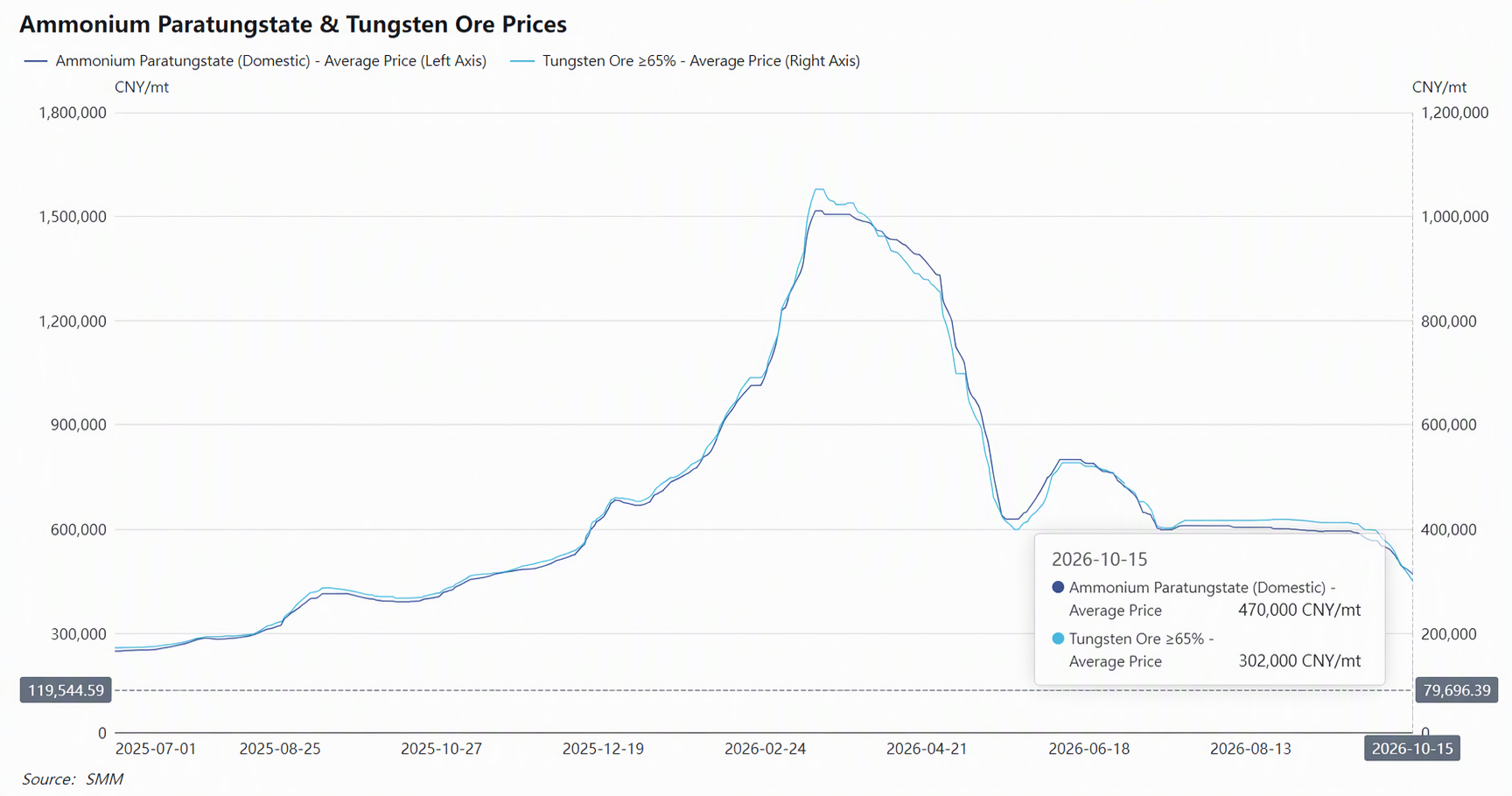
The major bearish factors facing the tungsten market in October are as follows:
Supply side: Tungsten ore imports surged, breaking the narrative of tight domestic quota balance
In 2026, China's total tungsten concentrate mining quota remains tightened, and domestic primary tungsten ore production is mainly down YoY. According to SMM sample data calculations, China's total tungsten concentrate production in the first three quarters of 2026 fell 7.84% YoY. With tightened quota controls and ore grades declining year by year, domestic tungsten concentrate supply is unlikely to see growth in the short term. Due to safety inspections in Luanchuan and other reasons, some tungsten-molybdenum mines have been shut down for extended periods, and the timeline for new projects to reach production has lengthened. China's total tungsten concentrate supply for 2026 is expected to reach 101,000 standard tonnes, down 6.1% YoY. However, domestic mining trading enterprises have stepped up efforts to source and purchase ore overseas. From January to August, China's tungsten concentrate imports surged sharply. According to customs data, China's total tungsten product imports from January to August 2026 amounted to approximately 25,000 mt, up 116% YoY. Based on SMM calculations using actual grades of tungsten concentrate imports from various countries, China's cumulative tungsten concentrate imports in 2026 totaled approximately 17,400 standard tonnes, up 118% YoY. SMM expects China's total tungsten concentrate imports for 2026 to reach 37,000 mt, up 80% YoY, equivalent to approximately 27,000 standard tonnes, an increase of 13,000 standard tonnes YoY, effectively offsetting the decline in domestic tungsten concentrate production.
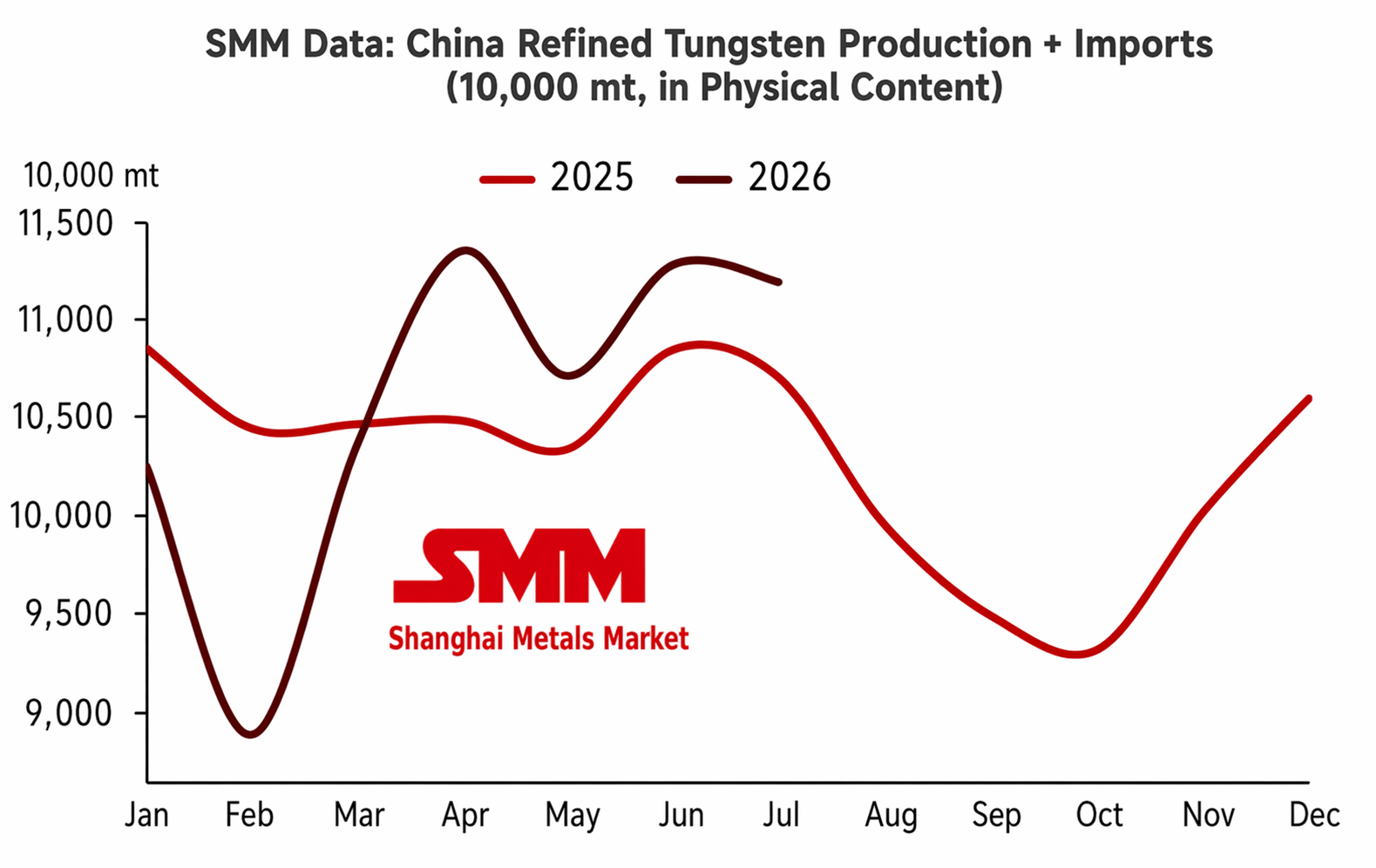
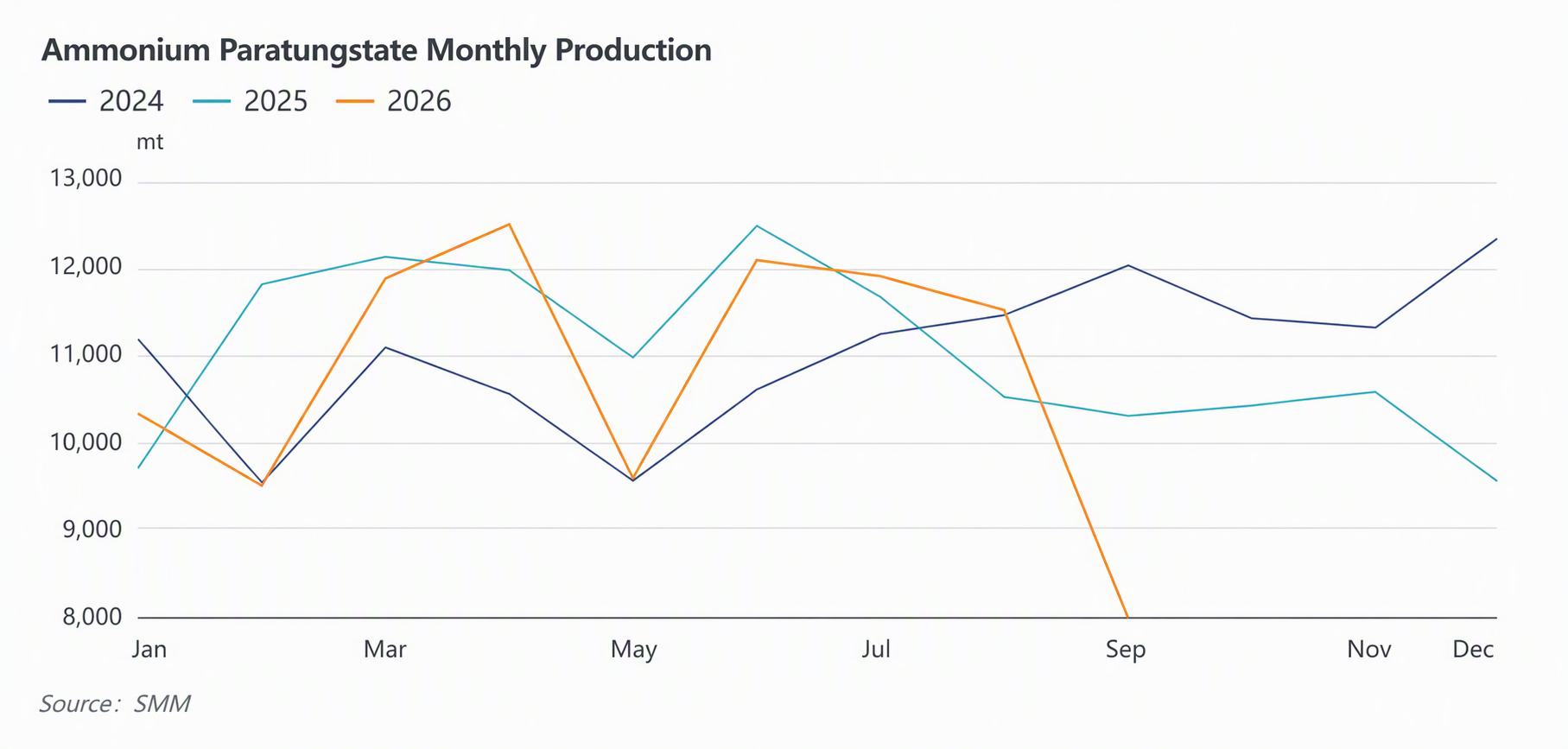
Smelting side: Smelters hold high inventories, and increased demand for capital turnover has led to heavier market selling pressure.
Since Q2, although the operating rate of APT industry production has declined, downstream cemented carbide enterprises have reduced procurement volumes. In H1, industrial end-users mainly consumed previous inventories, and concentrated restocking across the industry was slow. Mainstream smelting products such as APT saw severe inventory buildup. According to incomplete SMM statistics, domestic APT producer inventories at end-September were around 4,000 mt. In October, major industry players reduced long-term contract procurement volumes to further release liquidity. APT shipments were blocked, corporate capital recovery fell short of expectations, and capital turnover pressure rose significantly. Some smelters had earlier pledged APT warrants for financing to ease capital pressure. As APT prices plunged sharply, some pledged warrants hit forced liquidation lines, and enterprises faced pressure to add margin or supplement collateral. If credit enhancement cannot be replenished in time, pledged APT cargoes will be disposed of and auctioned by financial institutions, and enterprises face elimination from the market. To accelerate payment collection and reduce inventory depreciation risk, some smelters proactively cut prices to sell and cash out, further dragging down the pricing center for APT and upstream tungsten concentrates.
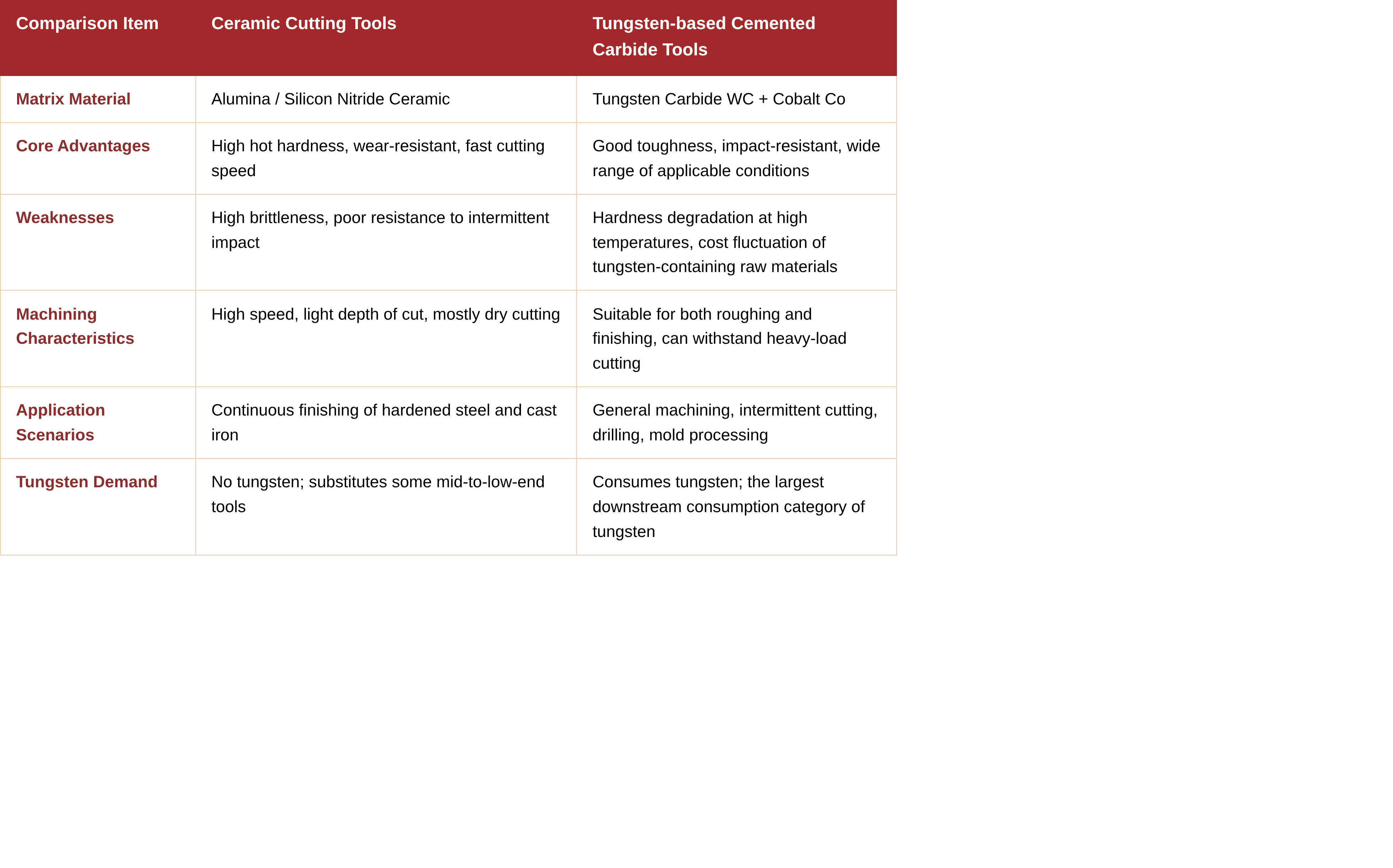
Demand side: Traditional application fields show weak consumption, and export markets struggle to see growth.
Against the backdrop of tungsten prices consolidating at highs in H1 2026, the trend of reduced alloying and material substitution in the cemented carbide industry has become increasingly evident—downstream cutting tool and mold enterprises have widely adopted tungsten-reduced formulations, while ceramic cutting tools and coated hard materials are accelerating the replacement of low and mid-end tungsten-based alloys. Coupled with sluggish manufacturing recovery, traditional cemented carbide enterprises continued to see low operating rates and weak willingness to restock raw materials. In 2026, tungsten usage growth in the AI/PCB sector accelerated, but total tungsten consumption in this segment still accounts for a relatively small share of overall downstream tungsten consumption. Based on SMM estimates from production data of major domestic PCB micro-drill and tungsten hexafluoride producers, total tungsten consumption in the PCB micro-drill and tungsten hexafluoride segments in 2026 is approximately 3,800 mt in metal content, up about 30% YoY, accounting for only about 4.6% of total domestic tungsten consumption. Traditional cutting tools, mining, and machining segments remain the main consumption drivers but are performing weakly.
Export market: Under export controls, high overseas premiums are unlikely to boost growth in tungsten intermediate product and finished product exports.
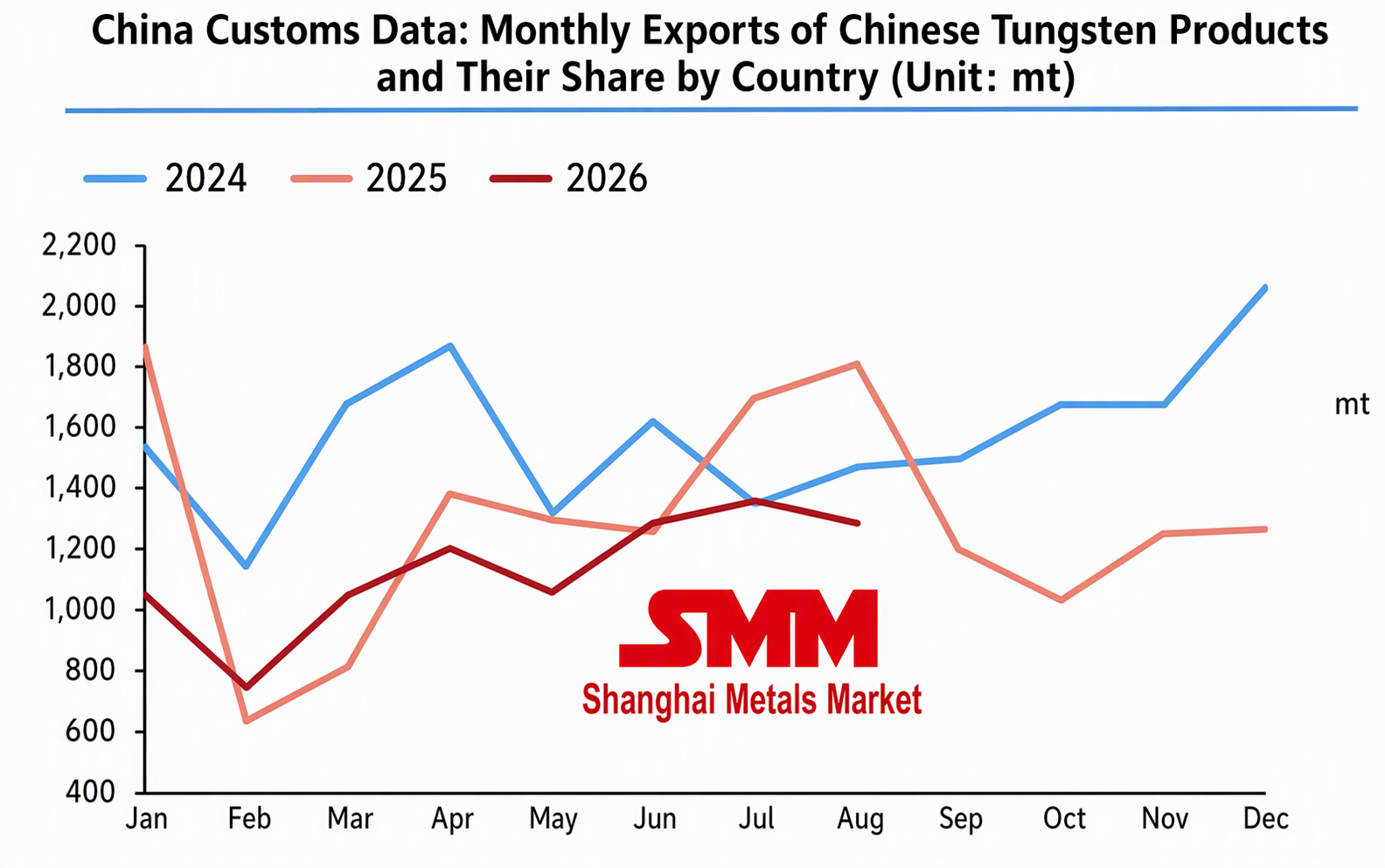
Since June 2026, the Ministry of Commerce has intensively introduced dual-use item control policies: adding 10 US military-industrial and rare earth enterprises to the embargo list; improving reporting mechanisms for violations involving strategic minerals such as tungsten, molybdenum, and rare earths; adding 40 Japanese military-related entities in two tiers, subject to comprehensive embargoes and strict case-by-case approvals; and working with customs to tighten precision machine tool clearance verification, comprehensively strengthening export controls on strategic minerals and military equipment. Dual-use tungsten intermediate product exports are unlikely to see growth. Domestic tungsten intermediate product exports totaled approximately 9,071 mt in January-August, down about 15% YoY on a cumulative basis. Domestic cemented carbide blade products have had a price advantage over overseas products since H2 this year, but exports have yet to show growth expectations. From January to August, China's total exports of cemented carbide blades reached 1,967 mt, down 15% YoY, which may be related to sluggish manufacturing activity among overseas end-users and trade volume fluctuations caused by tariff volatility.
Overall, the rapid decline in tungsten prices this round is essentially the result of the bursting of the previous price bubble combined with a resonance in the inventory cycle, with market sentiment shifting quickly from holding back supply in anticipation of higher prices to prioritizing cash. The sustained drop in prices has triggered panic selling across the industry chain, with ore traders, smelters, and some cemented carbide supporting enterprises selling ahead of schedule to avoid risk, amplifying the negative feedback loop. Downstream cemented carbide enterprises are only making just-in-time procurement, no longer restocking preventively, with orders placed on an as-needed basis. Long-term contract negotiations are being prolonged with significant pricing disagreements, spot cargo supply is increasing but effective transactions remain sluggish, and most deals are passive sell-offs at discounted prices. In the short term, the market is in a phase of inventory destocking and sentiment repair. In October, the tungsten market is likely to be dominated by an accelerated bottoming-out trend, and a stop to the price decline will require the following signals from the industry chain: first, voluntary production cuts in APT and tungsten concentrates expand in scope, with deep losses in the smelting segment triggering spontaneous production cuts to ease spot selling pressure; second, downstream orders for cemented carbide improve marginally, with the traditional manufacturing mini peak season in Q4 bringing a recovery in orders for cutting tools and mining tools, as well as low-price-driven restocking at lower levels; third, the pace of imported tungsten ore arrivals pulls back, with domestic price inversion suppressing overseas ore purchases and weakening the impact of import growth; fourth, scrap tungsten recycling supply contracts, as low prices reduce recycling enthusiasm and lessen the substitution of recycled materials for primary tungsten.
On the export front, China's tungsten products now have a price advantage, and overseas pre-Christmas stockpiling presents potential growth. However, restrictions on the approval of dual-use items remain, and only non-controlled categories such as ordinary cemented carbide blades and tungsten powder are expected to see modest volume increases, which are unlikely to dominate the market trend. Additionally, the sluggish recovery of overseas manufacturing has led to APT prices in overseas markets falling in tandem, with the price spread between Chinese and overseas markets narrowing only slowly.
In the medium and long term, China's policy of controlling total tungsten concentrate mining volume remains unchanged, primary ore production continues to decline, and supply rigidity persists due to falling ore grades and long commissioning cycles for new projects. The strategic resource attributes of tungsten remain intact, and supply is expected to stay in a contractionary state in 2027. Emerging downstream demand such as PCB micro-drills, tungsten hexafluoride, and PV tungsten wire continues to grow, but the volume is not enough to offset the weakness in traditional cemented carbide consumption. Once manufacturing recovers and inventories are fully digested, the medium and long-term supply-demand tight balance logic for tungsten is expected to re-emerge.
![[SMM Chromium Flash] Global Steel Demand Forecast Turns Flat in 2026 as China Weakens, Recovery Expected in 2027](https://imgqn.smm.cn/usercenter/eThpo20251217171723.jpeg)
![[SMM Chromium Flash] South Africa’s August Chrome Ore Exports Fall 11% as Ferrochrome Shipments Rebound 20%](https://imgqn.smm.cn/usercenter/rUQIB20251217171723.jpeg)
![[SMM Chromium Week Review] Export Flows Rebound as China's Port Stocks Rise and African Prices Diverge](https://imgqn.smm.cn/usercenter/QmrGh20251217171725.jpg)