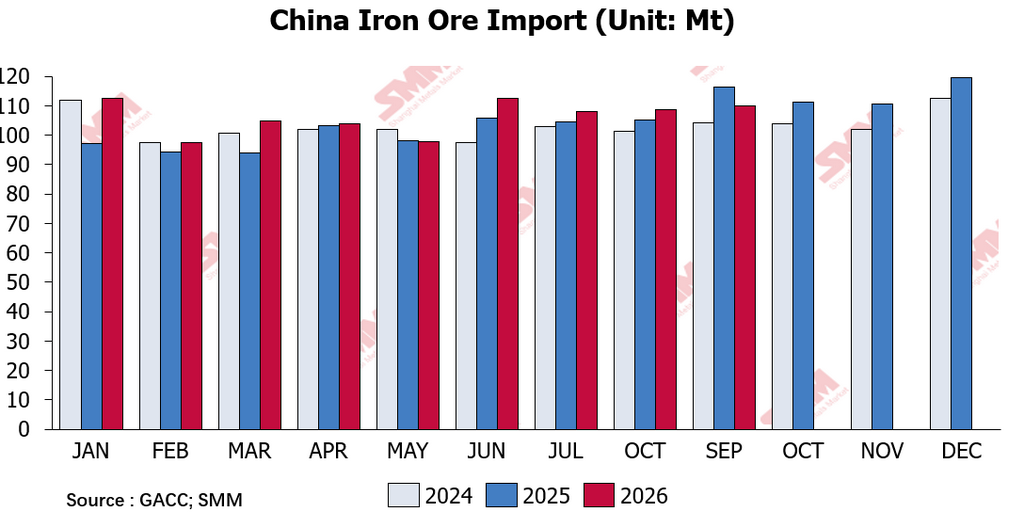
According to the latest data from the General Administration of Customs of China, China imported 109.817 million tonnes (mt) of iron ore and concentrates in September, up 1.18% MoM and down 5.47% YoY. Cumulative imports of iron ore and concentrates for January–September totalled 954.967 mt, up 4.1% YoY.
Looking back at September, a quarter-end push to hit targets drove a clear rebound in global iron ore shipments. SMM vessel schedule data show global shipments of 141.77 mt in September, up 9.67% MoM, with shipments from Australia and Brazil rising 10.50% and 5.70% respectively. The arrivals shortfall caused by the typhoon in late August was largely made up within the month, and arrivals at Chinese ports rose 12.67% MoM to 114.61 mt. On the demand side, widening steel mill losses and increased maintenance saw daily hot metal output fall from 2.4080 mt at the start of the month to 2.3882 mt at month-end. Port inventories declined first and then rebuilt, rising to 145.45 mt in the final week of September. Overall, the iron ore fundamentals reflected a relatively loose supply and weak demand picture.
During the month, the situation in the Middle East pushed up bunker fuel costs, and the freight rate on the Brazil Tubarão–Beilun/Baoshan route briefly climbed to USD 43.38/t. Some small and mid-sized Brazilian mines, squeezed by high freight and weaker netbacks, cut output in succession; among them, CSN Mineração lowered its full-year own-produced plus purchased volume guidance by approximately 6 mt.
Looking ahead to October, Australian shipments have slowed after the quarter-end push, with average weekly shipments in the first two weeks of October down 2.40% from September. Although Brazil remains in its dry-season shipping window, output cuts at small and mid-sized mines will weigh on marginal supply. If CSN’s volume reduction is concentrated in the remaining three months of the year, the impact would be at most around 2 mt per month, equivalent to roughly 6.5% of Brazil’s September shipments. However, freight rates have retreated from their highs, falling to USD 31.39/t in mid-October, so the curtailed mines retain some flexibility to restart.
On the arrivals side, the high volume shipped to China in September will underpin October arrivals, with average weekly arrivals in the first two weeks broadly flat versus September. Meanwhile, average weekly shipments to China over the same period fell 11.32%, so arrival pressure may not ease until November. On the demand side, blast furnace maintenance has increased after the holiday: in the week ending 14 October, daily hot metal output dropped to 2.3520 mt, while port inventories rose to 148.30 mt, so stock-building pressure persists. In addition, October contains one more weekly statistical period than September, which will amplify the month-on-month change in monthly totals.
Taking these factors together, average weekly shipments in October are expected to ease slightly, average weekly arrivals are expected to remain broadly flat, and customs-basis import volumes are likely to hold steady MoM.


![Arrivals fall for a third week but port stocks build, capping any recovery [SMM Daily Iron Ore Brief]](https://imgqn.smm.cn/usercenter/HbWNv20251217171718.jpg)