Ganfeng Lithium achieved a textbook earnings turnaround, driven by a rebound in lithium product prices and expanded lithium battery sales.
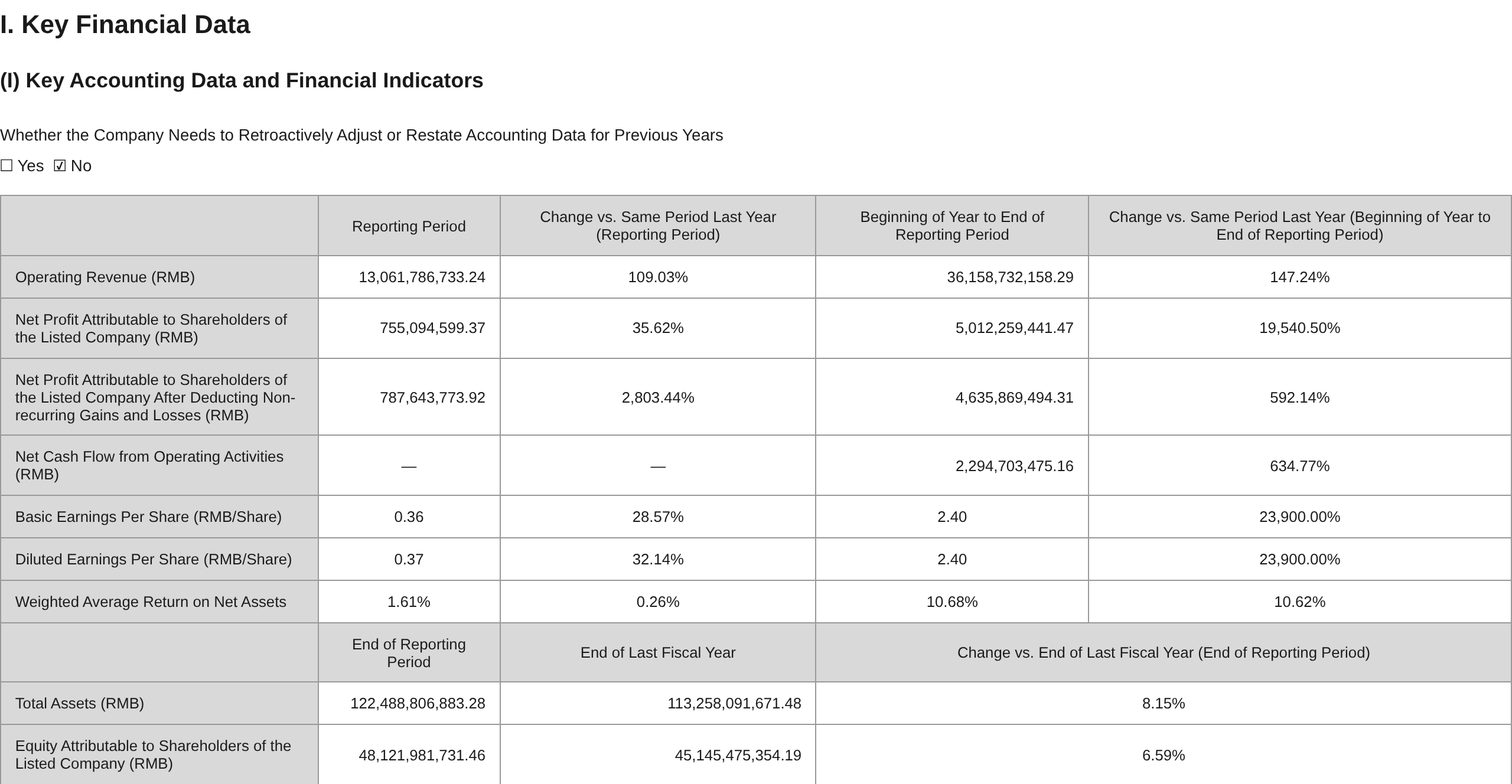
The company's Q3 report released on Thursday showed that net profit attributable to shareholders of the publicly listed firm reached 5.012 billion yuan in the first three quarters of 2026, up 19,540.50% YoY from just 25.52 million yuan a year earlier.Revenue climbed sharply to 36.159 billion yuan, up 147.24% YoY. The company attributed the improvement mainly to higher selling prices for lithium products and increased sales of lithium battery products.
In Q3 alone, net profit attributable to the parent company was 755 million yuan, with YoY growth narrowing to 35.62%. Q3 revenue was 13.062 billion yuan, up 109.03% YoY.
In terms of market impact, the results signal that Ganfeng Lithium has largely emerged from the downturn of the previous deep lithium price cycle. Net cash flow from operating activities turned positive to 2.295 billion yuan from a negative figure a year earlier, up 634.77% YoY, confirming a substantial improvement in earnings quality.
Revenue and profit both surged, while single-quarter growth slowed
First-three-quarter data showed that Ganfeng Lithium's revenue and profit both posted sharp gains. Revenue of 36.159 billion yuan was up more than 1.5x from 14.625 billion yuan a year earlier, while operating profit swung from a loss of 458 million yuan to a profit of 7.795 billion yuan.
However, quarterly performance revealed signs of narrowing growth momentum.Q3 net profit attributable to the parent company was 755 million yuan, with YoY growth narrowing to 35.62%, a marked slowdown from the triple-digit growth for the first three quarters combined. Q3 revenue was 13.062 billion yuan, up 109.03% YoY.
Excluding non-recurring items, net profit for the first three quarters was 4.636 billion yuan, compared with a loss of 936 million yuan a year earlier, reflecting a substantive recovery in core business profitability.
Investment income contributed significantly, and non-core income cannot be ignored
Beyond the improvement in the main business, the contribution of investment income to profit was also significant. Investment income reached 1.31 billion yuan in the first three quarters, up 235.90% YoY, including 826 million yuan from associates and joint ventures, as well as gains from the partial disposal of PLS shares.
Non-recurring items contributed approximately 376 million yuan in the first three quarters, mainly from investment gains on the disposal of PLS shares and government subsidies of 130 million yuan. Notably, the company bore about 11.1 million yuan in non-recurring net losses from associates due to environmental protection fines and tax late fees, in proportion to its shareholding.
Q3 non-GAAP net profit was 788 million yuan, up 2,803.44% YoY, higher than the growth rate of net profit attributable to the parent company including non-recurring items, indicating relatively solid core profitability in Q3.
Effective cost control and emerging economies of scale
On the cost side, operating costs rose to 26.246 billion yuan in the first three quarters, up 107.39% YoY, below the 147.24% revenue growth, reflecting cost dilution from economies of scale and improved capacity utilization.
R&D investment continued to increase, with R&D expenses reaching 1.172 billion yuan in the first three quarters, up 60.78% YoY. Taxes and surcharges rose 85.77% to 346 million yuan, which the company attributed mainly to a gradual increase in self-owned resource supply and higher export tariffs and resource taxes.
Income tax expenses rose sharply to 2.247 billion yuan, compared with a negative figure a year earlier due to losses. Taxes payable increased 128.33% YoY to 1.737 billion yuan, consistent with the profit growth trend.
Balance sheet expansion and FX fluctuations weighing on comprehensive income
As of September 30, 2026, total assets stood at 122.489 billion yuan, up 8.15% from the beginning of the year, while net assets attributable to shareholders of the publicly listed firm were 48.122 billion yuan, up 6.59%.
On the liability side, long-term borrowings increased by approximately 3.494 billion yuan from the beginning of the year to 19.538 billion yuan, and long-term payables rose 33.24% to 3.996 billion yuan, mainly due to the issuance of exchangeable notes and increased finance lease liabilities.
Comprehensive income was notably dragged down by currency factors. Other comprehensive income recorded a loss in the first three quarters, with changes in foreign currency financial statement translation differences producing a negative impact of over 1.435 billion yuan, resulting in a net after-tax other comprehensive income attributable to owners of the parent company of negative 1.477 billion yuan. This factor brought total comprehensive income for the first three quarters to 3.886 billion yuan, below the absolute value of net profit.
Cash flow improved across the board, while capital expenditure was scaled back
On the cash flow front, net cash flow from operating activities turned positive to 2.295 billion yuan from negative 429 million yuan a year earlier, mainly benefiting from a sharp increase in cash received from sales of goods and services to 30.331 billion yuan.
Net cash outflow from investing activities narrowed to 2.045 billion yuan from 2.988 billion yuan a year earlier, mainly because cash paid for the purchase of fixed assets, intangible assets, and other long-term assets was significantly reduced to 2.094 billion yuan from 5.381 billion yuan, indicating a moderation in capital expenditure.
In financing activities, net inflow narrowed to 706 million yuan from 5.797 billion yuan a year earlier, mainly due to higher cash payments for debt repayment during the period. At the end of the reporting period, cash and cash equivalents stood at 8.749 billion yuan, a slight increase from the beginning of the year.
![[SMM Cobalt-Lithium Morning Meeting Summary] Supply-demand expectations diverge, material prices under pressure, industry chain prosperity diverges](https://imgqn.smm.cn/usercenter/fblvS20251217171729.png)
![[SMM Cobalt Morning Meeting Summary] Weak Demand and Falling Costs Keep Industry Chain Prices Under Pressure and Hitting Bottom](https://imgqn.smm.cn/usercenter/yunIW20251217171723.jpeg)