The purchasing side is raising prices, while seller listings remain unchanged, and the upper end of short-term rental prices has started to move up first. This shift in the 5090 market has brought one question to the forefront: After buyers raise their purchase prices, where do the cards go, and how long will it take for them to become rentable resources?
If purchased cards first go through resale, inspection, assembly, or delivery, the return of some resources to the rental market may be delayed. Short-term rentals that need to organize supply on short notice may feel this change earlier. To determine whether this explanation holds, it is necessary to first clarify the price facts and transaction terms.

I. Purchasing side: What is truly worth tracking is three consecutive quotation days
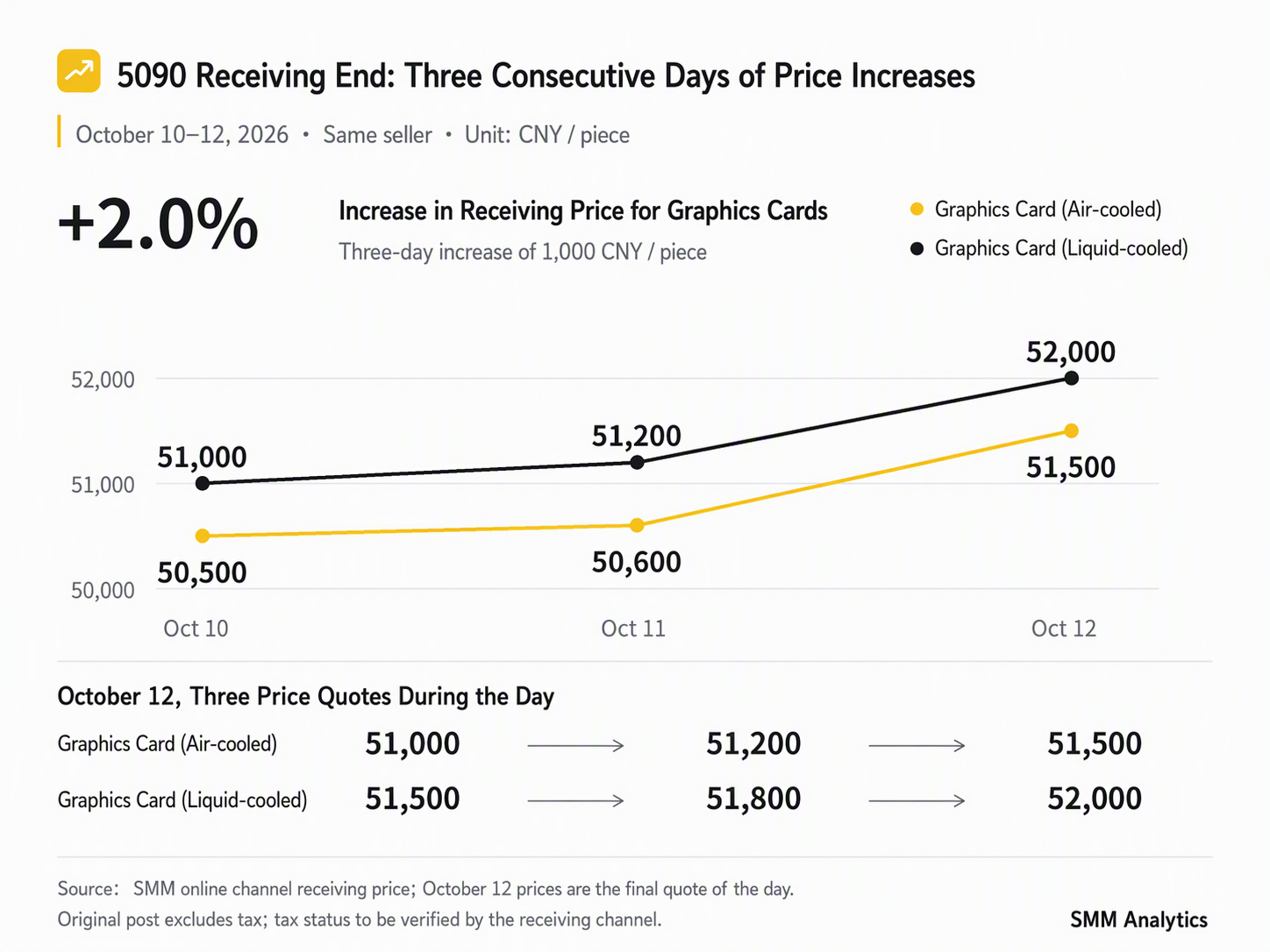
First, look at the consecutive quotations from the same buyer from October 10 to 12. Fan card bids rose from 50,500 yuan to 51,500 yuan per card, an increase of 1,000 yuan, or about 2.0%; blower cards rose from 51,000 yuan to 52,000 yuan per card.
Price increases also occurred on the same day. On October 12, fan cards were quoted at 51,000, 51,200, and 51,500 yuan in succession, while blower cards were quoted at 51,500, 51,800, and 52,000 yuan in succession. Consecutive quotation updates are more noteworthy than a single high purchase price.
On October 10, another independent buyer also quoted a fan card purchase price of 50,500 yuan, with quantities of 100 units and 200 cards respectively in the two messages. This shows that the price level received responses from different buyers, but it still cannot replace actual transaction records.
II. Seller listings: Purchase prices are approaching, but the difference is not profit
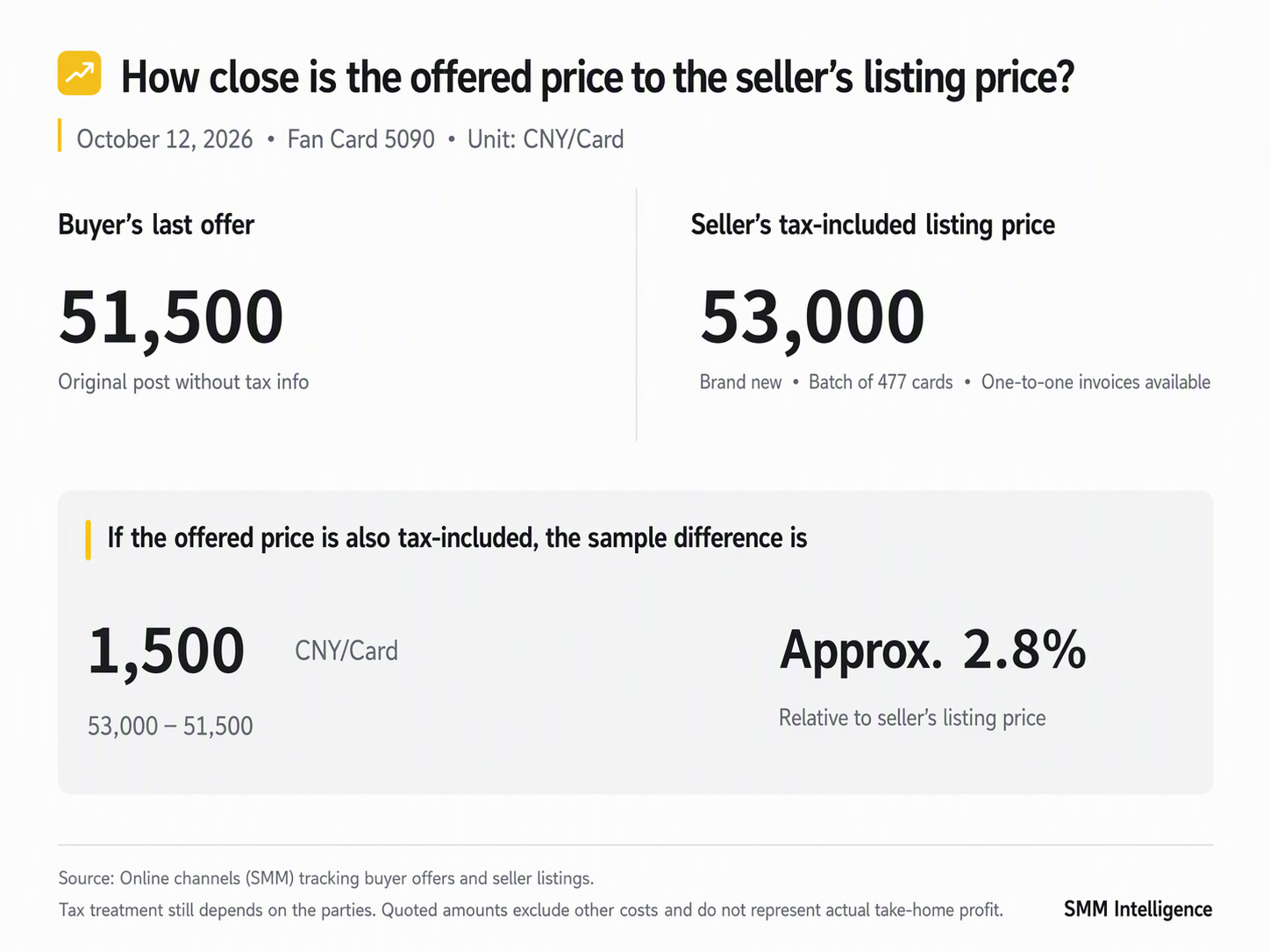
On October 12, a seller sample of 5090 fan cards gave a brand-new tax-inclusive listing of 53,000 yuan per card , with a total of 477 cards, supporting one-to-one invoicing. According to the original monitoring, this listing was not adjusted during the current observation period.
If the last fan card purchase bid of 51,500 yuan on that day is also tax-inclusive, the difference between the two is 1,500 yuan, about 2.8% of the seller's listing price, or approximately 3%. Under this premise, purchase samples are already close to the seller's external listing level.
This change may indicate that some buyers have increased their willingness to purchase, but it cannot be directly described as "leaving almost no profit." Purchase bids and seller listings are not transaction prices, and the conditions for quality, quantity, settlement, delivery, and taxes have not been fully standardized; the gap between quotes cannot substitute for actual resale returns.
During the same period, a brand-new turbo card appeared with an untaxed selling quote of 47,800 yuan per card. This should be recorded separately from the tax-inclusive listing of 53,000 yuan for the fan card, and the available information is not enough to conclude that the two are simply the pre-tax and post-tax prices of the same product.
III. Leasing: Short-term rental ceiling rises first, monthly average also moving
The most notable change on the leasing side appeared in the upper bound of the 5090 short-term rental price. On October 13, the highest short-term retail price rose to 4.5 yuan per card-hour, up 20.6% from 3.73 yuan on the 12th and up 30.4% from 3.45 yuan on the 8th.

A jump in the upper bound does not mean all rental prices rose by the same margin.On the same day, the short-term rental average rose from 2.89 to 2.98 yuan per card-hour, an increase of 3.1%. The gap between the highest price and the average indicates that further observation is needed on the coverage of high-price samples, order structure, and subsequent readings.
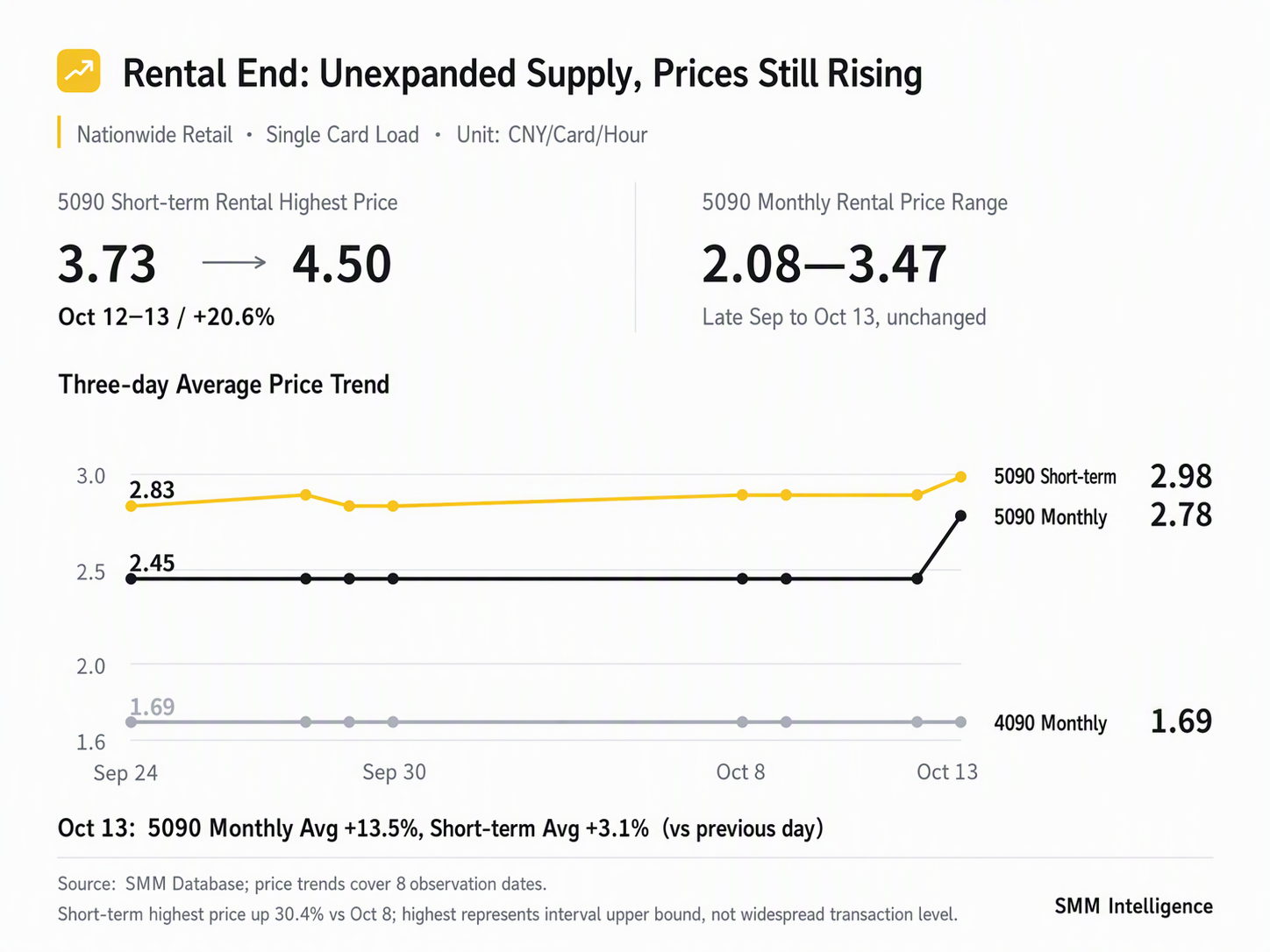
The monthly rental market also needs to be viewed separately in terms of "range" and "average": the highest monthly rental price for a single 5090 card remained unchanged at 3.47 yuan, and the lowest at 2.08 yuan per card-hour, but the average has risen from 2.45 to 2.78 yuan, a single-day increase of 13.5%. Therefore, a more accurate description is "the monthly rental range has not widened, but the average has moved up".
The average monthly rental price for complete systems also rose from 2.60 to 2.69 yuan per card-hour, a single-day increase of 3.5%. This indicator had already risen from 2.41 yuan at the end of September to 2.60 yuan on October 8, and moved further upward on the 13th.
By contrast, during the same period, the average monthly rental price for a single 4090 card remained unchanged at 1.69 yuan, and the short-term average at 1.89 yuan per card-hour. Current signals are mainly concentrated in the 5090 and are not yet sufficient to determine that the entire GPU rental market is tightening simultaneously.
IV. Complete cards and disassembled materials: providing clues but not directly indicating destination
There is another set of prices in the circulation market: purchase quotes for complete cards, PCBs, and disassembled chips. They reflect transaction options in different forms and also provide clues for understanding how cardholders dispose of their assets.
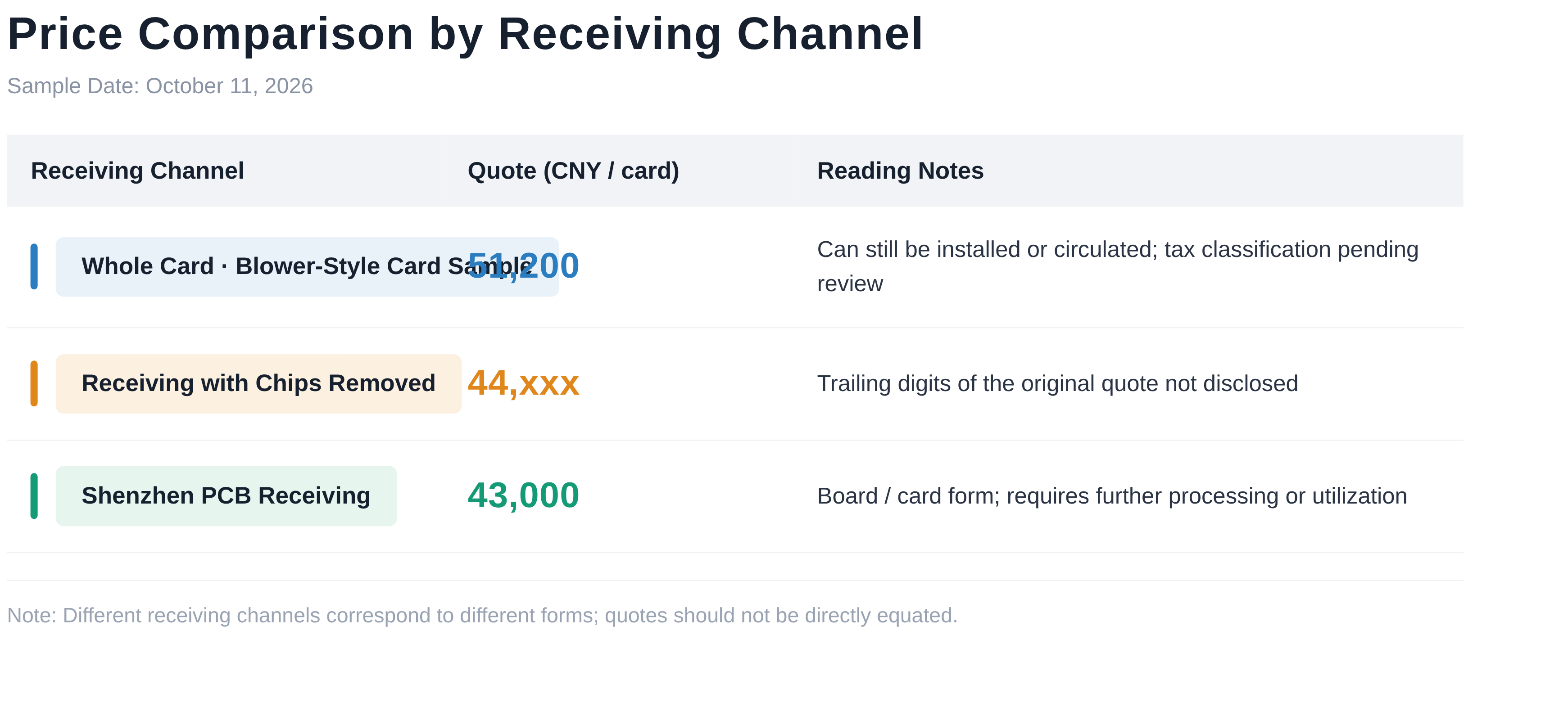
The book difference between the two samples of complete cards and PCBs is 8,200 yuan, approximately 19% of the PCB quote. However, the two do not involve the same party or the same batch of goods, and the conditions for quality, taxes, and delivery have not been standardized. This set of differences cannot be fully explained as a "liquidity premium," nor is it enough to prove that the whole cards collected were necessarily used for resale.
The recycling price for dismantled chips shows a different pace: the same recycler quoted identical prices for five consecutive days from October 9 to 13; compared with September 18, the 5090 rose 6.2%, the 4090D rose 2.8%, the 4080S rose 5.3%, the 4090 and 3090 remained flat, and the 3080 was newly listed.
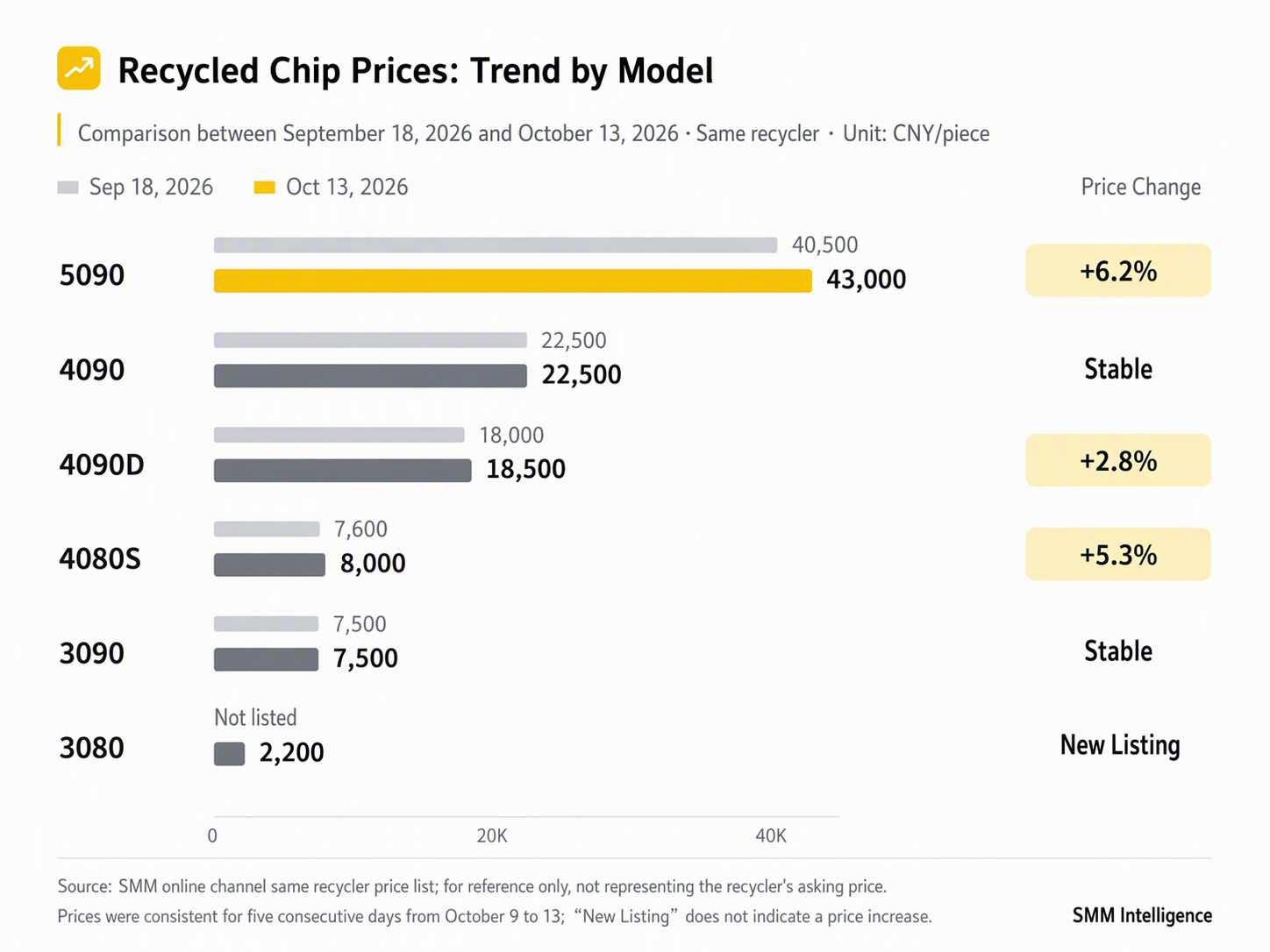
Therefore, what the recycling side reflects isdivergence in residual value quotes across different models. A single recycler's quote of 43,000 yuan can serve as one disposal price reference, but it cannot be used to determine the price floor for the entire market. Its role in this article is to supplement observation, rather than to directly prove that the supply has already left the rental market.
V. Connecting the logic: the supply may temporarily remain in the circulation chain
Putting the three price lines of purchasing, seller listings, and rentals together, one possible explanation can be proposed:Higher prices on the purchasing side increase the attractiveness of selling; if the collected graphics cards need to go through resale, inspection, assembly, or delivery, some immediately rentable resources may be released with a delay, and short-term rentals are more sensitive to this time gap.
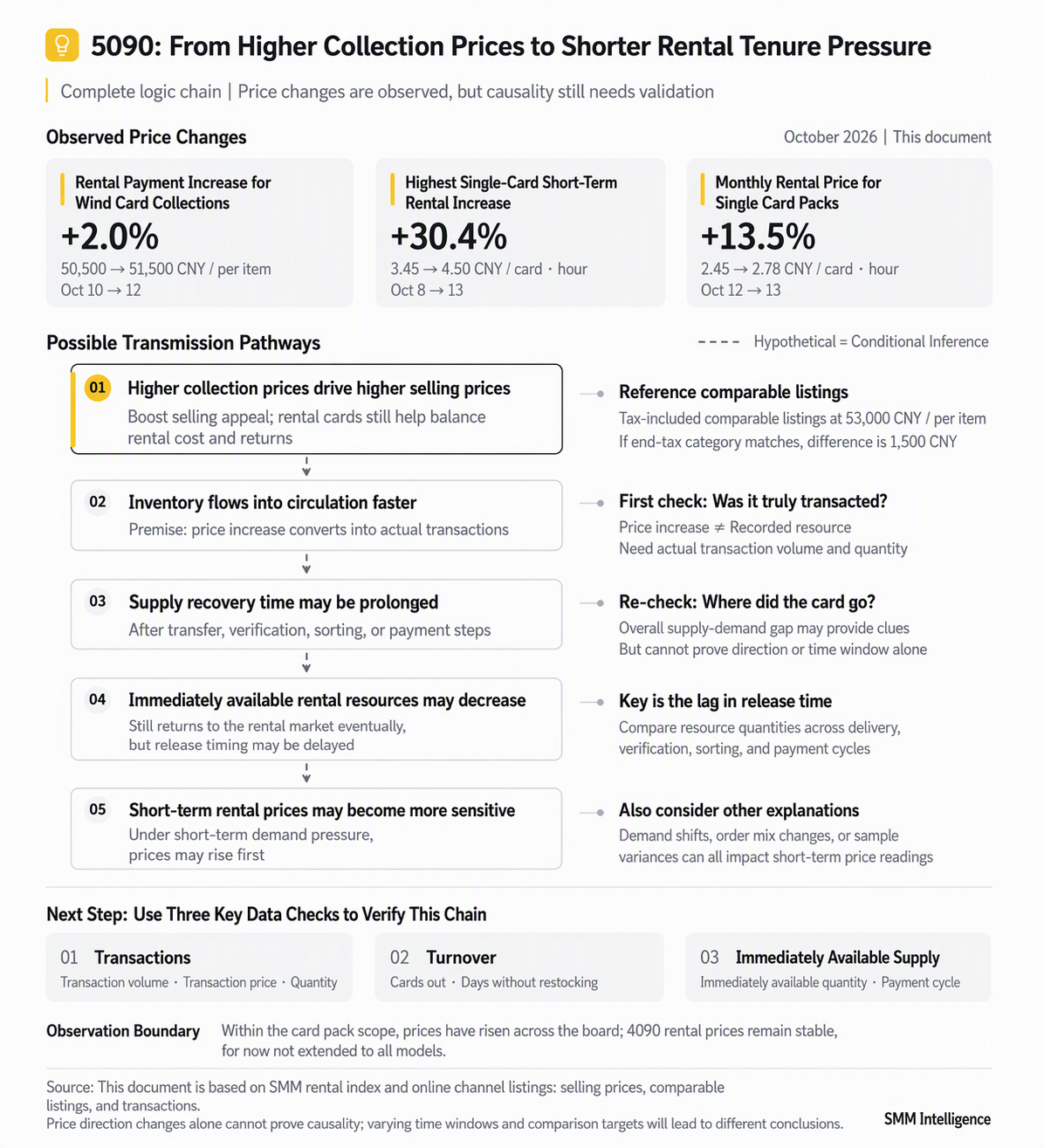
Step-1, the buyer raises its willingness to purchase
The same entity raised its bid on three consecutive quote days, and updated it multiple times on the 12th, which is already observed behavior. It shows that the buyer is willing to raise its purchase price. Whether card holders sell as a result still depends on rental expectations, utilization rate, costs, and payment terms.
Step-2, the supply may pass through one more circulation link
After purchase, whole cards can be resold, refurbished, assembled and delivered, or they can continue to be used for rental. If these links lengthen the turnover time, even if the graphics cards ultimately still enter the rental market, the resources that can be deployed at present may decrease. This step explainsthe time gap in supply release, and it requires support from transaction chain and turnover data.
Step-3, short-term rentals may reflect this change earlier
If the short-term rental business relies more on temporarily organizing supply, a reduction in deployable resources may first affect the upper end of its quotes. The monthly rental business may rely more on existing inventory, but the average monthly price has also risen this period, so it cannot be described as completely unaffected.
At this stage, "circulation temporarily occupying supply" is an explanation worth verifying. Only by simultaneously observing changes in transactions, turnover, and rentable quantities can we judge how much of a role it has played in this round of rental price fluctuations.
VI. SMM View: Next, focus on three sets of data.
First, watch whether purchase quotes can translate into transactions. Consecutive price increases can serve as a signal for observing buyers' willingness to purchase. Going forward, they need to be combined with trading volume, transaction prices, and actual purchase quantities to assess their sustainability and coverage.
Second, watch the turnover time of existing cards. Focus on tracking the resale, assembly, and delivery cycles after purchase, as well as the number of rental resources available for immediate delivery. How long resources remain in circulation is more helpful than a single high-price purchase report in explaining short-term rental pressure.
Third, watch whether the changes are spreading. For the 5090, short-term rental ceiling, short-term rental average price, and monthly average price should be observed simultaneously; models such as the 4090 can serve as a comparison. If more models also show same-direction changes in price, rentable quantity, and delivery cycle, then assess whether there is broader supply tightening.
In the short term (within 1 month), track whether bids, transactions, and immediately rentable quantities are moving in the same direction;
in the medium term (3-6 months), combine the price spread between whole cards and dismantled materials under comparable transaction conditions, rental prices, and resource turnover to observe whether supply is recovering. A single price spread or a single day's rent change is not enough to independently confirm a turning point.
![[SMM Computing Power Midday Review] 910B3 newly released 14,500, with 20,000 relocatable](https://imgqn.smm.cn/usercenter/PeWqW20251217171735.jpg)
![[SMM Computing Power News] 61,000 reported for 128 units of 910C in east China](https://imgqn.smm.cn/usercenter/obeMy20251217171735.jpg)