[SMM Building Materials Weekly Balance] Post-Holiday Demand Continues to Recover; Supply-Demand Fundamentals Maintain a Weak Balance

Published: Oct 15, 2026 10:52 (GMT+8)
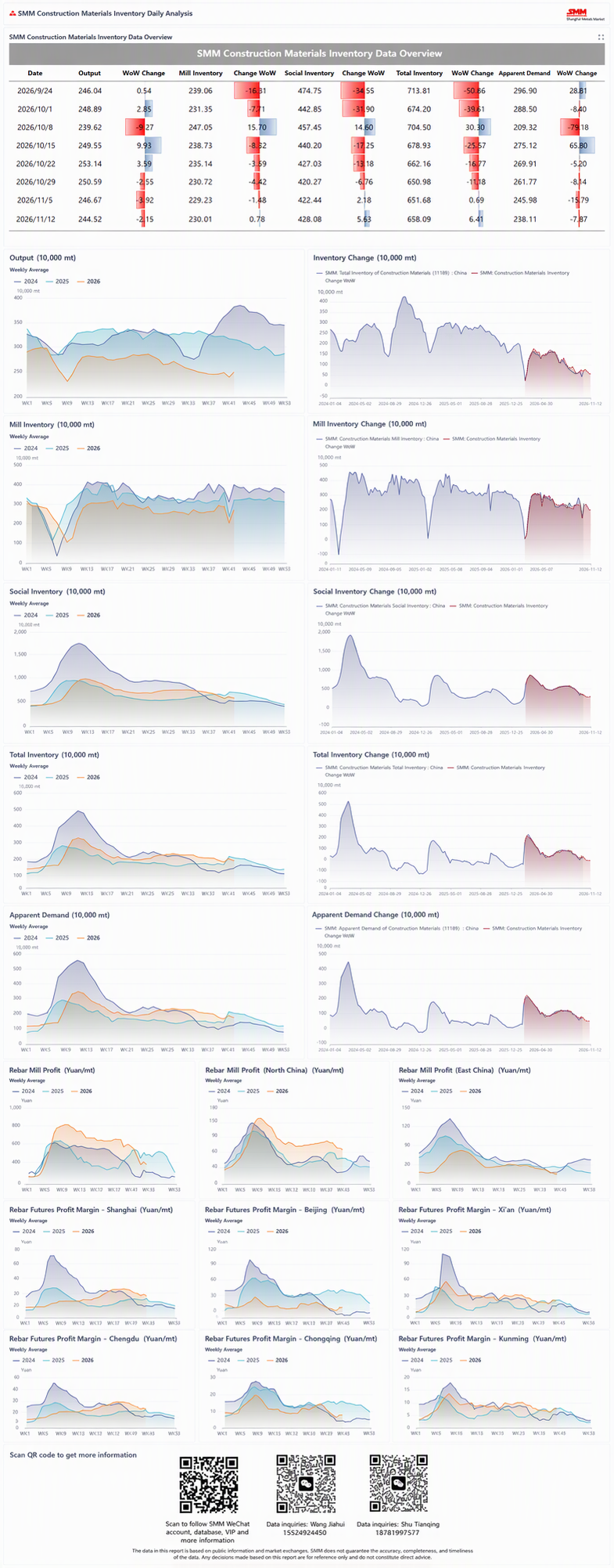
According to SMM statistics, building materials factory inventory and social inventory decreased during this period. Total building materials inventory was 6.7893 million mt, down 255,700 mt WoW, or -3.63% WoW, with inventory changes shifting from an increase to a decrease.

Supply side, most blast furnace steel mills are maintaining their current unsaturated production pace, with only a few producers resuming rolling line production as planned. After two rounds of coke price cuts were implemented, the cost-effectiveness of hot metal improved, easing the pressure on steel scrap procurement for electric furnaces. Coupled with per-tonne steel margins generally staying above the break-even line, some electric furnace mills have extended operating hours or resumed production. Demand side, the National Day holiday last period disrupted terminal construction and logistics transportation, causing a sharp decline in building materials demand. After the holiday, as demand gradually returned to normal levels and trading sentiment improved, apparent demand rose significantly WoW. According to SMM statistics, this period saw destocking in building materials mill inventories and social inventories, with total building materials inventory at 6.7893 million mt, down 255,700 mt WoW, or -3.63% WoW, shifting inventory changes from an increase to a decrease.
Data Source Statement: Except for publicly available information, all other data are processed by SMM based on publicly available information, market communication, and relying on SMM's internal database model. They are for reference only and do not constitute decision-making recommendations.

Images in this article contain AI-translated captions for reference only.

For any inquiries or for more information, please contact: lemonzhao@smm.cn
For more information on how to access our research reports, please contact:service.en@smm.cn
Related News
[SMM Iron Ore] Higher premiums and softer spot cut imported iron ore margins to 1.10 yuan/mt
28 mins ago
[SMM Iron Ore] Higher premiums and softer spot cut imported iron ore margins to 1.10 yuan/mt
Read More
[SMM Iron Ore] Higher premiums and softer spot cut imported iron ore margins to 1.10 yuan/mt
[SMM Iron Ore] Higher premiums and softer spot cut imported iron ore margins to 1.10 yuan/mt
28 mins ago
Why a Niche Steel Could Stall Europe's Electrification Plans
1 hour ago
Why a Niche Steel Could Stall Europe's Electrification Plans
Read More
Why a Niche Steel Could Stall Europe's Electrification Plans
On 18 September the European Commission imposed preliminary safeguard measures raising minimum import prices for grain-oriented electrical steel (GOES) and transformer cores, with permanence undecided; they expire in February 2027. EU GOES consumption rose 32% from 2021-2025, but EU mills' share fell from 66% to 43% as imports more than doubled, over half from China. Only Thyssenkrupp and Stalprodukt still produce GOES in the EU; Thyssenkrupp has cut output since December 2025. Germany's ZVEI says European producers cannot supply the needed volumes or top grades, making Japanese and Korean imports indispensable; T&D Europe warns the measures will raise transformer costs without requiring EU mills to expand output. The U.S. runs a single GOES mill; its 2018 tariffs covered finished products only from August 2025.
1 hour ago
Egyptian steel industry divided over billet import safeguard duties ahead of government talks
1 hour ago
Egyptian steel industry divided over billet import safeguard duties ahead of government talks
Read More
Egyptian steel industry divided over billet import safeguard duties ahead of government talks
Egypt's steel sector is split over billet import safeguards. Under Resolution No. 121 of 2026, duties run three years: 13.12% with a 70 USD/tonne floor in year one, 12% (64 USD/tonne) in year two and 11% (59 USD/tonne) in year three. Rolling mills say the duties raise costs and want supply judged on saleable output, not capacity, plus faster roll-out of eight billet licences totalling 2.8 million tonnes. Engineering firms cite a 40% price gap with imports; local supply covers only 55-65% of demand. Integrated producers defend the duties: imports rose from 128,000 tonnes in 2021 to 1.7 million tonnes in 2024 (1 billion USD). Billet capacity is 13.6 million tonnes versus 8.8 million tonnes for rebar. Ministerial talks are due October 19.
1 hour ago
Register to Continue Reading
Gain access to the latest insights in metals and new energy
Already have an account?Sign in here