SMM, October 13:
I. Prices: A brief rebound in August, followed by a mild pullback
In August 2026, driven by some enterprises holding prices firm and phased concentrated procurement, module prices ended their previous grind lower and saw a modest rebound, with mainstream TOPCon 210R quotes hitting a phase high in late August. Distributed module average prices briefly rose to around 0.725 yuan/W, while centralized module average prices traded around 0.71 yuan/W.
However, the uptrend failed to sustain. Entering September, demand-side absorption was insufficient, and with ample supply, quotes gradually softened; by mid-October, distributed module average prices had pulled back to around 0.716 yuan/W, and centralized module average prices had fallen to near 0.699 yuan/W, both down about 0.01 yuan/W from their late-August highs, representing declines of roughly 1.3% and 1.5%, respectively. Structurally, distributed quotes remained about 0.017 yuan/W higher than centralized quotes throughout, a spread that mainly reflects channel premiums and delivery cost differences in the distributed segment, and it has held steady recently.
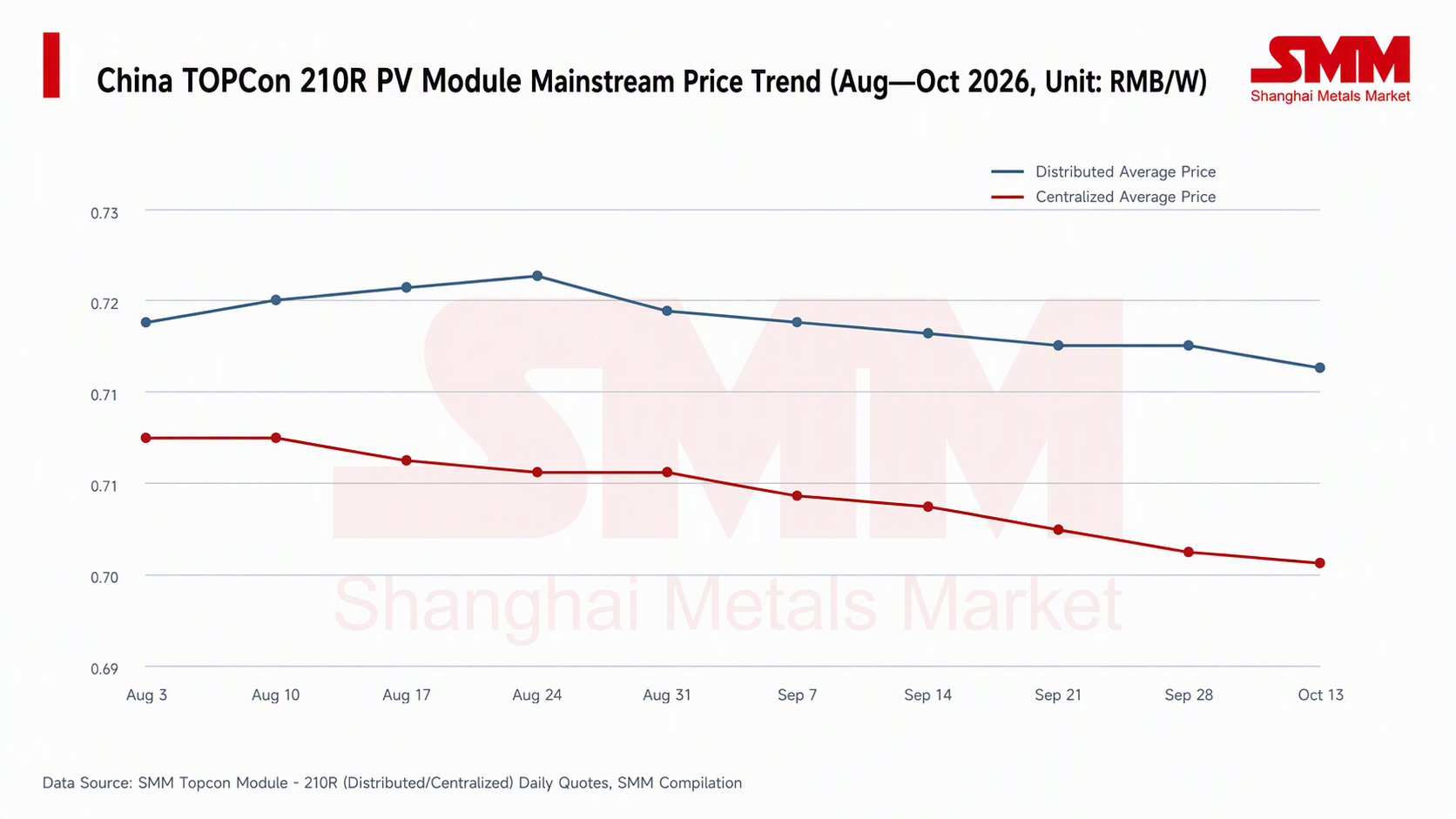
It is worth noting, however, that current module prices are already close to most enterprises' cash cost lines, so downside is also limited; prices are increasingly characterized by narrow-range movement, with supply capping the upside and costs providing a floor.
II. Inventories: Absolute levels remain high, exerting downward pressure on prices
The consecutive price declines are directly linked to still-elevated inventory levels.
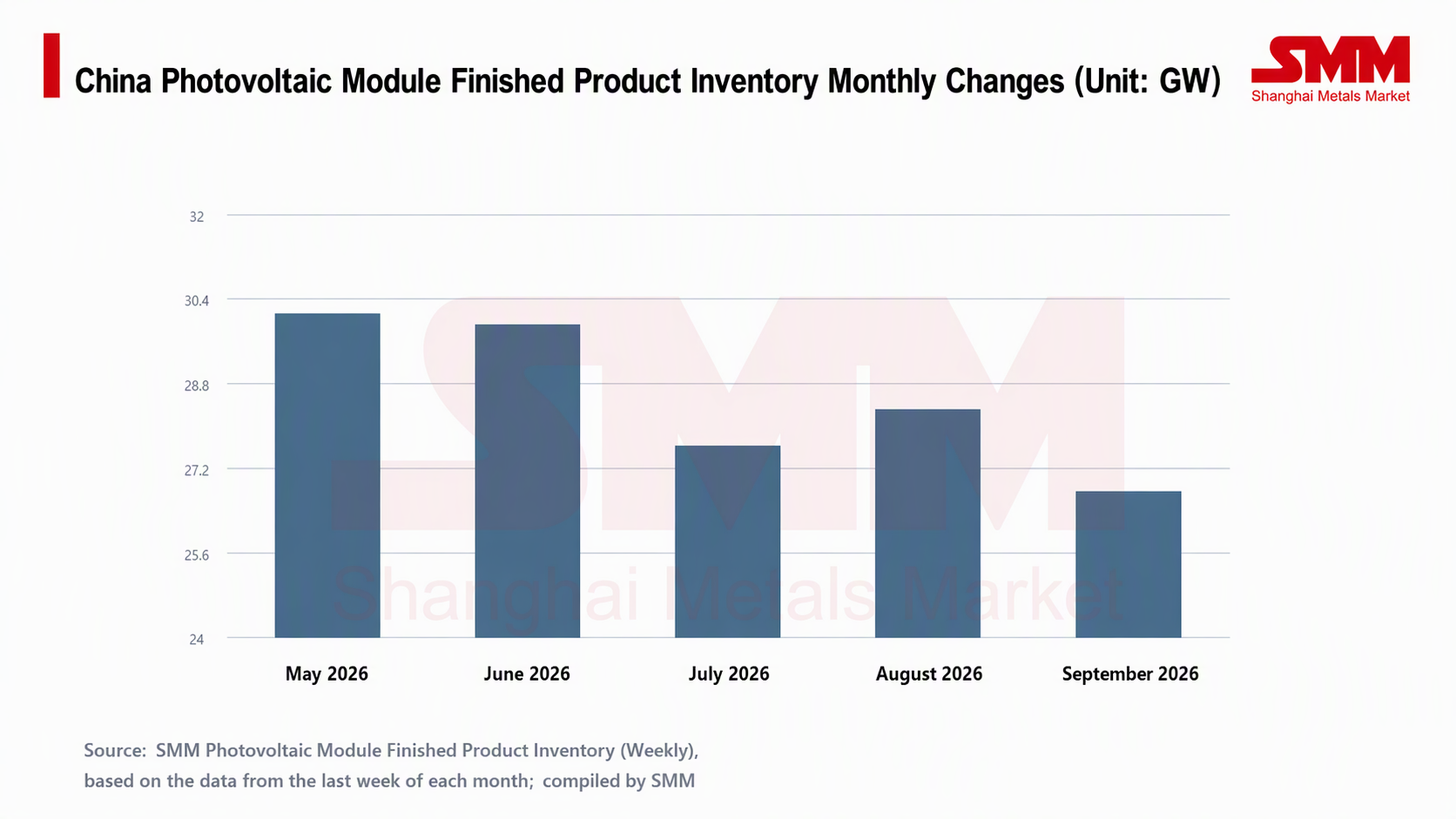
During September, module finished product inventories were in a state of mild destocking overall, but the pace was slow, and absolute levels did not fall to historical lows. This means the buffer stocks at both channel and factory ends remain in place; once demand weakens at the margin, inventory pressure on prices will resurface.
III. Production: Stabilizing at highs, with ample supply unchanged
The release of supply is the fundamental reason prices lack upward momentum.
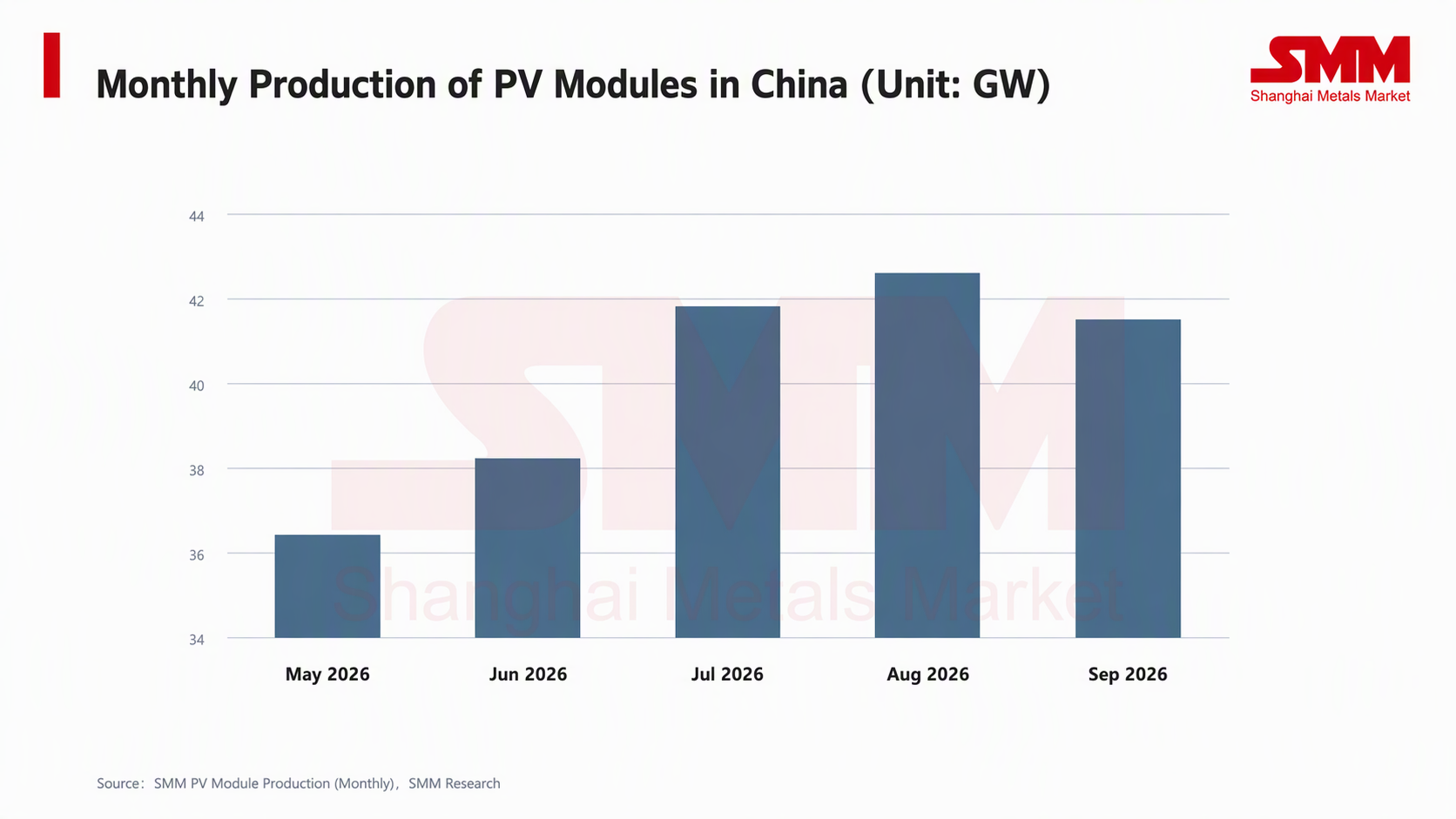
After a phased pullback in production this spring, monthly module production has clearly recovered and has continued to run in the high range for the year. Although production remains lower than the same period last year on a YoY basis, MoM fluctuations are limited and absolute output is ample, meaning the module segment is not tight in the supply-demand balance table. Without an unexpected surge in demand, high output will continue to offset any impulse to raise prices arising from costs or expectations.
IV. As energy efficiency grading advances, the rush to ship low-efficiency modules adds extra downward pressure on regular prices
As the energy efficiency grading system becomes clearer, some low-efficiency modules that do not rank favorably face a "window period" constraint: once the relevant standards are implemented, substandard low-efficiency products will find it harder to enter mainstream channels and risk becoming slow-moving inventory. Under this expectation, individual enterprises holding such inventory have become notably more eager to ship, leaning toward accelerating destocking through price cuts, sales promotions, and margin concessions before policy implementation, in a bid to complete turnover before the window closes.
This "rush to ship" behavior directly increases visible effective supply in the market, and the low-priced cargo is mostly aimed at price-sensitive small and medium-sized distributed projects and some centralized projects, overlapping heavily with the target customer base of mainstream TOPCon conventional modules. When low-efficiency modules enter the bargaining range at lower quotes, downstream buyers gain more room for price comparison, and the pricing confidence of conventional modules is correspondingly weakened—even if mainstream enterprises have no intention of proactively cutting prices, the presence of low-priced cargo lowers the overall transaction center, adding another layer of downward pressure on conventional module prices atop an already loose supply-demand pattern.
In other words, the differentiation under energy efficiency grading has objectively accelerated the inventory clearance of low-efficiency capacity, but the clearance process, accompanied by low-price dumping, has in the short term reinforced the "supply capping the upside" characteristic of prices, and together with high production and inventory replenishment, forms an important backdrop for low-range module prices in Q4.
V. Outlook: Rebound lacks foundation; consolidation at lows likely to dominate
Taking both supply and demand into account, SMM believes module prices in Q4 do not yet have the conditions for a trend reversal rebound. The core judgments are as follows:
Bearish factors: First, production remains at high levels. Module scheduled production has not seen proactive, sustained contraction, and the ample supply pattern is unlikely to change in the short term. Second, inventory levels remain high. Inventory replenishment since October indicates that destocking has not been smooth; if inventory buildup continues, it will further weaken pricing confidence. Third, demand absorption is limited. Downstream power station buyers have not abandoned their push for lower prices, and concentrated procurement is clearly pulse-like in nature, making it difficult to form sustained price momentum. Fourth, the low-price impact of low-efficiency module destocking shipments. As energy efficiency grading advances, the rush to ship substandard low-efficiency modules brings incremental low-price supply that overlaps with the customer base of conventional modules, dragging down the overall transaction center, and this is unlikely to dissipate in the short term.
Potential support: On the one hand, prices are already close to cash cost lines, and the loss pressure on some high-cost capacity provides a degree of protection for the bottom; on the other hand, if Q4 centralized project delivery accelerates and drives effective inventory destocking, prices may stabilize at lows, but a reversal is hard to call.
![[SMM PV Flash] Environmental Assessment Publicity for Gokin Solar PV Module Technological Transformation](https://imgqn.smm.cn/usercenter/GHTIQ20251217171741.jpg)
![[SMM PV Flash] PV-grade EVA Rally Continues](https://imgqn.smm.cn/usercenter/HdPjk20251217171741.jpg)
![[SMM PV News] AIKO ABC module achieves new breakthrough in the South African market, securing a 773.5 MW order](https://imgqn.smm.cn/usercenter/FmBvY20251217171737.jpg)