SMM, October 9:
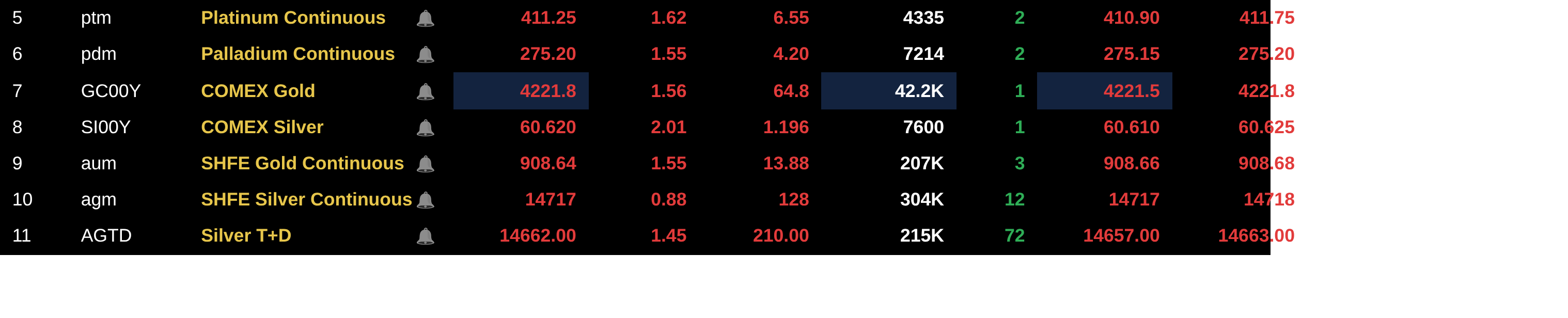
On October 9, precious metals futures and related stocks rebounded in tandem. Affected by weaker-than-expected US non-farm payrolls data, expectations for US Fed interest rate hikes cooled marginally, and US Treasury yields pulled back. US President Trump said on October 8 that the US is engaged in "productive" talks with Iran and will not take military action against Iran before the US midterm elections in November, sending oil prices lower. With cooling expectations for a US Fed rate hike in October, easing geopolitical risks, and the PBOC increasing its gold holdings for the 23rd consecutive month, precious metals futures rose across both domestic and overseas markets. As of 15:11 on October 9, COMEX gold rose 1.56% to $4,221.8/oz; the most-traded SHFE gold contract rose 1.55% to 908.64 yuan/g; COMEX silver rose 2.01% to $60.62/oz; the most-traded SHFE silver contract rose 0.88% to 14,717 yuan/kg; and silver T+D rose 1.45% to 14,662 yuan/kg. In addition, the most-traded platinum futures contract rose 1.62% to 417.15 yuan/g, and the most-traded palladium contract rose 1.55% to 275.2 yuan/g.
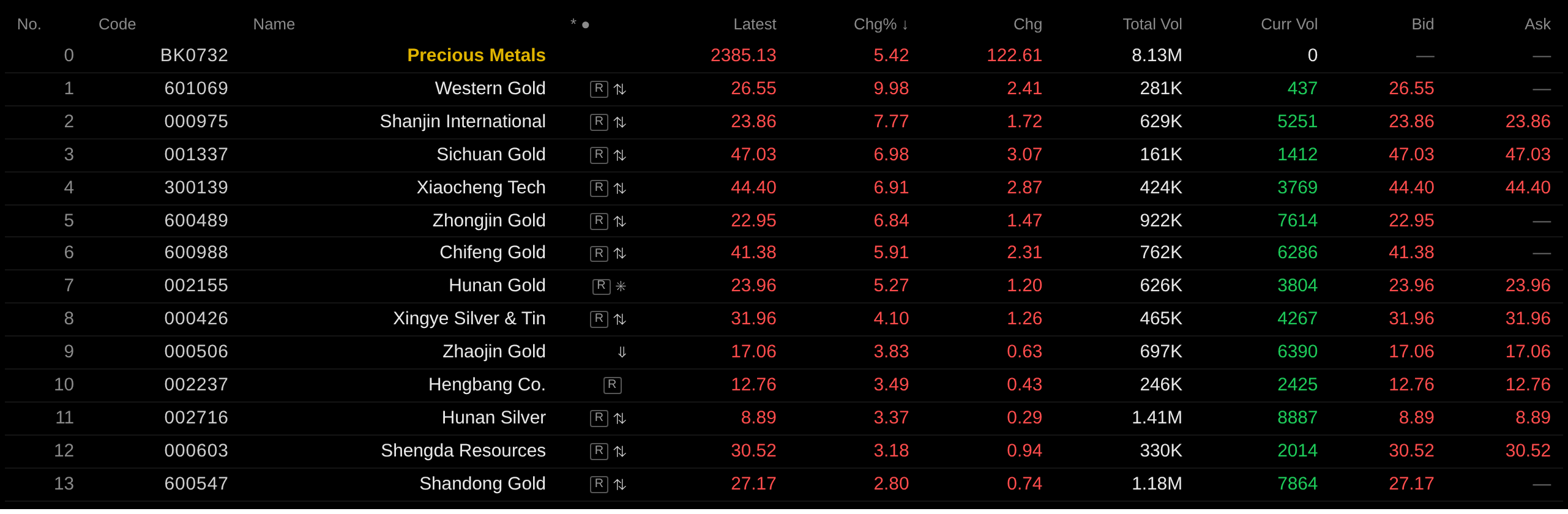
Equities: As of the close on October 9, the precious metals sector surged 5.42%. Among individual stocks, Western Region Gold hit the daily limit, while Shanjin International, Sichuan Gold, Xiaocheng Technology, Zhongjin Gold, and Chifeng Gold led gains.
Spot market
On October 9, the average ex-factory reference price for SMM #1 silver in the morning edged down from the previous trading day.
In the spot market, trading was relatively active for the second consecutive working day after the holiday. Silver prices continued to consolidate, with buyers making fairly active inquiries, some of which were restocking inquiries from traders. Actual inventory had not yet flowed to end-users for consumption. This morning, the basis between Ag (T+D) and the most-traded SHFE contract narrowed somewhat, fluctuating between 40-50 yuan/mt. Morning premium quotes in Shanghai were raised from the previous day, concentrated at a discount of 45 yuan/kg to SHFE 2612, but actual transactions remained at a discount of 50-55 yuan/kg. Quotes in Shenzhen were similar to those in Shanghai, but trading was more active.
Overall, expectations for US Fed rate hikes and geopolitical risks in the Middle East continued to cap silver's upside. Going forward, attention should be paid to capital flows and further signals from the US Fed. Spot trading was relatively strong today, but changes in actual warrant inventory still need to be monitored.
Market views
On the outlook for precious metals, views from some institutions are as follows:
Tony Sage, CEO of Critical Metals, said: "Further monetary policy tightening may still pose downside risks for gold... Looking ahead, traders will closely watch upcoming economic data, which may provide further clues on monetary policy and influence market sentiment ahead of the US Fed's October meeting.""If economic data or policy guidance falls short of expectations, it may drive yields further down, thereby supporting gold prices." (Jin10 Data APP)
CICC Wealth Futures noted that COMEX gold consolidated sideways intraday, with the strong US dollar and persistently high US Treasury yields continuing to limit gold's performance. The minutes of the US Fed's September meeting showed unanimous support for a 25bp rate hike in September, though officials were deeply divided on the rationale for further hikes. Most officials indicated another rate hike would be appropriate by year-end. "Some participants" argued that the longer energy prices remain elevated, the higher the risk of sector-specific cost increases spreading into broad-based inflation, necessitating rate hikes to curb the impact of energy and other price shocks. More hawkish officials, however, believed that mid-term AI-driven aggregate demand could outstrip supply, pushing inflation higher, while renewed tariff hikes also posed upside risks to inflation, warranting preemptive rate hikes to counter emerging demand-driven inflation. Nevertheless, diverging views on the necessity of further hikes, coupled with weaker-than-expected US September non-farm payrolls data and an unexpected pullback in August PCE data due to methodological revisions, kept market expectations for an October hike relatively muted. The strong US dollar and elevated US Treasury yields have reinforced downward pressure on gold as real rates rise, though central bank purchases and ETF demand continue to provide some support. On central bank buying, Turkey returned as a net buyer in August, while global central banks maintained gold purchases in September. The PBOC extended its gold accumulation streak to a 23rd month, and Russia announced it would quintuple its foreign exchange and gold purchases from October 7 to November 6 compared to September levels, bolstering gold's price floor. Fund flows showed global gold ETF open interest rising through October 7, while COMEX gold open interest declined as of the week ending September 29. (Zhitone Financial)
State Street Global Advisors strategists noted in a report that structural drivers of gold's bull run appear intact, including record government debt, robust physical demand from central banks and China's retail market, and heightened geopolitical and economic uncertainty. They warned that rising rates could further strain debt servicing costs in major economies, exacerbating fiscal imbalances. China's domestic gold price premium surged sharply this year, with consumer gold imports hitting a record 1,141mt in the first eight months despite higher prices. Strategists maintained their base-case forecast for gold to reach $4,750-$5,500/oz by Q1 2027.
Saxo Bank analysts said, "Gold price movements underscore the ongoing tug-of-war between macro traders and technical traders. On one hand, traders are selling gold due to rising financing costs and a stronger US dollar; on the other hand, investors are seeking to hedge against fiscal risks that may arise from rising debt and borrowing costs." (Jin10 Data APP)
The World Gold Council reported that global gold ETFs attracted $10 billion in inflows in September, pushing Q3 inflows to a record $31 billion, led by funds listed in Europe and North America. Despite the decline in gold prices, global gold holdings still increased by 67 mt to a record 4,256 mt, while total assets under management fell 7% QoQ to $574 billion. At the country and regional level, record Q3 inflows were led by the US, followed by strong contributions from UK-listed funds. The UK recorded its strongest quarter ever, helping Europe reach the same milestone at the regional level.
ING's head of commodities strategy Warren Patterson and Ewa Manthey said gold prices edged up on Tuesday. Falling oil prices and a stronger bond market eased inflation concerns and lowered market expectations for further rate hikes. Meanwhile, central banks continued to buy gold, providing support for gold prices. World Gold Council data showed that central banks continued to be net buyers of gold, with long-term reserve diversification remaining the main driver. Data showed that central banks continued to be net buyers of gold in August, adding 39 mt, bringing total purchases since the beginning of the year to 170 mt. Poland and Uzbekistan each added 8 mt. Turkey returned to being a net buyer of gold in August, buying 3 mt after three consecutive months of net selling. Other buyers included Kazakhstan, the Czech Republic, Bolivia, and Ghana. Russia reduced its gold holdings by 6 mt. The latest data showed that despite high gold prices, official sector gold demand remained resilient. Central banks' continued gold purchases are mainly driven by long-term reserve diversification goals rather than short-term market fluctuations. As Poland and several emerging market central banks continue to increase their gold holdings, official sector demand may remain an important support for the gold market in the coming months.
HSBC last Thursday lowered its gold price forecast, citing expectations of further US rate hikes and rising oil prices that may pressure gold in the short term. However, the bank believes the long-term factors supporting gold prices remain intact. HSBC now expects gold to average $4,490 per ounce in 2026, down from its previous forecast of $4,560, and lowered its 2027 average gold price forecast to $4,825 per ounce from $4,925. HSBC said market expectations of further US interest rate hikes and rising bond yields will continue to weigh on gold prices, as this undermines the appeal of non-yielding gold. The bank's economists expect the US Fed to raise rates again in December this year.
Gold prices have pulled back notably recently, pressured by rising US Treasury yields, but Morgan Stanley has not changed its bullish view for the next 12 months. The bank's strategists believe $4,000 is a "fairly strong floor." Gold has pulled back sharply recently, but its long-term allocation logic has not been shaken. That is the view from Morgan Stanley. Amy Gower, the bank's head of metals and mining strategy, said three factors could support gold prices in the coming months. Gower noted that physical gold demand remains strong, especially central bank buying, which stays active. Gower said concerns about long-term public debt and fiscal sustainability in global markets continue to rise, but rising bond yields remain the main challenge for gold. Gold itself generates no interest, and when bond yields rise, its relative appeal is easily suppressed. Oil price movements are also an important variable affecting gold. As US and Iranian officials are reportedly engaging through intermediaries, the months-long conflict in the Middle East could ease.
Recommended reading:
►
►