I. Power Spot Market Operations
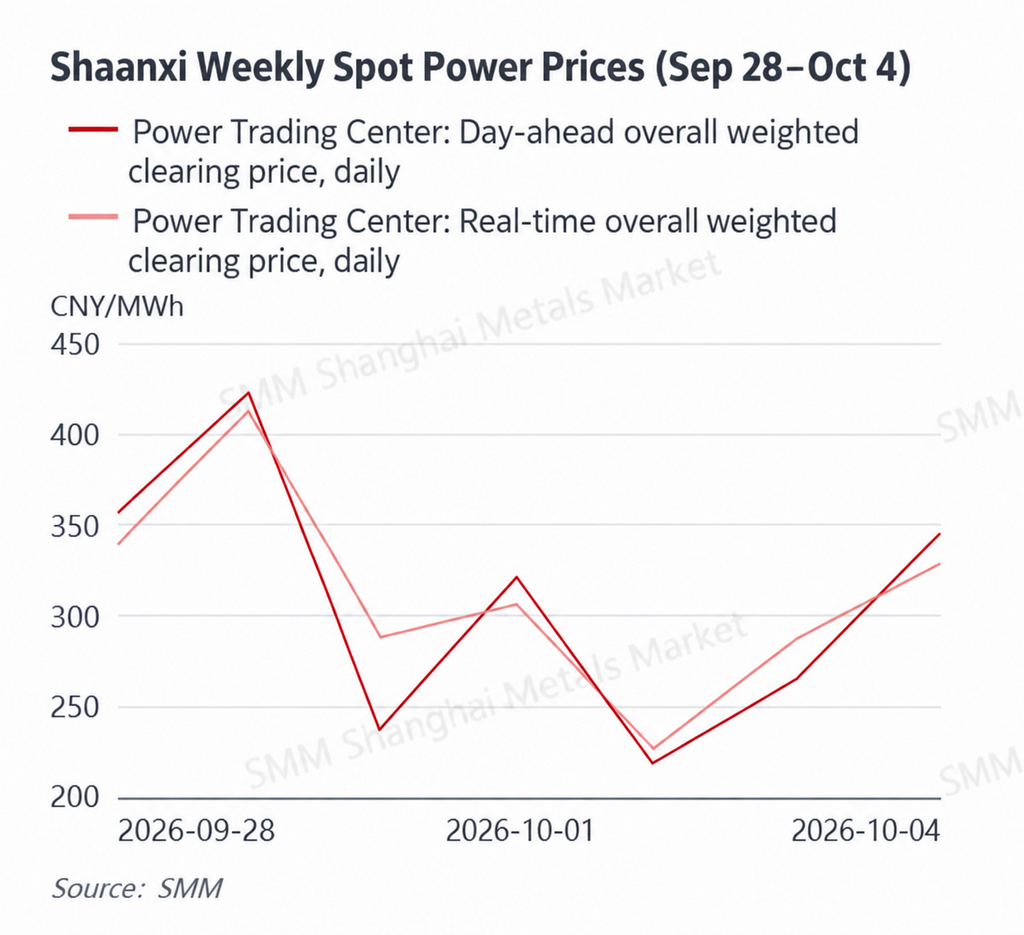
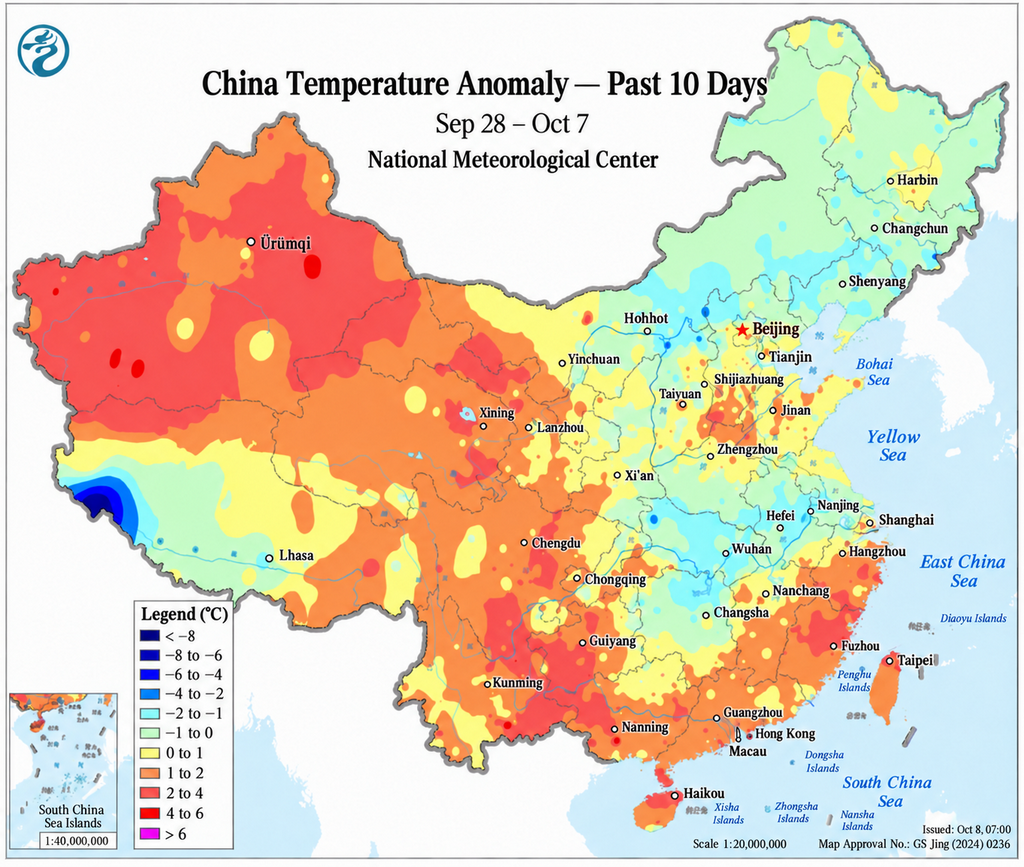
Weekly Overview: From September 28 to October 4, weather conditions across China showed a pronounced north-south divide. South China remained under the influence of the subtropical high through September 29–30, with maximum temperatures in parts of Guangdong still around 35°C. From October 1 onward, colder air moved southward, bringing a notable temperature decline to Shandong and other northern regions. At the same time, heavy rainfall affected parts of western China and the Huang-Huai region. The National Day holiday reduced commercial and industrial electricity demand, while cooling demand in northern China continued to fade. As a result, spot-price centres weakened across most monitored markets. Shandong’s real-time average for September 28–October 3 fell to approximately RMB 359.17/MWh, down around 16.6% from the previous week. Guangdong’s day-ahead average rose to RMB 563.29/MWh, while its real-time average declined to RMB 542.74/MWh. Inner Mongolia’s generation-side real-time average dropped to RMB 256.85/MWh. Shanxi’s day-ahead and intraday averages fell to RMB 259.45/MWh and RMB 324.27/MWh, respectively, while Shaanxi’s day-ahead and real-time averages stood at RMB 308.86/MWh and RMB 312.54/MWh.
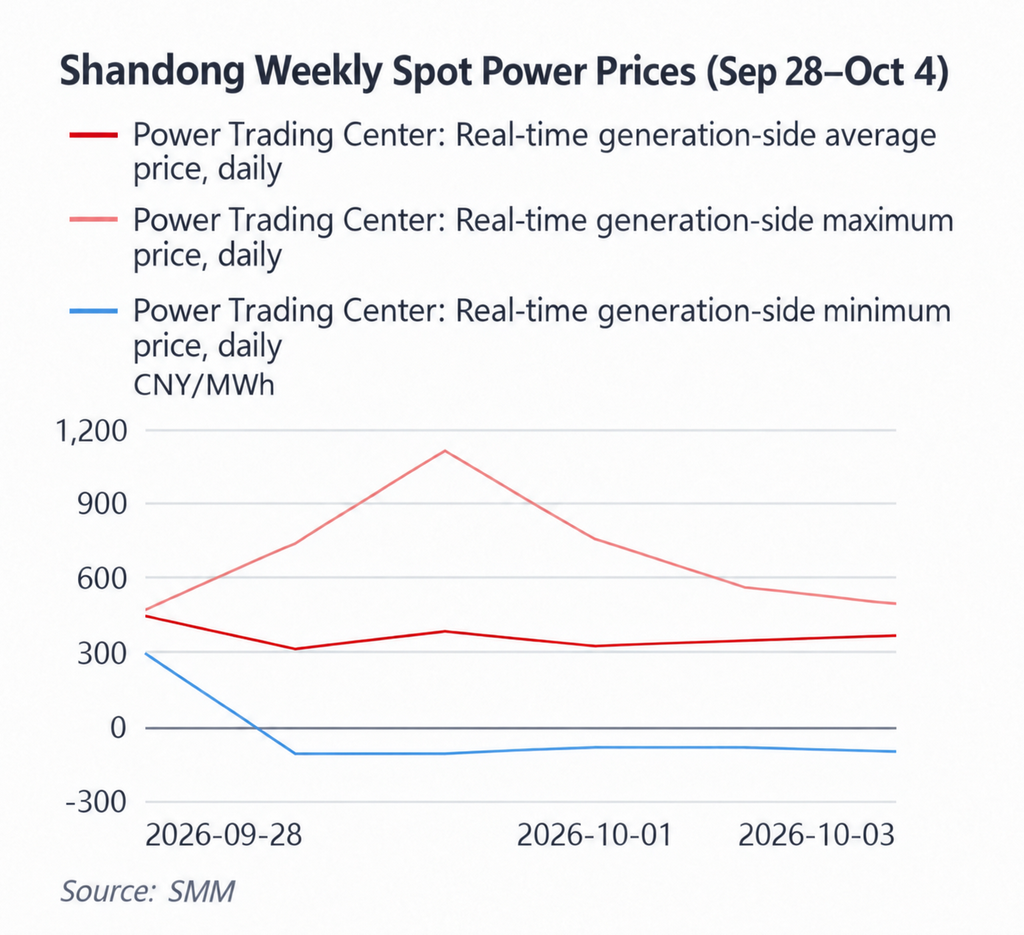
Shandong’s weekly price centre fell noticeably, with consecutive negative-price days and a further widening between intraday highs and lows. Shandong’s real-time generation-side average stood at RMB 441.35/MWh on September 28 before dropping to RMB 308.58/MWh on September 29. From September 30 to October 3, daily averages remained mainly within RMB 322–377/MWh. Based on available data through October 3, the weekly average was approximately RMB 359.17/MWh, down around 16.6% from RMB 430.49/MWh in the previous week. More notably, the daily minimum price fell to -RMB 100/MWh on both September 29 and 30, remained at -RMB 80/MWh on October 1 and 2, and was still -RMB 95/MWh on October 3. At the same time, daily maximum prices remained high, reaching RMB 735/MWh on September 29 and RMB 1,105.62/MWh on September 30. The National Day holiday reduced industrial and commercial demand, while colder weather further weakened cooling load. During periods of concentrated renewable generation, these conditions increased the likelihood of temporary oversupply. By contrast, when renewable output declined during peak hours, thermal generation had to ramp up quickly, pushing marginal prices sharply higher. Shandong therefore showed not simply weaker supply-demand conditions overall, but a more pronounced pattern of lower troughs and still-elevated peaks.
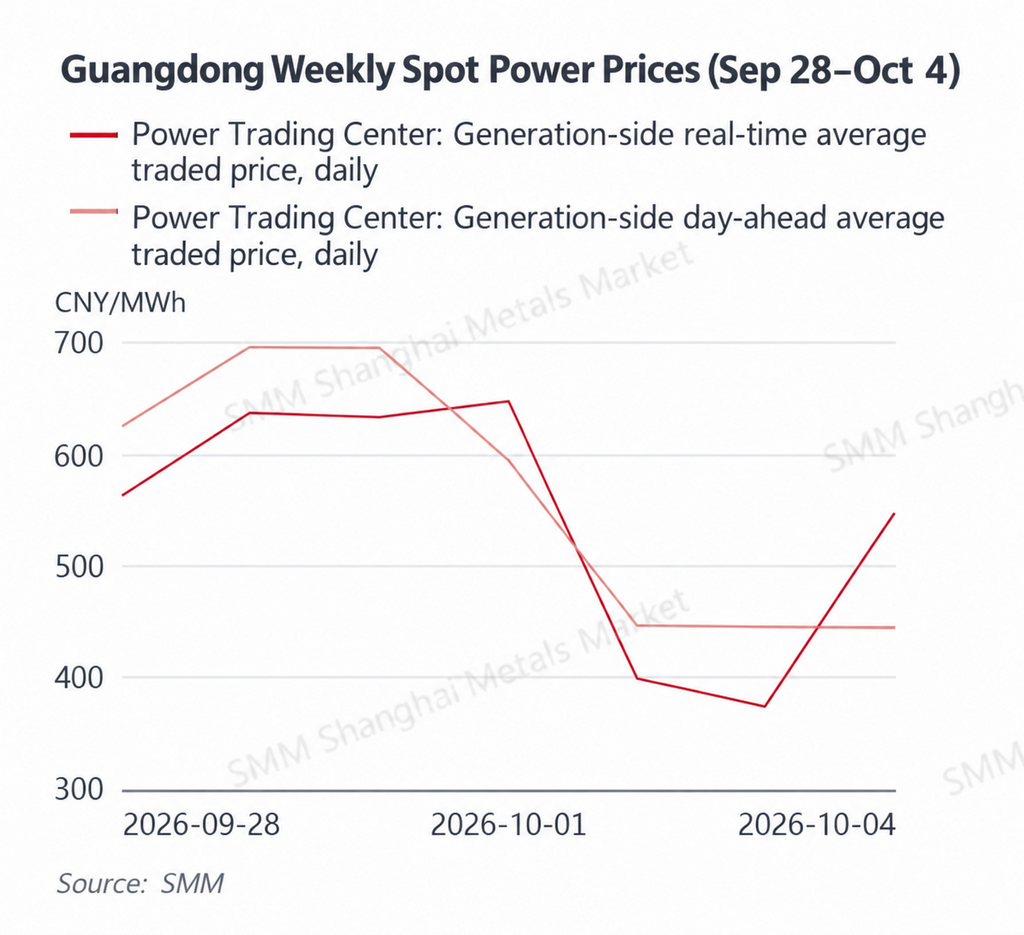
Guangdong showed a clear divergence between day-ahead and real-time prices, with early-week heat providing support before real-time prices weakened during the holiday. Guangdong’s weekly day-ahead average reached approximately RMB 563.29/MWh, up around 10.5% from the previous week, while the real-time average fell to approximately RMB 542.74/MWh, down around 6.0%. During September 28–30, Guangdong remained under late-summer heat, with day-ahead prices holding at RMB 624–696/MWh and real-time prices at RMB 563–637/MWh. Real-time prices remained elevated at RMB 646.98/MWh on October 1, but then fell sharply to RMB 399.36/MWh and RMB 372.57/MWh on October 2 and 3 as thunderstorms increased, temperatures declined from around 35°C toward 30°C and holiday demand weakened. Real-time prices rebounded to RMB 547.81/MWh on October 4, illustrating continued short-term volatility. The fact that the weekly day-ahead average exceeded the real-time average suggests that expectations for heat and demand were relatively strong during scheduling, while actual holiday load turned out to be weaker. Eastern Guangdong LNG prices remained elevated, continuing to support gas-fired generation costs, but this week fuel costs mainly limited the downside rather than determining the direction of spot prices.
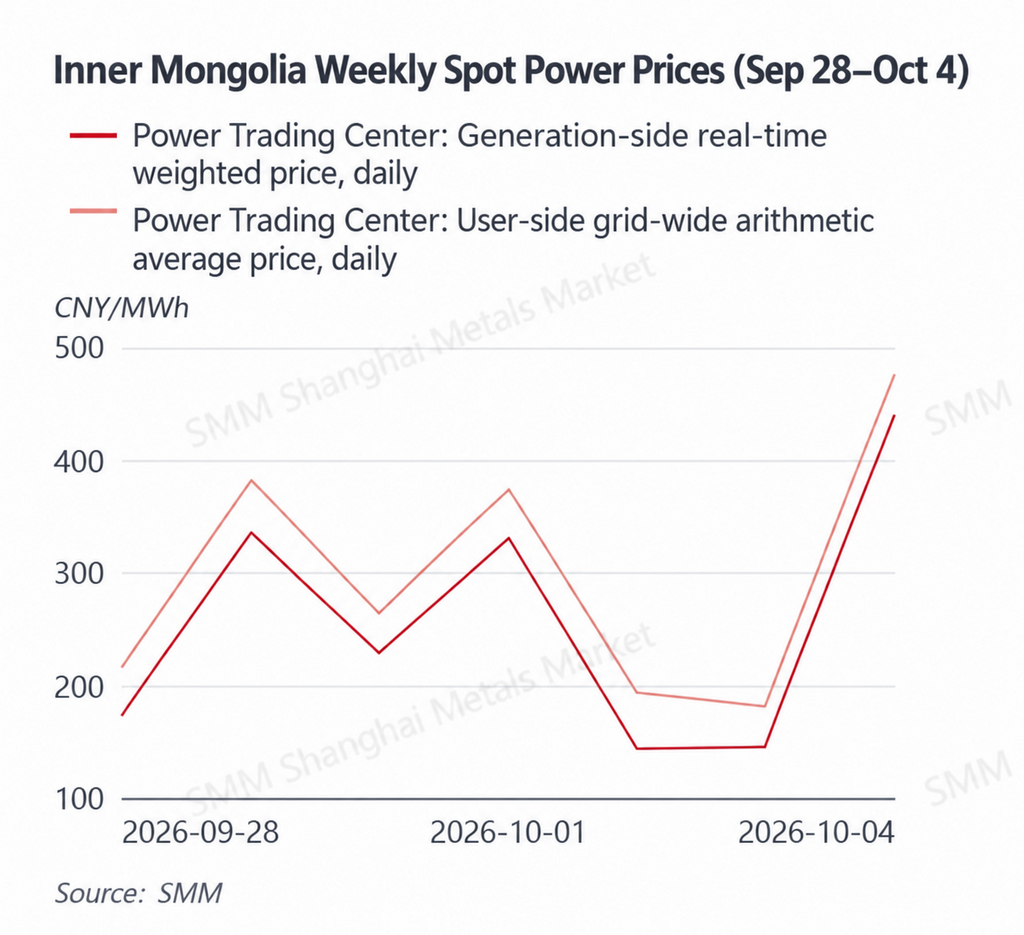
Inner Mongolia’s price centre fell sharply, with renewable output continuing to dominate short-term pricing under weaker holiday demand. Inner Mongolia’s generation-side real-time weighted average fell to approximately RMB 256.85/MWh, down around 34.0% from RMB 389.03/MWh in the previous week. The system-wide user-side arithmetic average declined to approximately RMB 297.95/MWh, down around 29.9%. Generation-side prices were only RMB 173.55/MWh on September 28 and fell further to RMB 144.90/MWh and RMB 146.64/MWh on October 2 and 3, before rebounding sharply to RMB 439.56/MWh on October 4. During the holiday, weaker electricity demand increased the downward impact of high wind and solar output on marginal prices. When renewable generation weakened and thermal units were required to increase output, prices could rebound rapidly. Elevated coal costs therefore acted more as an amplifier when coal-fired units became marginal, rather than as the main determinant of the overall weekly price direction.
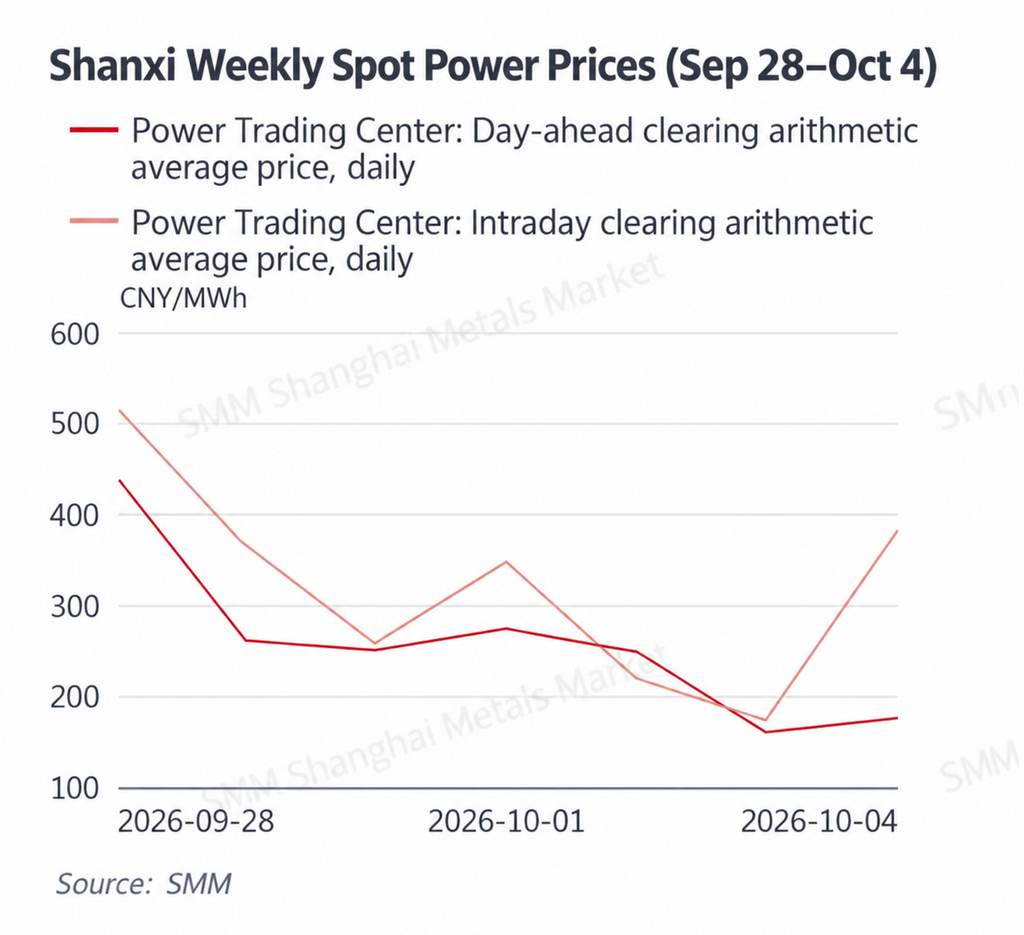
Shanxi’s day-ahead and intraday averages both declined sharply as weaker holiday demand outweighed the support from high coal costs. Shanxi’s weekly day-ahead arithmetic average fell to approximately RMB 259.45/MWh, down around 31.7% from the previous week, while its intraday average declined to approximately RMB 324.27/MWh, down around 28.4%. Intraday prices remained high at RMB 513.65/MWh on September 28, but subsequently trended lower, reaching RMB 221.57/MWh on October 2 and RMB 174.39/MWh on October 3. Day-ahead prices fell even further to RMB 161.81/MWh and RMB 176.69/MWh on October 3 and 4. The National Day holiday reduced industrial load, while colder conditions in northern China further weakened electricity demand. Although high coal prices continued to support the marginal cost of thermal generation, the effect of weaker demand was more pronounced. On October 4, the intraday average rebounded to RMB 383.83/MWh while the day-ahead average remained at only RMB 176.69/MWh, again demonstrating how rapidly intraday prices can diverge from day-ahead expectations when actual renewable output, load or export conditions change.
Shaanxi weakened only modestly, with day-ahead and real-time prices remaining relatively close and system conditions comparatively balanced. Shaanxi’s weekly day-ahead weighted average fell to approximately RMB 308.86/MWh, down around 6.0% from the previous week, while its real-time weighted average declined to approximately RMB 312.54/MWh, down around 2.3%. Day-ahead and real-time prices both strengthened on September 29, reaching RMB 423.85/MWh and RMB 413.19/MWh, respectively, before falling back. Real-time prices bottomed at RMB 227.48/MWh on October 2 and then gradually recovered, while October 4 day-ahead and real-time averages rose to RMB 343.60/MWh and RMB 327.15/MWh. Shaanxi’s decline was considerably smaller than those in Inner Mongolia and Shanxi, suggesting that although holiday demand exerted some downward pressure, renewable generation, interprovincial trading and coal-fired marginal costs jointly limited further downside.
Overall, with the exception of Guangdong’s day-ahead market, price centres weakened across the main monitored spot markets this week, with the National Day holiday acting as a common demand-side drag. Colder weather further reduced cooling demand in northern China, leading to particularly large declines in Inner Mongolia and Shanxi. Shandong, meanwhile, recorded repeated negative prices alongside high peak-hour prices, underscoring the growing intraday mismatch between renewable generation and load. Guangdong remained supported by high temperatures during the first half of the week, but real-time prices fell quickly once rainfall, cooler weather and holiday effects reduced demand. On the fuel side, coal prices remained elevated and continued to support thermal-generation marginal costs. SMM China LNG arrival prices generally declined, while eastern Guangdong LNG prices moved higher, creating a temporary divergence between imported and domestic gas prices. After the holiday, the key variables will be the pace of industrial demand recovery, temperature changes in northern China and actual wind and solar generation.
Primary Energy
September 28–October 4
Thermal coal: Port prices remained elevated, while holiday demand weakened and supply constraints and winter stockpiling expectations limited downside.
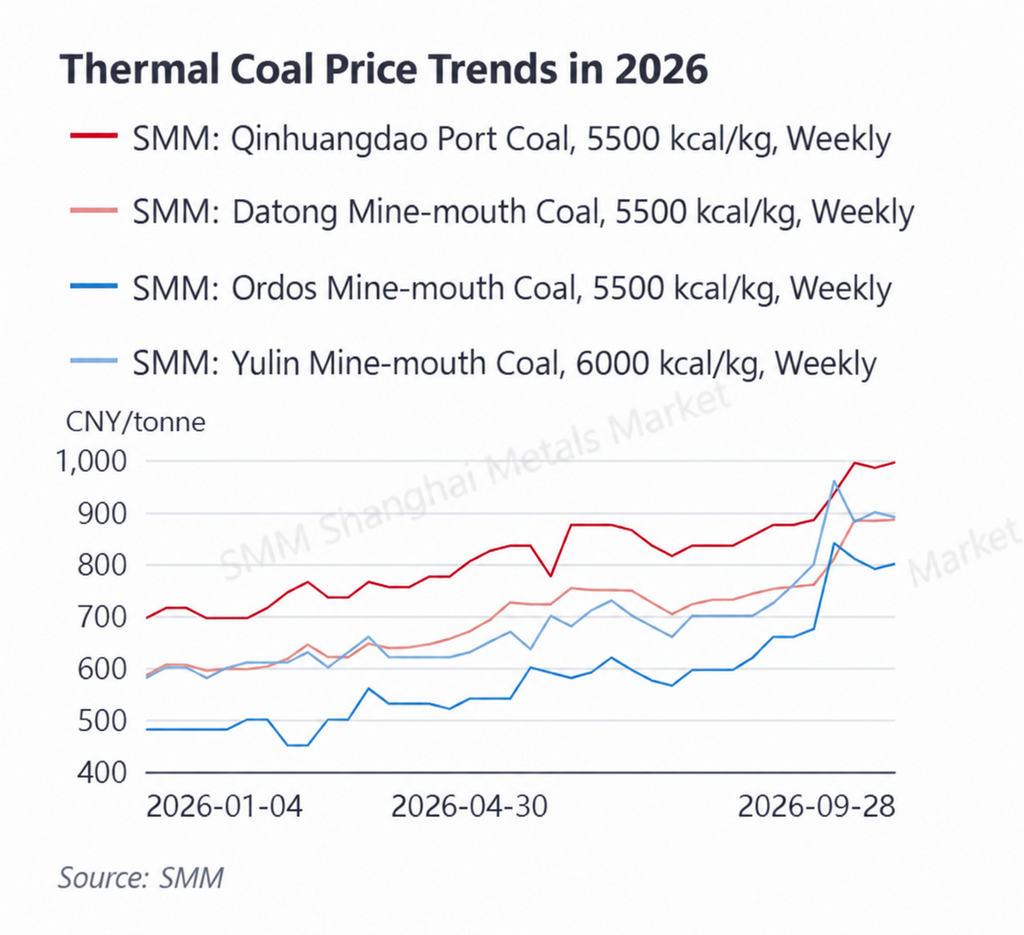
As of September 28, SMM Qinhuangdao Port 5,500 kcal coal stood at RMB 995/mt, up from RMB 985/mt on September 18. Over the same period, Datong mine-mouth 5,500 kcal coal was at RMB 885/mt, Ordos mine-mouth 5,500 kcal coal at RMB 800/mt and Yulin mine-mouth 6,000 kcal coal at RMB 890/mt. Overall, port prices remained high, while mine-mouth markets showed some differentiation, indicating a shift from the previous rapid rally toward high-level consolidation.
Supply: Safety supervision remained in place across major coal-producing regions, while production and restart schedules at some mines continued to be cautious, limiting near-term supply growth. During the National Day holiday, mining, transportation and spot-market activity were also affected to some extent. Meanwhile, economics for shipments from production areas to northern ports improved compared with earlier periods, helping port inflows recover. However, port inventories remained relatively low, while traders showed limited willingness to cut offers aggressively, reducing the scope for a rapid price decline.
Demand: The National Day holiday temporarily weakened industrial load and some non-power coal demand. Falling temperatures in northern China also reduced thermal-power coal burn further, while power generators continued to rely primarily on term-contract deliveries and essential spot procurement. However, the northern heating season is approaching, and expectations for winter inventory building are gradually becoming a source of support. The market therefore shows a clear pattern of weaker current demand but stronger expectations for future winter restocking.
Inventories: Northern port inventories remain relatively tight, while power-plant inventories still provide a reasonable buffer. The market therefore continues to show a structure in which port resources are relatively tight but end-users are not under immediate procurement pressure. Thermal coal prices are expected to remain elevated and range-bound in the near term: weaker shoulder-season demand limits the upside, while slow supply recovery and winter stockpiling expectations constrain the downside.
LNG: Imported prices continued to retreat from elevated levels, while eastern Guangdong prices increased, creating a short-term divergence between domestic and international markets.
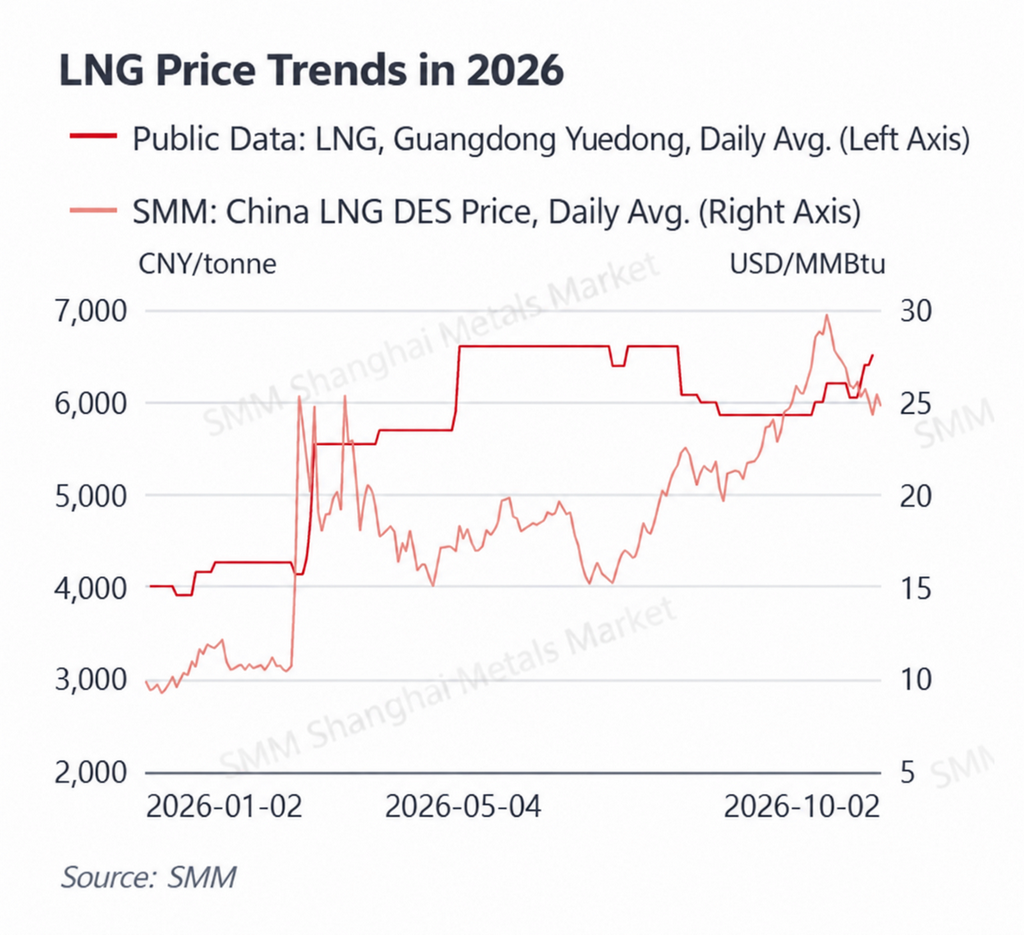
SMM China LNG arrival prices remained volatile but generally declined during the week. Prices stood at USD 25.74/MMBtu on September 28, fell to USD 25.07/MMBtu on September 29 and USD 24.29/MMBtu on September 30, rebounded temporarily to USD 25.49/MMBtu on October 1, and then eased again to USD 24.75/MMBtu on October 2. Eastern Guangdong LNG prices, by contrast, were RMB 6,405/mt on September 28–29 and rose further to RMB 6,515/mt on September 30, meaning domestic coastal prices did not immediately follow the decline in imported LNG costs. 粘贴的 Markdown (1)
Supply: Domestic feedgas costs remained elevated, while holiday-related changes in LNG production, logistics and resource allocation slowed the downward adjustment in domestic prices relative to imported costs. The impact of the earlier rise in international spot prices had also not yet been fully absorbed by the domestic market, leaving some suppliers with relatively strong resistance to price cuts. This led to the temporary divergence between declining imported LNG prices and rising eastern Guangdong spot prices.
Demand: Industrial gas consumption weakened during the National Day holiday, while northern China had not yet fully entered the heating season, leaving overall near-term demand relatively soft. However, Guangdong remained around 35°C during the first half of the week, sustaining some gas-fired power demand. As thunderstorms increased and temperatures fell on October 1–2, Guangdong real-time electricity prices also weakened noticeably, illustrating that although gas-fired generation costs remained high, demand conditions continued to determine the short-term direction of the power market.
Overall, the LNG market this week was characterized by falling import costs but slower domestic price adjustment. As northern temperatures continue to decline, heating demand will gradually strengthen, but relatively adequate inventories limit the likelihood of another immediate sharp price increase. For Guangdong’s power market, eastern Guangdong LNG at RMB 6,515/mt implies that the cost floor for gas-fired generation remains high. Even when electricity demand weakens, gas-fired costs may continue to limit the downside in spot prices.
Weather Review
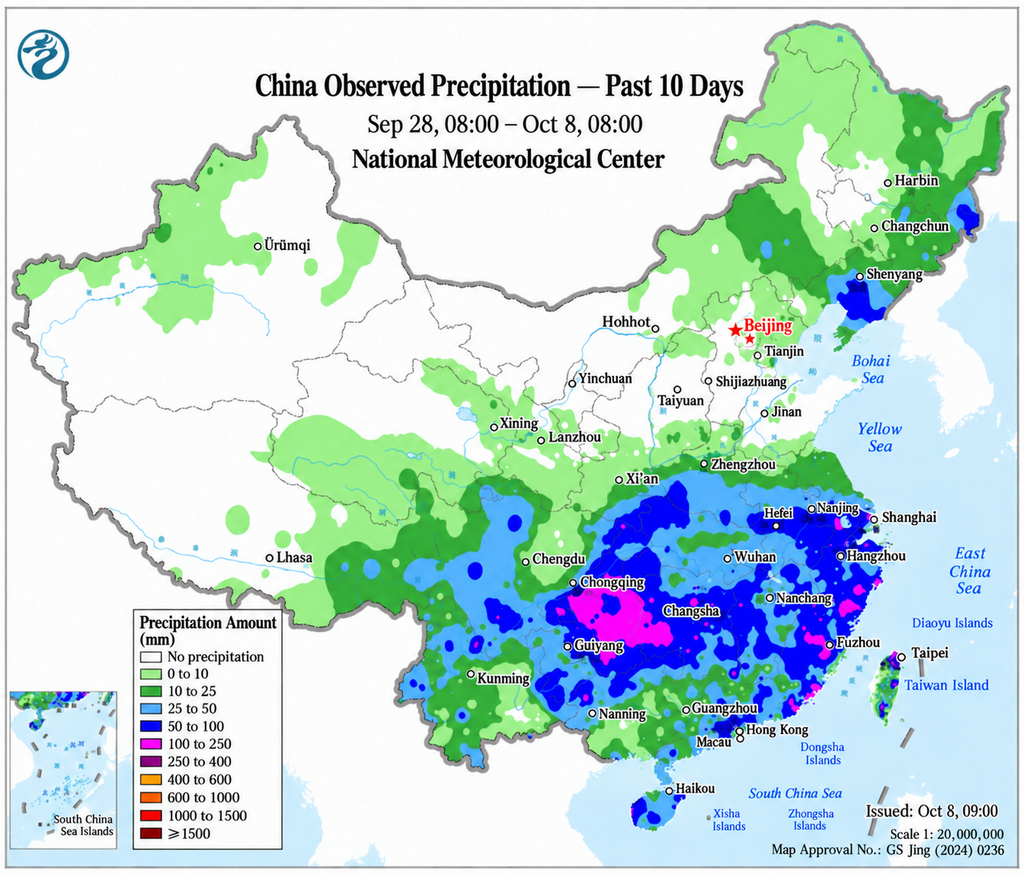
During September 28–October 4, China moved further from late summer into autumn, with a clear “cooler north, warmer south” weather pattern. During September 29–30, South China remained under the influence of the subtropical high, and maximum temperatures in parts of Guangdong were still around 35°C, keeping cooling demand relatively resilient ahead of the holiday. From October 1 onward, cold air moved southward and temperatures fell markedly across Shandong and northern China. In Shandong, daytime highs fell from around 29°C in late September to approximately 22–24°C, while minimum temperatures in some areas declined toward 9°C by October 4.
Rainfall also became a significant factor during the holiday. Between October 1 and 3, relatively heavy precipitation affected western China and the Huang-Huai region, including parts of southern and central Shandong and Henan. Guangdong shifted from hot weather to more frequent thunderstorms on October 1–2, with maximum temperatures falling toward 30°C, before conditions turned mainly cloudy on October 3–4. The combination of cooling, rainfall and holiday-related demand weakness contributed to lower electricity consumption in several provinces and provided an important backdrop to this week’s weaker spot prices.
As October progresses, northern China is entering a more typical autumn shoulder-demand period, with cooling demand continuing to decline while widespread heating demand has yet to begin. The direct sensitivity of spot electricity prices to temperature may therefore weaken, while renewable output, cloud cover, wind conditions and day-ahead forecast deviations are likely to play a larger role in short-term market movements.
II. Key Developments in China’s Power Market
On September 28, the Ministry of Industry and Information Technology, the National Development and Reform Commission, the Ministry of Transport, the Ministry of Commerce, the State Administration for Market Regulation, the National Energy Administration and the National Railway Administration jointly issued the 15th Five-Year Plan for the Development of the New-Type Battery Industry (MIIT Joint Planning [2026] No. 220). The plan proposes building a new battery product system led by lithium-ion batteries and supplemented by technologies including sodium-ion and flow batteries, while promoting wider deployment in new-type energy storage. As storage technologies continue to improve in safety, duration and cost, the technical supply of flexible resources available to the power market is expected to expand further, providing additional flexibility for spot and ancillary-service markets.
On September 28, the Liaoning Provincial Department of Industry and Information Technology, together with the Liaoning Provincial Development and Reform Commission and the Northeast China Energy Regulatory Bureau, released the 2027 Liaoning Power Market Trading Work Plan (Draft for Comments). The draft proposes that annual contractual electricity volumes between generators and consumers should in principle cover no less than 80% of actual generation and consumption, while medium- and long-term contract volumes should in principle cover no less than 90%. Liaoning’s spot market would continue continuous settlement operation in 2027, while the retail market would introduce a cooling-off period of up to 168 hours. The proposed framework further strengthens the role of medium- and long-term contracts in hedging spot-market risks while increasing flexibility for retail users in contract selection and risk management.
On September 30, the National Development and Reform Commission released the Measures for Power Market Risk Prevention and Control (Draft for Public Comment). The proposed rules aim to establish a more systematic national framework for identifying, monitoring, warning against and managing power-market risks, while clarifying the responsibilities of relevant market institutions and participants. They also strengthen monitoring of abnormal prices, supply-demand imbalances and other market-operation risks. As spot-market coverage and trading volumes continue to expand, the move toward a more unified national risk-control framework should help improve market stability.
On September 30, the General Office of the National Energy Administration released the revised Regulations on Power-Grid-Connected Operation Management (Draft for Comments). The revision updates the current rules to better reflect the development of China’s unified national power market and new-type power system. It further clarifies requirements for grid-connected operation, dispatch and system security while adapting the framework to emerging resources and operating models such as new-type energy storage, green-power direct connections and integrated source-grid-load-storage systems. The proposed changes would help clarify operational boundaries for a wider range of market participants after grid connection.
Overall, this week’s regulatory developments shifted further from simply expanding market participation toward strengthening market risk controls, refining grid-connected operation rules and broadening the flexible-resource base. As renewable energy, new-type energy storage and emerging market participants accelerate their integration into the power market, generators, electricity retailers and storage operators will face higher requirements for bidding strategies, risk management and coordinated participation across multiple market segments.