On September 30, ferrous metals futures ended weakly. During the National Day holiday, the ferrous metals complex was broadly subdued with sluggish trading. For iron ore, SGX fell more than 2% to $91.56/mt, and spot prices dropped by 6-10 yuan/mt after the holiday. Under a supply-strong, demand-weak pattern, the short-term outlook is bearish but with limited downside. Domestic iron ore concentrates pulled back in tandem, and the cost side continued to loosen. Coking coal was in the doldrums, and the first round of coke price cuts was implemented (wet quenching -100 / dry quenching -110). Expectations for a second round are building, negative feedback is still unfolding, and the market will watch the extent of production cuts at coking enterprises. Construction steel consolidated, with fluctuations of 10-20 yuan/mt in many regions. Production momentum at both integrated and short-process mills is insufficient, and supply pressure is relatively small. Short-term movement is expected to be sideways, with attention on whether "October peak season" demand materializes. Hot-rolled coil prices were mostly steady to weak in most cities (down 10-30 yuan/mt), and cold-rolled coil edged lower. Inventory is expected to accumulate sharply after the holiday, and prices are likely to trade in a weak range in the near term (the most-traded hot-rolled coil contract at 3,230-3,300). On the macro front, policy support coexists with external trade barriers and cost pressure. The ferrous metals complex is expected to remain weak after the holiday but with support at the bottom.
(The following prices are as of 12:00 on October 8)
[Iron Ore]
Imported ore:
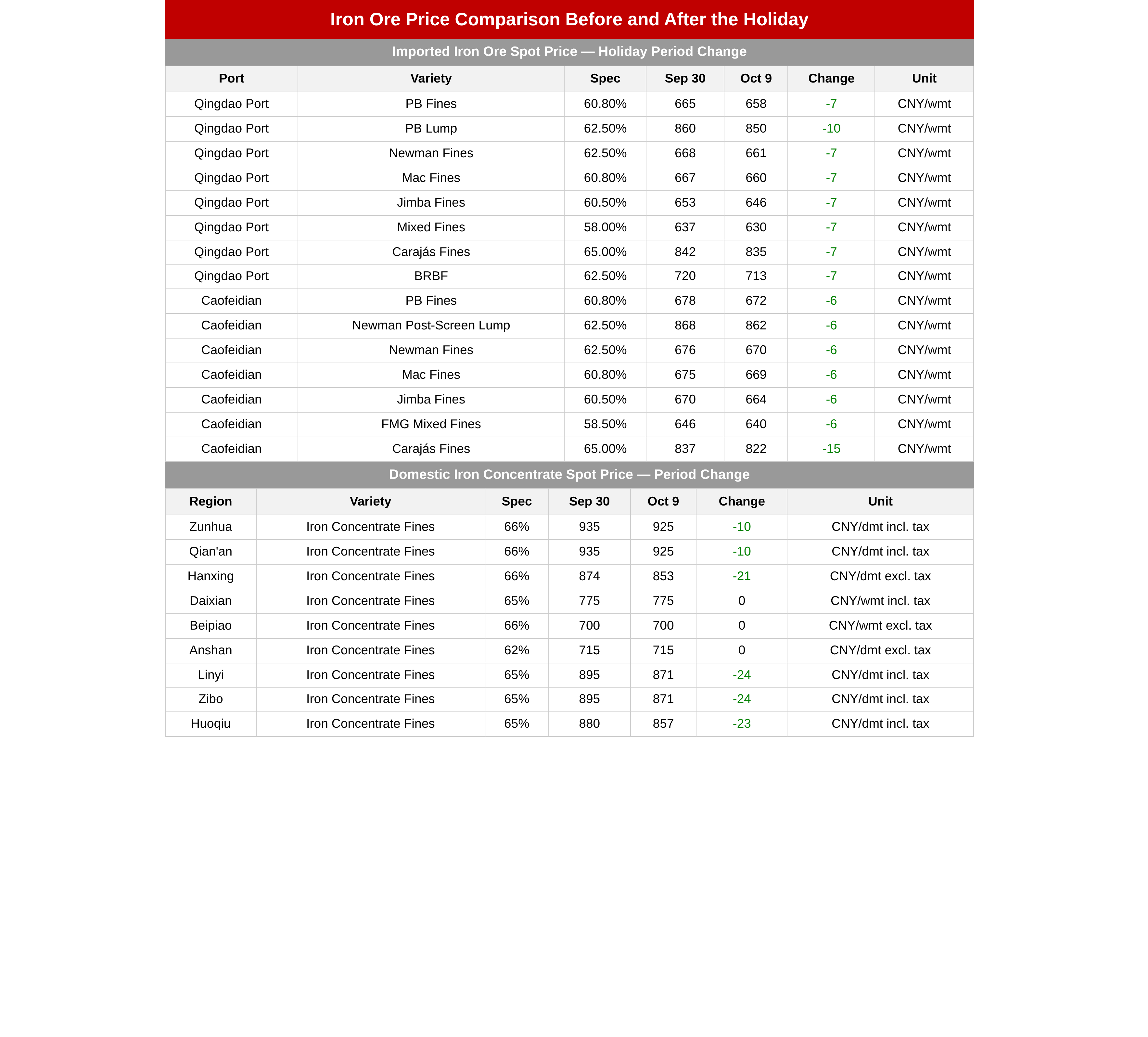
During the National Day holiday, China's futures market was closed. The most-traded Singapore iron ore swap contract was in the doldrums, hitting a low of $90.95/mt and closing at $91.56/mt on October 7, down $1.94/mt from the pre-holiday closing price, a decline of more than 2%.
In the spot market, as steel mills had completed stockpiling before the holiday, traders were mostly on the sidelines during the holiday, and transactions for port spot cargoes in China basically stalled. On the first trading day after the holiday, the most-traded iron ore futures contract continued to consolidate on a subdued note, and spot prices fell by 6-10 yuan/mt. PB fines spot prices at Shandong ports were mostly quoted at 658 yuan/mt, while those at Hebei ports were quoted at 672-676 yuan/mt.
From a fundamental perspective, global iron ore shipments are still in a growth cycle, and port arrivals also remain high. Although elevated ocean freight rates have somewhat constrained shipments from some non-mainstream mines, overall iron ore supply still carries growth expectations. On the demand side, performance is weak. China's demand has not improved, and hot metal production at steel mills is expected to decline. The supply-strong, demand-weak pattern is weighing on iron ore prices. However, end-use demand has not yet entered the off-season, and demand outside China has improved somewhat. After coke prices fell, steel mill profits recovered to some extent, and the downside for hot metal production is limited going forward. Iron ore demand still has some support. Therefore, iron ore prices are expected to remain mainly bearish in the short term, but the downside is relatively limited.
Domestic ore:
Compared with pre-holiday levels, the comprehensive price of domestic iron ore concentrates pulled back slightly during the holiday. By region, east China was dominated by Shandong and Anhui, where iron ore concentrate prices fell by 20-25 yuan/mt due to lower Platts index readings; north China was dominated by Hebei, with prices down 5-10 yuan/mt; prices in north-east China were relatively stable.
On fundamentals, domestic iron ore supply in China remained tight; however, steel mills were clearly loss-making, and domestic iron ore concentrates still lacked a clear cost advantage, so steel mills overall had a strong desire to bargain down prices. After the holiday, with steel mills still loss-making, hot metal production is expected to continue its downward trend overall, providing weak support for iron ore concentrate demand; combined with imported iron ore prices showing little sign of improvement recently, domestic iron ore concentrate prices are expected to continue to edge lower.
[Coking Coal and Coke]
Coking coal:
Spot circulation stalled during the National Day holiday, with the market in the doldrums overall, though supply growth for premium coking coal grades was limited, providing some support. On the supply side, domestic coal mine production was released modestly under supply guarantee policies, but growth was limited by safety supervision constraints; Mongolian coal border crossings resumed after the holiday, making import growth a key variable. On the demand side, coke producers had not yet significantly reduced operating rates, maintaining rigid consumption of coking coal, but they were pushing for lower prices and purchasing as needed, mainly drawing down inventory with low willingness to restock. In summary, most coal grades face expectations of price declines in the short term, with negative feedback continuing to transmit, but tight supply of premium grades will limit the scope for deep declines, resulting in an overall drift lower.
Coke:
During the National Day holiday, the first round of price cuts was implemented, with wet quenching coke down 100 yuan/mt and coke dry quenching down 110 yuan/mt, and market expectations for a second round of coke price cuts intensified, with a second cut expected to follow. On the supply side, most coke producers remained loss-making, but there was no large-scale voluntary production restrictions, and in-factory inventory accumulated modestly at a normal pace. On the demand side, finished steel inventory continued to build during the holiday, and with steel mills' own profitability deteriorating, hot metal production continued to pull back, maintaining purchases of coke as needed with insufficient willingness to restock. In summary, coke prices still face expectations of declines in the short term, with negative feedback still developing; the key going forward is to watch the extent of coke producers' production cuts—if they maintain existing production levels, downward pressure will intensify, while if they proactively step up production restrictions, the downtrend could be eased.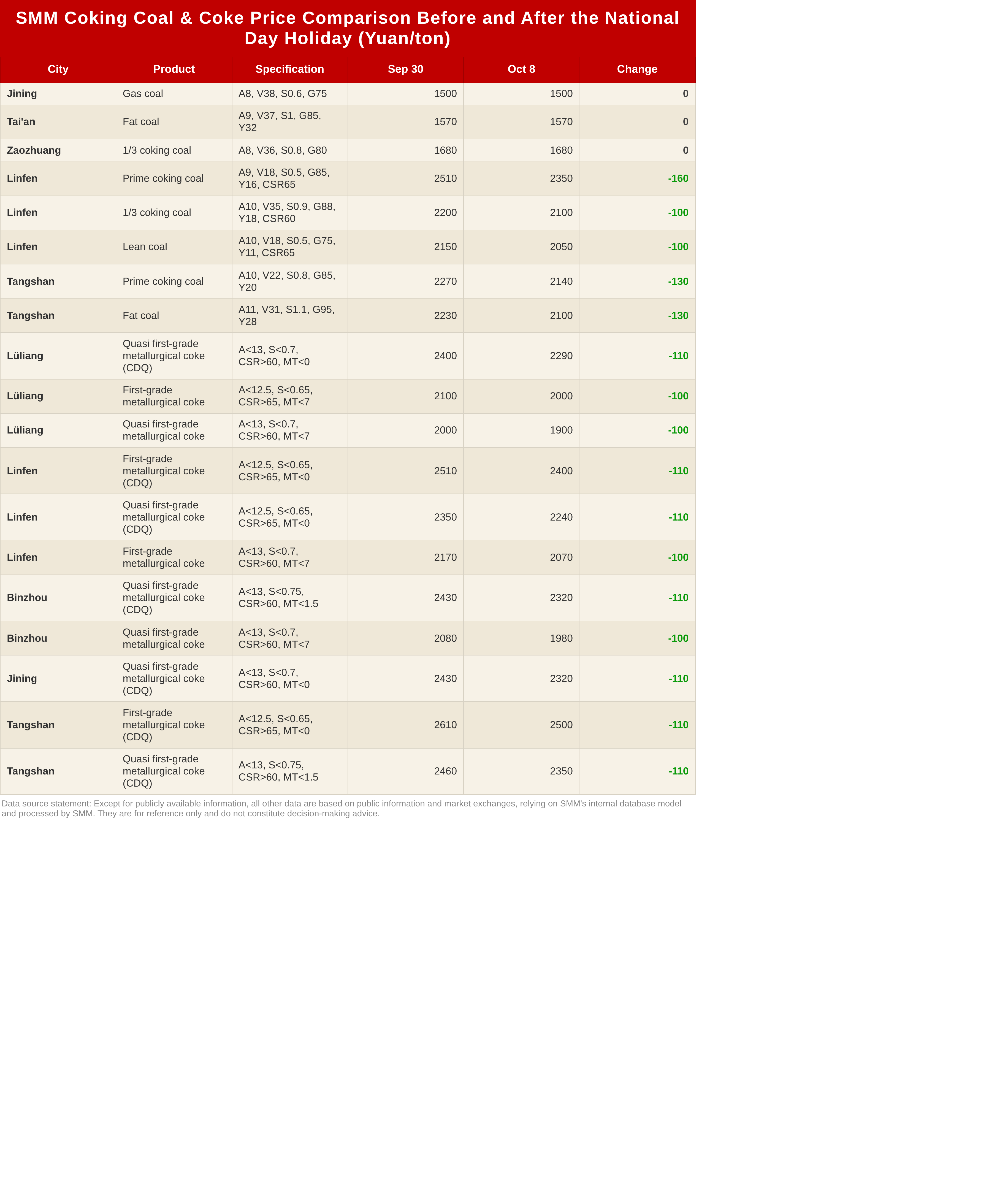
[Construction Steel]
During the National Day holiday, spot prices of construction steel across China consolidated, with quotes mostly stable in many regions and a few markets fluctuating 10-20 yuan/mt. On the supply side, blast furnace steel mills remained loss-making, with limited production enthusiasm during the holiday, and some mills diverted hot metal to higher-margin products; in addition, a steel mill in south-west China had already begun production controls in September, so overall production edged down slightly. During the holiday, scrap collection difficulties persisted in some regions, and EAF steel mills saw profitability decline, with some operating near breakeven, so overall operating hours were maintained at off-peak and flat electricity tariff levels. On inventory, most traders took 3-5 days off during the holiday, and on other statutory holiday days, merchants arranged staff on duty, but downstream construction sites were in a semi-stalled state during the holiday, with relatively slow construction progress and a marked decline in procurement volume; arrivals at market were generally normal during the holiday, and in-factory and social inventories accumulated in phases. According to market feedback, demand in east China during the National Day holiday was moderate, and in the Shandong market, some mills produced limited volumes of construction steel, resulting in specification shortages overall, with slight price increases during the holiday; after the holiday, in Zhejiang, some spot-futures traders accelerated profit-taking, pushing bottom prices lower; while in the north-west market, weather factors led to some resources being shipped out gradually, which may limit nearby market prices in the short term.
Looking ahead, construction steel market prices across regions are expected to diverge slightly after the holiday, but downside is likely to be relatively limited, with bottom prices remaining firm, mainly because both blast furnace and EAF production momentum is insufficient and supply-side pressure is relatively small; moreover, as northern China gradually enters winter in October, some downstream projects still have demand to rush to meet deadlines, while in south China, with the impact of rain weakening, demand may still see phased releases. Overall, merchants were more cautious during this year's National Day holiday, with less speculative activity than in previous years, so short-term construction steel prices have limited room both up and down, moving sideways in a narrow range, but in the medium and long term, attention still needs to be paid to whether October peak season demand materializes.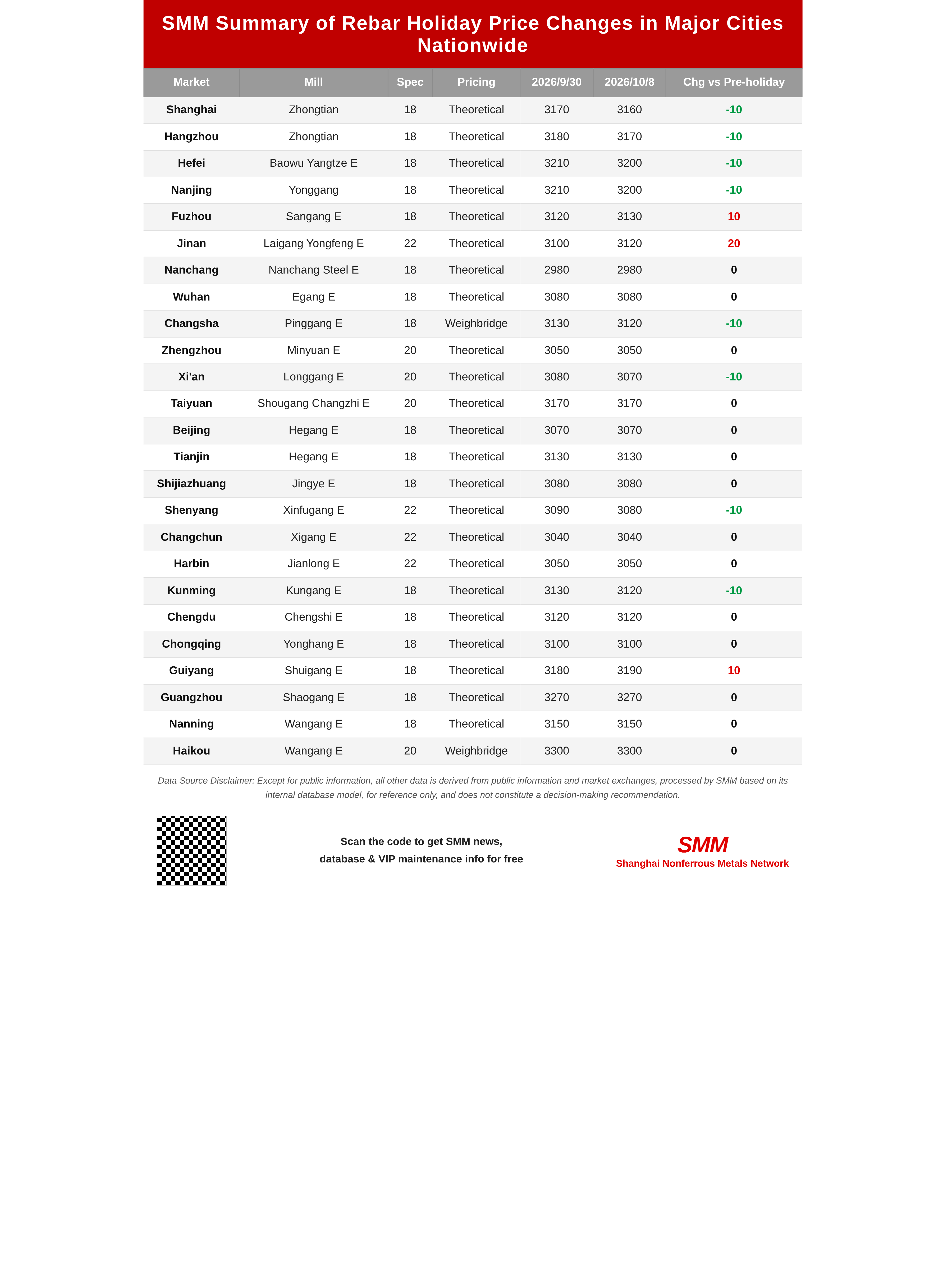
[Sheets & Plates]
HRC:During the National Day holiday, HRC prices in mainstream cities across China remained stable.
In the east China market, Shanghai quotes were down 20-30 yuan/mt from pre-holiday levels, with mainstream resource quotes at 3,280-3,290 yuan/mt, and market inquiry sentiment was average. Ningbo spot quotes were at 3,280-3,290 yuan/mt, down 20-30 yuan/mt from pre-holiday levels, with market trading sentiment improving slightly, but some end-users showed weak purchasing enthusiasm and mainly adopted a wait-and-see stance. Hangzhou spot quotes were at 3,300-3,310 yuan/mt, down 20 yuan/mt from pre-holiday levels, with traders mostly holding prices firm for now.
In the south China market, Lecong quotes were down 10-20 yuan/mt from pre-holiday levels, with mainstream resource quotes at 3,260-3,270 yuan/mt; traders were relatively firm on prices, market inquiry sentiment was average, and there was no obvious release of inquiries.
In north China, Tangshan quotes were down about 10 yuan/mt from pre-holiday levels, with mainstream resource quotes at 3,210-3,220 yuan/mt; traders had weak expectations for the market outlook, but because their own inventory was not high, they had some willingness to hold prices firm, while downstream buyers also showed heavy wait-and-see sentiment, resulting in average market trading sentiment and relatively low overall trading volume.
CRC:
On the first day after the holiday, Bensteel Group CRC in the Shanghai market was quoted at 3,710 yuan/mt, down 10 yuan/mt from pre-holiday levels; there was no significant restocking after the holiday, with the market mostly in a wait-and-see state and prices edging down with limited declines.
Looking ahead, with the holiday over, nationwide inventory is expected to accumulate significantly, and attention should be paid to demand recovery and inventory destocking pace in the 1-2 weeks after the holiday; in the short term, HRC prices are expected to operate in a weak range, with focus on the 3,230-3,300 range for the most-traded contract.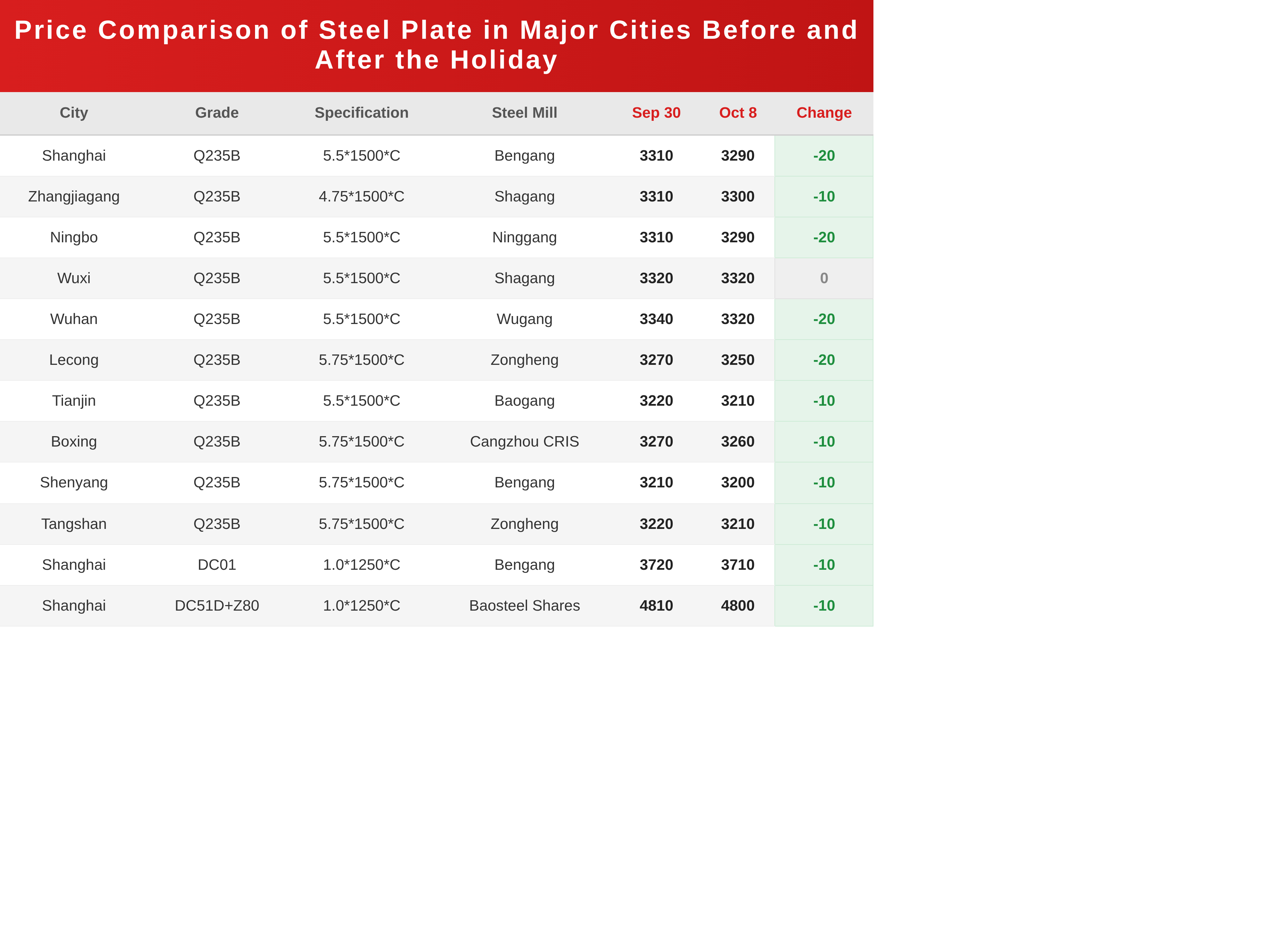
[Key Holiday News Roundup]
[Macro Policy] Fiscal and monetary policies working in tandem as stable growth enters implementation window
Around the National Day holiday, policymakers intensively released stable growth signals, with fiscal and monetary coordination significantly enhanced. On October 1, the Minister of Finance published an article in Qiushi, clarifying that this year's general public budget expenditure is set to exceed 30 trillion yuan, new government bond issuance of all types will reach 11.89 trillion yuan, and mentioning the study of incremental tools such as using the unused local government debt quota limits, with policy focus shifting from "scale expansion" to "targeted efficiency improvement."
Meanwhile, the resident home purchase loan interest subsidy implemented from October 1 marks the first time the central government has directly subsidized interest on commercial personal housing loans, forming a "boost consumption + stabilize property" policy package with the fourth batch of 62.5 billion yuan in trade-in special government bonds implemented before the holiday. On the monetary side, the central bank's Q3 regular meeting maintained a moderately accommodative tone, with the PSL rate cut to 1.5% and support areas expanded, while re-lending quotas for technological innovation and technical transformation were increased simultaneously. The policy bottom for the opening year of the "15th Five-Year Plan" has been clearly established, and the pace and effectiveness of Q4 policy implementation will become the market's core focus.
[International Environment] Phased easing between China and the US, but global steel trade barriers and cost pressures rising
The international landscape presents a pattern of "coexistence of easing and pressure." On bilateral relations, the China-US summit meeting and the eighth round of China-US economic and trade consultations achieved ten pragmatic outcomes, including "30 billion for 30 billion" reciprocal tariff reductions, extending the suspension of mutual additional tariffs to January 10, 2027, China's import of coal from the US, and the establishment of an agricultural working group, providing phased repair of market confidence and bringing marginal improvement to domestic commodity demand expectations.
However, the global steel trade environment has clearly tightened: the EU's new steel rules implemented in July slashed tariff-free import quotas from about 33 million mt to 18.3 million mt, raised out-of-quota tariffs from 25% to 50%, and mandated "melt & pour" traceability from October; with the formal phase of CBAM overlapping, China's steel exports to Europe face dual pressure from "tariffs + carbon." In North America, US-Canada trade negotiations broke down, and the US imposed additional tariffs on Canadian goods including aluminum, further fragmenting the steel and aluminum supply chain. On the macro front, the US Fed raised interest rates to 3.75%-4.00% in September, the US dollar remained strong, and the 10-year US Treasury yield once broke above 5.3%; Brent crude oil approached $100/barrel, and metallurgical coal near-month prices surged, pushing up global steelmaking costs. worldsteel expects global steel demand to grow only 0.3% in 2026, and the OECD warns that surplus capacity could reach 745 million mt by 2028—external tightening, trade barriers, and oversupply remain variables that the global steel market needs to continue tracking.
[Resident Home Purchase Loan Interest Subsidy Implemented Nationwide from October 1]
The Ministry of Finance, the central bank, and the National Financial Regulatory Administration jointly issued a notice that, starting October 1, eligible newly issued first-home commercial personal housing loans will receive a fiscal interest subsidy of 1 percentage point annualized, for up to 5 years, with a per-household cap of 1 million yuan; this is the first time the central government has subsidized mortgage interest, with the policy implementation period tentatively set at 1 year and no cap on total funding, and the six major banks have already implemented "subsidy without application." Impact on the global steel market: the subsidy focuses on first-home rigid demand for homes under 120 square meters and within 1.5 million yuan, precisely supporting property sales and completion chains, providing a mild positive boost to demand for construction steel such as rebar and wire rod; however, the threshold limits it to rigid demand rather than universal coverage, so the boost to overall steel consumption is limited and unlikely to reverse the long-cycle decline in property-related steel use.
[September Manufacturing PMI Returns to Expansion Territory, but New Orders-Production Scissors Gap Turns Negative]
Manufacturing PMI was 50.1 (August: 49.8), non-manufacturing 50.2, and composite 50.7, all returning to expansion; however, the new orders-production scissors gap turned negative, with the raw material purchase price index at 60.8 and ex-works prices at 54.0, concentrating profits in the mid-upstream. The PMI's return above the 50 mark boosts domestic steel use expectations, but the structure of "strong production, weak demand" means steel prices lack upward momentum.
[Central Bank Cuts One-Year PSL Rate to 1.5% and Expands "Six Networks," Re-lending Increased]
On the last day before the holiday, the PSL rate was cut by 0.25 percentage points, six types of infrastructure "networks" were included in support areas, and new re-lending quotas of 200 billion yuan for technological innovation and 500 billion yuan for agriculture and small businesses were added, with large outright reverse repos to follow after the holiday. The PSL expansion directly benefits infrastructure and pipeline network investment, supporting domestic steel demand in the medium term; however, transmission to actual steel use takes time, and in the short term, it provides more expectation support than actual boost for ferrous metals.