Five markets, five kinds of break
Costs fell but prices held. Costs fell and prices rose. Costs rose and prices stayed flat. In Q3 all of these were happening in overseas stainless markets at the same time.
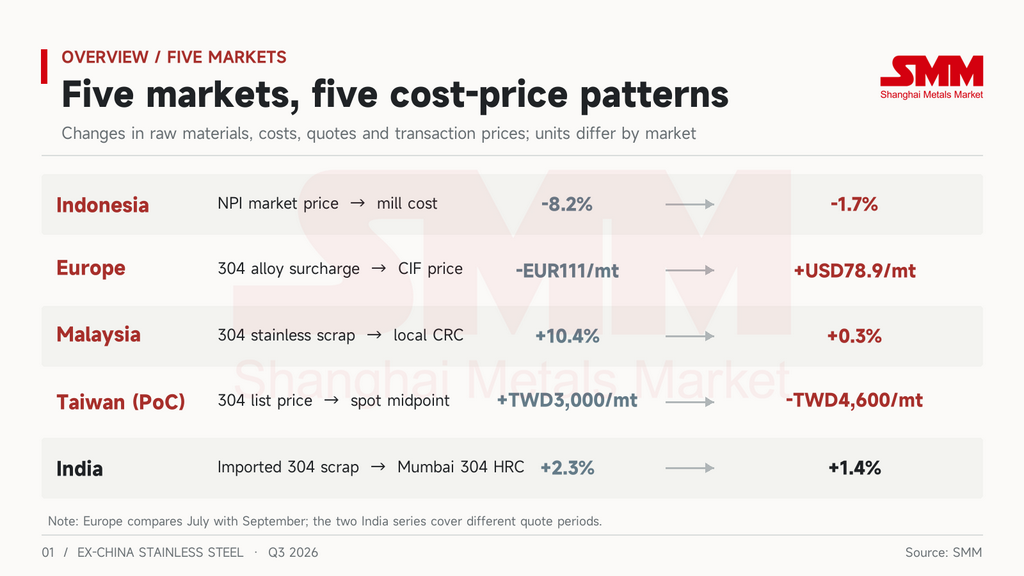
Stainless prices normally follow raw materials. Nickel is the largest cost in 304. Asian mills use Indonesian nickel pig iron (NPI), while European mills use stainless scrap and publish a monthly alloy surcharge. In the past, a rough read on prices in either region could be taken from the cost side. In Q3 that link broke in almost every market, at a different point in each. In Indonesia it broke between the NPI market price and the mills' own costs. In Europe it broke between costs and landed prices, in Malaysia between raw materials and end-users, and in Taiwan (PoC) between list prices and actual deals.
Where the link broke will decide which way prices adjust in Q4.
Indonesia: an 8% NPI drop that never reached integrated mills
Indonesian NPI fell hardest in the first half of September.
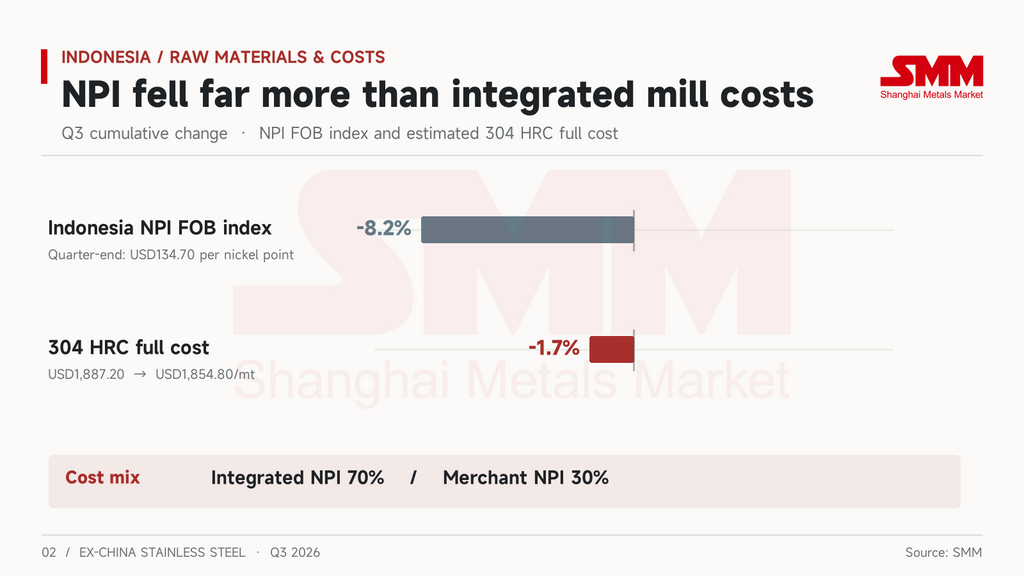
The Indonesian NPI FOB index held at USD145–147/nickel point through July and August. Between September 1 and 18 it fell from USD144.40 to USD135.20, and it closed the quarter at USD134.70/nickel point, down 8.2% over Q3.
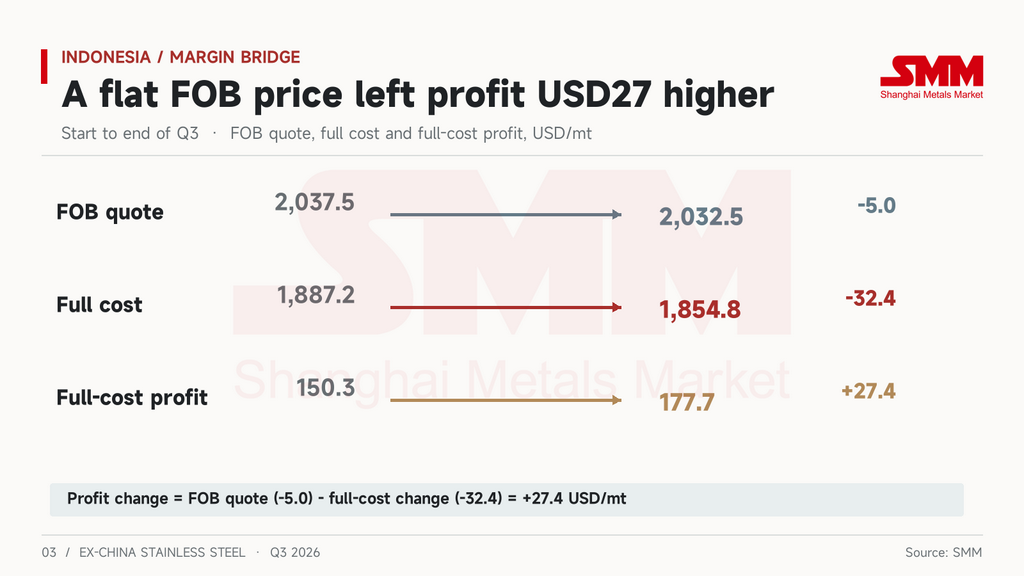
Indonesian stainless mills' costs barely moved. SMM's estimate assumes a mix of 70% integrated NPI and 30% bought on the market. On that basis, the full cost of Indonesian 304 hot-rolled coil (HRC) went from USD1,887.20/mt at the start of the quarter to USD1,854.80/mt at the end. That is a drop of just USD32.40, or 1.7%, and cash cost went from USD1,774.50/mt to USD1,741/mt. The timing tells the story. The largest single cost move came on July 15, a drop of about USD19 in one day, when NPI prices had barely shifted. From September 1 to 18, NPI fell about 6% and full cost fell only USD3.40.
The NPI market price is not what an integrated mill pays. These mills produce 70% of their own NPI, so a drop in the market price reaches them only through the 30% they buy. Falling NPI prices hit buyers of merchant NPI first.
With costs stable, profit came down to pricing. Indonesian 304/NO.1 coil FOB was adjusted eight times in Q3. It started at USD2,037.50/mt and ended at USD2,032.50/mt, only USD5 lower. Mills moved prices back and forth in USD30 steps. In July they cut USD55 on the 10th and another USD10 on the 13th, then added USD30 on both the 20th and the 27th. In August they cut USD30 on the 3rd and added USD30 back on the 6th. In September they cut USD30 on the 2nd and raised it again on the 21st.
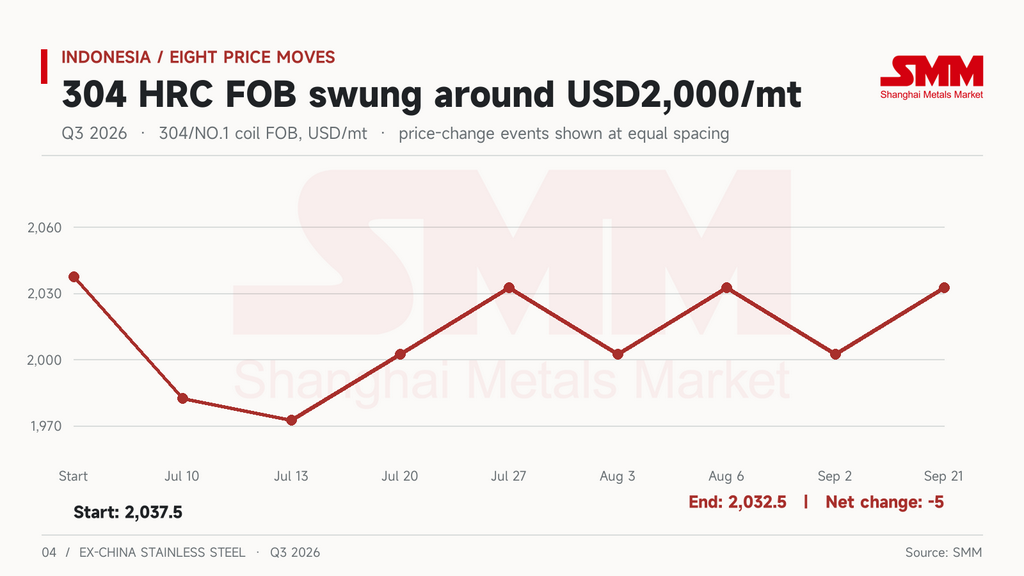
Margins moved in step with price. After the two July cuts, full-cost profit fell to USD93.30/mt on July 13, a 4.7% margin and the lowest of the quarter. By September 24 it had reached USD182.60/mt, or 9%, the quarter's high. Measured on daily changes, more than 90% of the quarter's profit variation came from price moves, and each USD30 adjustment shifted the margin by about 1.5 percentage points.
Across the quarter, full-cost profit rose from USD150.30/mt to USD177.70/mt. The margin went from 7.4% to 8.7%, averaging 7.8%, and the cash-cost margin went from 12.9% to 14.3%. Prices did not fall below full cost on any day in Q3. The extra USD27 of profit came from a USD32 fall in cost, partly offset by USD5 given up on price.
Indonesian mills held their prices in Q3, but costs were not the reason. The September 21 hike came at two pressure points. From September 22, a water shortage at the IMIP park forced RKEF NPI plants to cut run rates by about 30–40%. Buyers were also placing their last orders before the EU's melt-and-pour declaration took effect on October 1. Downstream trading was thin all quarter, and the September 2 cut was a direct response to demand that never showed up.
At quarter-end, Indonesian 304 HRC FOB was still about USD178/mt above full cost and about USD292/mt above cash cost. Prices have room to fall in Q4. If they do, it will be the mills' pricing choice rather than a cost-driven move.
Europe: costs down, landed prices up
Europe was the only market in Q3 where costs and prices moved in opposite directions.
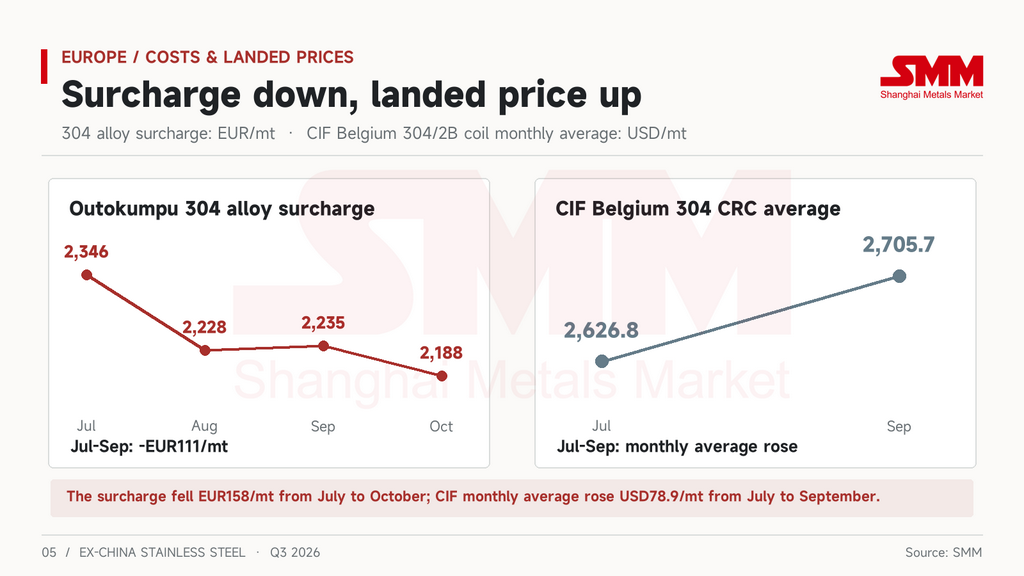
Outokumpu's 304 alloy surcharge was EUR2,346/mt in July and fell to EUR2,228/mt in August. It edged back to EUR2,235/mt in September and dropped again to EUR2,188/mt for October. Demand offered no support. July and August were the summer break. After work resumed in September, Italian flat product shipments and prices stayed soft. Distributors struggled to pass costs on, and European stainless scrap was under pressure all quarter.
CIF Belgium 304/2B coil (mill edge) went the other way. Its monthly average rose from USD2,626.80/mt in July to USD2,705.70/mt in September. In mid-July, during the summer break, landed prices sat at the quarter's low of USD2,600. They jumped USD75 in one day on August 3, were raised twice more in September, and closed the quarter at USD2,740/mt.
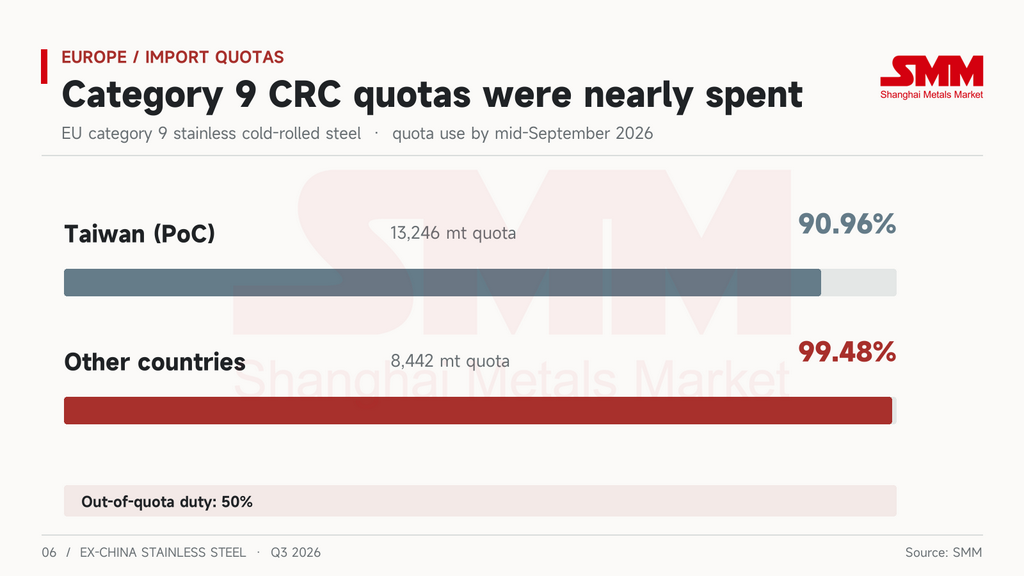
The difference is the price of quotas and duties. Q3 was the first full quarter under the new steel import regime, and quotas ran out faster than expected. By mid-September, Taiwan (PoC) had used 90.96% of its 13,246t quota for category 9 stainless cold-rolled. Its exporters stopped shipping and waited for the Q4 allocation. The "other countries" quota of 8,442t was 99.48% used, and anything above it pays a 50% out-of-quota duty.
At quarter-end, the EU added five trade defence proceedings on the same cold-rolled products. It opened an anti-dumping expiry review on China, Taiwan (PoC), India and Indonesia on September 15. It followed with a countervailing expiry review on India and Indonesia on September 30. Interim reviews of the anti-dumping and countervailing duties on India were also opened. Existing rates stay in force while the reviews run.
Melt-and-pour declarations took effect on October 1, and an earlier SMM analysis covered the details. For Q4 the point is simple. Every bill of lading now needs one more document, and cargo that arrives without the paperwork will be rejected, so arrivals will slow.
The carbon bill is not settled either. Also on September 30, the Commission's tax and customs directorate (DG TAXUD) published its review of the CBAM exemption threshold. The 50 mt annual import threshold stays, but the review arrived five months late and came with no methodology. The delegated act on how certificates are sold and priced is still missing, four months before sales are due to open on February 1, 2027. Quotas, trade reviews, melt-and-pour and carbon costs are all changing at the same quarter-end.
What European buyers are paying for is not nickel but the certainty that their cargo will clear customs.
Malaysia: raw material costs rose, end-users didn't follow
In Malaysia, the break came downstream.
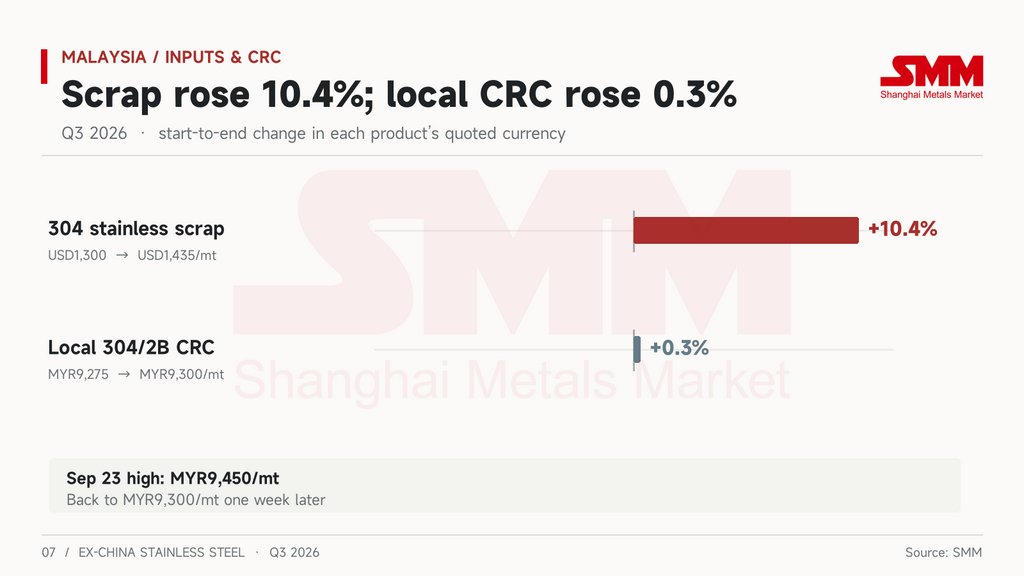
Malaysian 304 stainless scrap started the quarter at USD1,300/mt. It began climbing in late July and reached USD1,435/mt by mid-September, up 10.4%. Local 304/2B coil (mill edge) went from MYR 9,275/mt to MYR 9,300/mt over the same period, a rise of just 0.3%. It followed Indonesia up to a quarter high of MYR 9,450/mt on September 23, then slipped back to MYR 9,300/mt a week later. Local buyers bought only what they needed all quarter, and the leading cold-rolling mills relied mainly on export orders.
Weak demand was only part of the reason local prices couldn't rise. Cheaper material also kept coming in. Vietnamese cold-rolled coil (CRC) took advantage of zero duty to ship in quickly before any anti-dumping duty could land. Vietnamese 304 CRC was offered at about USD2,160/mt CIF, USD30–50 below Indonesian material. On September 9, the Ministry of Investment, Trade and Industry (MITI) opened an anti-dumping investigation into Indonesian CRC, acting on a petition from Bahru Stainless. The case is now in its 30-day questionnaire stage, and the market expects a rate above 20%.
Malaysia's own exports are also under scrutiny. POSCO is preparing an anti-circumvention complaint against Malaysian CRC. It targets material from China, Indonesia or Taiwan (PoC) that is processed in Malaysia and shipped to Korea. In the EU, Malaysia's quota is about 48% smaller than before, and from October every shipment must prove where its steel was melted.
Raw material costs are rising, local prices are held down by imports and exports are being capped. Malaysian cold-rolling mills are squeezed from three sides.
Taiwan (PoC): list prices rose, spot didn't follow
In Taiwan (PoC), the break came between the mills and their distributors.
In July, Yieh United Steel, Tang Eng Iron Works and Walsin Lihwa all held list prices flat, ending seven straight monthly increases. In August and September, Yieh United and Tang Eng each raised 304 list prices by TWD 1,500/mt and 316L surcharges by TWD 2,500/mt.
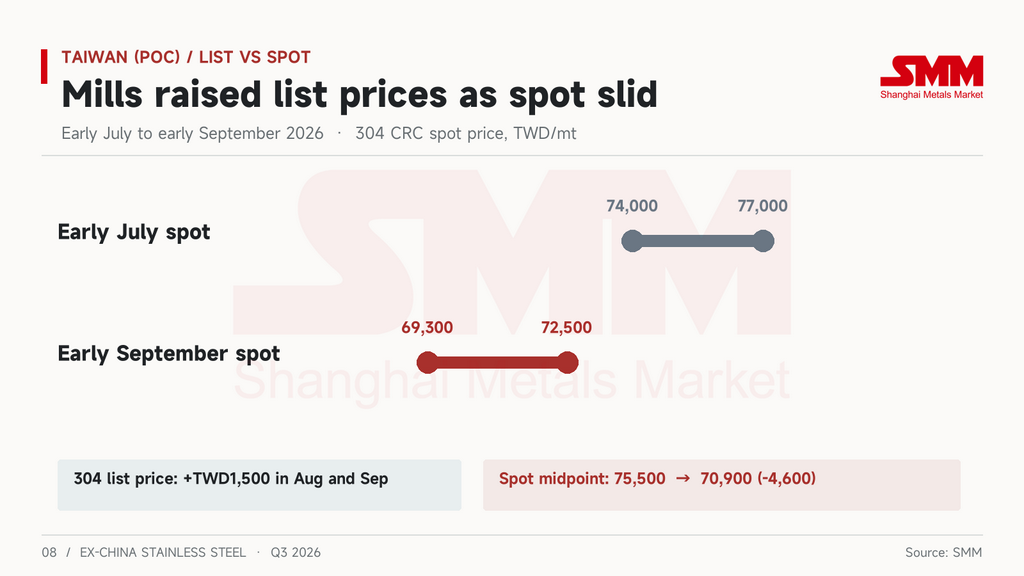
Spot prices didn't follow. The 304 CRC spot range fell from TWD 74,000–77,000/mt in early July to TWD 69,300–72,500/mt in early September, which moved the midpoint down about TWD 4,600. In the first week after the August hike, actual deals were already back at July levels. A restocking wave in mid-August briefly lifted volume. Over three days, small traders and end-users bought more than in the whole first half of the month, but the buying didn't last.
The mills' confidence to keep raising prices came from the import side. On August 14, Taiwan (PoC) formally opened an anti-dumping case against Vietnamese CRC. The petitioner estimated the dumping margin at 31.36% and named 20 Vietnamese producers. After the case opened, August stainless imports fell to about 92,700t and import prices rose to a three-year high. That raised the price of foreign material but did nothing for local transaction prices. Downstream processors Yuen Long and Tung Mung publicly opposed the case. They argued that upstream mills buy cheap Indonesian HRC while shutting out Vietnamese CRC.
List prices show what the mills want, and spot prices show what distributors think. In Q3 the two drifted further apart.
India: the only market where costs and prices moved together
India was the strongest overseas market in Q3. It was also the only one behaving normally.
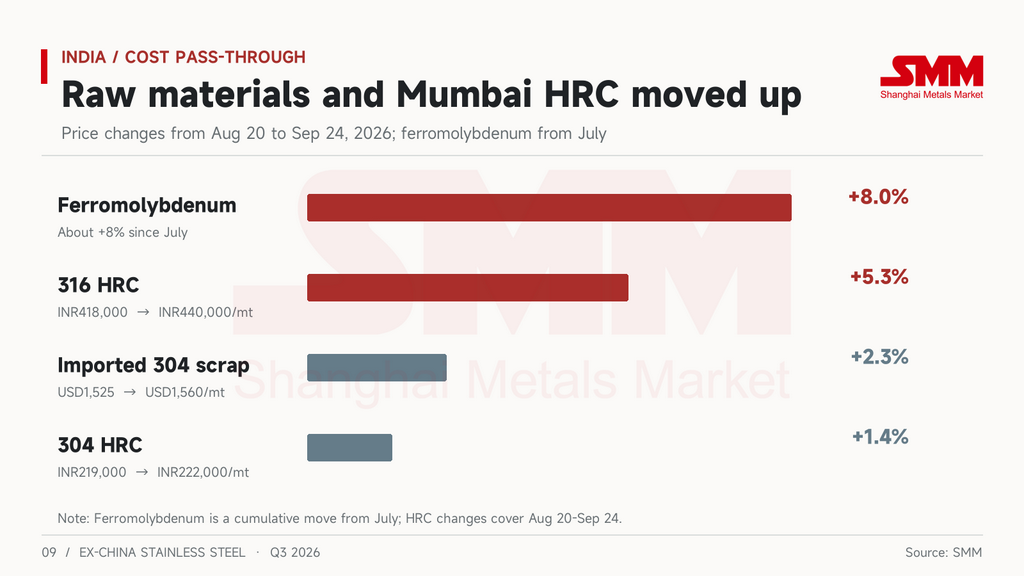
Between August 20 and September 24, Mumbai ex-works 316 HRC rose from INR 418,000/mt to INR 440,000/mt, and 304 HRC from INR 219,000/mt to INR 222,000/mt. 316 rose more because ferromolybdenum has gained about 8% since July. 304 rose less because its raw material support comes mainly from scrap. India's NPI imports fell 62% year on year in H1 to 20,000t, and mills switched to stainless scrap for their nickel units. Domestic 304 scrap climbed as high as INR 151,000/mt. Imported 304 scrap (CFR Mundra) went from USD1,525/mt to USD1,560/mt. Leading mills adjusted prices three times in August and twice in September, and each change can be traced to a raw material cost.
India could pass costs through because domestic demand was steady and imports were not a threat for now. The QCO exemption has been extended to March 31, 2027. The anti-dumping investigation into CRC from China, Indonesia and Vietnam now runs to March 28, 2027, with no provisional duties. This is a rally driven by domestic demand, though, and exports have not kept pace. 304 bright bar FOB stayed flat all quarter at USD2,350–2,380/mt, as European buyers held back on account of CBAM and quotas.
Asia starts closing its doors on its neighbours
The other new development in Q3 was Asian markets opening cases against each other.
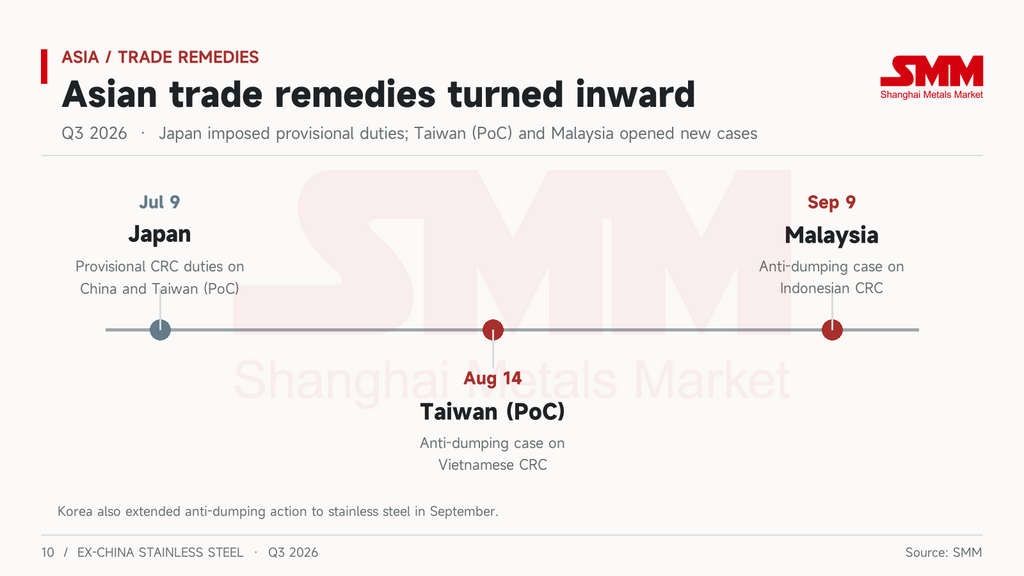
On July 9, Japan imposed provisional anti-dumping duties on CRC from China and Taiwan (PoC), running until November 8. The rates are 27.7–42.1% for China and 3.6–20.1% for Taiwan (PoC). Japan's CRC imports that month came to about 18,100t, up 7.9% month on month and the highest so far this year. Imports from China, however, fell 62.6% year on year and those from Taiwan (PoC) fell 71.5%, leaving Korea as the largest source at 8,890t. Japanese domestic prices softened soon after. Nippon Steel cut its September–November wire rod contract prices, taking SUS304 down JPY 25,000/mt, its first cut in five quarters.
Taiwan (PoC) opened its case against Vietnam on August 14, and Malaysia opened its case against Indonesia on September 9. In September Korea extended anti-dumping action to stainless, and POSCO is preparing its anti-circumvention complaint against Malaysia. India's investigation into China, Indonesia and Vietnam is still under way.
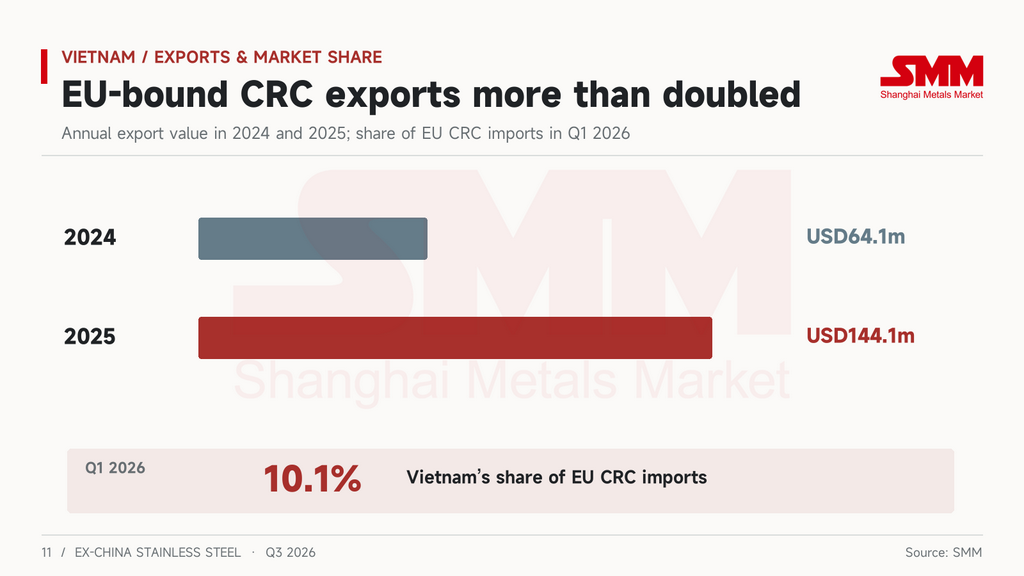
Vietnam was named most often. Most of its CRC is rolled from Indonesian HRC. Its CRC exports to the EU recovered from USD64.1 million in 2024 to USD144.1 million in 2025, and in Q1 2026 it supplied 10.1% of EU CRC imports. In Q3, Taiwan (PoC) and India both moved against Vietnamese material, and Turkey opened a sunset review on Vietnamese stainless pipe. Korea had already imposed anti-dumping duties of 11.37–18.81% on Vietnam. Yongjin's project in Ha Tinh province is due to break ground in early November, and its second phase adds 2 million mt/yr of stainless billet. For an export industry built mainly on re-rolling, it is Vietnam's first step toward melting capacity of its own.
Before Q3, Asian exporters worried about doors closing in Europe and the US. From now on, the doors closing next door have to be priced in too.
Other markets: plenty of trade remedies, few price events
The UK decided to nationalise Speciality Steel UK. Its CBAM accounting rules are final and take effect on January 1, 2027, and its quota for stainless bars and light sections ran out on August 17. In July the US opened anti-dumping and countervailing investigations into welded stainless pipe from India, Turkey and the UAE, and the preliminary countervailing ruling on India has been pushed back to December 14. Turkey opened a sunset review on Vietnamese stainless pipe. Thailand appeared with Malaysia and India on the exclusion list in the EU's draft waste shipment regulation. None of these markets saw an independent price event in Q3.
Outlook: which link reconnects first in Q4
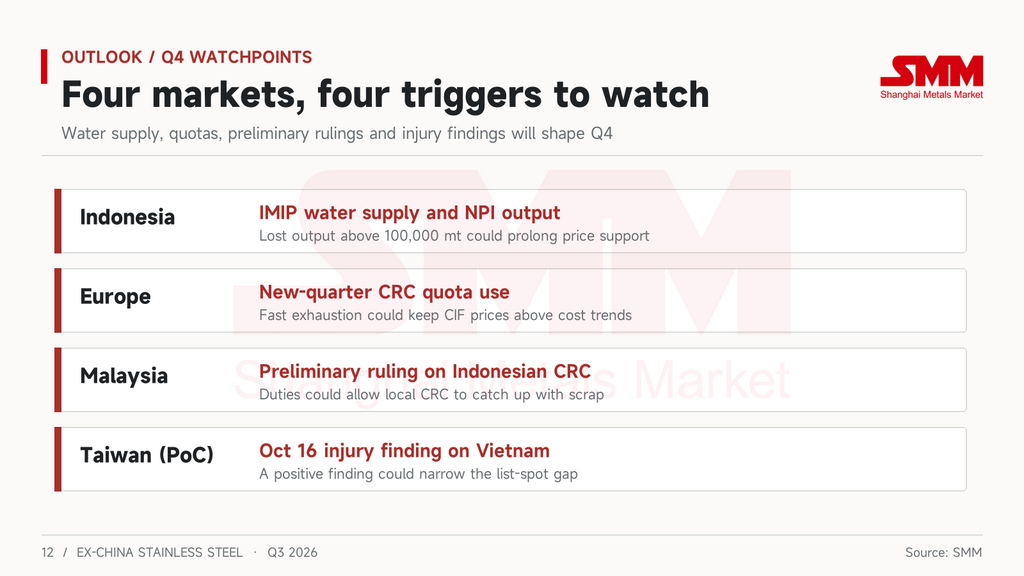
Indonesia is the most likely to move first, but through prices rather than costs. Even if IMIP's water supply returns and NPI keeps falling, integrated mills' costs won't move much. Any FOB cut would be the mills choosing to trade margin for orders. On quarter-end figures, prices are still about USD178/mt above full cost, so there is plenty of room to give. If the water shortage lasts more than half a month and lost NPI output passes 100,000t, merchant NPI will tighten and prices can hold for a while longer.
Europe depends on how fast Q4 quotas are used up, and the first signal is already in. Five days after the quota period opened on October 1, India had exceeded its quotas for stainless bars and light sections and for seamless stainless tubes, with more cargo waiting at EU ports than the whole quarter allows. If cold-rolled quotas fill at the same pace, landed prices will keep moving against the surcharge. If use slows, that means buyers have reached their limit, and landed prices will start moving back toward cost.
Malaysia depends on the preliminary anti-dumping ruling. Only once duties land on Indonesian material will local CRC prices have a chance to catch up with scrap.
Taiwan (PoC) depends on the preliminary injury determination on Vietnam, due October 16. If injury is found, the gap between list and spot prices should narrow. If it is not, mills will struggle to raise prices again in November.
![[SMM Nickel Flash News] Indonesia Update — October 8, 2026](https://imgqn.smm.cn/usercenter/GmHLU20251217171733.jpg)
![[SMM Flash]Canada's Import and Export Data of Sulfur and Sulfuric Acid in August](https://imgqn.smm.cn/usercenter/EOMNB20251217171709.jpg)