SMM, September 30:
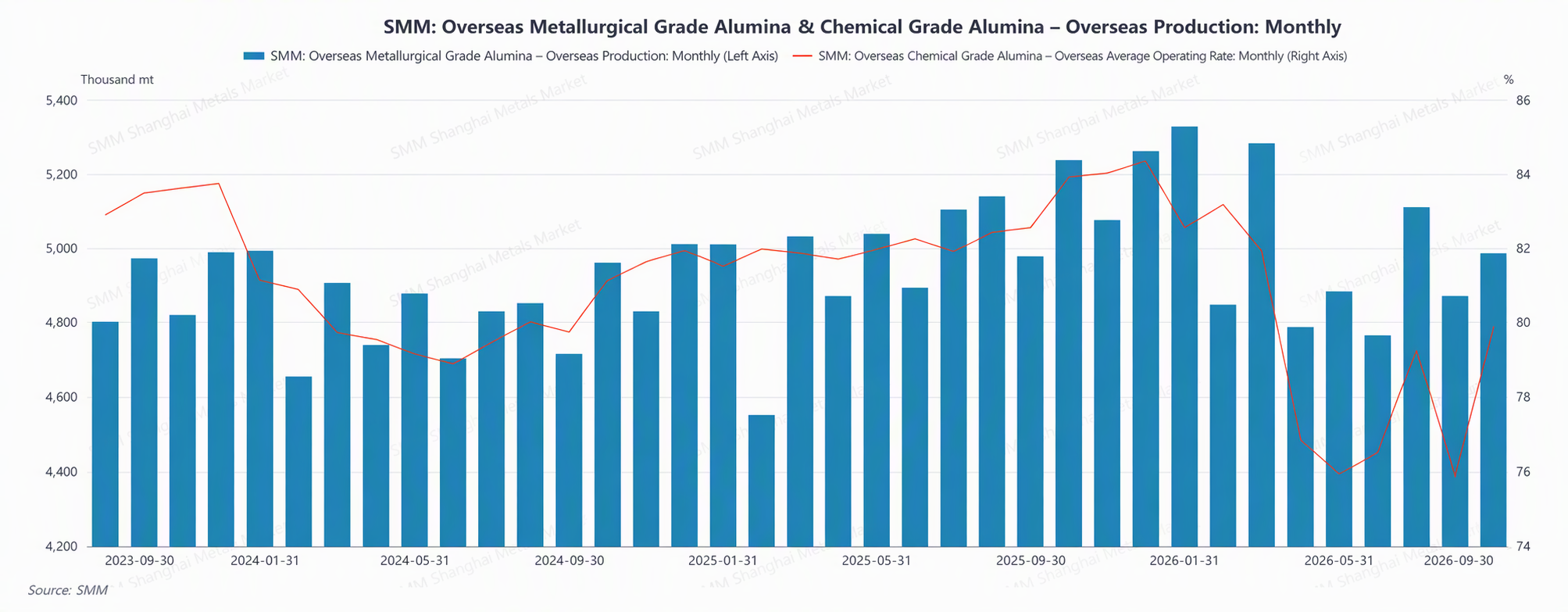
According to SMM statistics, total overseas metallurgical-grade alumina production in September 2026 edged up 0.15% YoY and rebounded about 2.3% MoM. Supply-side conditions showed a mild recovery in September, mainly driven by Brazil's Alunorte returning to normal operating levels after temporary production cuts in late August, along with incremental gains from the ongoing production resumption at Al Taweelah in the Middle East. However, regional disruptions have not been fully resolved: geopolitical conflict in the Middle East intensified again in mid-September, and the operating status of aluminum plants in Bahrain and Qatar remains under watch. Overall, September production rebounded MoM but posted only a marginal YoY increase, with market supply continuing to recover.
By region:
In South America/Brazil, the Alunorte alumina refinery maintained full-capacity operations throughout September, contributing a complete month of production. The 100,000-120,000 mt of output temporarily curtailed in late August due to the natural gas supply disruption announced by supplier CELBA was fully recovered in September. Combined with stable operations at other Brazilian alumina refineries, South American production surged 28.8% MoM in September, making it the single largest driver of the overseas production rebound. Following ANP approval for Alunorte to become an independent natural gas importer, the stability of its raw material supply has further improved.
In the Middle East, production resumption at Emirates Global Aluminium's Al Taweelah plant continues to advance. As of August 22, approximately 25% of the plant's 1,262 pots had been restarted, with production expected to return to pre-incident levels by Q1 2027. Resumption capex is approximately $400 million, with most spending expected to be completed in 2026. The new recycling plant is currently running at 10% capacity, targeting full production by end-Q4. In September, production in the rest of Asia/Middle East region rebounded 5.0% MoM, but remained down 16.5% YoY from September 2025 due to the base effect from the 2024 incident. Additionally, with Middle East geopolitical conflict intensifying again in mid-September, the operating status of plants such as Bahrain's Alba and Qatar's Qatalum remains under watch.
In Africa/Guinea, the alumina refinery project planned by Guinean bauxite company CBG has gained new financing possibilities. Guinea's Ministry of Mines recently indicated that officials have held talks with the U.S. International Development Finance Corporation (DFC) and the Export-Import Bank of the United States regarding CBG's planned refinery project, adding US financing channels to Guinea's strategy of expanding domestic bauxite processing capacity. Prior to this, international capital has long been the main supporting force behind Guinea's bauxite processing strategy—multiple Asian and European enterprises have announced plans in recent months to develop new processing plants in Guinea linked to their mines, with estimated project investments of approximately $1 billion each. CBG previously stated plans to start refinery construction before the end of 2026; the Guinean government holds a 49% stake in the joint venture, with Alcoa and Rio Tinto also holding stakes as partners. In addition, the Friguia railway restoration continued to advance in September, and bauxite shipments from Guinea's main ports stayed high.
In India, Odisha's aluminum industry development has gained a key raw material supply guarantee. The state government held talks with Vedanta's senior management, pledging to supply local bauxite to Vedanta's Lanjigarh alumina refinery in the Kalahandi region and discussing the acceleration of Vedanta's proposed 1 trillion rupee (approximately $10.42 billion) aluminum investment project in the state. For Vedanta's integrated aluminum operations in Odisha, securing bauxite supply is critical, as the Lanjigarh plant is its main alumina production site; this raw material supply commitment comes as the state plans to add large-scale aluminum and alumina capacity.
In Indonesia/Russia, RUSAL is working with Indonesian companies to build an integrated bauxite-alumina complex, and the Indonesian president confirmed the partnership at the Eastern Economic Forum (EEF-2026). RUSAL had previously signed a memorandum of intent with Indonesia's PT Arbaya Energi. In addition, RUSAL is exploring the sale of its Windalco bauxite and alumina operations in Jamaica, including the Ewarton alumina refinery in St Catherine, bauxite mines, and the Port Esquivel shipping terminal, and the sale may also cover its bauxite assets in Guyana. According to RUSAL's annual report, its Jamaican operations recently produced 1.565 million mt of bauxite and 396,000 mt of alumina, with the alumina production accounting for less than 6% of RUSAL's total production.
Looking ahead to October, supply-side disruptions for metallurgical-grade alumina outside China have not been fully resolved: an alumina enterprise in Australia has implemented production cuts, continuing to weigh on regional production; if the Middle East geopolitical conflict escalates again and blocks the Strait of Hormuz, Middle East alumina production and global shipping costs will come under further pressure. However, Alunorte in Brazil is maintaining full-capacity operations, and the production resumption at Al Taweelah in the Middle East continues to advance, which will still contribute stable growth. Overall, metallurgical-grade alumina production outside China in October is expected to remain in the range of 4.98 million to 5.02 million mt, with market supply still expected to remain ample.
(The above information is based on market collection and a comprehensive assessment by the SMM research team. The information provided herein is for reference only. This document does not constitute direct investment research advice. Clients should make decisions prudently and not use this as a replacement for their own independent judgment. Any decisions made by clients are unrelated to SMM.)
Data source: SMM