SMM, September 30:
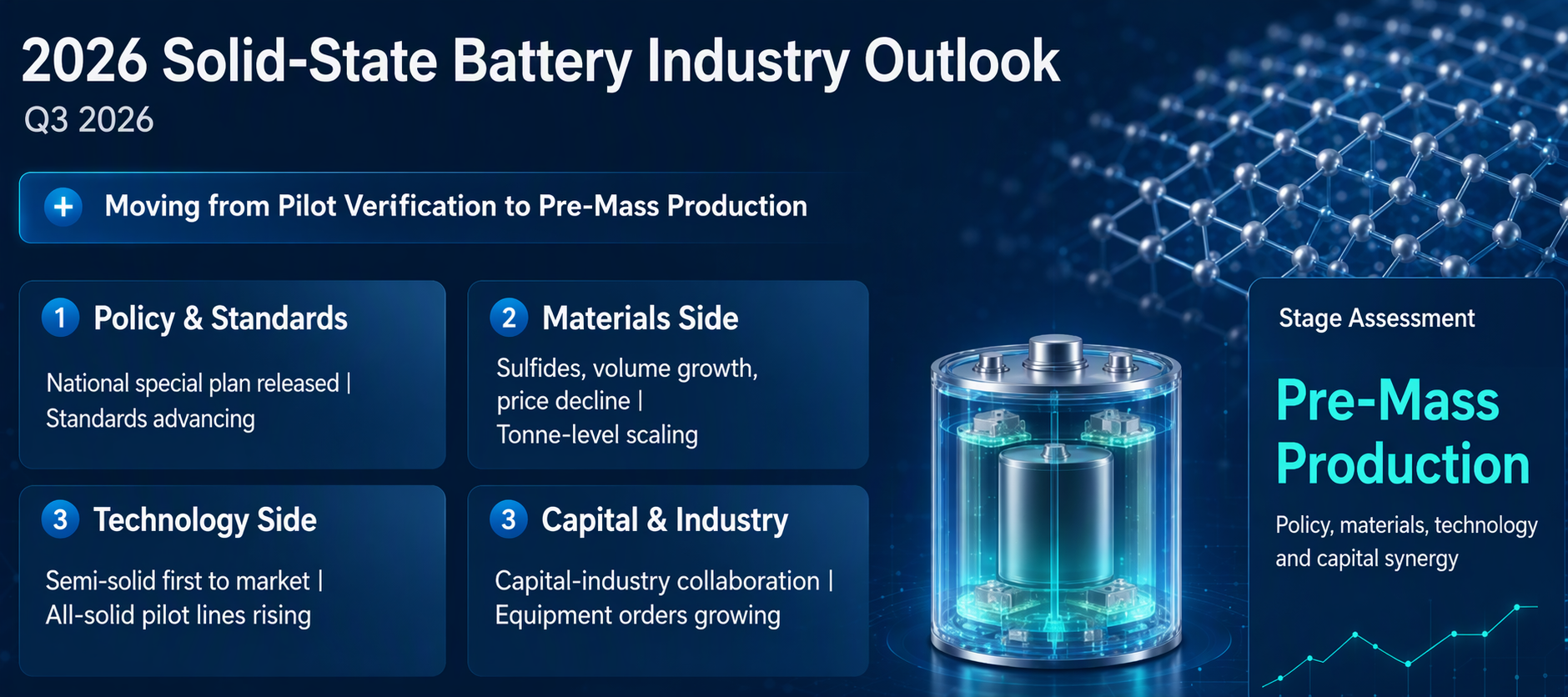
Key points: In Q3 2026, the solid-state battery industry is at a critical stage transitioning from "pilot verification" to "pre-mass production." National-level special plans have been implemented, and the standards system is accelerating its improvement. On the materials side, sulphide is seeing "volume growth with falling prices," entering a transition period of "tonne-level" volume ramp-up. On the technology side, solid-liquid (semi-solid-state) batteries are taking the lead in commercial vehicles, energy storage, eVTOL and other application scenarios, while pilot lines for all-solid-state batteries are being intensively constructed. Capital and industry are deeply aligned, equipment orders continue to be secured, and downstream application scenarios are blossoming across multiple fronts. At the same time, risks such as insufficient capacity utilization rate, order delays, and interface and manufacturing bottlenecks remain, requiring a rational view of the pace of industrialisation.
Foreword: Material price analysis – policy side hot, spot side cold; sulphide sees "volume growth with falling prices"
In Q3 2026, the solid-state battery sector showed a notable divergence of "hot policy side, cold material spot side." On September 28, the Ministry of Industry and Information Technology and six other departments issued the "15th Five-Year Plan for the Development of the New-type Battery Industry," specifying initial large-scale application of all-solid-state batteries by 2030, which drove the battery sector and solid-state battery sector higher on September 29. However, on the material spot side, the pricing anchor centered on lithium chemicals trended downward unilaterally, and sulphide electrolytes exhibited a typical pattern of "volume growth with falling prices."
For lithium chemicals, the average spot price of battery-grade lithium carbonate in Q3 was approximately 148,000 yuan/mt. Quarter-end quotes: battery-grade lithium carbonate was 123,000 yuan/mt on September 29, down 22.9% cumulatively in Q3.
For solid-state battery-specific materials, sulphide electrolytes were the segment with the most pronounced "price collapse" this quarter. From January to August 2026, China's cumulative production of sulphide electrolytes reached 70 mt, up 119.7% YoY, already exceeding the full-year 2025 total of 58.29 mt, but only 19.6% of the annual forecast target of 360 mt was achieved. In August, the capacity utilization rate was only 5.82%, and product prices continued to plummet, with LPSC falling more than 24% in a single month. Lithium sulphide ramped up in tandem: in August, China's battery-grade lithium sulphide production was 7.79 mt, up 3.6% MoM and 143% YoY. The January-August cumulative total was 52.9 mt, already exceeding the 2025 global full-year total of 34 mt. China's production accounted for approximately 95% of the global total, and monthly production is expected to rise to 9-10 mt in Q4, with a full-year total of 85-95 mt.
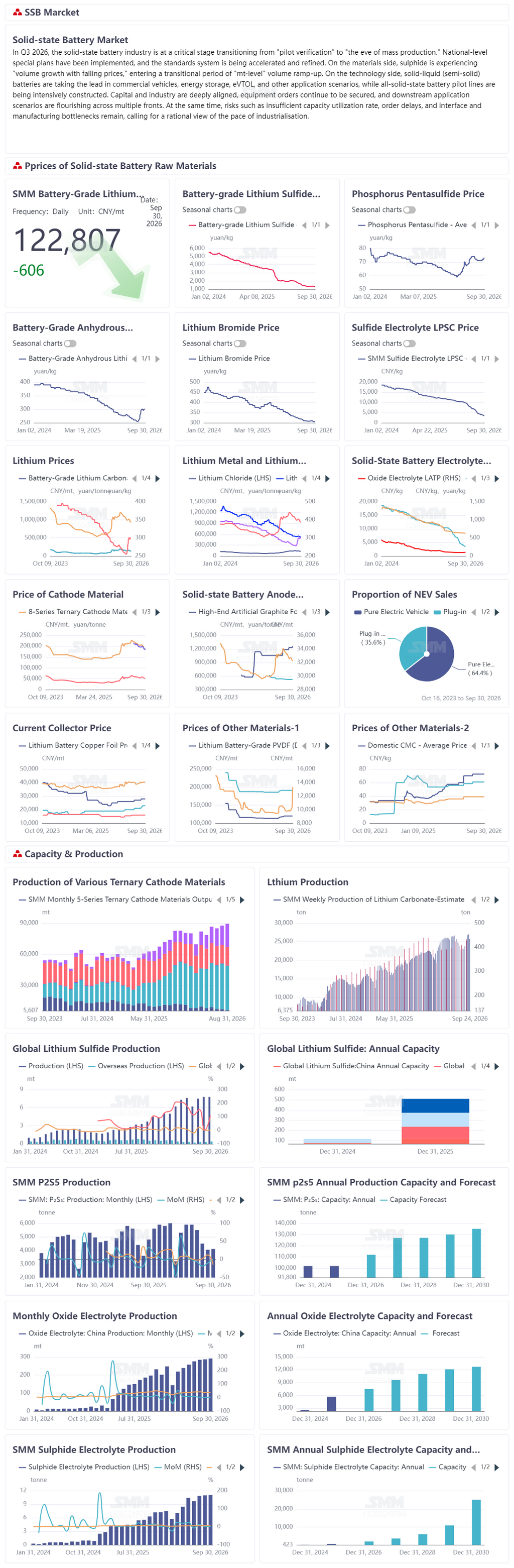
On the supply side, Q3 saw a concentrated rollout of "hundred-tonne-level" production lines: Tinci's hundred-tonne-level lithium sulphide and solid-state electrolyte pilot line was completed and put into production in Q3; Shandong Chuanglu's 150 mt/year solid-state electrolyte production line completed installation and commissioning; Capchem's oxide electrolyte is set to bring thousand-tonne-level capacity online in 2026. However, supply and demand for lithium sulphide and sulphide electrolytes were both weak in H1, and price pressure was the main theme of Q3. The anode was relatively resilient, while additives were structurally strong. Overall, the solid-state battery materials sector has entered a transition phase shifting from "kilogram-level transactions" to "tonne-level transactions," with the price center moving lower. Q4 will need to verify the quality of tonne-level volume ramp-up.
I. Solid-state battery materials
1. Electrolytes: Sulphide upstream capacity release but prices under pressure, oxide capacity first to scale up, halide reserves accelerating
The sulphide route is the most intensive direction for material-side capacity expansion in Q3. SEMCORP's controlling subsidiary has completed construction of a high-purity lithium sulphide pilot line, with plans to achieve kt-level mass production of sulphide-halide solid-state electrolytes from 2026 to 2027. Tinci Materials has completed construction of a 100mt-level lithium sulphide and solid-state electrolyte pilot production line and began trial production in Q3, using a self-developed liquid-phase method with costs 30%-40% lower than mainstream solid-phase methods. XTC New Energy Materials (Xiamen) has entered trial production of high-purity lithium sulphide. Yahua Group's lithium sulphide pilot line has entered the feasibility and design stage and samples have been delivered. Tianqi Lithium's 50mt lithium sulphide pilot project is under construction, with completion expected in H2; preparation of sulphide electrolytes of the lithium argyrodite type has achieved most process steps outside the glovebox. Gotion High-tech's controlling subsidiary has launched the world's first 10kt-level high-purity lithium sulphide production line in Anqing, with plans to complete pilot testing by the end of 2026 and achieve full mass production in 2027, with purity reaching 99.99%. Qinghai Weixiang's 3,000mt lithium sulphide project has completed filing, with Phase I at 500mt and Phase II at 2,500mt, planned for completion in July 2027. Easpring Technology's sulphide electrolytes have entered the small-scale validation stage with top-tier solid-state battery clients and the company has large-scale supply capability. Sinocera Materials has completed an automated production line for sulphide solid-state electrolytes, with a strategic focus on sulphides. LionGo New Energy has achieved 100mt-level capacity for sulphide and halide solid-state electrolytes, with next-step plans for kt-level or even 10kt-level capacity. Tengyuan Cobalt is co-building a lithium sulphide pilot line with Hunan Sulphur Lithium.
The oxide route leads in engineering and capacity. LionGo New Energy has achieved 10kt-level capacity for oxide solid-state electrolytes; Shenzhen Senior Technology Material's investee Shenzhen Xinyuanbang has kt-level capacity and 100mt-level shipments of oxide electrolytes; Yibin Chenfeng's RMB530 million kt solid-state electrolyte project has been signed and settled in Heyuan, Guangdong, focusing on oxide solid-state electrolytes, with production planned to start in October 2027; Capchem's oxide electrolytes are already in mass production and sales, with kt-level capacity to be commissioned in 2026; Kunlun New Materials' Huzhou base is gradually releasing kt-level capacity for oxide hybrid solid-liquid electrolytes; Mitsubishi Chemical plans to invest approximately JPY15 billion in a new oxide solid-state electrolyte production line with annual capacity of 1,000mt, scheduled for commissioning in Q1 2028. Orient Zirconic's zirconia powder has received preliminary recognition from some solid-state battery material producers in R&D trials; MGL has obtained an invention patent for nano-scale oxide solid-state electrolytes; Jiuwu Hi-Tech's LATP solid-state electrolyte has passed extreme overcharge and overdischarge tests; Great Power Energy's oxide route has achieved laboratory energy density exceeding 400Wh/kg, with operating temperature from -40°C to 105°C.
The halide route is accelerating deployment as a potential alternative. Xinyuren's second-generation halide solid-state electrolyte has been successfully trial-produced and entered preliminary testing; Sumitomo Chemical plans to mass-produce halide solid-state electrolytes in FY2028; Shanghai Jiao Tong University has publicly tendered for an intelligent halide solid-state electrolyte preparation and testing system.
2. Cathodes: High-nickel, ultra-high-nickel, and lithium-rich manganese-based progressing in parallel, solid-liquid cathodes first to scale up, all-solid-state cathodes entering mt-level validation
BTR has achieved full coverage of the three core materials for solid-state batteries - cathodes, anodes, and electrolytes. For hybrid solid-liquid batteries, it adopts a polymer + oxide composite solution; for all-solid-state batteries, it focuses on sulphide electrolytes, and has developed the industry's first high-performance three-dimensional framework material matched with lithium-carbon composite anodes for all-solid-state batteries.
Easpring Technology's all-solid-state cathode materials have passed testing by multiple top-tier players and entered vehicle-mounted validation, with cumulative shipments of 50mt; cathode materials for solid-liquid batteries have achieved cumulative kt-level shipments, and dual-phase composite solid cathode materials have achieved stable monthly shipments of over 100mt; new-type sulphide solid-state electrolytes have large-scale supply capability. Ronbay Technology's solid-state battery cathode materials have received positive client test feedback, with 9-series high-nickel shipment share rising to 35%, demand expected to reach 100mt-level this year, and a 10mt-level solid-state electrolyte production line planned for completion within the year. GEM has achieved mt-level or higher shipments of high-nickel, ultra-high-nickel, and lithium-rich manganese-based cathodes for solid-state batteries, and has jointly established a solid-state battery cathode material joint laboratory with Academician Sun Xueliang's team. Canmax's subsidiary Jiangsu Yili has launched a solid-state battery cathode material mass production line, planning 10kt-level high-nickel ternary cathodes with a supporting kt-level pilot line. Zhenhua New Materials' solid-state electrolyte pilot line installation is nearing completion, while simultaneously advancing the industrialisation of mid-nickel high-voltage, high-nickel, ultra-high-nickel ternary, and lithium-rich manganese-based materials. Sichuan University has released ultra-high-nickel all-solid-state battery results, with ultra-high-nickel cathodes achieving 0.1C discharge specific capacity exceeding 240mAh/g, solid-state battery energy density exceeding 400Wh/kg, and cycle life of over 800 cycles.
Overall, cathode materials are advancing along high-nickel, ultra-high-nickel, and lithium-rich manganese-based directions; semi-solid/solid-liquid battery cathodes are first to scale up, while all-solid-state cathodes remain in the mt-level validation and vehicle-mounted validation stage.
3. Anodes: Silicon carbon anode industrialisation accelerating, lithium metal anode pilot testing advancing, composite anodes/three-dimensional frameworks emerging as new directions
BTR has developed the industry's first high-performance three-dimensional framework structure material matched with lithium-carbon composite anodes for all-solid-state batteries. Dowstone Technology's silicon carbon anodes have achieved batch shipments, single-walled carbon nanotubes are being supplied in batches to multiple battery cell manufacturers, and solid-state electrolytes are being supplied in small batches to some clients. Xiangfenghua's CVD silicon carbon anodes are in the client certification stage, with ongoing product validation with Qingtao Energy. Litan's silicon carbon anode project has reached mass production, with annual capacity of 6,500mt, Phase I at 1,500mt, and expected to capture 30% of China's market share after reaching full production. Yibin has signed a 5,000mt porous carbon and 1,000mt solid-state battery-specific silicon carbon anode project. Furi Co. acquired a 78.80% stake in Bosailisi for RMB399.6 million; Bosailisi has entered mass production supply for Gotion High-tech and Yinrui Battery Materials, with annual capacity of approximately 540mt. Zhihua Energy has completed Series C financing to expand silicon carbon anodes. Shanshan Co. is deploying anodes for solid-state batteries and solid-state electrolyte composite anodes. PTL's silicon carbon anodes, lithium metal anodes, and solid-state electrolytes (LLZO/LATP) are all applicable to solid-state/solid-liquid batteries. Tianqi Lithium can produce 300mm-wide roll-to-roll ultra-thin lithium metal strip, directly supplying solid-state battery producers as anode metal material. Ganfeng Lithium is advancing both silicon carbon and lithium metal anode routes.
4. Others: Equipment first, separator/aluminum-plastic film/adhesive/additive supporting follow-up
The equipment segment is one of the most active areas for industrialisation in Q3. Naknor has launched lithium strip calendering equipment, lithium supplement composite integrated machines, electrolyte transfer printing equipment, and isostatic pressing equipment, with some entering client validation or delivery, and orders on hand of RMB2.718 billion. Lead Intelligent Equipment has completed the full process flow for all-solid-state battery mass production, achieving full coverage of turnkey solutions and key equipment for all process stages, and continued to secure orders from top-tier clients in Q3, covering dry electrodes, electrolyte coating, transfer printing, solid-state stacking, and isostatic pressing. Lyric's all-solid-state turnkey line project has completed phased acceptance, with warm isostatic pressing equipment reaching mass production delivery standards, and has received orders for key machine models and pilot lines from two top-tier clients. Golden Milky Way plans to raise no more than RMB1.5 billion through a private placement, targeting R&D of high-end intelligent equipment for solid-state batteries. UW Laser has delivered all-solid-state assembly lines to top-tier clients for trial production. PTL has delivered dry-process and solid-state battery electrode equipment to top-tier clients in China and overseas, with cumulative orders exceeding RMB200 million. ST Funeng's subsidiary Chaoye Precision has achieved small-batch delivery of solid-state battery-related equipment.
In auxiliary materials, Crown New Materials' solid-state battery aluminum-plastic film has completed client sample trials, withstanding high temperatures of 120°C; Zhonglun New Materials' solid-state battery-specific BOPA film has been sent for sample validation; Shenzhen Senior Technology Material is jointly developing high-performance solid electrolyte membranes with Reasolid New Material; SEMCORP is deploying lithium sulphide, sulphide electrolytes, and oxide coated separators for solid-liquid batteries; Huitian New Materials' lithium battery anode adhesive and thermal conductive adhesive are compatible with solid-liquid (semi-solid) batteries; Tinci Materials is delivering small-batch samples of UV frame adhesive for solid-state batteries.
II. Solid-state battery technology
1. Technology: Sulphide pursues high conductivity and low pressure, oxide leads in engineering, polymer excels in processability, and solid-solid interfaces and continuous manufacturing remain core bottlenecks
Sulphide technology: Boron-doped mixed-halide argyrodite electrolyte achieves an ionic conductivity of 7.53mS/cm, with enhanced air tolerance and lithium deposition/stripping reversibility; the Qingdao Institute of Bioenergy and Bioprocess Technology, Chinese Academy of Sciences, has made a breakthrough in the dry electrode process for sulphide all-solid-state batteries, using polyamide-based adhesives for melt bonding; the team of Tu Jiangping and Zhong Yu at Zhejiang University has achieved kilogram-scale liquid-phase synthesis of high-conductivity sulphide electrolytes, with LSPS0.45 achieving a room-temperature conductivity of 5.42mS/cm; FAW Group, in collaboration with Eastern Institute of Technology, has developed an ion-elastomer interface, enabling stable cycling of large-capacity sulphide all-solid-state battery cells at a low pressure of 5MPa; a defect-engineered LiYO2 interlayer improves the compatibility between high-nickel cathodes and sulphide electrolytes; dynamic redox control constructs a self-adaptive interface to stabilise lithium metal anodes; the team of Academician Sun Xueliang has revealed that the electronic conductivity of solid electrolytes is a "hidden killer" of self-discharge, with capacity loss reaching 94.5% after one month of rest when the electrolyte thickness is reduced to 20μm; Stanford/SLAC has discovered that mechanical compression can force lithium dendrites to expand horizontally; Purdue University has revealed the formation mechanism of interfacial defects.
Oxide technology: Great Power Energy's laboratory oxide-route batteries achieve an energy density of over 400Wh/kg, with an operating temperature range of -40°C to 105°C; Changan Automobile has completed validation of a 20Ah oxide-polymer composite solid-state battery, with a new-type electrolyte conductivity of >4.5mS/cm, an energy density of >350Wh/kg, and a hot-box temperature of 250°C; Baima Lake Laboratory's boride solid-state batteries achieve an energy density of 400Wh/kg, over 2,000 cycles, a hot-box temperature of 180°C, and an operating pressure reduced to below 5MPa, with trial production of 20Ah battery cells completed; Jiuwu Hi-Tech's LATP solid electrolyte has passed extreme overcharge and over-discharge tests.
Polymer technology: Sunwoda's polymer all-solid-state battery "Xin Bixiao" achieves an energy density of 400Wh/kg, cycles 1,200 times under ultra-low pressure, passes a 200°C hot-box test, and plans to complete a 0.2GWh pilot line by the end of 2025; Ion Energy's 51Ah automotive-grade polymer-based all-solid-state battery achieves an energy density of 520Wh/kg, supports 6-minute ultra-fast charging, operates across a full temperature range of -45°C to 120°C, cycles over 3,500 times, and passes GB38031-2025.
Halide technology: Xinyuren has successfully trial-produced its second-generation halide solid electrolyte; Sumitomo Chemical plans to mass-produce halide electrolytes in fiscal 2028.
Overall, the focus of technological competition has extended from "material formulations" to "interface engineering + low-pressure operation + continuous manufacturing + electronic conductivity control". Solid-solid interface contact, side reactions, porosity, continuous manufacturing, and self-discharge remain core bottlenecks for the industrialisation of all-solid-state batteries.
2. Products: Breakthroughs in automotive-grade large-capacity battery cells, with solid-liquid (semi-solid) batteries landing first, all-solid-state batteries in small batches in 2027, and initial scale-up in 2030
CATL's sulphide all-solid-state battery has an energy density of 500Wh/kg and a cycle life exceeding 2,000 cycles. Samples have entered vehicle installation testing, with small-batch production planned for 2027. Chairman Zeng Yuqun stated bluntly that the likelihood of million-unit vehicle installation of all-solid-state batteries before 2030 is very small. BYD confirmed it will launch solid-state battery demonstration vehicles in 2027. Chery's Rhino solid-state battery cell has an energy density of 400Wh/kg, with the solid-liquid hybrid version to be installed in vehicles in Q4 2026 and all-solid-state validation on vehicles in 2027. Geely Holding targets a 500Wh/kg all-solid-state battery, with cross-brand pilot vehicle installation in 2027. Changan Automobile has completed validation of a 20Ah oxygen-polymer composite solid-state battery. Dongfeng Motor targets launching 100 solid-state battery demonstration vehicles by the end of 2026, with small-scale mass production around 2030. Gotion High-tech's G Yuan solid-liquid hybrid battery has mass production capability, with a 197Ah prismatic battery cell energy density of 300Wh/kg and system-level 235Wh/kg, and plans 12GWh of capacity in Tongcheng; the Jinshi all-solid-state battery has passed multiple safety tests. EVE's "Longquan No.3" and "Longquan No.4" all-solid-state batteries have rolled off the line with a capacity of 60Ah, achieving an automotive-grade breakthrough. Farasis Energy's first-generation sulphide all-solid-state battery has an energy density of 400Wh/kg, while the second generation adopts lithium-rich manganese-based/high-nickel ternary cathodes and lithium metal anodes, achieving 500Wh/kg. Ganfeng Lithium's 500Wh/kg-class 10Ah product is in small-batch mass production, and its 400Wh/kg battery has achieved a cycle life exceeding 1,100 cycles. ProLogium Technology's Gen3.5 lithium ceramic battery has entered mass production, with a 185.4Ah battery cell energy density of 381Wh/kg and 903Wh/L, passed TÜV certification, and is classified as an all-solid-state battery under GB/T43568-2026; the first phase of its Dunkirk plant in France is planned at 4GWh, with long-term total capacity of 44GWh. Samsung SDI has set its all-solid-state battery mass production target for H2 2027, with the first commercial application likely to come from humanoid robots. LG Energy Solution plans to establish an all-solid-state dry electrode pilot line in H2. Panasonic is expected to begin all-solid-state battery sampling in Q4 2026.
III. Solid-state battery projects: Q3 moves from "pilot lines" to "mass production lines", with equipment and material projects landing in concentration
Q3 project activity showed three major characteristics: first, material projects expanded from kilogram/ten-tonne scale to hundred-tonne, thousand-tonne, and ten-thousand-tonne scale; second, battery cell projects advanced from laboratory pilot lines to GWh-class mass production lines; third, equipment orders moved from validation to delivery.
Key projects in September included: BTR achieved full coverage of the three core materials of cathode, anode, and electrolyte; NAKNOR's core solid-state battery equipment entered client validation or delivery; SEMCORP completed its high-purity lithium sulphide pilot line and plans thousand-tonne mass production from 2026 to 2027; Jinyinhe plans a private placement to raise no more than 1.5 billion yuan for high-end intelligent solid-state battery equipment; Yibin Chenfeng's 530 million yuan thousand-tonne solid-state electrolyte project landed in Heyuan; the Zhongke Circular Industrial Park in Yingkou, Liaoning commenced, with planned annual output of 2GWh solid-state batteries and 5,000 mt of solid-state electrolyte materials; Suzhou's advanced prismatic all-solid-state battery industrialisation project plans a 0.2GWh pilot line and a 4GWh PACK mass production line; Ion Energy's Wuhan R&D and production site went into operation, with polymer-based all-solid-state batteries moving toward large-scale mass production; Dongfeng's oxide-polymer composite solid-liquid (semi-solid) battery entered the mass production stage; Yinrui Technology's high-C-rate solid-state battery project for drones plans 1GWh in phase one.
Key projects in August included: Qingsong Guneng's 10GWh solid-state battery project landed in Dongtai with a total investment of 3 billion yuan; Tuoyi Guneng invested 6 billion yuan in Inner Mongolia to build a 30GWh solid-state battery project; Xinjie Energy completed a Series B round of over $100 million and added a 3GWh solid-state battery mass production line; Shen'an Lithium Energy invested 200 million yuan in its Shaoxing base to build a 500MWh battery cell production line; Guangdong Shanhui invested 2 billion yuan to build a 3GWh all-solid-state battery finished product project; Hukou Chunli New Energy's 6GWh all-solid-state ESS battery project phase one is expected to begin trial production by month-end September; Enpower's Wuxi 2GWh advanced battery pack production site went into operation; WELION New Energy landed a 3GWh solid-state battery pack and electric heavy truck industrial park in Qingyang, Gansu.
Key projects in July included: Yaoshi Lithium Battery's project with annual output of 20 million high-energy-density solid-state batteries signed in Nanping, Fujian; Guosheng Global (Tieling)'s 10GWh solid-state battery project saw first-line equipment enter the workshop; SEVC POWER's first domestic all-solid-state battery intelligent manufacturing pilot line is expected to be completed by year-end; Daoketesi's all-solid-state battery GWh production line went into operation with an energy density of 350Wh/kg; Sunwoda's Zaozhuang base phase three laid out two solid-state battery production lines.
Overall, Q3 solid-state battery project investment concentrated on sulphide electrolytes, oxide electrolytes, silicon carbon anodes, solid-state equipment, and GWh-class battery cell lines, but actual effective demand remains in a ramp-up period, with some projects facing the risk of "capacity ahead of orders".
IV. Solid-state battery financing and cooperation: national teams and industrial capital increase stakes, overseas cooperation deepens
Q3 financing and cooperation were active. Jinyu New Energy completed a B+ round strategic financing, with investors including the National Social Security Fund, BOC Asset Management, ABC Capital, Zhechuang Investment, and Hangzhou Capital; its 1.2GWh solid-state battery production line began operation in January 2026. SEVC POWER completed hundreds of millions of yuan in financing for sulphide electrolytes, high-safety batteries, all-solid-state battery cells, and PACK production line construction. Xinjie Energy completed a Series B round of over $100 million led by Puhua Capital and added a 3GWh solid-state battery mass production line. Guxin Energy completed a 100-million-yuan-level financing round led by Toukong Donghai, with strategic upgrades anchored on embodied AI, the low-altitude economy, and commercial aerospace. Ruizhi New Energy received tens of millions of yuan in Pre-A+ round state-owned capital financing. HYLIC completed a Series A round of hundreds of millions of yuan led by Xiaomi Yangtze River Fund. Zhihua Energy completed a Series C round to increase investment in silicon carbon anodes. Yili Technology completed a Series A round with participation from Skyworth Group and others.
In terms of cooperation, GEM joined forces with Academician Sun Xueliang's team to establish a joint laboratory for solid-state battery cathode materials; Tinci Materials engaged in exchanges with Samsung SDI on lithium sulphide and sulphide electrolyte production lines; Factorial Energy partnered with Mitsui Kinzoku to advance large-scale mass production of sulphide solid-state electrolytes; WELION New Energy signed a 150MWh solid-liquid (semi-solid) energy storage project framework agreement with Hungary's Szermann Kft and signed a 50MWh energy storage cooperation with Romania's HOSTIX Zso; Mercedes-Benz signed a joint testing agreement with ProLogium, securing priority testing rights for Gen4 all-inorganic solid-state batteries; SK Innovation invested $30 million in Solid Power to jointly develop all-solid-state batteries; Kyushu Electric Power plans a strategic investment in ProLogium Technology; China Automotive New Energy signed a technical cooperation agreement with Leap Motor to conduct R&D collaboration on solid-state batteries and other frontier areas; Tengyuan Cobalt partnered with Hunan Sulphur Lithium to build a lithium sulphide pilot line.
Overall, capital is concentrating on leading material, equipment, and battery cell enterprises, with national teams, industrial capital, and overseas strategic investors jointly driving the industrialisation of solid-state batteries.
V. Solid-state battery overseas progress: Japan, South Korea, the US, and Europe advance on multiple fronts, with sulphide and oxide racing ahead
Overseas, Hyundai Motor Group reiterated that it will not abandon all-solid-state battery development. Mercedes-Benz signed a joint testing agreement with ProLogium, securing priority testing rights for Gen4 all-inorganic solid-state batteries; ProLogium's Taoyuan plant completed GWh-class manufacturing validation, and Gen3.5 lithium ceramic batteries have entered mass production. Schaeffler announced progress in solid-state electrolyte coating processes, noting that solid-state electrolytes are one of the most expensive components of all-solid-state batteries. SK Innovation invested $30 million in Solid Power to jointly develop all-solid-state batteries. Samsung SDI has set its all-solid-state battery mass production target for H2 2027, with the first commercial application likely to come from humanoid robots, and visited Tinci's Jiujiang production line to inspect domestic sulphide electrolytes. LG Energy Solution plans to launch an all-solid-state dry electrode pilot line in H2. Panasonic is expected to begin all-solid-state battery sampling in Q4 2026, initially targeting industrial machinery and automotive sensors. EcoPro BM has formed an all-solid-state battery team covering the full chain of "raw materials-materials-battery cells", targeting commercialisation in 2027; EcoPro's sulphide solid electrolyte pilot line has gone into operation, aiming for mass production in 2027. Solid Power plans to establish a joint venture in South Korea, planning a solid-state electrolyte production site with maximum capacity of 20,000 mt/year. Factorial Energy received its first commercial drone battery order and partnered with TulipTech to advance commercial deployment of solid-state batteries for drones. QuantumScape shipped QSE-5 battery cells to a major US defense contractor and established a new partnership with Honda. US companies such as Amprius, SES, and Enovix reported revenue growth or narrowing losses in their financial results. Mitsubishi Chemical plans to expand oxide electrolyte production, and Sumitomo Chemical plans to mass-produce halide electrolytes in FY2028. ITEN participated in the SOLIMED project to advance solid-state energy storage for medical implant devices. Gelion partnered with Mitsui Kinzoku to advance nano-encapsulated sulphur cathode materials. Korea Marine Drone Technology signed a strategic cooperation with Solitec to develop 500Wh/kg-class solid-state batteries for drones.
Overall, Japan and South Korea are advancing resolutely on sulphide all-solid-state batteries and mass production timetables, the US leads in niche scenarios such as lithium metal, silicon anodes, and defense and aerospace, and Europe is accelerating validation through automaker-startup cooperation. China has advantages in material supply chains, equipment, and solid-liquid (semi-solid) mass production, but pressure is rising from overseas leading client validation and patent competition.
VI. Solid-state battery industry voices and expert opinions: solid-liquid (semi-solid) first to land becomes consensus, all-solid-state still awaits breakthroughs in interfaces and manufacturing
Wan Gang proposed a three-tier advancement strategy: "deepen all-solid-state battery technology R&D and industrial application; accelerate hybrid solid-liquid battery technology R&D and large-scale application; continue to optimise and improve liquid batteries, and encourage R&D and application of new-type sodium-ion batteries and others." Academician Ouyang Minggao pointed out that dual technology routes are indispensable, that all-solid-state battery breakthroughs are highly dependent on AI R&D platforms, and that the next five years are a critical window for battery R&D to shift from traditional models to AI-driven intelligent R&D, with China's lithium-ion battery shipments expected to exceed 3,600GWh in 2030. Zhang Jinhua proposed that the industry will form a three-tier echelon pattern of "liquid as the foundation, solid-liquid as the bridge, and solid-state as the breakthrough", with all-solid-state batteries expected to enter a large-scale application window around 2035. Yin Tongyue revealed that Chery's solid-state battery cell has an energy density of 400Wh/kg, with solid-liquid hybrid installation in Q4 2026 and all-solid-state vehicle validation in 2027. Yang Hongxin believes that all-solid-state batteries are unlikely to achieve large-scale popularisation before 2030, and that hybrid solid-liquid batteries will serve as a transitional solution and be the first to see rapid penetration rate growth; enterprises should adopt a "hybrid solid-liquid first, all-solid-state later" route. Miao Lixiao stated bluntly that all-solid-state batteries are being "pushed forward hard", with the two hurdles of solid-solid interfaces and continuous manufacturing yet to be overcome. Wang Fang pointed out that solid-state batteries face new challenges such as solid-solid interface contact and side reactions, impedance, and porosity, and refuted rumours that CATARC has made compliance determinations on solid-state battery enterprises. Yuan Wenjing believes that solid-state electrolytes remain the least mature component, and that solid-liquid hybrid batteries are more competitive for industrialisation. Zeng Yuqun stated that the likelihood of million-unit vehicle installation of all-solid-state batteries before 2030 is very small. CATL's Wu Kai stated that solid-state batteries are expected to achieve small-batch production in 2027. SMM predicts that the Wh cost of all-solid-state batteries will fall below 1 yuan from 2030 to 2031, on par with current high-nickel ternary batteries.
Industry consensus is gradually becoming clear: semi-solid/solid-liquid batteries will land first from 2026 to 2027, all-solid-state passenger vehicles will see small-scale introduction from 2027 to 2028, initial large-scale application will occur in 2030, and large-scale popularisation in 2035. Bottlenecks are concentrated in solid-solid interfaces, continuous manufacturing, low-pressure operation, self-discharge caused by electronic conductivity, and cost and yield.
VII. Solid-state battery policies and regulations: shifting from encouraging R&D to guiding mass production, with standards and tax exemption windows running in parallel
Q3 saw intensive policies, marking solid-state batteries’ shift from “R&D encouragement” to “production guidance”.
On 28 September, the Ministry of Industry and Information Technology (MIIT) and six other departments issued the 15th Five-Year Plan for the Development of the New-Type Battery Industry, the first national-level special plan, which explicitly targets initial large-scale application of all-solid-state batteries by 2030. On 17 September, the MIIT and the National Development and Reform Commission (NDRC) issued the 15th Five-Year Plan for the Development of the Electronic Information Manufacturing Industry, proposing continued breakthroughs in key materials such as solid-state batteries, new-type electrolytes, high-nickel cathodes, and silicon-based anodes, and accelerating pilot testing and demonstration vehicle installation of solid-state batteries. On 9 September, the MIIT and eight other departments issued the 15th Five-Year Plan for the Development of the Intelligent Connected NEV Industry, incorporating automotive solid-state batteries into the special standards system and accelerating the supply of cutting-edge technology standards. On 16 September, the Application Guide, Test Items and Conditions for Secondary Lithium-Ion Solid-State Batteries for EV Drive, proposed under China’s leadership, was successfully approved as a project at the IEC, becoming the world’s first international standard in the solid-state battery field.
On consumption tax, from 1 September 2026, lithium-ion batteries are subject to a 2% consumption tax, rising to 4% from 1 September 2027; sodium-ion batteries, solid-state batteries, and fuel cells are exempt until 31 December 2028, with the exemption contingent on compliance with corresponding national standards. On 1 July, the world’s first national standard for automotive solid-state batteries, GB/T43568-2026 Solid-State Batteries for EVs – Part 1: Terminology and Classification, came into effect; GB38031-2025 Safety Requirements for Traction Batteries for EVs has also been implemented. A project approval review meeting was held for two group standards on solid-state batteries for embodied AI robots. The MIIT, together with relevant departments, has listed technical breakthroughs in the four major components – cathode, anode, electrolyte, and separator – as a key focus under the special initiative for “enhancing core manufacturing competitiveness”.
Overall, the policy side includes national special plans + standards systems + consumption tax exemptions + international standards, providing regulatory support and window-period dividends for the industrialisation of solid-state batteries.
Summary and Q4 Focus
In Q3 2026, the solid-state battery industry showed a pattern of “warming policy and capital, cooling materials spot markets, accelerating technology and products, and front-running projects and equipment”. In September, policies were rolled out intensively, international standards achieved breakthroughs, equipment orders continued to be secured, sulphide materials saw “volume up, price down”, oxide capacity ramped up, silicon-carbon anode industrialisation accelerated, and high-nickel/lithium-rich manganese-based cathodes entered mt-level validation. Semi-solid/solid-liquid batteries took the lead in commercial vehicles, energy storage, eVTOL, robotics, and other application scenarios, while all-solid-state batteries remained in the pilot testing and vehicle validation stage.
Key areas to watch in Q4: First, whether average monthly production of sulphide electrolytes in Q4 can deliver on the 10-20 mt ramp-up expectations; second, the progress of material procurement shifting from “kg-level” to “mt-level” ahead of the 2027 vehicle installation period for solid-state batteries; third, whether engineering breakthroughs are achieved on core bottlenecks such as solid-solid interfaces, continuous manufacturing, low-pressure operation, and self-discharge in all-solid-state batteries; fourth, whether top-tier players accelerate capacity and order lock-ins for solid-state batteries under the consumption tax exemption window.
SMM Solid-State Battery Conference Attendee List (Partial)
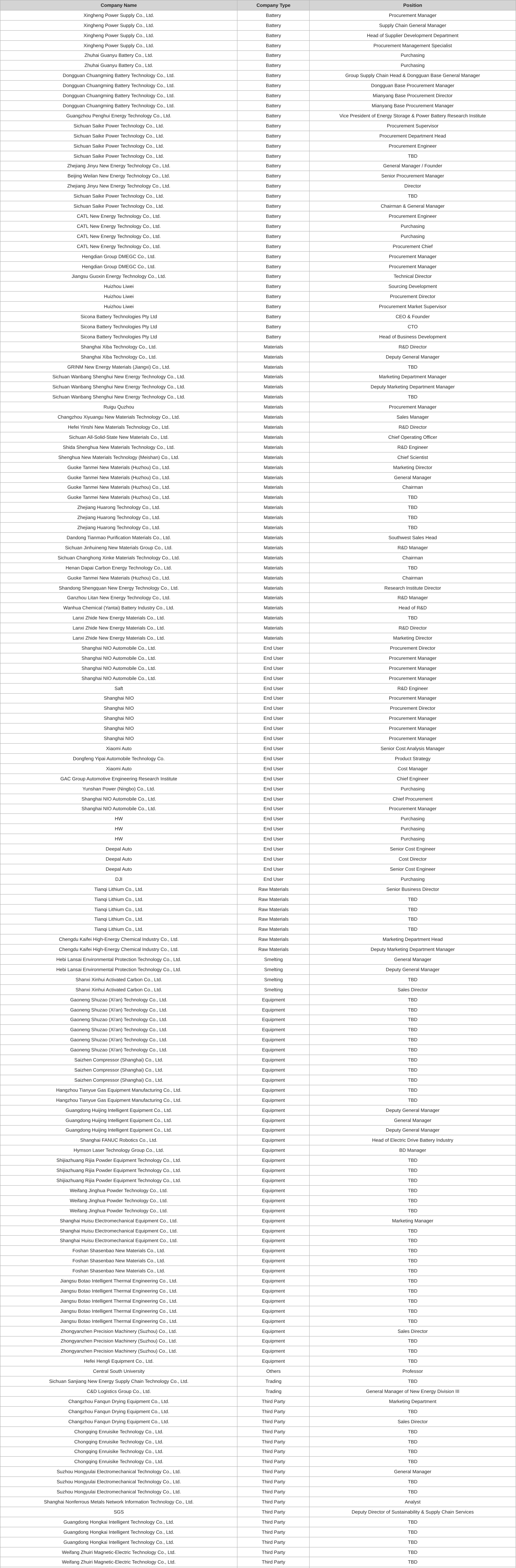
Note: If you have any additions to the details mentioned in this article or are following the development of solid-state batteries, feel free to contact us at any time. Contact information is as follows:
Tel: 021-20707860 (or add WeChat: 13585549799) Yang Chaoxing, thank you!

Related Reading
![[MOFCOM: 2027 Auto and Motorcycle Export License Applications]](https://imgqn.smm.cn/usercenter/QGlKw20251217171730.jpg)
![[CAAM: Will Support Government Response to EU Unilateral Trade Tools]](https://imgqn.smm.cn/usercenter/oVqJl20251217171730.jpg)
![[Bethel: Q3 EMB Shipments Up; Suspension Mass Production Due in H2]](https://imgqn.smm.cn/usercenter/PBUeR20251217171730.jpg)