SMM, September 30:
In the metals market:
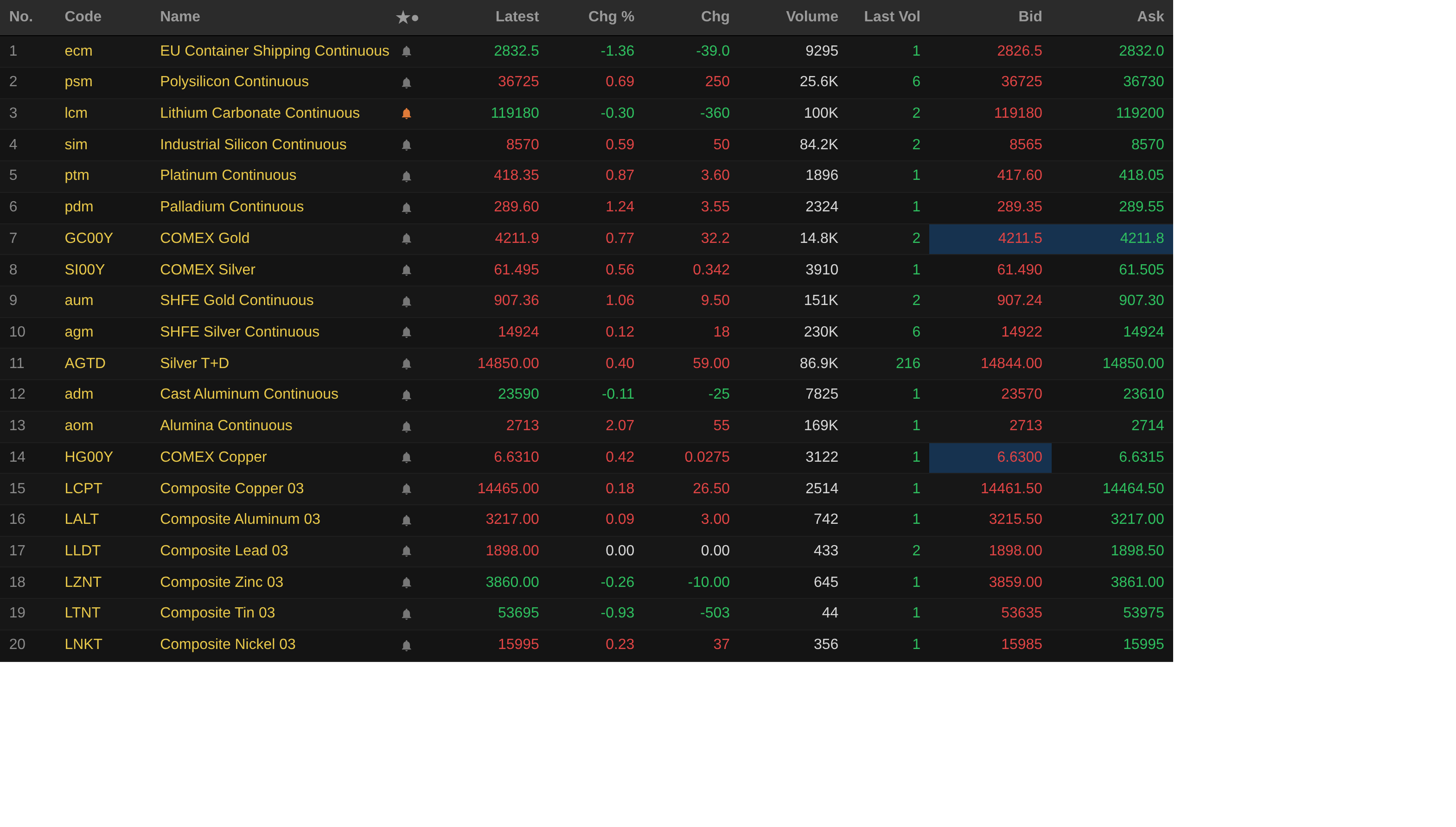
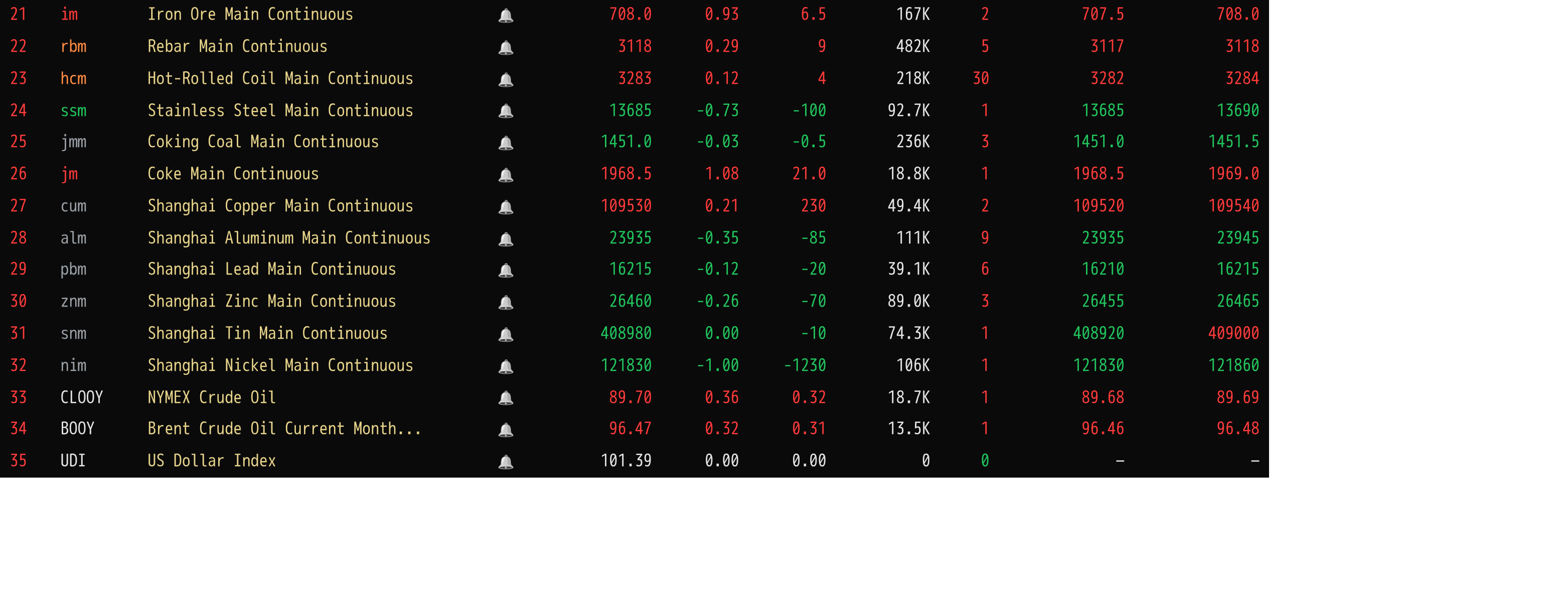
As of the midday close, base metals in the domestic market were nearly all lower. SHFE copper rose 0.21%, while SHFE aluminum fell 0.35%. SHFE lead edged down 0.12%. SHFE zinc fell 0.26%. SHFE tin was flat at 408,980 yuan/mt, and SHFE nickel fell 1%.
In addition, the most-traded cast aluminum futures contract fell 0.11%, while the most-traded alumina contract rose 2.07%. The most-traded lithium carbonate contract fell 0.3%. The most-traded silicon metal contract rose 0.59%. The most-traded polysilicon futures contract rose 0.69%.
Ferrous metals were mostly higher. Iron ore rose 0.93%, rebar rose 0.29%, and HRC rose 0.12%. Stainless steel fell 0.73%. In coking coal and coke, the most-traded coking coal contract edged down, while the most-traded coke contract rose 1.08%.
In overseas base metals, as of 11:41, LME metals showed mixed performance. LME copper rose 0.18%, and LME aluminum edged up 0.09%. LME lead was flat at $1,898/mt, and LME zinc fell 0.26%. LME tin fell 0.93%. LME nickel rose 0.23%.
In precious metals, as of 11:41, COMEX gold rose 0.77%, and COMEX silver rose 0.56%. In domestic precious metals, SHFE gold rose 1.06%, and the most-traded SHFE silver contract rose 0.12%.
In addition, as of the midday close, the most-traded platinum futures contract rose 0.87%, and the most-traded palladium futures contract rose 1.24%.
As of the midday close, the most-traded European shipping futures contract fell 1.36% to 2,832.5 points.
As of 11:41 on September 30, selected futures midday quotes:
Spot and Fundamentals
Copper: Today, spot #1 copper cathode in Guangdong against the front-month contract: high-quality copper was quoted at a premium of 900 yuan/mt, unchanged from the previous trading day; standard-quality copper was quoted at a premium of 600 yuan/mt, unchanged from the previous trading day; SX-EW copper was quoted at a premium of 540 yuan/mt, unchanged from the previous trading day. The average price of #1 copper cathode in Guangdong was 111,130 yuan/mt, up 490 yuan/mt from the previous trading day, while the average price of SX-EW copper was 110,920 yuan/mt, up 490 yuan/mt from the previous trading day. Spot market: Guangdong inventory continued to edge down today, mainly due to reduced arrivals...
Macro Front
Domestic:
[NBS: September manufacturing PMI came in at 50.1%, with the manufacturing sector's prosperity scope expanding] On September 30, 2026, the Service Industry Survey Center of the National Bureau of Statistics (NBS) and the China Federation of Logistics and Purchasing released China's PMI. Huo Lihui, chief statistician at the NBS Service Industry Survey Center, provided an interpretation. In September, the manufacturing PMI, non-manufacturing business activity index, and composite PMI output index stood at 50.1%, 50.2%, and 50.7%, respectively, up 0.3, 1.2, and 1.2 percentage points from the previous month, indicating a rebound in economic activity. By enterprise size, the PMI for large enterprises was 50.6%, unchanged from the previous month and above the threshold; the PMIs for medium-sized and small enterprises were 49.7% and 48.9%, respectively, up 0.3 and 1.0 percentage points from the previous month, both below the threshold. Among the five sub-indices that make up the manufacturing PMI, the production index, new orders index, and supplier delivery time index were all above the threshold, while the raw material inventory index and employment index were below the threshold.
[NDRC: All RMB250 billion of 2026 ultra-long-term special government bonds supporting consumer goods trade-ins have been allocated]Recently, the National Development and Reform Commission, together with the Ministry of Finance, allocated the fourth batch of RMB62.5 billion in ultra-long-term special government bonds for this year to local governments to support consumer goods trade-ins. With this, the full-year allocation of RMB250 billion for consumer goods trade-ins has been completed. Since the beginning of this year, relevant departments have earnestly implemented the decisions and arrangements of the CPC Central Committee and the State Council, optimized the scope, subsidy standards, and implementation methods for consumer goods trade-ins, guided local governments to solidly advance policy implementation, and achieved positive results. From January to August, sales of goods related to trade-ins reached RMB1.55 trillion, with subsidies benefiting 208 million person-times. Among these, 5.353 million vehicles were traded in, 91.458 million units of six categories of home appliances were traded in, and 108 million digital and smart products were newly purchased. Driven by the consumer goods trade-in policy, retail sales of communication equipment, high-efficiency home appliances, and wearable smart devices maintained rapid growth, and the share of passenger NEVs in new passenger vehicle retail sales has exceeded 60% for five consecutive months.
PBOC: Based on demand from primary dealers in open market operations, the volume of 7-day reverse repo operations on September 30, 2026 was zero. Meanwhile, RMB833.5 billion in overnight reverse repo operations were conducted.
US dollar:
As of 11:41, the US dollar index was flat at 101.39. Several US Fed officials spoke intensively on Tuesday, reinforcing expectations that further monetary policy tightening is still needed within the year, but market bets on a near-term rate hike cooled somewhat.
New York Fed President John Williams said there is no need for the Fed to rush into another move after the rate hike at the September meeting, and that it can wait for more economic data to determine the next policy direction. Williams said that if the economy develops broadly in line with his expectations, a further increase in the target range for the federal funds rate may be needed before year-end to bring inflation back to the 2% target in a more timely manner. He stressed, however, that this is only his personal forecast and the final decision will depend on upcoming data. Williams said that with solid economic growth and a well-performing labour market, inflation pressures will remain the focus of monetary policy. He said the US Fed must ensure inflation does not remain persistently elevated due to shocks and avoid second-round inflation effects from taking hold. He noted that inflation pressures this year have been affected by Trump's tariff policies and higher energy prices caused by the Middle East conflict, while AI investment has also pushed up some price pressures. Williams expects US inflation to reach around 3.5% by the end of this year, then gradually pull back and return to the target level in 2028. Williams expects US economic growth of around 2.25% this year and an unemployment rate of around 4% next year. He said immigration factors, an ageing population and limited productivity growth are constraining the economy's long-term growth potential. (Jin10 Data APP)
According to CME "US Fed Watch": the probability of the US Fed keeping rates unchanged at 3.75%-4.00% at its October meeting is 49.6%, while the probability of a 25bp hike is 50.4%. The probability of the US Fed keeping rates unchanged at 3.75%-4.00% by December is 8.5%, the probability of a cumulative 25bp hike is 49.8%, and the probability of a cumulative 50bp hike is 41.8%.
In other currencies:
On Wednesday, the yen strengthened past the 157 level against the US dollar, driven by the Japanese government's repeated release of exchange-rate warnings and quarter-end fund flows. In early Asian trading, the yen rose as much as 0.6% against the US dollar to 156.38, making it the strongest performer among G10 currencies. Japan's top currency official Atsushi Mimura said on Monday that the Japanese prime minister and finance minister, as well as the US side, have recently sent "very clear" signals about currency depreciation. Japanese Prime Minister Sanae Takaichi also said earlier that when she met with US President Trump last week, Trump expressed concern about yen weakness. "The market seems to be gradually accepting the view that policy may be shifting in a more yen-supportive direction," said Moh Siong Sim, a strategist at OCBC Bank. "Since the start of this week, the yen has remained firm after Trump expressed concern about yen weakness." Koike Shinya, head of global markets trading at Sumitomo Mitsui Trust Bank, said quarter-end fund flows may also be one of the factors driving the yen higher. Citigroup strategists said in a report that as the Bank of Japan raises rates and Japanese interest rates rise, the yen's long-term trend may have shifted towards appreciation. Strategists wrote that the policy stance of the Sanae Takaichi government has shifted markedly, with its previous inclination toward pro-inflation policies now likely to have weakened. Citi said that after Japan escaped deflation under former Prime Minister Shinzo Abe's "Abenomics" policies, the shift from supporting a weaker yen to supporting a stronger yen is a necessary transition. Citi said the US policy stance has also changed, moving from previously limiting excessive yen weakness to guiding yen strength.
On the data front:
Today will see the release of the UK Q2 final GDP annual rate, UK Q2 current account, France September preliminary CPI monthly rate, Germany September seasonally adjusted unemployment change, Germany September seasonally adjusted unemployment rate, Switzerland September ZEW investor sentiment index, Germany September preliminary CPI monthly rate, US September ADP employment change, US August core PCE price index annual rate, US August personal spending monthly rate, US Q2 final real GDP annualized quarterly rate, US Q2 final real personal consumption expenditures quarterly rate, US Q2 final core PCE price index annualized quarterly rate, US August core PCE price index monthly rate, US September Chicago PMI, and other data.
In addition, watch for: OpenAI CEO Altman's interview with CNBC; US Fed Governor Barr's speech; 2027 FOMC voter and Chicago Fed President Goolsbee's speech; OpenAI CEO Altman's keynote speech at the OpenAI Developer Conference; 2028 FOMC voter and St. Louis Fed President Musalem's speech at the London School of Economics; FOMC permanent voter and New York Fed President Williams' keynote speech at the University at Buffalo; and US Fed Governor Waller's speech.
Notably: On September 30, China's Shanghai Gold Exchange, SHFE, Zhengzhou Commodity Exchange, and DCE will have no night session trading due to the eve of the National Day holiday; on October 1,China's Hong Kong Exchanges will be closed for one day for National Day, with northbound and southbound trading shut;China's Shanghai, Shenzhen, and Beijing stock exchanges, as well as domestic futures exchanges, will be closed from October 1 (Thursday) to October 7 (Wednesday) for National Day; on October 2, October 5, October 6, and October 7,China's Hong Kong Exchanges will operate normally, with northbound and southbound trading shut.
On the crude oil front:
As of 11:41, oil prices in both markets edged up, with WTI up 0.36% and Brent up 0.32%. The market continues to watch developments in the Middle East situation.
According to the Financial Times, mediators are making a renewed push for a deal between the US and Iran. Two officials briefed on the negotiations said mediators are expected to submit the latest revised draft of the interim agreement to Iran on Tuesday after shuttling between US and Iranian officials on Monday. Under the terms of the agreement, Iran would allow ships to pass freely through the Strait of Hormuz, and the US would correspondingly lift its blockade of Iranian ports. The mediators hope this interim agreement can push both sides to resume negotiations on a final plan to end the war. One of the officials said progress has been made in the talks, but the parties are still bargaining over the sequencing of implementation in the subsequent phases of the agreement. The officials said follow-up measures include the US restoring oil waivers and allowing Iran to sell oil, enabling Tehran to access some of its frozen assets outside China, as well as arrangements related to Iran's nuclear program, including allowing International Atomic Energy Agency inspectors to return to Iran. (Jin10 Data APP)
According to CCTV News, the US Department of Energy's Office of Strategic Petroleum Reserve Project Management issued a solicitation announcement on the 29th, planning to release 40 million barrels of crude oil to the market through an "exchange" arrangement. According to the announcement, enterprises planning to participate in the "exchange" need to submit proposals in the coming days. After the "exchange" contracts are announced, the federal government is expected to deliver reserve crude oil in batches in November and December. Enterprises can begin returning the crude oil as early as April 2027, with the latest return deadline being the end of 2029.
Spot Market Overview:
►
►
►
►
►
►
►
►
►
►
►