September 29, 2026 News:
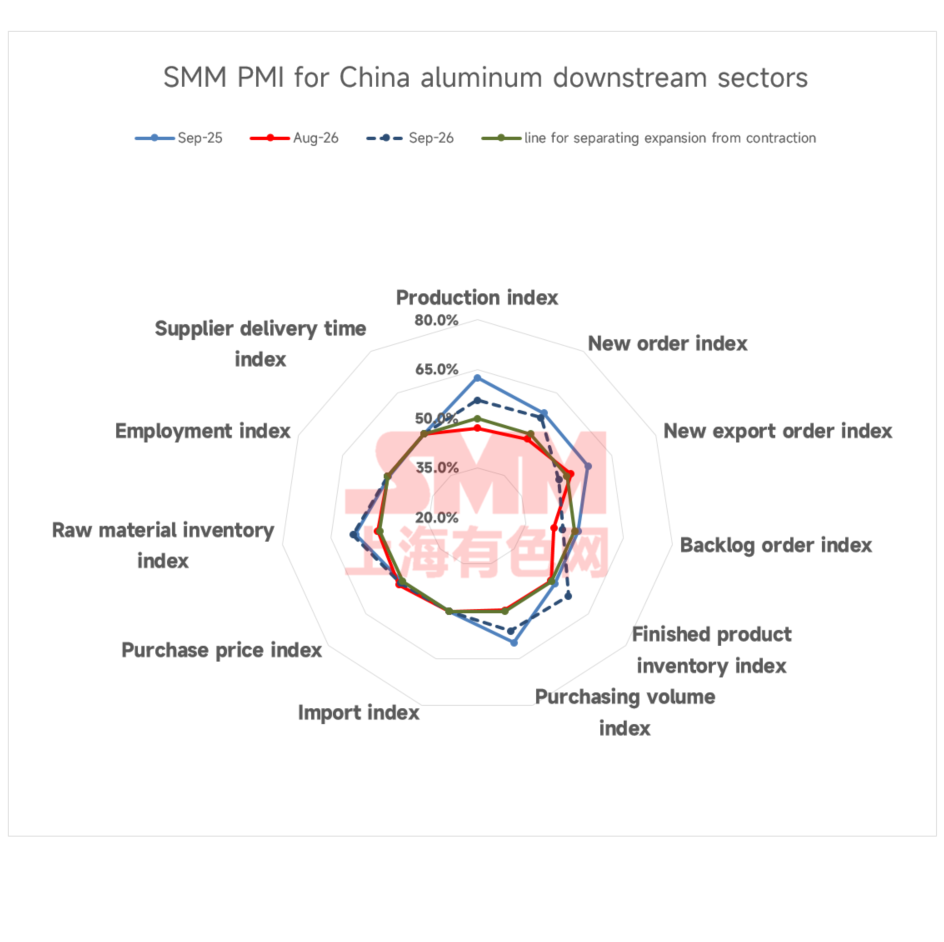
In September, China's aluminum processing industry composite PMI came in at 53.9%, up significantly from 48.7% in August and returning above the 50-mark after two months, with the industry shifting from a "weak recovery" to "structural expansion," though divergence among sectors further intensified. Among the seven major downstream sectors, the primary aluminum alloy PMI came in at 61.6%, with stronger peak-season production willingness and continuous destocking of finished goods; the secondary aluminum alloy PMI came in at 60.1%, up sharply by 13.4 percentage points MoM, as improved auto and motorcycle orders drove a rebound in sentiment; the aluminum plate, sheet and strip PMI came in at 56.7%, with both the production index and new orders index at 58.9%, but the new export orders index plunged to 39.7% and the finished goods inventory index surged to 69.2%, highlighting dual pressure from exports and inventories; the industrial aluminum profile PMI came in at 53.7%, underpinned by strong orders for new energy vehicle components and energy storage, though low processing fees and long payment collection periods constrained order-taking; the aluminum foil PMI came in at 52.6%, with battery foil production schedules already booked through December and packaging foil peak-season orders full, effectively offsetting weakness in air-conditioner foil; the aluminum wire and cable PMI came in at 51.8%, still in expansion territory, but the new orders index fell 12.7 percentage points from August, indicating notably weakening order momentum; the construction aluminum profile PMI came in at 48.9%, remaining the only sector below the 50-mark, as deeply negative growth in new housing starts and completions dragged on end-user demand, with the "Golden September" boost relatively mild.
By product category:
Aluminum Plate, Sheet and Strip: The aluminum plate, sheet and strip industry composite PMI came in at 56.7% in September, returning to a strong expansion range. By sub-index, both the production index and new orders index came in at 58.9%, indicating a phased recovery in production load and order intake during the traditional "Golden September and Silver October" peak season, with some 5-series and 6-series thick plates even showing supply shortages. The procurement volume index (62.4%) and raw material inventory index (67.8%) both expanded sharply—a rare simultaneous surge—reflecting concentrated stockpiling by enterprises for the peak season and the National Day holiday, leaving factory raw material inventories temporarily ample. However, structural contradictions were also sharply prominent: the new export orders index plunged to 39.7%, deep in contraction territory, as the domestic-international price spread continued to narrow in September, exports lost core economic viability, and some main products even faced losses; some orders shipped early in a "front-running" manner also front-loaded subsequent demand, cooling new export orders. The finished goods inventory index surged to a high of 69.2%, as aluminum prices remained above 24,000 yuan/ton in September, strong price aversion among end-users led to blocked shipments, and some enterprises were forced to accumulate finished goods inventories. Overall, although the industry is in an expansion channel, high aluminum prices and the rapid export slump have constrained upside room, and the aluminum plate, sheet and strip PMI is expected to return to around the 50-mark in October, with the sustainability of peak-season momentum in question.
Aluminum Foil: The aluminum foil industry composite PMI came in at 52.6% in September, with the core drivers being the steady expansion of the production index (53.7%) and new orders index (53.7%), thanks to strong structural divergence within the industry providing an offset: on one hand, demand for battery aluminum foil remained strong, with some enterprises continuously shifting capacity toward battery foil and production schedules booked through December, providing a solid foundation for overall operations; on the other hand, packaging foil entered a peak-season order fulfillment window, with single-zero foil, double-zero foil, and aseptic packaging orders full, together effectively offsetting continued weakness in the air-conditioner foil segment. The new export orders index reached 59.5%, with rigid overseas packaging demand in Q4 underpinning export order output. On inventories, the finished goods inventory index came in at 58.4%, similar to the predicament in aluminum plate, sheet and strip, as high aluminum prices also slowed downstream pickup and blocked shipments, forcing some enterprises to accept inventory accumulation. The procurement volume index and raw material inventory index expanded simultaneously, with enterprises proactively maintaining relatively ample raw material stocks. Overall, the robust performance of the aluminum foil PMI in September was jointly underpinned by the strength of battery foil and peak-season fulfillment of packaging foil. Looking ahead, supported by peak-season effects, leading aluminum foil enterprises can still maintain relatively full order books, but growth has quietly slowed.
Construction Aluminum Profiles: The construction aluminum profile PMI came in at 48.9% in September, still below the 50-mark. By sub-index, the new production index was 47.7%, the new orders index 48.1%, and the procurement volume index 49.1%, all recovering MoM, with sentiment improving somewhat from last month. Order structure continued to diverge: some large enterprises in traditional production regions such as Guangdong and Shandong still focused on executing large engineering orders such as corporate headquarters and school construction, with a relatively stable base; while terminal volume from window and door distribution and home decoration retail channels remained below expectations. On inventories, enterprises adhered to "procurement based on orders" for raw materials and strictly scheduled production and delivered on time for finished goods, continuing a proactive strategy of keeping finished goods inventories low. Overall, against the backdrop of deeply negative growth in new housing starts and completions, the "Golden September" peak season provided only a mild boost to construction aluminum profile demand, with no trend reversal in end-user demand expected, and the construction aluminum profile PMI is expected to remain weakly below the 50-mark in October.
Industrial Profiles: The industrial aluminum profile industry composite PMI came in at 53.7% in September, returning above the 50-mark. By sub-index, the production index was 57.4%, the new orders index 56.3%, and the procurement volume index 55.8%, all returning to expansion territory simultaneously. Demand showed a pattern of peak-season support with terminal divergence. Driven by the traditional consumption peak season, some manufacturers reported a clear increase in new energy vehicle component aluminum profile orders in early September, driving monthly production higher; energy storage component aluminum profiles continued steady growth in demand amid industry expansion. For photovoltaic aluminum frames, driven by order delivery pressure in early October, some leading frame manufacturers maintained relatively full production from last month, but some enterprises reported expectations that downstream module makers would cut production schedules, taking a weak view on subsequent production. On exports, the August export index came in at 50.8%, above the 50-mark; some enterprises in Anhui reported increased export orders in September for aluminum ladders, textile machinery parts, and industrial tubes and bars, and industrial profile exports are expected to remain broadly stable. On raw material procurement, the rebound in the procurement volume index mainly followed the increase in new orders, with enterprises still stocking based on order demand. Overall, industrial aluminum profiles returned to expansion territory in September, with demand for supporting aluminum profiles performing well across terminals under traditional consumption drivers. However, although energy storage and new energy vehicle component orders are growing well, they face constraints of low processing fees and long payment collection periods, and some enterprises plan to moderately control the scale of orders accepted; combined with photovoltaic frames being dragged by expectations of lower module production schedules, industrial profile sector sentiment is expected to decline somewhat in October but remain above the 50-mark.
Aluminum Wire and Cable: The domestic aluminum wire and cable industry PMI came in at 51.8% in September, down 2.7 percentage points MoM. Although still above the 50-mark, expansion momentum weakened notably, and the industry's sentiment recovery fell short of expectations. By segment, the production index came in at 52.33%, up 4.58 percentage points from 47.75% in August, returning above the 50-mark, with enterprise production schedules returning to normal and industry operations recovering slightly, but with aluminum prices persistently high, enterprises mostly focused on just-in-time production and on-demand stocking, and production enthusiasm improved only limitedly. The new orders index came in at 52.25%, down 12.7 percentage points from 64.95% in August; although grid projects gradually entered the execution phase, actual pickup pace has not yet ramped up. The new export orders index came in at 47.67%, down 5.36 percentage points from 53.03% in August, falling back into contraction territory, with overseas new order levels still fragmented and unable to provide effective support. The backlog of orders index came in at 54.20%, down 4.86 percentage points from 59.06% in August, with order backlogs continuously being worked down and enterprises scheduling production based on existing orders. The procurement volume index came in at 59.06%, up 2.14 percentage points from 56.92% in August, and the raw material inventory index came in at 63.59%, up 5.7 percentage points from 57.89% in August, with pre-holiday stocking basically completed. Overall, the aluminum wire and cable industry's operating side improved somewhat in September from August, but the recovery was weaker than expected, order-side performance remained weak, and production enthusiasm improved only limitedly; with the Mid-Autumn Festival and National Day holidays approaching, mainstream aluminum wire and cable enterprises' production lines will basically continue normal operations during the holidays, but some enterprises reported plans for production line maintenance during the holiday, which may reduce production load during the period. Combined with poor grid delivery expectations this year and fewer orders in hand YoY, the aluminum wire and cable industry PMI is expected to show a moderate recovery in October.
Primary Alloy: The primary aluminum alloy industry PMI came in at 61.6% in September, returning above the 50-mark, a clear improvement from earlier, indicating a recovery in industry sentiment and a warming market mood. By sub-index, the September production index reached 70.48%, with overall output higher than August, showing that enterprises increased production willingness against the backdrop of the traditional "Golden September and Silver October" peak season, with production-side activity clearly rising. At the same time, overall order volumes also gradually expanded, with both supply and demand showing positive signs and industry operations recovering somewhat from earlier. On inventories, some enterprises maintained normal production schedules while demand increased slightly, driving some destocking of finished goods in factories, with the finished goods inventory index at 43.47%, below the 50-mark, indicating that inventories did not accumulate but instead declined slightly. During the Mid-Autumn Festival, downstream enterprises of leading primary aluminum alloy producers did not arrange holidays, and products continued to be shipped out, so inventories did not pile up notably, maintaining a relatively smooth destocking pace. However, demand recovery was still constrained to some extent. September aluminum prices were overall higher than August, with prices continuing to run at high levels, suppressing bulk orders to some extent and preventing new orders from achieving significant growth. Meanwhile, auto demand declined YoY, with overall demand somewhat lower, but increased MoM, showing signs of marginal improvement, though recovery strength remained limited. Looking ahead to October, the industry remains in the traditional peak season, and overall sentiment is expected to remain above the 50-mark. Aluminum price centers are expected to decline somewhat, which to some extent will help ease downstream cost pressure and further improve market sentiment. However, it should be noted that overall supply this year exceeds last year while demand growth lags supply, and market supply-demand pressure persists. In summary, the primary aluminum alloy industry PMI is expected to be around 59.4% in October, down somewhat from September but still above the 50-mark, with the industry overall in a moderate expansion range.
Secondary Alloy: The secondary aluminum industry PMI came in at 60.1% in September, up 13.4 percentage points MoM, returning above the 50-mark, with improved industry sentiment. On demand, as the traditional consumption peak season gradually kicked off, orders from major downstream sectors such as autos and motorcycles improved somewhat from earlier, with enterprises accelerating order-taking and procurement pace, driving demand-side recovery, though peak-season demand release remained relatively moderate and downstream purchasing enthusiasm did not increase notably. On production, improved demand drove a rebound in enterprise operating rates, but tight supply of compliant scrap aluminum and high procurement costs still constrained output release to some extent. At the end of September during the Mid-Autumn Festival, most enterprises basically maintained normal production; during the National Day holiday, large enterprises or aluminum liquid direct-supply enterprises, considering continuous production and downstream supporting demand, generally did not halt production, though some enterprises moderately reduced production load; other enterprises mainly took 3-5 days off, with a few enterprises more affected by insufficient orders or tax invoice restrictions possibly extending holidays to about 7 days. On inventories, as enterprise operations recovered, factory finished goods inventories increased somewhat; on the raw material side, to ensure production and peak-season order delivery, enterprises overall increased scrap collection enthusiasm, but due to tight supply of compliant scrap aluminum and increased procurement difficulty, raw material inventory increases were limited, and enterprises still face stocking pressure. Looking ahead to October, the National Day holiday will cause phased disruption to industry production, and although enterprises are expected to gradually resume normal production after the holiday, industry sentiment is expected to decline somewhat from September due to holiday impacts; meanwhile, whether peak-season demand can continue to be released and the impact of tax invoice policies on compliant scrap aluminum supply remain key market focuses going forward.
Outlook:
Looking ahead to October, the "Golden September and Silver October" peak-season effect will diminish marginally, and combined with phased disruption to some production lines from the National Day holiday, aluminum processing industry sentiment is expected to pull back from highs, with the composite PMI likely returning toward the 50-mark. By sector: the primary aluminum alloy PMI is expected to fall to around 59.4%, still in moderate expansion; secondary aluminum sentiment is expected to decline somewhat from September due to holiday production disruption and tight compliant scrap aluminum supply; aluminum plate, sheet and strip PMI is expected to hover around the 50-mark under the dual constraints of rapid export decline and high finished goods inventories, with peak-season momentum sustainability in question; leading aluminum foil enterprises can still maintain relatively full order books, but growth has quietly slowed; industrial aluminum profile sentiment is expected to decline somewhat but remain above the 50-mark; aluminum wire and cable is expected to show moderate recovery against the backdrop of weak grid delivery expectations and fewer orders in hand YoY; construction aluminum profiles will remain weakly below the 50-mark, with no trend reversal in end-user demand expected. Overall, the sector divergence pattern will continue in October, with high aluminum prices and weak exports still constraining upside room.