SMM, September 26:
Metals market:
Overnight, base metals on the domestic market were closed for the Mid-Autumn Festival holiday.
Overnight, ferrous metals were closed for the Mid-Autumn Festival holiday.
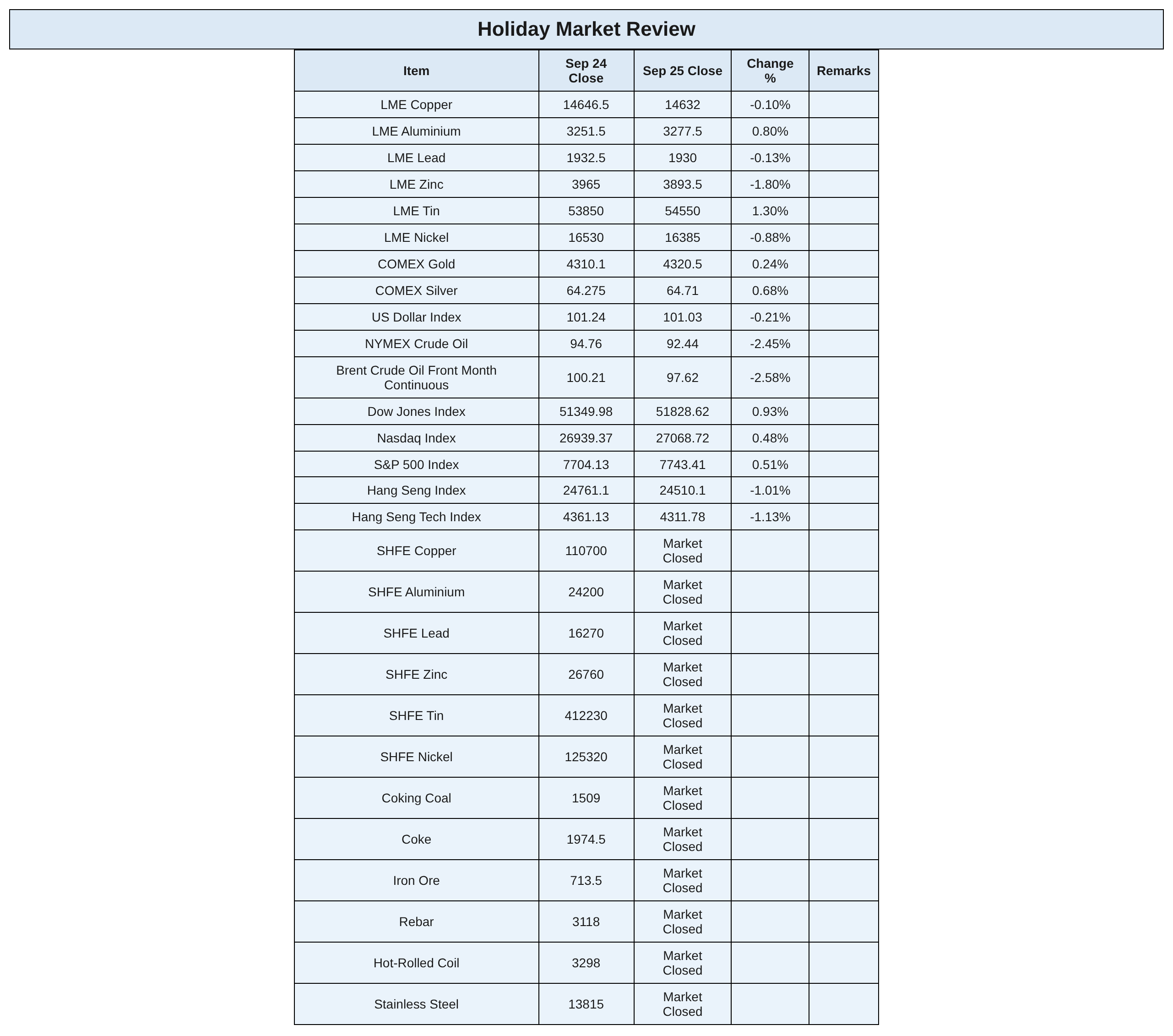
Overnight on the overseas market, LME base metals mostly fell. LME copper fell 0.1%, LME aluminum rose 0.8%. LME lead fell 0.13%. LME zinc fell 1.8%. LME tin rose 1.3%. LME nickel fell 0.88%.
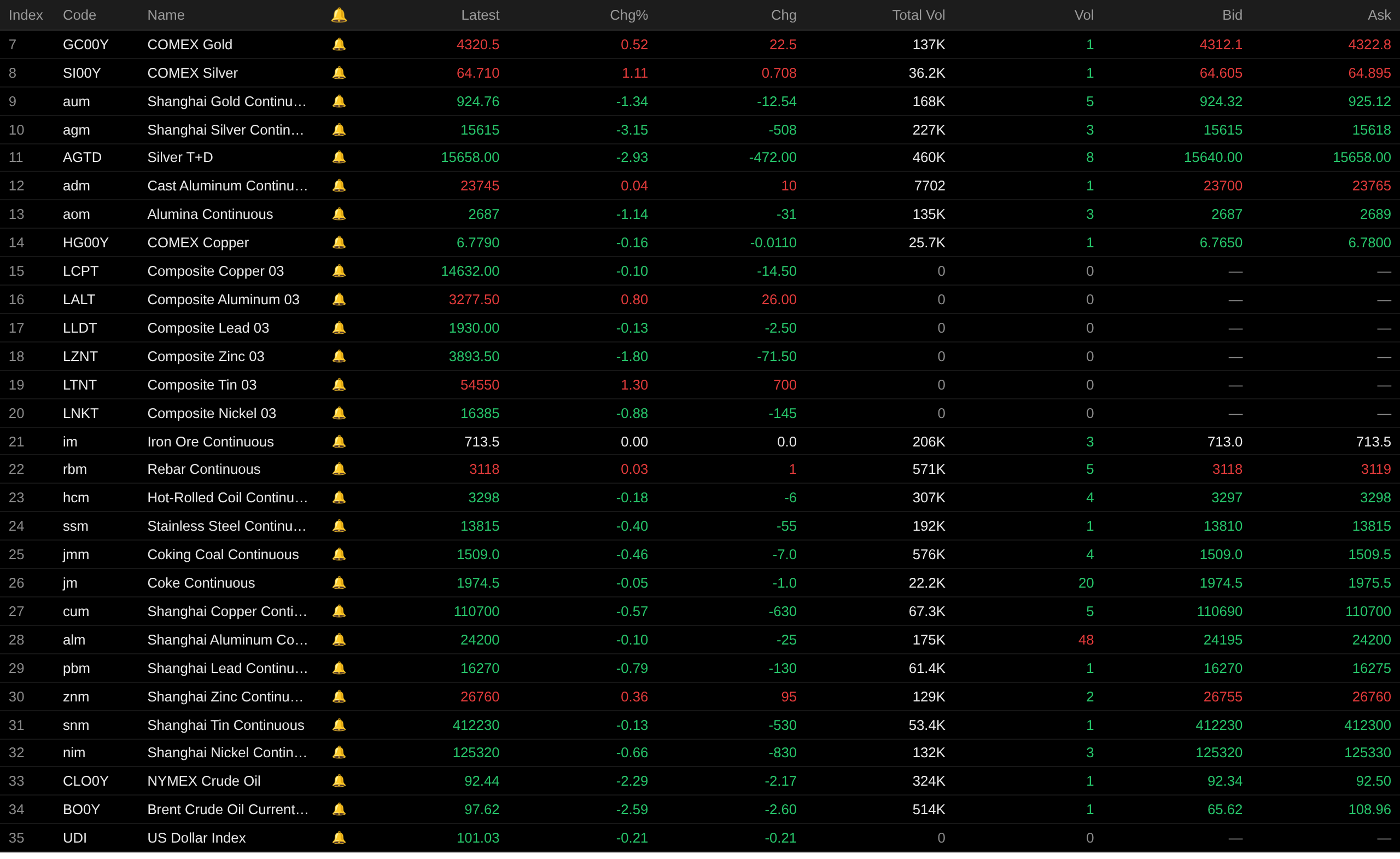
Overnight in precious metals : COMEX gold rose 0.52%, with COMEX gold posting a weekly decline of 2.36% for the week; COMEX silver rose 1.11%, with COMEX silver posting a weekly decline of 3.63% for the week. Overnight, the most-traded SHFE gold contract was closed for the Mid-Autumn Festival holiday, with SHFE gold posting a weekly decline of 1.97% for the week; the most-traded SHFE silver contract was closed for the Mid-Autumn Festival holiday, with SHFE silver posting a weekly decline of 2.75% for the week.
Other financial markets:
In addition, US stocks: On Friday, September 25, US stocks drifted higher. Early-session fluctuations in US stocks were notably driven by US economic data. After the final reading of the University of Michigan consumer sentiment index for September was released, both the S&P 500 and the Nasdaq briefly turned slightly lower, and the Dow briefly gave back most of its gains. Shortly thereafter, the three major indices regained their upward momentum, and the Dow snapped a three-day losing streak. As of the close on September 25, the Dow Jones Industrial Average rose 0.93% to 51,828.62 points; the Nasdaq Composite rose 0.48% to 27,068.72 points; the S&P 500 rose 0.51% to 7,743.41 points.
Hong Kong stocks: As of the close on September 25, the Hang Seng Index fell 1.01% to 24,510.09 points; the Hang Seng Tech Index fell 1.13% to 4,311.78 points.
As of 8:15 a.m. on September 26, overnight closing prices:
Macro front
China:
[On the first day of the Mid-Autumn Festival holiday, cross-regional passenger flows nationwide exceeded 243 million] According to the latest data from the Ministry of Transport, on the first day of the Mid-Autumn Festival holiday, cross-regional passenger flows nationwide were expected to exceed 243 million, up 6.4% from the previous day. Passenger flows on highways, railways, civil aviation, and waterways all increased notably, and transport authorities added capacity to ensure orderly travel. (CCTV)
[HKEX's derivatives clearing house to accept China government bonds, policy bank bonds, and MOF bonds as non-cash collateral from November] Hong Kong Exchanges and Clearing Limited (HKEX) announced today (Friday) that its wholly-owned subsidiaries and exchange derivatives clearing houses, HKFE Clearing Corporation Limited (HKCC) and The SEHK Options Clearing House Limited (SEOCH), will accept China government bonds and policy bank bonds held through Bond Connect "Northbound Trading" (collectively, Bond Connect bonds), as well as bonds issued offshore by the Ministry of Finance of the People's Republic of China (MOF bonds), as eligible non-cash collateral for margin requirements, effective from November 2026, subject to regulatory approval. Bonnie Liu, Chief Operating Officer of Hong Kong Exchanges and Clearing, said the implementation of this enhancement will increase the use cases for Chinese government bonds in the Hong Kong market. By accepting these bonds as collateral for meeting clearing house margin requirements, HKEX will help provide market participants with more flexible collateral management options, improve capital efficiency, and promote the continued development of Hong Kong's fixed income and RMB ecosystem. (Jin10 Data APP)
US dollar:
The US dollar index fell 0.21% overnight to 101.03. Weekly: The US dollar index posted its second consecutive weekly gain, rising 0.81% for the week.
Data: University of Michigan survey data showed US consumers' assessments of their current and future personal finances over the next year both declined by about 10%, with concerns over high prices continuing to mount. Buying conditions for durable goods improved slightly, partly because consumers believe completing such purchases now helps avoid future price increases. Expectations for short-term business conditions deteriorated sharply as the market renewed concerns that high fuel prices and an escalation in trade disputes could spill over into the broader economy. Overall, the survey showed respondents across political affiliations generally believe the US economic outlook has weakened compared with the start of the year. After the sharp drop in consumer confidence this month, sentiment among Republicans fell 20% from January 2026, while sentiment among Democrats fell 13% over the same period. One-year-ahead inflation expectations rose to 4.6% this month from 4.0% last month, the highest level since June. This level is now significantly above the 3.4% recorded in February before the Iran conflict began and above all months in 2024. Long-term inflation expectations edged up to 3.4%, ending three consecutive months at 3.3%. This expectation remains above the 2.8% to 3.2% range seen in 2024. (Jin10 Data APP)
A gauge of US Treasury volatility is heading for its biggest gain in more than a year after bond yields climbed to multi-decade highs, shaking the market out of its recent slump. ICE BofA's MOVE Index, a measure of bond market volatility, has risen about 29.69% this week, the largest increase since last April's so-called "Liberation Day," when Trump's sweeping import tariffs triggered global market turmoil. The index has now climbed to its highest level since March this year, when the Iran war first broke out. With markets swinging wildly, many traders have opted to stay on the sidelines. For example, Adam Kurpiel, head of rates strategy at Societe Generale, said his team currently holds a neutral view on US rates and is waiting for "volatility to decline before trading." (Jin10 Data APP)
Cleveland Fed President Beth Hammack said the recent sharp rise in US Treasury yields was not driven by a loss of confidence in the pullback of inflation, but was primarily propelled by higher real rates, a strong economic outlook, fiscal policy, and competition for investor funds. She said inflation expectations remain "generally well anchored" at present, but inflation persistently above the Fed's 2% target still imposes real costs and may affect economic planning and wage pressures. Hammack said the biggest inflation risk now is the formation of an "inflation mentality," where the public begins to believe high inflation will persist over the long term. She noted that inflation has been above target for multiple consecutive years, and the Fed needs to ensure monetary policy remains restrictive to drive inflation back to the 2% target. On the bond market, Hammack said the rise in yields partly reflects market repricing of Fed policy and government fiscal policy, while investment demand in AI and the tech sector is also competing with the bond market for investment funds. She also said the current US fiscal path is unsustainable. (Jin10 Data APP)
Apollo Global Management Chief Economist Torsten Slok warned that the inflation threat from record diesel prices may exceed the Fed's current expectations, because fuel costs are feeding through into the core consumer price index. Slok said diesel-related transportation costs differ from the impact of gasoline prices. Because transporting goods is critical to business activity, from retail supply chains to data center construction, demand is highly inelastic, and price increases will ultimately be passed on to enterprises and consumers. The impact of rising diesel prices is particularly critical as the Fed formulates monetary policy after its first rate hike since 2023. Inflation remains clearly above the central bank's 2% target. So-called core inflation measures strip out energy factors, and Slok believes the Fed cannot simply treat rising diesel prices as a transitory phenomenon, because they will affect core inflation categories through spillover effects. (Jin10 Data APP)
On the macro front:
Next week will see the release of China's August year-to-date industrial profits above designated size YoY, the US September Dallas Fed business activity index, Australia's RBA rate decision through September 29, Switzerland's September KOF economic leading indicator, UK August mortgage approvals, Eurozone September industrial sentiment, Eurozone September economic sentiment, Canada July GDP MoM, US July FHFA house price index MoM, US July S&P/CS 20-city unadjusted house price index YoY, US August JOLTs job openings, US September Conference Board consumer confidence, China September official manufacturing PMI, Australia August unadjusted CPI YoY, China September RatingDog manufacturing PMI, China September RatingDog services PMI, UK Q2 GDP YoY final, UK Q2 current account, France September CPI MoM preliminary, Germany September seasonally adjusted unemployment change, Germany September seasonally adjusted unemployment rate, Switzerland September ZEW investor confidence, Germany September CPI MoM preliminary, US September ADP employment change, US August core PCE price index YoY, US August personal spending MoM, US Q2 real GDP annualized QoQ final, US Q2 real personal consumption expenditures QoQ final, US Q2 core PCE price index annualized QoQ final, US August core PCE price index MoM, US September Chicago PMI, Switzerland September CPI MoM, Switzerland August real retail sales YoY, France September manufacturing PMI final, Germany September manufacturing PMI final, Eurozone September manufacturing PMI final, UK September manufacturing PMI final, Eurozone August unemployment rate, US September Challenger job cuts, US initial jobless claims for the week ending September 26, US September S&P Global manufacturing PMI final, US September ISM manufacturing PMI, US August construction spending MoM, Japan August unemployment rate, Eurozone September CPI YoY preliminary, Eurozone September CPI MoM preliminary, US September unemployment rate, US September seasonally adjusted nonfarm payrolls, US September average hourly earnings YoY, US September average hourly earnings MoM, US August factory orders MoM, and other data.
In addition, the following events should be watched next week: Bank of England Deputy Governor Ramsden speaks on quantitative tightening; the Reserve Bank of Australia announces its interest rate decision; RBA Governor Bullock holds a monetary policy press conference; 2027 FOMC voting member and Chicago Fed President Goolsbee speaks; 2028 FOMC voting member and St. Louis Fed President Musalem speaks at the London School of Economics; FOMC permanent voting member and New York Fed President Williams delivers a keynote speech at the University at Buffalo; 2027 FOMC voting member and Richmond Fed President Barkin delivers welcome remarks at an event; Fed Governor Lisa Cook speaks; 2027 FOMC voting member and Chicago Fed President Goolsbee speaks; 2026 FOMC voting member and Minneapolis Fed President Kashkari speaks; the Bank of Japan releases the summary of opinions from its September monetary policy meeting; Bank of England Governor Bailey speaks; Richmond Fed President Barkin, Boston Fed President Collins, and Kansas City Fed President Schmid speak; ECB President Lagarde speaks; FOMC permanent voting member and New York Fed President Williams moderates a discussion at a central bank symposium hosted by the New York Fed, with Fed Governor Lisa Cook attending the same discussion; 2026 FOMC voting member and Dallas Fed President Logan speaks; 2026 FOMC voting member and Dallas Fed President Logan delivers welcome remarks at the fifth "Macroeconomic Implications of Immigration" symposium.
It is worth noting that: On September 30, China's SGE, SHFE, ZCE, and DCE will have no night session due to the eve of the National Day holiday; on October 1, the Hong Kong Stock Exchange will be closed for one day for National Day, with northbound and southbound trading suspended; China's Shanghai and Shenzhen stock exchanges, the Beijing Stock Exchange, and domestic futures exchanges will be closed from Thursday, October 1 to Wednesday, October 7 for National Day; on October 2, October 5, October 6, and October 7, the Hong Kong Stock Exchange will be open as usual, with northbound and southbound trading suspended.
In crude oil:
Both oil futures fell overnight, with WTI down 2.29% and Brent down 2.59%. On the weekly chart, WTI futures posted a second consecutive weekly decline, falling 3.79% for the week; Brent futures also fell for a second straight week, down 1.68% for the week.
Oil prices fell on Friday as the market weighed the possibility of US-Iran ceasefire talks while also fretting that escalating Houthi attacks on Saudi Arabia could disrupt supply from the major Middle Eastern producer. This followed a week of wild swings in the market. According to sources close to the discussions, US and Iranian negotiators meeting in New York this week have explored a phased path to ending the conflict, including Tehran reopening the Strait of Hormuz and Washington lifting its economic blockade on Iran. Iranian President Pezeshkian said on Thursday that when the war ends still depends on US decisions. In any case, vessel traffic data released by Reuters still shows that the physical supply situation remains fragile. On Wednesday, only 10 commodity vessels passed through the Strait of Hormuz, up from 7 the previous day but still significantly below the daily average of about 17 over the past 10 days. Positive news on diplomatic progress may help oil prices shed some geopolitical premium, but shipping data still indicates that any true normalization is still some distance away. (Jin10 Data APP)
On September 25 local time, a US official revealed that the US is engaged in "active and constructive" discussions with Iran following Iran's plan to open the Strait of Hormuz and resume negotiations after the proposal is accepted. The official said the US is in no rush, as it is currently in a favorable position; he noted that nearly 40 million barrels of oil have passed through the Strait of Hormuz under US escort in the past 48 hours. (CCTV)
According to people familiar with the matter, Iraq's state marketing company is offering last-minute crude cargoes to buyers, as high freight costs complicate purchases from deep in the Persian Gulf. Given its location far from the Strait of Hormuz, Iraq faces more difficulties in transportation than some neighboring countries and instead relies on trading companies to market and transport its crude. It has offered steep discounts to incentivize buyers, lowering prices for Basrah Medium and Heavy crude in recent tenders. (Jin10 Data APP)
In addition, Russia's seventh-largest refinery by crude processing volume, the Perm refinery, has halted operations after a Ukrainian drone attack. Two industry sources said the attack sparked a fire on Friday and caused damage to pipelines, storage facilities, and process units. The refinery is located about 1,460 km (907 miles) northeast of Moscow and processed about 12.6 million mt of crude oil in 2024, or 252,000 barrels per day; it produced 2 million mt of gasoline, 5.3 million mt of diesel, 200,000 mt of fuel oil, and 700,000 mt of petroleum coke. (Jin10 Data APP)
Recommended reading: