Market Review
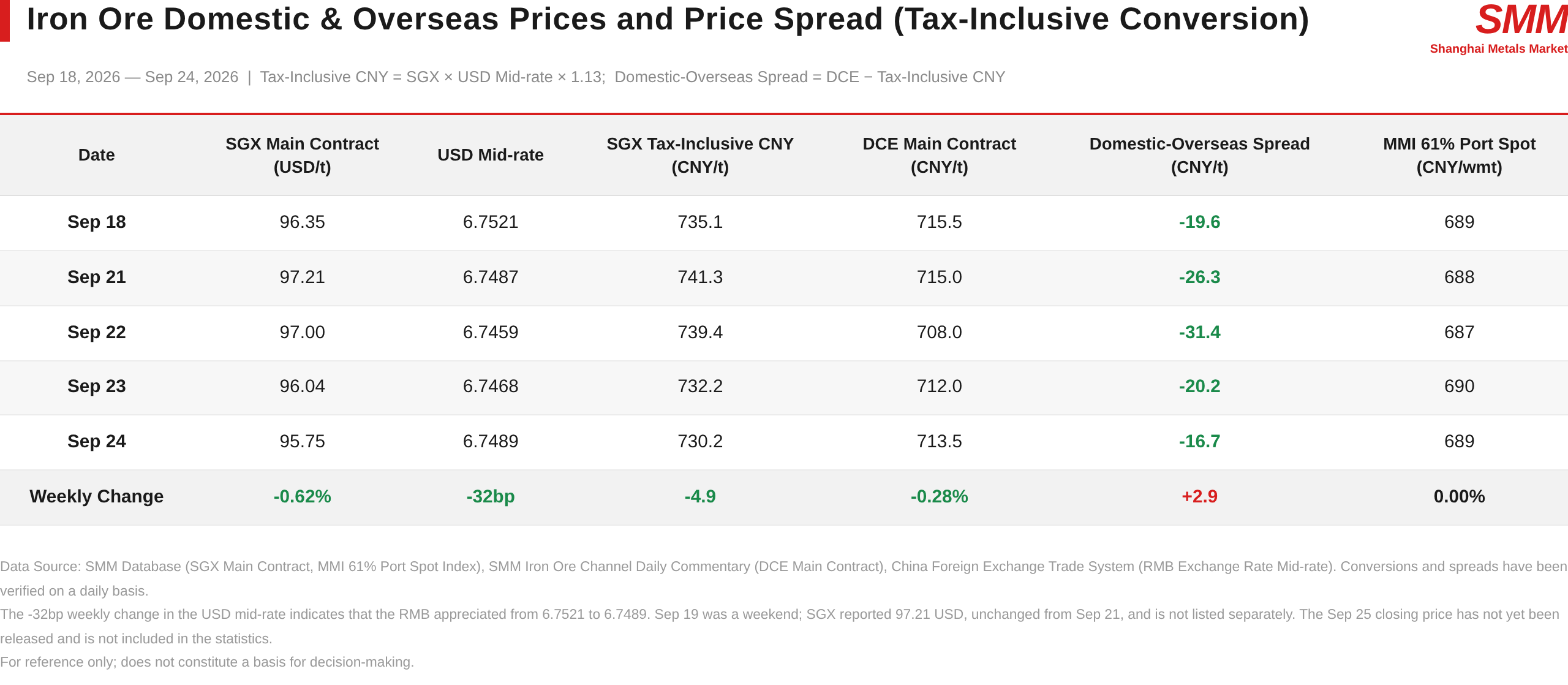
The most-traded SGX contract pulled back from $96.35/mt on September 18 to $95.75/mt on September 24, down 0.62% for the week; the most-traded DCE I2701 contract edged down from 715.5 yuan/mt to 713.5 yuan/mt, down 0.28%; the MMI 61% iron ore port spot index closed at 689 yuan/wmt, flat from last Friday.
Looking first at average prices. The MMI 61% port spot weekly average price was 688.6 yuan/wmt this week, compared with 687.0 yuan/wmt last week, up 1.6 yuan WoW, consistent with our daily commentary's statement that "the weekly average price rose about 2 yuan WoW." The close was flat while the average moved higher, indicating the price center was pushed up once mid-week, only to return to its original level before Friday. Support came from pre-holiday restocking, rising ocean freight rates, and expectations of supply contraction from Brazil.
Turning to the price spread between Chinese and overseas markets, this line traced a full expansion-then-convergence pattern. It stood at −19.6 yuan/mt on September 18, widened to −31.4 yuan/mt by September 22, then retraced over the following three sessions to −16.7 yuan/mt, a net narrowing of 2.9 yuan for the week. This shape closely matched the news flow: on September 22, rumors of low-grade ore import restrictions being lifted dragged down the domestic market, with DCE falling 1.05% that day while the overseas market slipped only slightly, widening the spread; on September 23, the overseas market led the decline, giving back $1.25 over two sessions, and the spread retraced accordingly. In other words, this week's strength rotation between domestic and overseas markets was driven by rumors, with limited connection to fundamentals, and no clear direction emerged.
The central parity rate of the yuan strengthened by 32 basis points over the week to 6.7489, providing some offset to import costs, but the extent was limited; in yuan terms, SGX still fell 4.9 yuan/mt.
Fundamental pressure concentrated on the inventory side
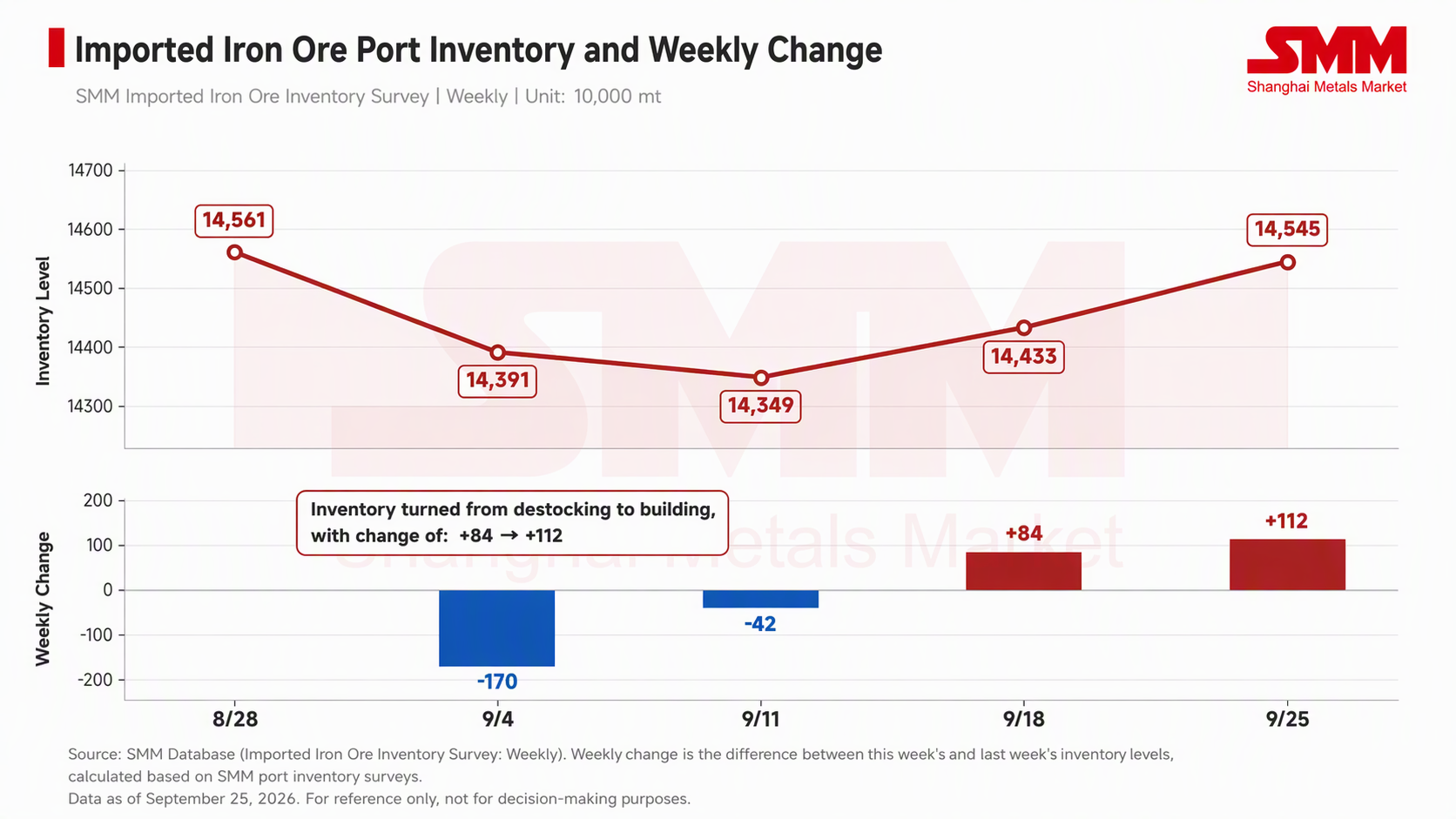
SMM data showed nationwide imported iron ore inventories (combined basis) at 144.33 million mt on September 18 and 145.45 million mt on September 25, an inventory buildup of 1.12 million mt WoW; the previous week saw inventories rise from 143.49 million mt to 144.33 million mt, a buildup of 840,000 mt WoW. Inventories built for two consecutive weeks, with the increment expanding by one-third. Over the same period, daily average port pick-up volume on September 18 fell 25,000 mt WoW to 3.21 million mt; on September 24, total inventories at the 10 key ports stood at 102.59 million mt, up 680,000 mt WoW, with the buildup concentrated in coarse fines, while concentrate, lump ore, and pellets all showed mild destocking.
Shipments, meanwhile, have already begun to retreat. Last week, total global iron ore shipments were 34.41 million mt, down 8% WoW, with cumulative volume flat YoY; both Australia and Brazil edged lower, while Peru and India among non-mainstream countries posted notable growth. However, total iron ore arrivals into China reached 31.32 million mt, up 16% WoW, with cumulative arrivals up 4.8% YoY. Shipments have retreated from highs, but arrivals are still surging, as the cargoes currently being unloaded are from the earlier volume push. The release of supply pressure lags by roughly two to three weeks, which explains why shipments have already turned negative WoW while port inventories are still accelerating their buildup.
Demand side: restocking provides a floor, maintenance expands
As of this week, most steel mills had not yet completed pre-holiday stockpiling, and purchasing demand extended into the week. But stockpiling is nearing its end, with mills showing strong willingness to buy the dip and clearly pushing for lower prices; spot transactions were overall sluggish, and the floor support weakened day by day. This is also why ore price declines were limited this week.
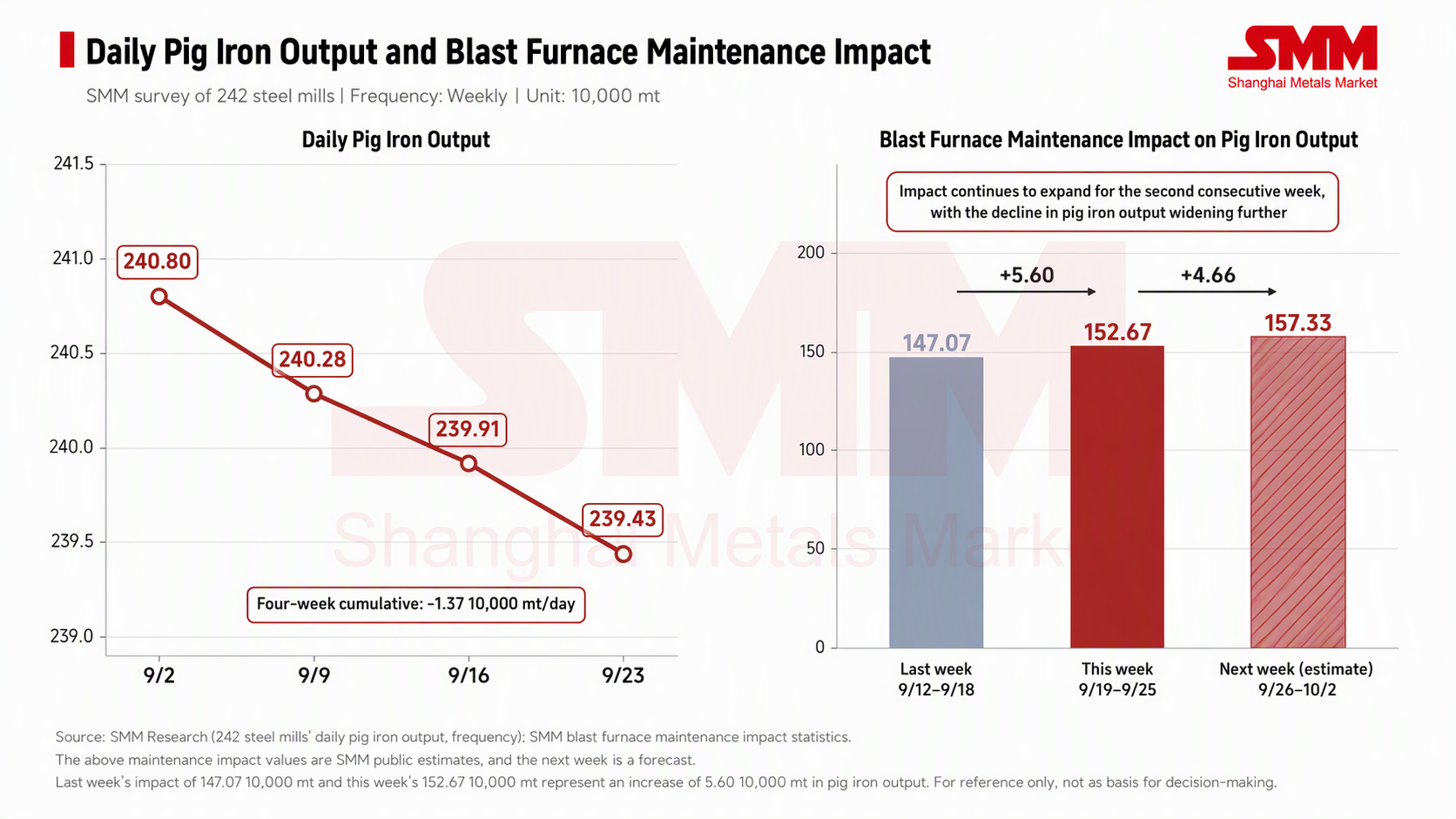
According to SMM statistics, this week (September 19–25), blast furnace maintenance impacted hot metal production by 1.5267 million mt, up 56,000 mt WoW; next week (September 26–October 2), the impact is expected to rise to 1.5733 million mt, up another 46,600 mt WoW. On September 23, SMM data showed the blast furnace operating rate at 242 steel mills was 88.76%, down 0.17 percentage points WoW; daily average hot metal production at sample mills was 2.3943 million mt, down 4,800 mt WoW.
The current hot metal decline is mild, but the impact from maintenance has already been scheduled at 1.5733 million mt for next week, and the increment itself is widening. This points to an accelerated decline in hot metal after the holiday, rather than a collapse in the current period. The root cause lies in persistent losses at steel mills; without profit recovery, the maintenance scope will be difficult to narrow.
On the event front, two rumors in opposite directions
This week's price disturbances came almost entirely from the news flow. On September 22, rumors of low-grade ore import restrictions being lifted dragged down the domestic market; on September 23, rumors of reduced Brazilian shipments boosted the overseas market. The two rumors pointed in opposite directions, arrived one day apart, were neither strongly confirmed, and neither changed fundamentals. But with both sellers and buyers lacking clear drivers, they amplified intraday futures volatility and the swing in the price spread between Chinese and overseas markets considerably. This week's rise in ocean freight rates, together with the Brazil expectation, was counted among the support factors for the weekly average price moving higher.
On September 18, the Iron Ore Working Committee of the China Iron and Steel Association (CISA) held a meeting in Beijing to make arrangements for the upcoming launch of an imported iron ore port spot price index by the Beijing Iron Ore Trading Center, with procurement heads from domestic steel mills and traders in attendance. There was no direct impact on current prices, but the pricing mechanism angle is worth watching.
At the macro level, no new variables emerged this week. Market sentiment this week was dominated by a tug-of-war between the tail end of restocking and maintenance expectations, then repeatedly pushed by two unconfirmed rumors, leaving prices oscillating within a narrow range without ever choosing a direction.
Market Outlook and Key Watchpoints
Next week, pre-holiday stockpiling will come to an end, and the maintenance impact rising to 1.5733 million mt will materialize; floor support will exit while pressure factors enter. Port inventory buildup has confirmed acceleration, and arrivals remain at high levels, so downward pressure on ore prices will be greater than this week. However, with funds leaving the market and open interest contracting before the National Day holiday, volatility is expected to narrow. The most-traded SGX contract is expected to trade in a reference range of $94–97/mt, with the price center shifting lower; a substantive break below will still need to wait for the post-holiday hot metal decline to materialize. The price spread between Chinese and overseas markets has now narrowed to −16.7 yuan/mt; if the overseas market continues to lead declines and pushes the spread into positive territory, import margins will be squeezed, forward purchase willingness will retreat accordingly, and the domestic market's relative resilience will be difficult to sustain.
![[SMM Iron Ore Weekly] Faster Inventory Builds Meet Widening Maintenance: Supply and Demand Are Already Weakening](https://imgqn.smm.cn/usercenter/aPBtI20251217171717.jpg)
![[Coal to Power India Till 2035-36 — A Boost for Steel & Induction Furnace Sector]](https://imgqn.smm.cn/usercenter/rBCZR20251217171716.jpg)
![[SMM Steel] European HRC: Supply Tightness Fails to Lift Prices](https://imgqn.smm.cn/usercenter/zLhJl20251217171720.jpg)