With the National Day holiday approaching, SMM conducted an in-depth survey on the holiday production arrangements of 14 major wire and cable enterprises in China, with a combined sample capacity of 1.444 million mt. The details are as follows:
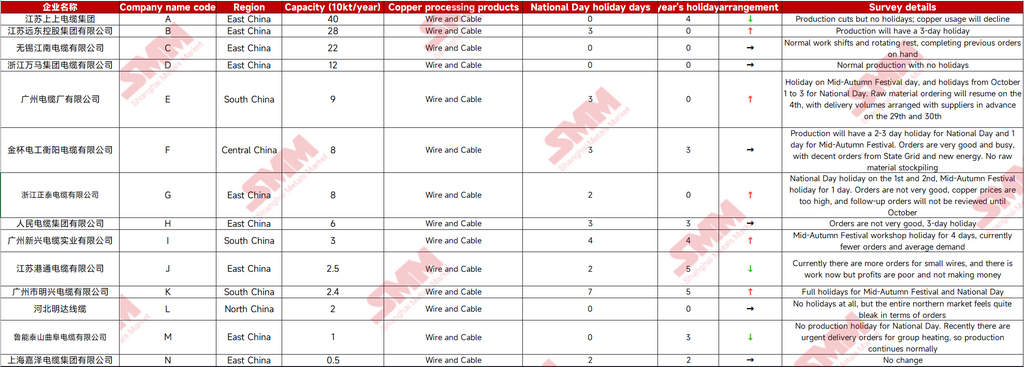
From the holiday data, the surveyed enterprises had an average holiday duration of 2.07 days this year, flat YoY. However, last year featured an 8-day combined National Day and Mid-Autumn Festival break, while this year's National Day holiday is 7 days, meaning the statistical baseline was reduced by 1 day. This indicates that the actual downtime arranged by enterprises has lengthened in relative terms. Enterprise holiday strategies diverged notably. Large wire and cable enterprises with bigger capacity mostly chose to continue production or implement minor production cuts to ensure continuity in project delivery, while small and medium-sized wire and cable factories showed greater production flexibility. Those with weaker orders proactively extended downtime, arranging holidays as needed to reduce production and raw material holding costs.
Regarding pre-holiday raw material stockpiling, constrained by high copper prices and high premiums, wire and cable enterprises showed generally weak willingness to stock up on raw materials. Most factories reduced advance stockpiling and instead made cautious purchases as needed based on order progress, to avoid inventory impairment risks from copper price fluctuations.
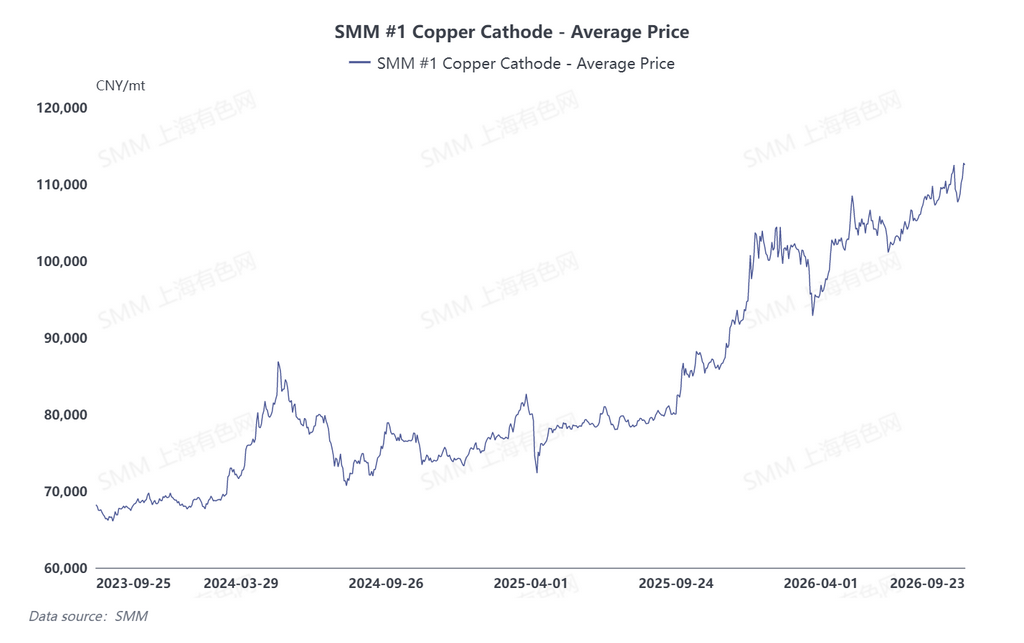
According to SMM, in terms of order performance, weak end-use demand combined with elevated copper prices suppressed downstream purchase willingness. New orders at enterprises were not smoothly connected, and some factories' orders on hand were not enough to support full-capacity production during the holiday. In addition, rising copper prices drove up raw material costs, causing some low-priced orders taken earlier by enterprises to incur losses, with overall profit margins being severely squeezed. Meanwhile, the rise in copper prices pushed up current raw material procurement costs, and many enterprises' previously accepted low-priced orders fell into losses, with industry-wide profit margins continuing to be compressed. By end-user segment, the power sector was supported by rigid orders from the power grid, and new energy demand still showed resilience, but overall end-user orders did not see a substantive recovery in the traditional peak season.
Looking ahead to October, copper prices are expected to remain above 110,000, continuing to suppress downstream purchasing enthusiasm, and many wire and cable enterprises remain cautious about downstream demand. The market has concerns about the pace of copper wire and cable procurement releases from State Grid and China Southern Power Grid in October, and with the continuation of earlier weak demand, "underperform in peak season" will become the mainstream judgment for the October consumer market. However, copper price movements still need to be watched. If copper prices show room for a pullback, orders are expected to see marginal recovery.