I. Survey Overview: Production Halts Expand, Stockpiling Intentions Generally Cautious
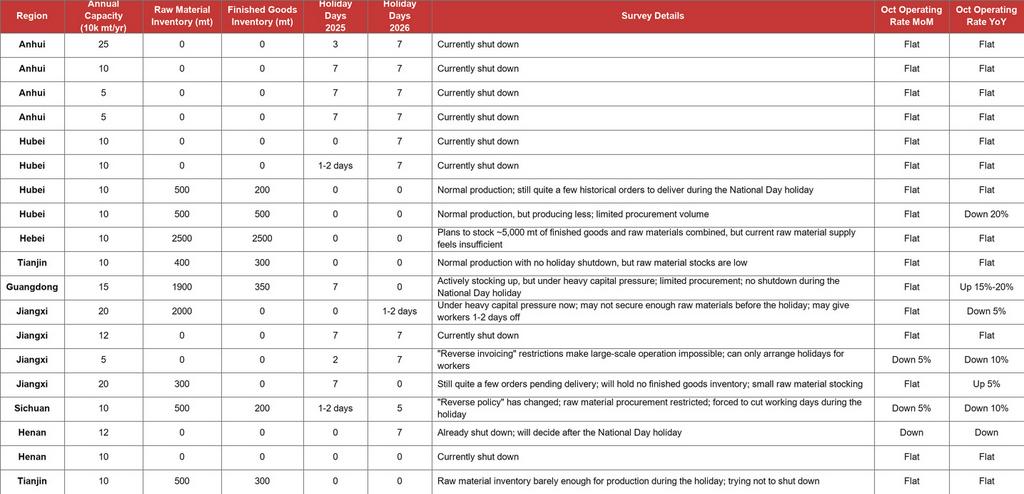
With the National Day holiday approaching, SMM conducted a survey on pre-holiday stockpiling and production arrangements among 19 secondary copper rod enterprises across 8 provinces and cities, including Anhui, Hubei, Hebei, Tianjin, Guangdong, Jiangxi, Sichuan, and Henan, with a combined annual capacity of 2.19 million mt. The survey results show that the industry currently presents a stark "two extremes" landscape: 9 enterprises are in a state of production halt, involving an annual capacity of 990,000 mt, accounting for approximately 45% of the total sample capacity; among enterprises maintaining production, raw material stockpiling is also generally cautious, with 10 enterprises reporting zero raw material stockpiles, and the pre-holiday "stockpiling wave" did not materialize as expected.
II. Stockpiling Situation: Raw Material Restocking Clearly Divergent, Finished Product Inventories Generally Low
On the raw material side, only 9 of the 19 sampled enterprises actually stockpiled, with a combined stockpiling volume of approximately 9,600 mt, and the concentration was relatively high: one enterprise in Hebei planned to stockpile around 5,000 mt each of raw materials and finished products, making it the most active producer in this survey, though it also admitted that "raw materials are currently not quite sufficient"; one enterprise each in Guangdong (1,900 mt) and Jiangxi (2,000 mt) had stockpiling volumes of around 2,000 mt; the remaining enterprises with stockpiles were mostly at low levels of 300–500 mt. On the finished product side, the sampled enterprises' combined finished product stockpiles totaled only about 4,350 mt, with most enterprises choosing to hold "zero finished product inventory" over the holiday. Two enterprises in Jiangxi explicitly stated that "there are still quite a few pending orders to deliver, so there will be no finished product inventory," and an enterprise in Hubei also noted that "there are still many historical orders to be delivered during the National Day holiday." This reflects that in an environment of weak demand, enterprises generally adopt a defensive strategy of producing based on sales and operating with low inventories.
III. Holiday Arrangements: Holidays Generally Extended to 7 Days, Production Halt Scope Exceeds Last Year
Compared with 2024, the 2025 National Day holiday arrangements have been significantly extended: the number of enterprises in the sample taking a full 7-day holiday increased from 6 last year to 9; one enterprise in Sichuan took 5 days off; another enterprise in Jiangxi arranged 1–2 days of worker rotation. Even enterprises maintaining production mostly reported "normal production, just producing a bit less."
It is worth noting that the production halts at some enterprises are not solely due to holiday factors—one enterprise in Henan with 120,000 mt of capacity "has already halted production and will decide after the National Day holiday," and 4 enterprises in Anhui (with a combined capacity of 450,000 mt) are all in a state of production halt, reflecting the operational difficulties the industry faces under the dual squeeze of raw materials and capital. IV. Triple Pressures: Policies, Capital, and Orders Weigh on Operations
Survey details reveal that the sluggish stockpiling this round stems from three overlapping pressures:
1. The "reverse invoicing" policy constrains raw material procurement. A 50,000 mt enterprise in Jiangxi stated bluntly, "The 'reverse invoicing' policy has restrictions, so we cannot operate at scale and have no choice but to send workers on holiday." A Sichuan enterprise also reported, "The 'reverse invoicing' policy has changed, limiting raw material procurement, forcing us to reduce operating days during the holiday." The compliance bottleneck in copper scrap invoicing has become the primary factor constraining enterprises' purchase willingness.
2. Capital pressure limits procurement capacity. A Guangdong enterprise said it was "actively stockpiling, but capital pressure is high and procurement volume is limited." A 200,000 mt enterprise in Jiangxi also noted, "Capital pressure is high, and we may not procure sufficient raw materials before the holiday."
3. Order structure is dominated by existing orders. Multiple operating enterprises are maintaining production on the back of historical orders pending delivery, while remaining cautious about taking on new orders, naturally weakening the incentive to stockpile before the holiday.
V. October Operating Rate Outlook: Roughly Flat MoM, Weaker YoY
Looking ahead to October, the operating rates of surveyed enterprises are expected to remain "flat" MoM as the main theme (14 enterprises), but 4 enterprises already anticipate a MoM decline (3 of them by around 5%, and one suspended enterprise in Henan explicitly expects a decline).
The YoY divergence is more pronounced: an enterprise in Hubei expects a 20% decline, while multiple enterprises in Jiangxi and Sichuan expect declines of 5%-10%. Only a Guangdong enterprise (up 15%-20%) and one Jiangxi enterprise (up 5%) expect YoY growth. Overall, the pattern of "stable MoM, under pressure YoY" for October industry operating rates is essentially established.
VI. Summary: Defensive Holiday Stance Becomes Industry Consensus
Based on this survey, the secondary copper rod industry did not see the traditional concentrated pre-holiday stockpiling ahead of the National Day holiday. Amid tightening "reverse invoicing" policies, high capital lockup, and weak end-user orders, enterprises have made highly consistent choices: those that can avoid halting production are maintaining operations with low inventory and produce based on sales; those unable to withstand the pressure are simply halting production early and extending holidays. Pre-holiday raw material stockpiling is concentrated among a few well-capitalized top-tier players, while the trend of small and medium-sized capacity exiting the market continues to accelerate. After the holiday, close attention should be paid to changes in policy implementation and the recovery of copper scrap supply, which will determine whether Q4 industry operating rates can stabilize and rebound.