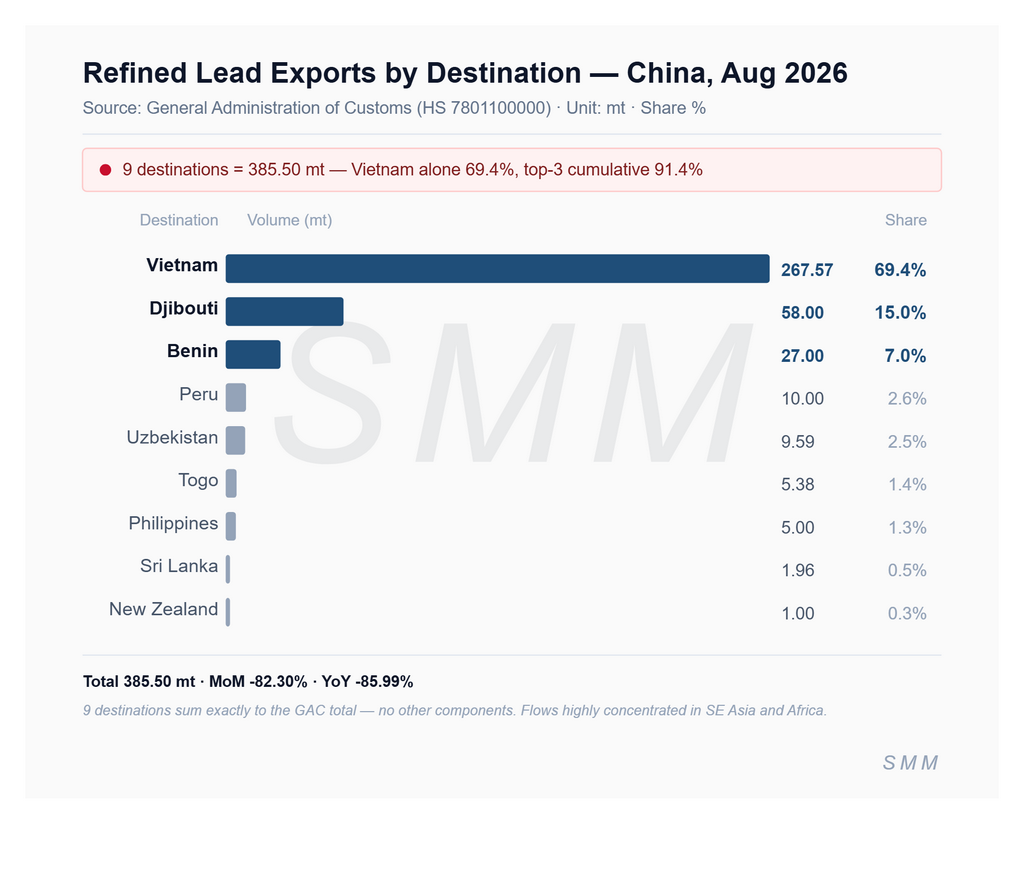
China Customs data shows that in August 2026, the refined lead trade landscape became increasingly "polarized": exports totaled only 385.5 mt, plunging 82.30% MoM and falling 85.99% YoY; cumulative exports from January to August reached 31,800 mt, contracting sharply by 31.80% YoY. Imports came in at 9,178.51 mt, down 0.39% MoM but surging 404.16% YoY; cumulative imports from January to August reached 165,400 mt, up 648.73% YoY.
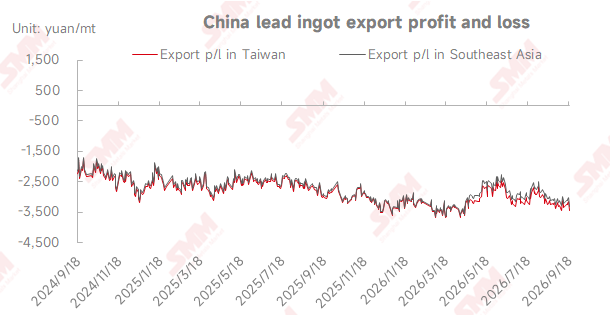
Exports by country showed extreme concentration—Vietnam alone accounted for 267.57 mt, or 69.4%, Djibouti 58 mt, or 15.0%, and Benin 27 mt, or 7.0%, with the top three combined at 91.4%; Peru, Uzbekistan, Togo, the Philippines, Sri Lanka, and New Zealand each shipped under 10 mt, together less than 9%. This pattern stemmed from an inverted price ratio: SMM's Southeast Asia export profit margin stood at -3,238.52 yuan/mt at end-August, widening the loss by 201.8 yuan MoM, forcing smelters to passively cut export orders, with only a small volume of long-term contracts and rigid regional orders from Southeast Asia and Africa keeping flows alive.
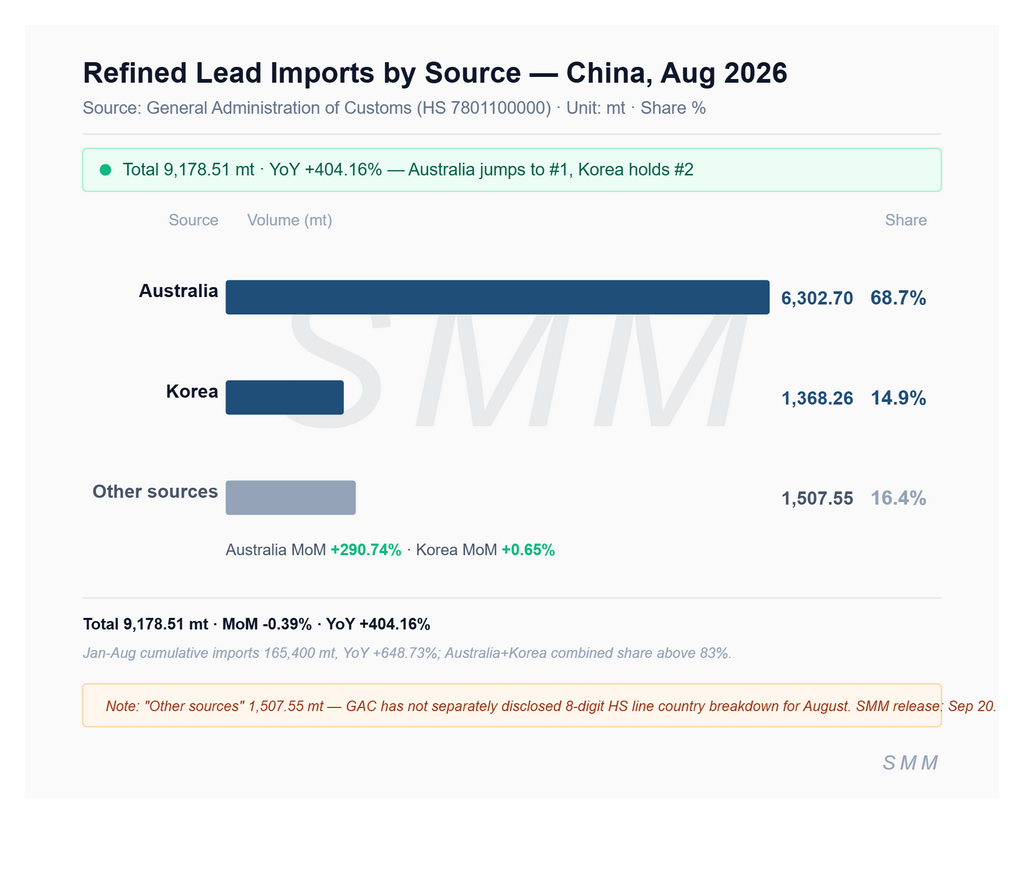
Imports by country showed an "Australia-South Korea duopoly"—Australia dominated with 6,302.7 mt, or 68.7%, surging 290.74% MoM, followed by South Korea at 1,368.26 mt (up 0.65% MoM), with the two countries combined exceeding 83%; the remaining 1,507.55 mt was spread across multiple countries. The SHFE/LME price ratio strengthened, and import profit margins stayed above 150 yuan/mt throughout August.
In September, lead-acid battery enterprises successively carried out concentrated lead ingot stockpiling for the Mid-Autumn Festival and National Day holidays, making lead market trading active. After primary lead smelters sold out their inventories, some downstream enterprises shifted procurement to social warehouse sources, driving overall inventory lower; meanwhile, imported crude lead gradually arrived at ports to supplement supply, but new transaction orders performed poorly. At present, most downstream enterprises have largely wrapped up their stockpiling, and with primary lead smelters in central and northern China about to complete maintenance, the supply gap may be eased to some extent. However, given that primary lead smelters are producing against back-to-back orders, social inventory of lead ingots is expected to continue declining in the short term. Entering October, SMM expects the pace of imported lead ingot arrivals to accelerate, with social inventory accumulation expectations rising in mid-to-late October; lead prices will encounter resistance on the upside, and import profit margins may face compression.