India’s domestic sponge iron market has reached its highest level in two years, with prices continuing to rise to mid-September. The recent increase has been driven mainly by higher input costs, particularly thermal coal, while improving buying interest and some restocking have also supported the move. Producers have been passing higher costs on to buyers, with the price rise therefore appearing predominantly cost-driven, while a speculative element has also started to build over the past two weeks.
I.Bellary and Raipur lead the charge
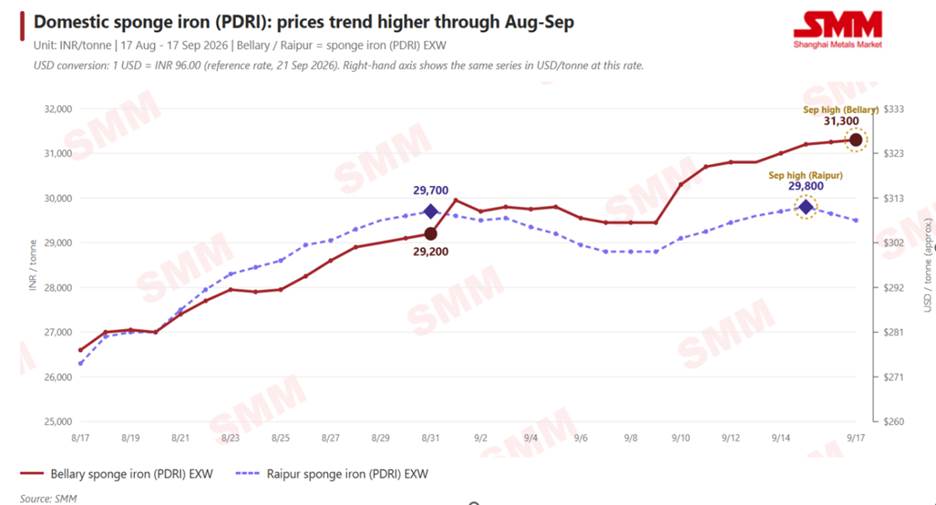
PDRI Sponge iron prices moved to a two-year high at the end of August and kept climbing into mid-September, with gains ranging from around 1-22 USD/tonne (100-2,100 INR/tonne) across key markets. On our tracked benchmarks, Raipur PDRI sponge iron touched a two-year high of 309 USD/tonne (29,700 INR/tonne) EXW on August 31 and touched at 310 USD/tonne (29,800 INR/tonne) EXW Raipur on September 15. While Bellary PDRI was assessed at 304 USD/tonne (29,200 INR/tonne) on August 31 and pushed further to 326 USD/tonne (31,300 INR/tonne) EXW as of September 17.
On a monthly basis, Bellary PDRI increased by 49 USD/tonne (4,700 INR/tonne) EXW Bellary or 17.7% rising from 277 USD/tonne (26,600 INR/tonne) on August 17 to 326 USD/tonne (31,300 INR/tonne) on September 17. Raipur PDRI prices rose by 33 USD/tonne (3,200 INR/tonne) (12.2%) MoM from 274 USD/tonne (26,300 INR/tonne) on August 17 to 307 USD/tonne (29,500 INR/tonne) on September 17. Over the same period, Raipur billet prices increased by 57 USD/tonne (5,500 INR/tonne) or 14.1% MoM, from 406 USD/tonne (39,000 INR/tonne) to 464 USD/tonne (44,500 INR/tonne). The rise in both PDRI and billet prices suggests that higher input costs were being partly passed through to billet buyers, while buyers' acceptance of higher prices provided some support to the market. However, the price increase appears to have been driven more by higher raw-material costs than by a sharp improvement in end-user demand.
Trading volumes stayed healthy on days when prices rose, which is consistent with necessity-driven buying as mills continued to cover immediate raw material needs, although some market participants were also restocking amid expectations of further price increases. Margins for downstream billet makers have also stayed largely stable, indicating that most of the cost increase is being passed down the chain rather than absorbed by producers.
II.Coal Cost drivers
India is the world's largest sponge iron producer, with roughly 336 plants and around 50 million tonnes of annual output and the steel and sponge iron sector accounts for about 40% of India's imported coal. Sponge iron in India is largely made through the coal-based (rotary kiln) route, which mainly runs on non-coking (thermal) coal — sourced both domestically and via imports from Indonesia, South Africa, and Russia.
There are various factors have pushed coal costs higher this year:
-
Rising freight and insurance costs: Higher bunker and insurance costs amid heightened Middle East tensions have increased the landed cost of imported coal into India, adding to buyers’ overall procurement costs.
-
Firmer global coal prices: Higher thermal coal prices have increased input costs for Indian sponge iron producers, adding to domestic production costs. Thermal Coal prices from key suppliers have risen since May, with Indonesian thermal coal up 18–20%, while Russian and South African thermal coal prices increased by 14% and 19%, respectively, according to trade sources.This has added to cost pressure in the domestic sponge iron market.
-
Tight domestic coal supply: Power plants got priority access during peak summer demand, while monsoon rains disrupted both mining output and rail transport — leaving little room for sponge iron makers to fall back on cheaper domestic coal.
Producers are keeping inventories lean, buying only what they need immediately rather than stocking up at current high prices. This is also reflected in thermal coal imports by steel and sponge iron makers, which fell by 11% in June and 19% in July.
III.Scrap Substitution
Buyers here means the induction furnace and EAF steel mills that use scrap or sponge iron as their raw material. Right now, most of them are leaning toward sponge iron over scrap because it works out cheaper, which keeps demand for sponge iron steady even as prices rise. Scrap stays an option, but its supply is less consistent, so mills are largely sticking with sponge iron instead of switching over.
IV.Market comment
Industry participants attribute the tightness partly to buying patterns earlier in the year — importers had scaled back coal purchases in June and July when import prices looked expensive relative to domestic levels, which ended up creating a supply gap and pushing domestic coal prices higher. On the sponge iron side, buyers who initially held off in hopes of a price correction have since returned to cover urgent requirements, while sellers have stayed firm on offers, expecting further increases. In Bellary, some deals were reportedly concluded around 325–326 USD/tonne (31,200-31,300 INR/tonne) while higher offers near 328–329 USD/tonne (31,500-31,600 INR/tonne) EXW Bellary are meeting resistance. Market voices also point out that part of the recent price jump has an element of speculative behaviour — in a rising market, sellers tend to hold back stock and buyers rush to lock in supply, a pattern that can reverse quickly if prices correct. At the same time, most participants expect the market to stabilise sometime in September, since sustained high input costs could eventually strain manufacturers' margins and cool demand.
V.Outlook
The market may depend on whether the sponge iron-scrap price gap narrows further, which could shift some demand toward scrap, and whether buying interest remains strong enough to support current price levels.
Sponge iron prices look likely to stay firm near current levels over the next couple of months. A meaningful correction would most likely need lower global coal prices, easing freight costs, or a faster recovery in domestic coal supply, although seaborne thermal coal prices have shown that they can turn lower quickly when Chinese and Indian buying weakens. India’s continued push to substitute imported coal with domestic supply could also add downside pressure on coal prices and, in turn, sponge iron costs.
Note: Prices and volumes referenced are indicative spot-level figures for market commentary purposes and move daily; this is not investment or trading advice.
Xe conversion: (1 USD = 96 INR), on September 21
![[Domestic Iron Ore Brief] Iron ore concentrates prices in Shandong are expected to consolidate on a subdued note](https://imgqn.smm.cn/usercenter/SEwWP20251217171716.jpg)
![[Malaysia steel price index up 0.1-5.1% y-o-y in September, rebar average down 2.4% m-o-m]](https://imgqn.smm.cn/usercenter/exdqc20251217171717.jpg)