Weekly Market Review
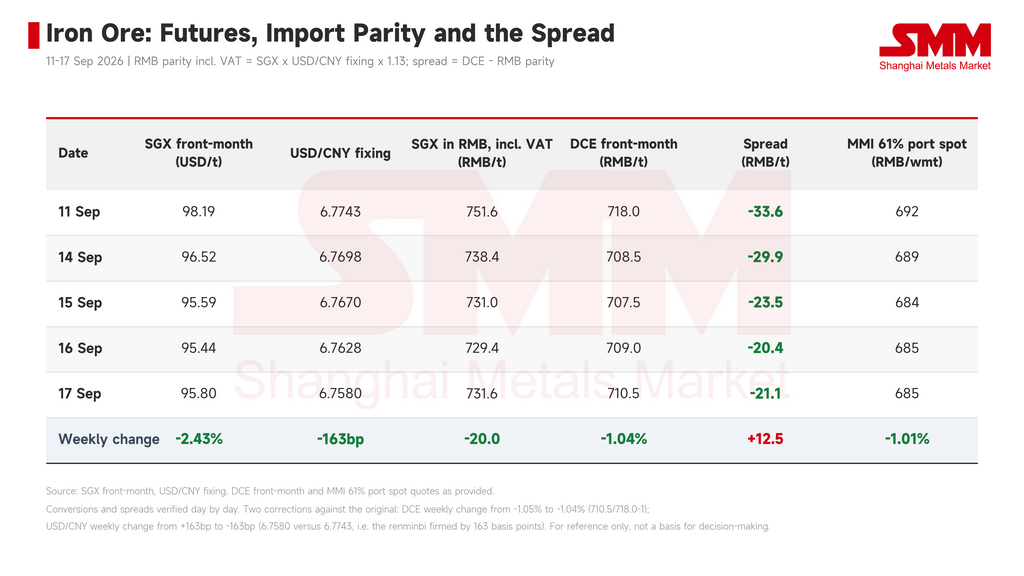
Iron ore prices showed a clear divergence between domestic and overseas markets this week. The SGX most-active contract retreated from USD 98.19/mt on 11 September to USD 95.80/mt on 17 September, a cumulative weekly loss of USD 2.39 or 2.43%, touching a weekly intraday low of USD 95.44 on 16 September. Over the same period, the DCE most-active contract fell from RMB 718.0/mt to RMB 710.5/mt, down 1.05%, while the MMI 61% iron ore port spot index eased from RMB 692/wet mt to RMB 685/wet mt, down 1.01%.
The overseas decline was twice that of the domestic market. The DCE bottomed at RMB 707.5 on 15 September before rebounding for two consecutive sessions, with port spot prices likewise steadying on 16 September, whereas the SGX low came one session later. Domestic futures and spot declines were closely aligned at around 1%, indicating that the domestic pricing chain functioned smoothly and that the driver of this round of weakness came primarily from outside China.
Fundamentals: Supply-side pressure becomes visible
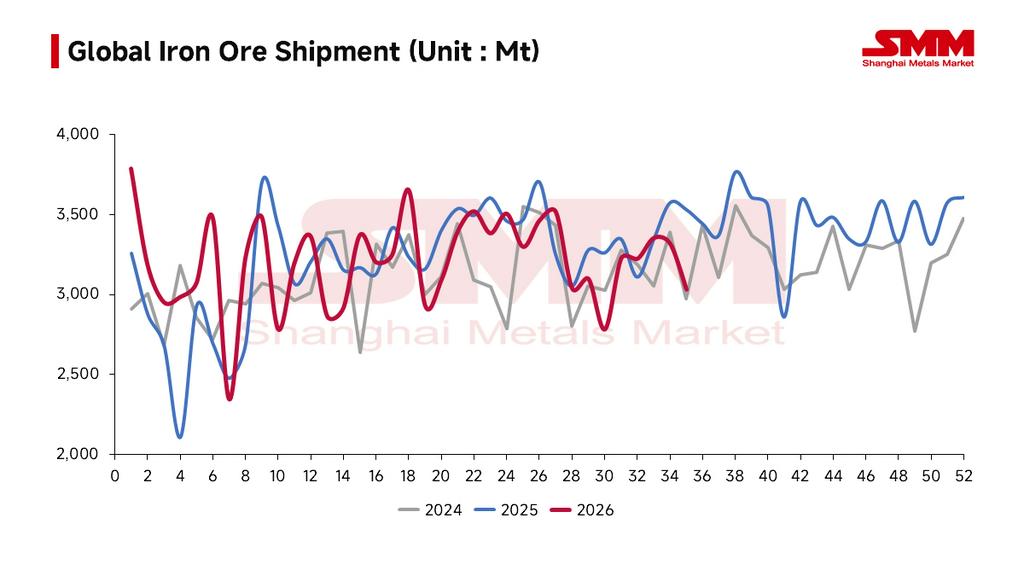
Shipments surged for a second straight week. Iron ore departures from the 123 ports rose from 30.3182 million mt in the week of 28 August to 34.4481 million mt in the week of 4 September, and increased further to 37.4058 million mt in the week of 11 September, a cumulative two-week gain of around 23%. Arrivals at the 61 ports moved up in step from 22.6493 million mt to 26.9126 million mt, holding at an elevated plateau of 26.9105 million mt in the week of 11 September.
Inventories turned from drawdown to build. SMM imported iron ore inventories stood at 143.91 million mt on 4 September, edged down to 143.49 million mt on 11 September, then rebounded to 144.33 million mt on 18 September — a weekly build of 840,000 mt that broke the earlier destocking trend. Transmission from elevated shipments through to arrivals and then to port inventories is now complete, making this the most clearly established fundamental variable weighing on futures this week.
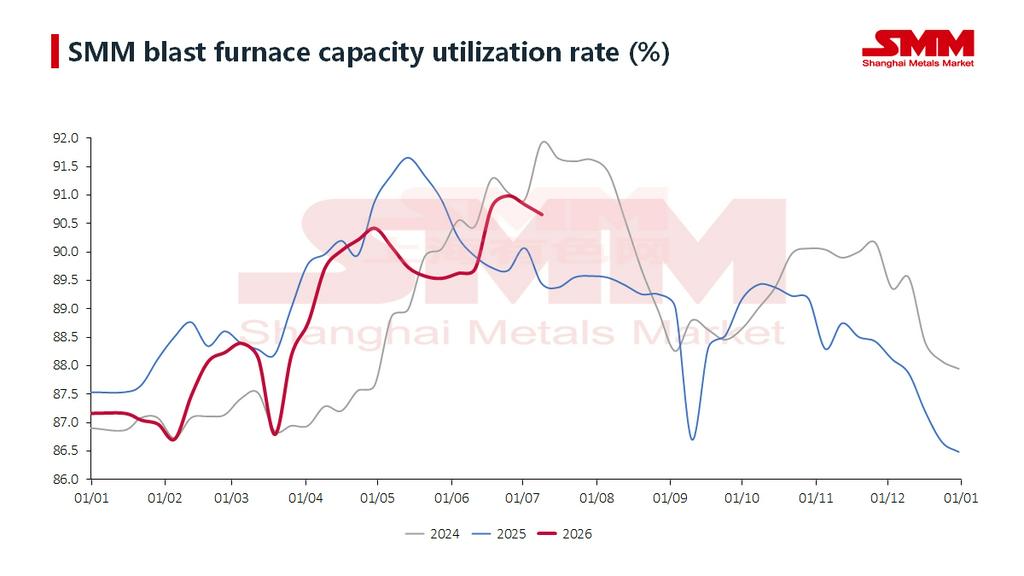
Demand held steady and did not contribute at the margin. Average daily hot metal output at the 242 steel mills slipped from 2.4028 million mt on 9 September to 2.3991 million mt on 16 September, down 3,700 mt/day week-on-week, while the capacity utilisation rate eased from 88.69% to 88.55%. Mill margins remain squeezed by coke costs, but the pace of cutbacks has been gradual and demand was not an independent driver this week.
Macro and event drivers
The Fed's rate hike landed. On 16 September, the FOMC voted 12-0 to raise rates by 25 basis points, lifting the federal funds target range to 3.75%–4.00% — the first hike since 2023 — with the dot plot also pointing to the possibility of one further hike this year. The dollar index strengthened to around 100 in response, while the 10-year Treasury yield held above 5%. Dollar-denominated SGX contracts traded offshore are considerably more sensitive to liquidity conditions than the DCE, and the coincidence of the SGX weekly low with the policy decision date points to a clear link.
Port Hedland strike expectations were falsified. On 15 September, BHP's port unions announced that, after more than nine months of talks on a four-year agreement failed to produce agreement, they would apply to Australia's Fair Work Commission for an "intractable bargaining declaration." Such a declaration can only be sought once bargaining has been deadlocked for nine months; once granted, if the dispute remains unresolved the Commission will determine employment terms directly. The market read this as talks having broken down but near-term strike risk being removed. Port Hedland handled 580.4 million mt in FY2025-26, and a single day of stoppage affects around AUD 80 million of shipments; futures had previously priced in a corresponding risk premium, which was systematically squeezed out this week. As a seaborne supply event, it was barely priced by the DCE.
Outlook and what to watch
On balance, market sentiment this week was dominated by the twin factors of the rate hike landing and strike expectations being falsified, compounded by forward supply pressure from the surge in shipments — ample logical grounding for the overseas market's independent decline. The more restrained domestic fall reflected support from port transactions and pre-holiday restocking demand, along with the absence of any marked collapse in hot metal output. That said, mills' iron ore inventories are relatively ample, so the volume of demand that pre-holiday restocking can release may be fairly limited.
The centre of gravity for ore prices is tilting slightly lower in the near term. Any upward shift in the price centre would require mill margins to recover and hot metal output to stabilise and rebound. Points to watch next week: whether pre-holiday restocking demand can be sustained, and whether rate-hike expectations ahead of the FOMC meeting continue to weigh on dollar-denominated contracts.
![[ Vietnam Extends Antidumping Probe Deadline for Prestressed Steel Bars ]](https://imgqn.smm.cn/usercenter/ikbxI20251217171718.jpg)
![[ HKM Decommissions 42-Year-Old Coke Oven Battery in Duisburg ]](https://imgqn.smm.cn/usercenter/UqlZJ20251217171717.jpg)
![[ Nippon Steel Commits €900 Million for Slovakian Electric Arc Furnace ]](https://imgqn.smm.cn/usercenter/exdqc20251217171717.jpg)