Major PV module markets remained divided by region and product segment this week. China port FOB prices moved in both directions but stayed within narrow ranges. Some Southeast Asian CIF assessments edged higher at the low end, although incremental transactions remained limited. Europe continued to rely on deliveries against existing contracts, while selected suppliers offered concessions to secure medium- and long-term projects. In India, domestic content requirement (DCR) module prices held steady, while non-DCR prices eased as earlier stockpiling demand faded.
Expectations of a fourth-quarter recovery have made sellers less willing to cut prices broadly. However, demand is still too weak to support a general increase. Costs continue to limit the downside, while executable orders determine realised prices. The result is wider differentiation between standard and high-power products, and between policy-backed and market-driven demand.
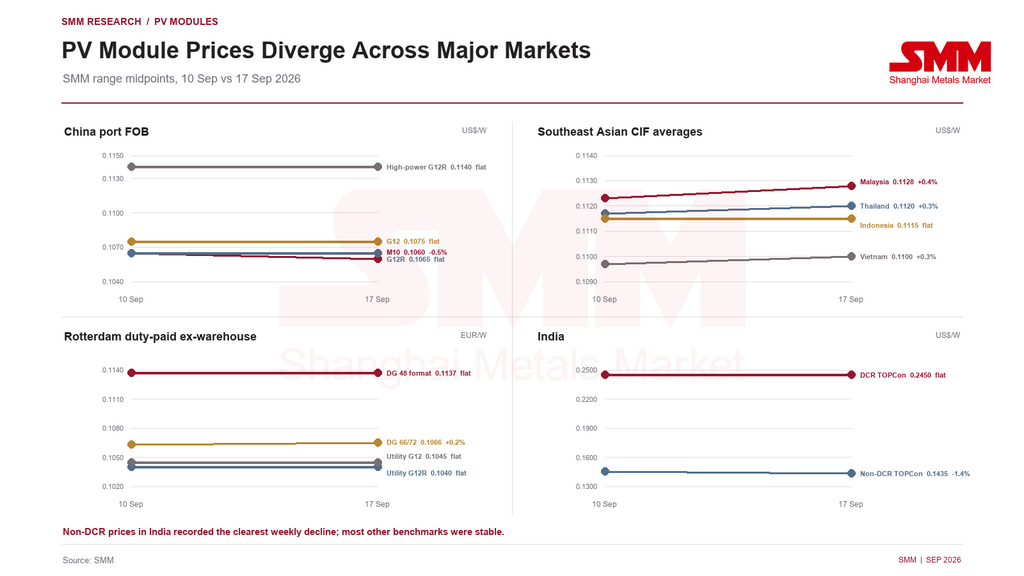
China port FOB: interest in high-power products improves, but prices remain rangebound
Most manufacturers retained the previous week's offers at the start of the week while monitoring the pace of demand recovery. Expectations of firmer fourth-quarter demand reduced the incentive for broad price cuts. Even so, weak transaction volumes kept buyers and sellers in negotiation, with targeted discounts still available for selected orders.
Buying interest in TOPCon 3.0 products strengthened in premium international markets. Some suppliers adjusted the price gap between TOPCon 2.0 and TOPCon 3.0 products to promote high-power shipments. Based on the midpoint of SMM's weekly ranges, high-power TOPCon G12R modules carried a premium of about 7.0% over standard G12R products. This reflects the value of higher efficiency and output, although further premium expansion will depend on whether project developers recognise the lifetime yield benefit.
The market's lowest offers were partly withdrawn, suggesting less willingness among suppliers to chase prices down. Competition for orders remains intense, however, and some second-tier manufacturers may continue to use low offers to secure business. The upper end of the M10 range fell by US$0.001/W week on week, while other key specifications were broadly unchanged, leaving the market without a uniform direction.
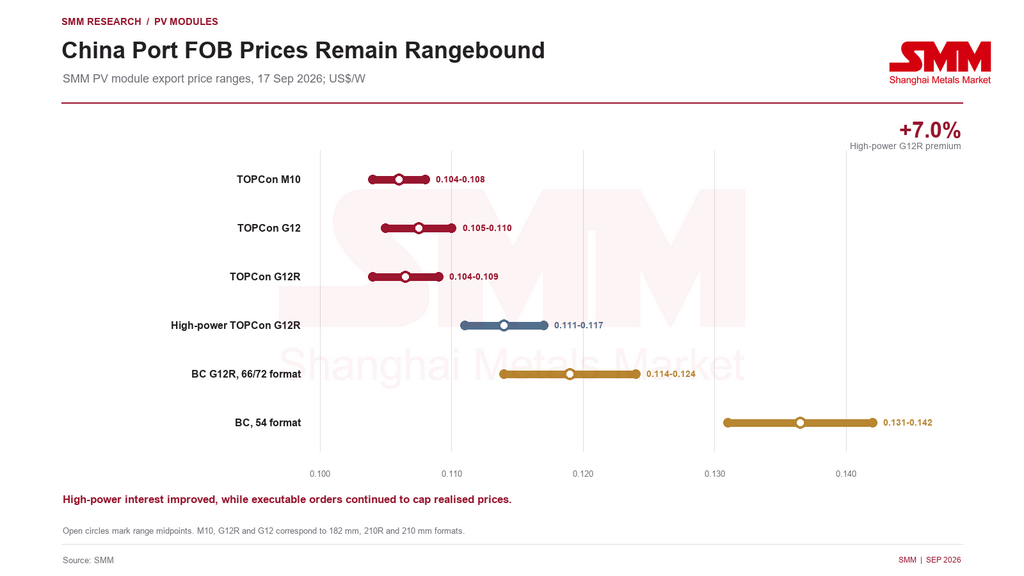
SMM expects China port FOB prices to remain rangebound in the near term. The key test will be whether October orders start on schedule and whether enquiries for TOPCon 3.0 products convert into volume. If orders disappoint, low-price competition could intensify again.
Southeast Asia: enquiries improve, but purchasing volumes remain limited
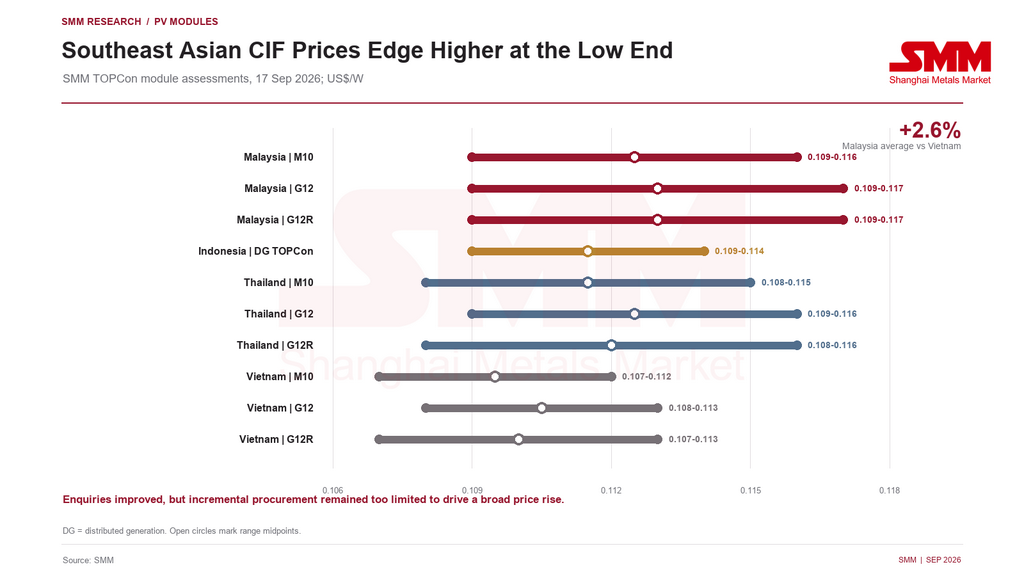
Southeast Asian module prices continued to fluctuate within narrow ranges at low levels. The lower ends of several assessments in Malaysia, Thailand and Vietnam moved slightly higher. Enquiry activity improved, but the increase in transactions remained modest and price negotiations continued.
Across the three main formats, the simple average of range midpoints was approximately US$0.1128/W in Malaysia, US$0.1120/W in Thailand and US$0.1100/W in Vietnam. Malaysia's average was about 2.6% above Vietnam's. Some purchasing demand has emerged in Malaysia, but project sizes and procurement volumes remain too small to support a broad regional increase.
Vietnam and Indonesia were broadly unchanged week on week. In Thailand, the near-term focus remains certification by the Thai Industrial Standards Institute (TISI). According to SMM research, some suppliers have started to obtain certification. As the number of certified suppliers increases, the temporary supply gap created by the certification transition should narrow, returning pricing power to project demand, brand positioning and delivery costs.
Europe: existing contracts underpin deliveries as high-power interest rises
Europe's demand recovery remained limited, with shipments still dominated by existing contracts. Some manufacturers offered concessions on selected projects of several hundred megawatts to secure deliveries scheduled for 2027. These orders improve forward visibility but do not indicate a broad recovery in Europe's spot market.
Distributor interest in high-power TOPCon modules increased, although end-user acceptance of the efficiency premium remains the key uncertainty. Standard modules continued to face strong price negotiation, with realised prices staying low.
At Rotterdam, the midpoint for the distributed-generation G12R 48-format product was about 9.3% above the utility-scale G12R 66/72-format assessment, reflecting the format premium in rooftop and other space-constrained applications. The midpoint gap between distributed-generation and utility-scale G12R 66/72-format products was about 2.5%. Warehouse prices in Portugal and Greece remained approximately 2.2-2.4% above Rotterdam, reflecting regional logistics and local delivery premiums.
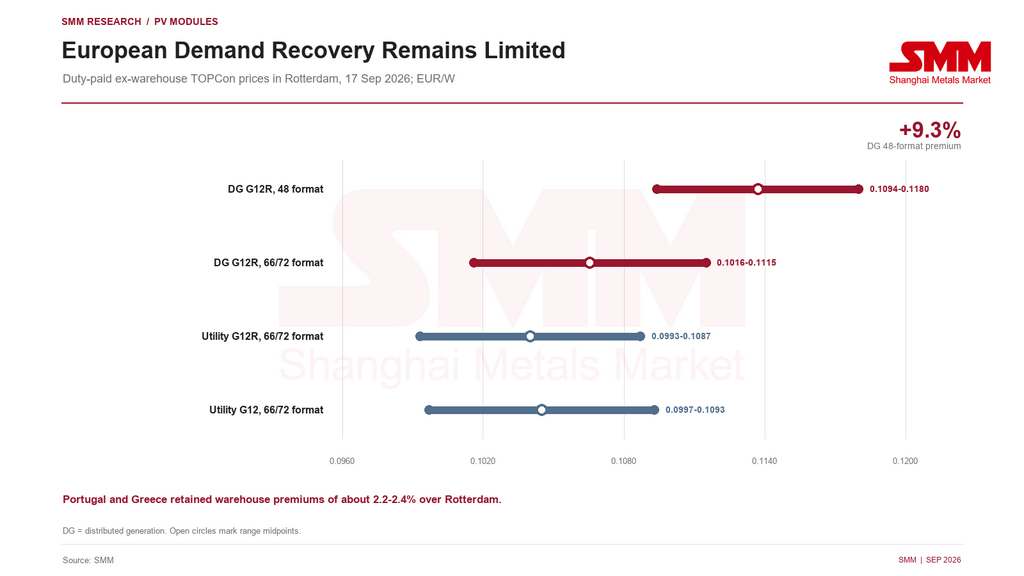
The fourth-quarter outlook depends on whether enquiries convert into new contracts. If demand underperforms, manufacturers and distributors may return to price competition for a limited pool of orders.
India: non-DCR stockpiling fades as export-oriented capacity faces policy uncertainty
Indian DCR module prices held steady, while non-DCR prices eased. Based on range midpoints, DCR TOPCon modules averaged about US$0.245/W and non-DCR modules US$0.1435/W, leaving DCR products at a premium of approximately 70.7%. The non-DCR midpoint fell about 1.4% week on week as support from earlier stockpiling demand weakened.
The non-DCR market had previously seen temporary stockpiling linked to expectations surrounding planned US Section 232 measures. As this buying cooled, end-user resistance to elevated offers again constrained prices.
The US Department of Commerce has also issued its final anti-dumping and countervailing duty determinations on crystalline-silicon PV cells and modules from India. The US International Trade Commission is scheduled to issue its final injury determination on 14 October. Orders will be imposed only if the Commission reaches an affirmative determination; a negative finding would terminate the investigations. The case therefore affects India's US-oriented non-DCR capacity and order outlook first, rather than domestic DCR demand. DCR performance will continue to depend on Indian policy-backed procurement, inventory drawdowns and the pace of domestic supply.
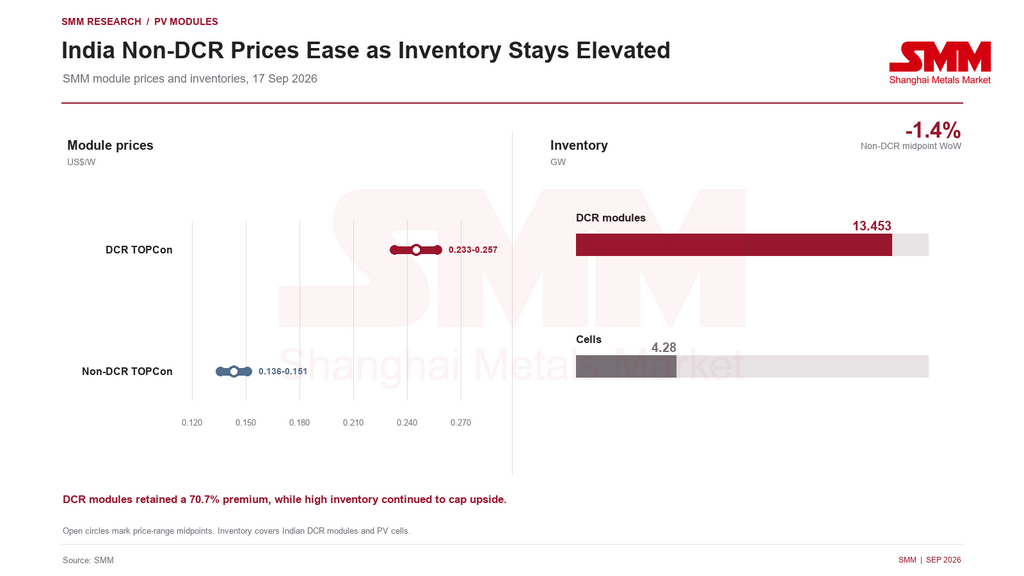
Indian DCR module inventory stood at approximately 13.453 GW, while cell inventory was around 4.28 GW. Elevated stocks continue to cap the upside for DCR module prices. If domestic project procurement does not accelerate, manufacturers may need to adjust production, optimise their product mix or compete more aggressively for orders.
Outlook: October order starts will test the strength of the recovery
Chinese module suppliers have less incentive to make broad price cuts, but international demand is not yet strong enough to support a general increase. Standard TOPCon products are likely to remain rangebound, while high-power TOPCon and back-contact products should continue to differentiate by efficiency premium, brand and project suitability.
Under the current policy timetable, some projects already contracted for delivery in the first and second quarters of 2027 are expected to begin incorporating additional costs associated with the consumption tax on solar cells. To avoid cost-price mismatches at delivery, module suppliers may raise forward offers or include price-adjustment mechanisms in contracts, giving these projects a degree of upward price momentum.
In Southeast Asia, the main questions are whether year-end installation demand will arrive on schedule and whether Thailand's temporary supply gap will close smoothly as more suppliers secure TISI certification. Without a material increase in procurement, higher offers in selected segments may not translate into broader transaction gains.
Europe will be driven by high-power product enquiries, contracting for 2027 deliveries and new fourth-quarter awards. Concessions on selected large projects improve order visibility but also show that project developers retain significant negotiating leverage.
India requires a clear distinction between domestic DCR demand and US-oriented non-DCR exports. Non-DCR prices may remain exposed to fading stockpiling demand and uncertainty over US trade measures. Any improvement in the DCR market will depend on domestic project procurement and the pace of inventory drawdowns.
Overall, international PV module markets are likely to remain characterised by limited price movement, regional divergence, product upgrading and order-led pricing. SMM will continue to track price, order, inventory and project procurement developments across major PV module markets.
Source: SMM
Written by:
Ryan Tey Tze Yang | SMM PV Analyst
+60 127179370 | ryan.tey@metal.com
![[SMM PV Flash] China's First In-Orbit Verification of Flexible Perovskite PV Module at Module Level Launched](https://imgqn.smm.cn/usercenter/ZqmSz20251217171738.jpg)
![[SMM PV News] Huaneng Yushe 1 GW Wind and Solar Base Ximazi Subproject Commences Construction](https://imgqn.smm.cn/usercenter/XNRWp20251217171738.jpg)
![[SMM PV News] China Resources New Energy: Solar power project electricity sales, January-August, up 26.99% YoY](https://imgqn.smm.cn/usercenter/AuVub20251217171738.jpg)