Overseas primary aluminum spot trading was generally quiet this week, with little improvement in downstream buying interest. Across Asia, market sentiment remained soft as end-user orders stayed thin and buyers showed limited urgency to secure additional material.
Thailand continued to suffer from weak downstream order books, while South Korea saw sellers become increasingly flexible on pricing amid comfortable supply. In Japan, spot MJP activity was slow as market participants waited for further developments in the Q4 MJP negotiations. The US Midwest DDP market was also largely unchanged, with few fresh signals emerging during the week.
I. Review of Spot Premiums by Region
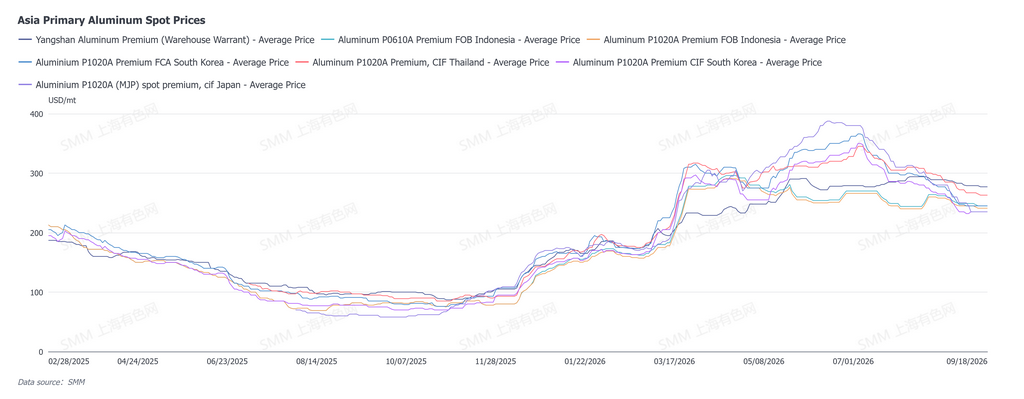
SMM data showed that Asian primary aluminum premiums continued to trade at relatively soft levels as of September 18. The CIF Thailand P1020A premium averaged USD 263/mt, while FOB South Korea averaged USD 245/mt and CIF South Korea averaged USD 235/mt.
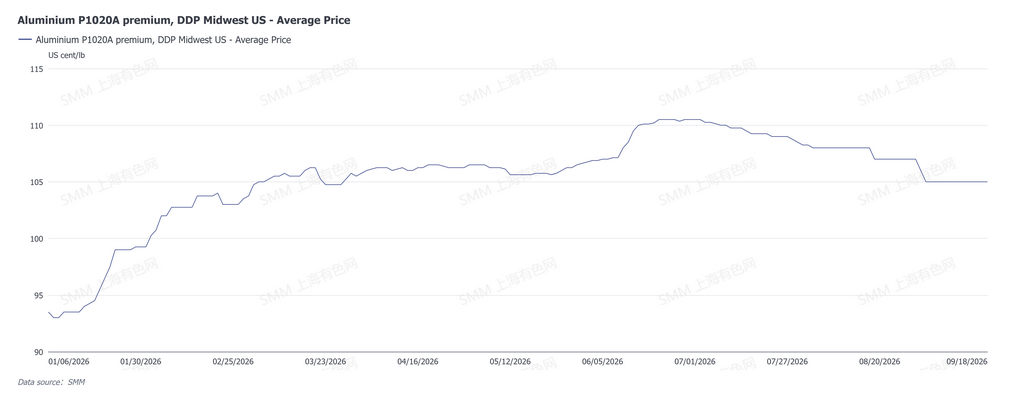
In Japan, the CIF MJP spot premium averaged USD 235/mt, compared with around USD 277/mt for warehouse-warrant material. Meanwhile, the US Midwest DDP premium stood at 105 US cents/lb.
Southeast Asia
Thailand: Order Shortage, Offer Prices Trending Down
The Thai market performed weakly this week, with the key drag stemming from the persistent shortage of downstream orders. As end-demand has not shown notable improvement, holders have grown more willing to sell, and overall market offer prices have trended downward. Buyers are dominated by a wait-and-see sentiment with low willingness to take goods, and market transactions are mainly small orders driven by inelastic demand, which can hardly form effective support for prices.
As a result, trading remained fragmented and mostly involved smaller cargoes. The CIF Thailand P1020A premium averaged USD 263/mt as of September 18.
South Korea: Supply and demand game, prices operating at low levels
The South Korean market remains relatively chaotic this week. Although there has been some sporadic restocking activity in the downstream segment, the overall demand momentum is limited, and the price center still stays at a relatively low level. From the perspective of both supply and demand, there is no sign of an increase in downstream acceptance of current prices, and buyers have a clear mindset of driving down prices; meanwhile, sellers' offers are relatively active with a strong willingness to sell, and the two sides continue to game at the price level, leaving the market without clear directional guidance.
As of September 18, the FOB South Korea P1020A premium averaged USD 245/mt, while the CIF premium averaged USD 235/mt.
Japan
CIF Japan MJP Primary Aluminum Spot
Japan’s MJP spot market saw only limited activity this week, with both inquiries and completed transactions staying relatively scarce.
Downstream demand remained slow, while market participants showed a preference to wait for clearer direction from the ongoing Q4 MJP negotiations before making larger procurement decisions. Some offers were still heard in the market, but buyer interest remained limited.
Against this backdrop, spot premiums continued to soften rather than stabilise. As of September 18, the CIF Japan MJP spot premium averaged USD 235/mt.
United States
US Midwest DDP Primary Aluminum Premium
The US Midwest DDP market was largely uneventful this week.
Trading interest remained subdued, with neither buyers nor sellers showing a strong need to adjust their positions. In the absence of any significant changes in supply availability or downstream consumption, premium movements were limited.
As of September 18, the US Midwest DDP P1020A premium averaged 105 US cents/lb.
Market Outlook
Near-term conditions across overseas primary aluminum markets are likely to remain soft unless downstream order activity begins to recover.
Thailand still lacks sufficient end-user demand to support stronger purchasing, while South Korea continues to face pressure from readily available material and aggressive seller competition.
In Japan, the market is likely to stay cautious while participants await greater clarity on Q4 MJP. The lack of urgency among buyers may continue to limit spot transactions in the meantime.
Overall, the current market is being shaped less by supply disruptions and more by weak order visibility and buyers’ preference to postpone purchases, leaving limited room for a meaningful rebound in spot premiums in the short term.