Key points: Solid–liquid batteries are the vanguard in the industrialization of solid-state batteries. They have entered large-scale mass production, with multiple lines put into operation from 2024 to 2026. By 2035, capacity will approach 2,000 GWh, about 1.8 times that of solid-state batteries, with utilization rates of 50%–77% and strong supply and demand. WeLion, Qingtao, Ganfeng, Tailan, and Farasis are leading. Energy storage, low-altitude economy, robotics, and commercial vehicles are the first to scale up. Risks include terminology confusion, cost, price wars, and overcapacity.
Notes:
The solid-state battery capacity analysis is divided into Part 1 and Part 2. Part 1 covers solid-liquid batteries, and Part 2 covers solid-state batteries. As a transitional route toward solid-state batteries, solid-liquid batteries will also exist for a long time; for now, they are analyzed within the solid-state battery system. Solid-liquid batteries include gel-state batteries, solid-liquid hybrid batteries, quasi-solid-state batteries, and semi-solid-state batteries. For batteries with a liquid electrolyte mass proportion of 5%–20%, a solid electrolyte framework is added to constrain a small amount of liquid electrolyte.
Solid-State Battery Capacity Analysis (Part 1): Solid-Liquid Batteries as the Vanguard — A Transitional Route with Both Supply and Demand Booming
Solid-State Battery Capacity Analysis (Part 2): Solid-State Battery Pilot Production Deployed Intensively — Capacity Planning and Demand Mismatch
This article is Part 1: the capacity status of solid-liquid batteries or solid-liquid hybrid batteries.
Data: This capacity data is based on enterprises' capacity planning and SMM demand model analysis. Medium- and long-term data, in particular, relies on the SMM demand model.
Final data shall be subject to the capacity data officially released by enterprises.
1. Industry Stage: Entered Large-Scale Mass Production; Multiple Lines to Be Commissioned in 2024–2026
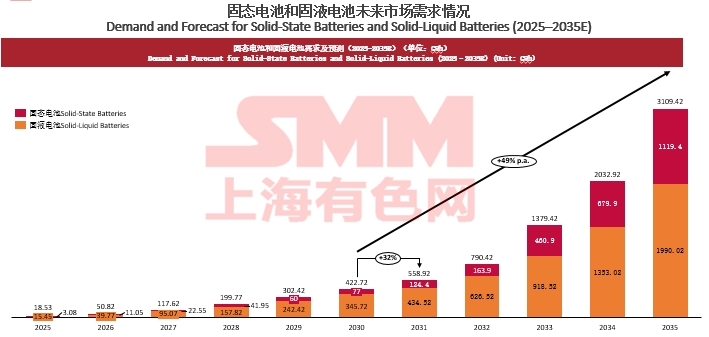
Solid–liquid batteries (solid–liquid / quasi-solid / hybrid solid–liquid) are currently the fastest-industrializing branch of solid-state battery technology. The table shows that multiple GWh-level solid–liquid battery production lines have already been commissioned from 2024 to 2026:
WeLion New Energy: Zhuhai 6 GWh solid–liquid energy storage battery line was commissioned in March 2025; 314 Ah large-capacity solid–liquid battery was mass-produced for the first time globally.
Qingtao Energy: Taizhou 3.5 GWh solid–liquid battery production line was commissioned in March 2026; products are power cells.
Ganfeng Lithium: Chongqing 20 GWh solid-state battery industrial park; PACK line has been commissioned; more than 1,000 units delivered as of August 2024.
Tianneng: Changxing 6 GWh solid–liquid mass production line was commissioned in November 2023.
Degar Energy: Huzhou Changxing 1 GWh high-energy-density solid–liquid battery project was commissioned in March 2025.
Enpower: Anhui Chuzhou Fengyang 2 GWh solid–liquid cell base completed capacity ramp-up in July 2026, with a yield rate of 99.8%.
Heyuan Lithium Innovation: First solid–liquid cell rolled off the line at the Xiantao plant in May 2026; the first solid–liquid battery production line in central China was commissioned.
Anwa New Energy: The world's first GWh-level new-type solid–liquid battery production line had its first batch of samples roll off in July 2025, with a designed capacity of 1.25 GWh.
Solid–liquid batteries have crossed the "from 0 to 1" stage and entered the "from 1 to N" stage of large-scale replication.
2. Capacity: Nearly 2,000 GWh by 2035, About 1.8 Times the Scale of Solid-State Batteries
Solid–liquid battery capacity may reach 2,000 GWh, with most capacity switched from co-lined liquid battery production.
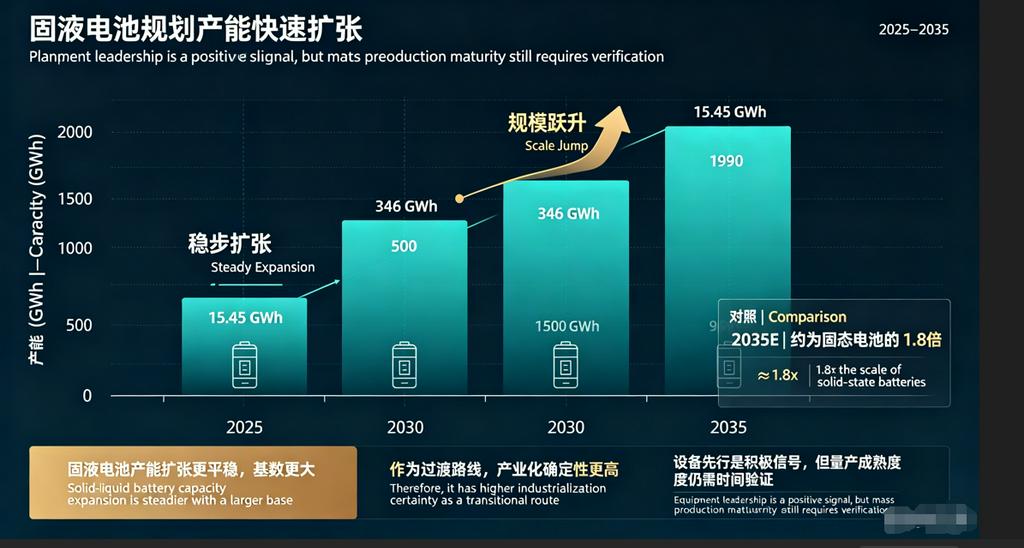
Solid–liquid battery capacity will grow from 15.45 GWh in 2025 to 346 GWh and 1,990 GWh in 2030 and 2035, respectively, about 1.8 times the scale of solid-state batteries. The capacity expansion pace of solid–liquid batteries is steadier and the base is larger, indicating higher industrialization certainty as a transitional route.
3. Demand and Utilization Rate: Supply and Demand Relatively Matched; Utilization Rate Stable at 50%–77%
The release of solid–liquid battery demand is relatively well matched with capacity planning.
The utilization rate will reach 49% in 2026 and stabilize at around 75% after 2031. This contrasts sharply with the 1%–15% utilization rate for solid-state batteries, showing that solid–liquid batteries already have real market demand and commercialization capability. With strong supply and demand, they are the main force in the current industrialization of solid-state batteries.
4. Technology Routes: Polymer / Oxide / Composite as the Main Routes; LFP Solid–Liquid Favored in Energy Storage
Solid–liquid battery technology routes are more diverse.
Polymer route: WeLion, Shenlan Huize, Heyi New Energy, Guojiju Electric, etc. Polymer electrolytes are easy to process and have good interfacial contact, but their room-temperature ionic conductivity is low.
Oxide route: Qingtao, Heyuan Lithium Innovation, Delfu, etc. Oxides have good stability but high interfacial impedance.
Composite route: Anwa New Energy, Tailan New Energy, Chuangming New Energy, etc. Composite electrolytes balance performance and cost.
LFP solid–liquid: Chunli New Energy, Guansheng Dongchi, Shoutong New Energy, etc. LFP-based solid–liquid batteries are in strong demand in energy storage.
Gel route: Xiamen Xinshuneng, focusing on high-energy-density gel solid–liquid lithium batteries.
Sulfide + halide composite: BYD's second-generation Blade solid–liquid battery, with energy density of 350–400 Wh/kg.
Overall, solid–liquid batteries do not pursue extreme performance of a single route, but focus on cost, safety, and mass producibility, prioritizing scenarios such as energy storage, commercial vehicles, and the low-altitude economy.
5. Corporate Landscape: WeLion, Qingtao, Ganfeng, Tailan, Farasis, etc. Lead
The solid–liquid battery field has formed a group of enterprises with mass production capability.
WeLion New Energy: Zhuhai 6 GWh, Huzhou, Zibo, Nanjing 15 GWh, Guangzhou Huadu 6 GWh, Qingyang 3 GWh, etc., with total planned capacity exceeding 100 GWh. Its solid–liquid battery has been used in NIO's 150 kWh battery pack.
Qingtao Energy: Taizhou 3.5 GWh, Chengdu 15 GWh, Inner Mongolia 20 GWh, Wuhai 10 GWh, Kunshan 10 GWh, etc., planning to reach 98.2 GWh by 2030. Its oxide solid–liquid battery has been installed in IM L6.
Ganfeng Lithium: Chongqing 20 GWh, Xinyu 12 GWh, Nanchang 10 GWh; its solid–liquid battery industrial park has delivered more than 1,000 units.
Tailan New Energy: Chongqing 2 GWh, Huainan 10 GWh; its solid–liquid power batteries target high-end new energy vehicles.
Farasis Energy: Zhenjiang 54 GWh designed capacity; Turkey Siro 6 GWh has been put into production; its 330 Wh/kg solid–liquid battery has obtained an eVTOL designation.
Enpower: Fengyang 2 GWh has been put into production, with total planned capacity of 10 GWh; solid–liquid cell yield rate is 99.8%.
Heyuan Lithium Innovation: Huai'an 10 GWh, Xiantao 20 GWh; oxide solid–liquid batteries with energy density of 250–400 Wh/kg.
Tianneng: Changxing 6 GWh solid–liquid mass production line, with planned 15 GWh.
Guansheng Dongchi: Wenzhou 4 GWh solid–liquid LFP battery; environmental assessment in January 2026.
Anwa New Energy: Wuhu 1.25 GWh, affiliated with Chery; first-generation energy density exceeds 300 Wh/kg.
In addition, Guoyi New Energy, Luochu Power, Xinshuneng, Jinyu New Energy, Chunli New Energy, Chuangming New Energy, Daoketesi, and others are also positioning in niche scenarios.
6. Application Scenarios: Energy Storage, Low-Altitude, Robotics, and Commercial Vehicles Scale Up First
The application scenarios of solid–liquid batteries are broader than those of all-solid-state batteries, and there are already actual orders.
Energy storage: WeLion Zhuhai 6 GWh solid–liquid energy storage battery, Ganfeng Xinyu 12 GWh solid–liquid energy storage battery, Chunli 1 GWh solid–liquid energy storage battery, Guansheng Dongchi 4 GWh solid–liquid LFP.
Low-altitude economy: Farasis's 330 Wh/kg solid–liquid battery obtained eVTOL designation; Dianjiangjun's Foshan Nanhai low-altitude economy solid-state battery base 5 GWh; Saike Power aviation power battery 0.5 GWh.
Robotics: Farasis all-solid-liquid 60 Ah samples for robots; Heyuan Lithium Innovation Xiantao targets humanoid robots; Xinjie Energy's Hangzhou 2 GWh solid-state lithium metal battery for embodied robots.
Commercial vehicles: WeLion Qingyang 3 GWh solid-state battery pack and electric heavy trucks; validation by FAW, Dongfeng, and other automakers.
Two-wheelers / consumer electronics: Guoyi New Energy, Marathon Solid-State, Yaoshi Lithium Battery, etc.
New energy vehicles: Qingtao installed in IM L6; WeLion supplies NIO; Tailan focuses on high-end EVs.
With higher safety and energy density, solid–liquid batteries are forming differentiated substitution against liquid batteries.
7. Risks and Challenges: Terminology Confusion, Cost, Price Wars, and Overly Large Capacity Plans
Terminology confusion: Terms such as solid–liquid, quasi-solid, solid–liquid hybrid, and gel solid-state are not unified. The national standard uses a weight loss rate ≤0.5% and "no visible liquid leakage" to determine all-solid-state, but solid–liquid batteries still contain electrolyte, which can easily confuse the market.
Cost remains high: Although solid–liquid cost can already reach RMB 0.85/Wh, there is still a gap compared with liquid batteries; cost reduction depends on in-house material development and economies of scale.
Price war risk: As capacity is released, solid–liquid batteries may be the first to see price competition in energy storage, low-altitude economy, and other fields.
Capacity plans are too large: Nearly 2,000 GWh is planned for 2035; if demand falls short of expectations, utilization rates may decline.
Automotive-grade validation: Solid–liquid batteries still need to pass automotive-grade safety, cycling, and fast-charging validation, which takes a long time.
8. Conclusion
Solid–liquid batteries are the "vanguard" of the current industrialization of solid-state batteries. They have higher technological maturity, faster mass production progress, and better supply-demand matching, and will maintain rapid growth from 2026 to 2030. WeLion, Qingtao, Ganfeng, Tailan, Farasis, Enpower, and others have formed the first echelon; energy storage, low-altitude economy, robotics, and commercial vehicles are core application scenarios. Solid–liquid batteries are not only a transitional route to all-solid-state, but may also coexist with liquid batteries in the mid-to-high-end market for a long time. Enterprises should seize the current window period to accelerate capacity ramp-up, cost reduction, and customer binding, while guarding against concept hype and overcapacity risks.
Summary: Solid-state batteries are the future, while solid–liquid batteries are the present. Solid-state battery capacity plans are aggressive, but short-term demand is insufficient and utilization rates are low; we need to wait patiently for volume growth after 2030. Solid–liquid batteries have entered large-scale mass production, with strong supply and demand, and are the main force in current industrialization. The two lines run in parallel, jointly driving battery technology toward higher safety and higher energy density.

**Note:** For further details or inquiries regarding solid-state battery development, please contact:
Phone: 021-20707860 (or WeChat: 13585549799)
Contact: Chaoxing Yang. Thank you!
![Solid-State Battery Next Decade Series, Part 9 of 9: A Brand-New Track, Not a "Simple Sequel" to Liquid Lithium Batteries [SMM Analysis]](https://imgqn.smm.cn/usercenter/ezoBg20251217171730.jpg)
![[Solid-state: Chunli New Energy's 1GWh solid-state battery plant starts production in Jiangxi]](https://imgqn.smm.cn/usercenter/MaxcL20251217171730.jpg)
![National Day Holiday Solid-State Battery Industry Review: Strong Policy Push but Slow Industrial Progress [SMM Analysis]](https://imgqn.smm.cn/usercenter/QxQbN20251217171727.jpg)