Indonesia Revises Nickel Ore HPM Again: Low-Grade Limonite HPM Moves Back Toward Market Levels, Easing Miners’ Tax Burden
Indonesia’s Ministry of Energy and Mineral Resources (ESDM) recently further revised the benchmark price (HPM) formula for nickel ore, making a targeted adjustment to the pricing mechanism introduced under Kepmen ESDM No.144.K/MB.01/MEM.B/2026, which took effect on April 15, 2026. Kepmen ESDM No.363.K/MB.01/MEM.B/2026 which took effect on September 15, 2026. This revision specifically targets the two parameters that have had the greatest impact on the pricing of low-grade limonite used as feedstock for HPAL — the nickel correction factor (CF) for the 1.2% nickel grade range and the cobalt coefficient — while other parameters remain unchanged.
For nickel mining companies, the significance of this revision goes far beyond the benchmark price reduction itself: HPM serves not only as a reference price for domestic nickel ore transactions, but also as the basis for calculating royalties and other government-related taxes and fees. Against the backdrop of actual limonite transaction prices remaining significantly below HPM for an extended period, bringing the tax benchmark closer to market value means that the fiscal burden on mining companies will be directly reduced.

1. What has changed in this revision: Nickel CF and cobalt coefficient for limonite both reduced
The latest revision maintains the formula structure introduced under Kepmen 144, while making targeted adjustments to key coefficients:
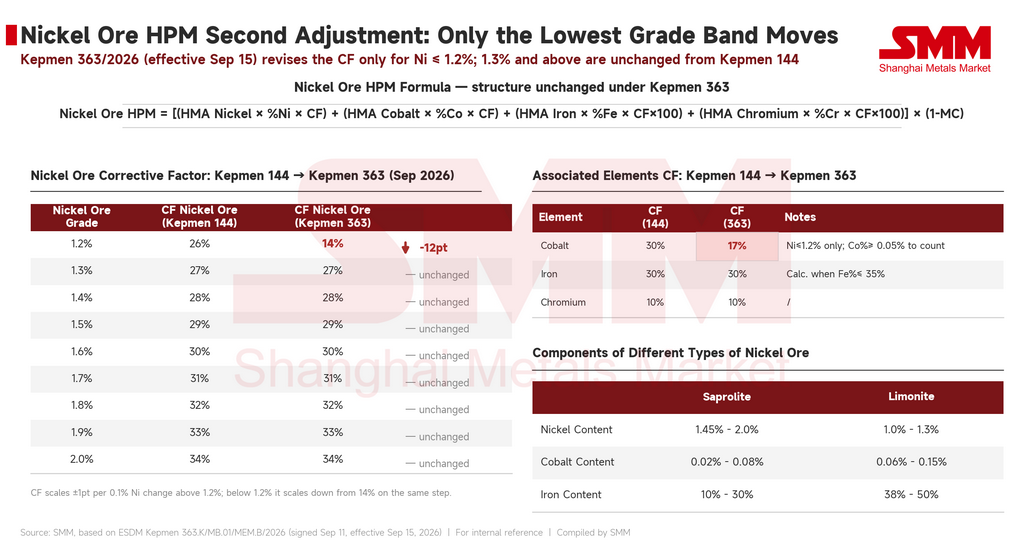
Limonite generally has nickel grades of 1.0%–1.2% and cobalt content of 0.06%–0.15%, while conventional saprolite has nickel grades of 1.45%–2.0% and cobalt content of 0.02%–0.08%. However, due to the gradual decline in ore grades, 1.3% Ni low-grade saprolite has increasingly appeared in market transactions. As a result, the revision is expected to have its largest impact on limonite. For conventional higher-grade saprolite used mainly in RKEF production, the impact on raw material costs is expected to be limited.
2. Why was it revised: HPM and market prices became significantly disconnected after the April adjustment
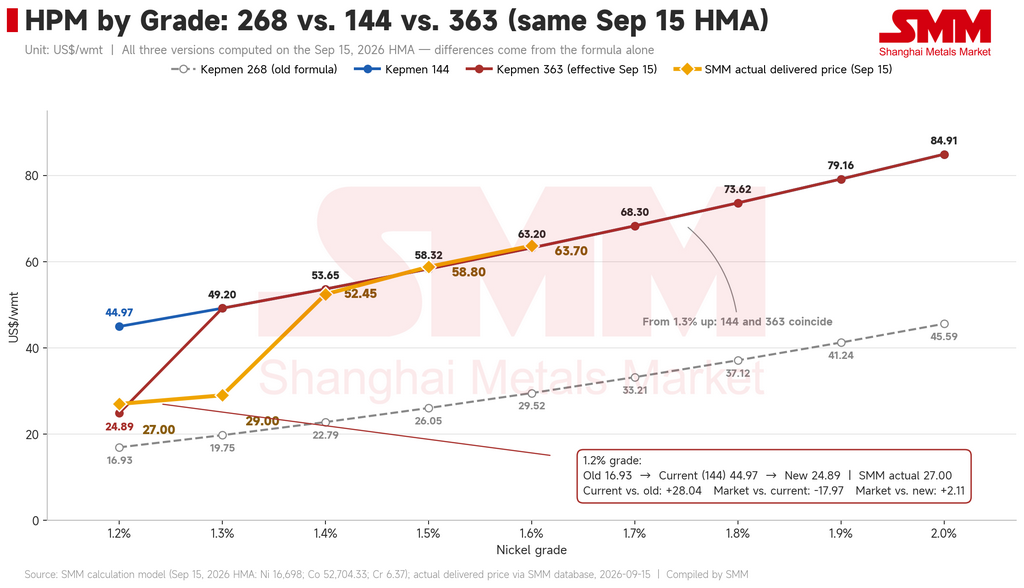
Kepmen 144 in April increased the nickel CF for 1.6% nickel ore from 17% to 30% and, for the first time, incorporated cobalt, iron and chromium into the pricing formula, pushing HPM sharply higher. Taking 1.2% nickel ore as an example, HPM jumped from $17.33/wmt on April 1 to $46.06/wmt on April 15, an increase of 166%.
However, actual spot prices did not rise in parallel. Since mid-April, the actual delivered price of 1.2% limonite has remained within a relatively narrow range of $28–30.5/wmt, creating a persistent gap of $17–18/wmt between HPM and the market price. Before the reform, the relationship was exactly the opposite — the market price, at around $26/wmt, was higher than HPM at $17.33/wmt, allowing the benchmark to function as a “floor” for market prices. After the reform, this relationship was completely reversed, with HPM instead becoming a “ceiling” above the market price.
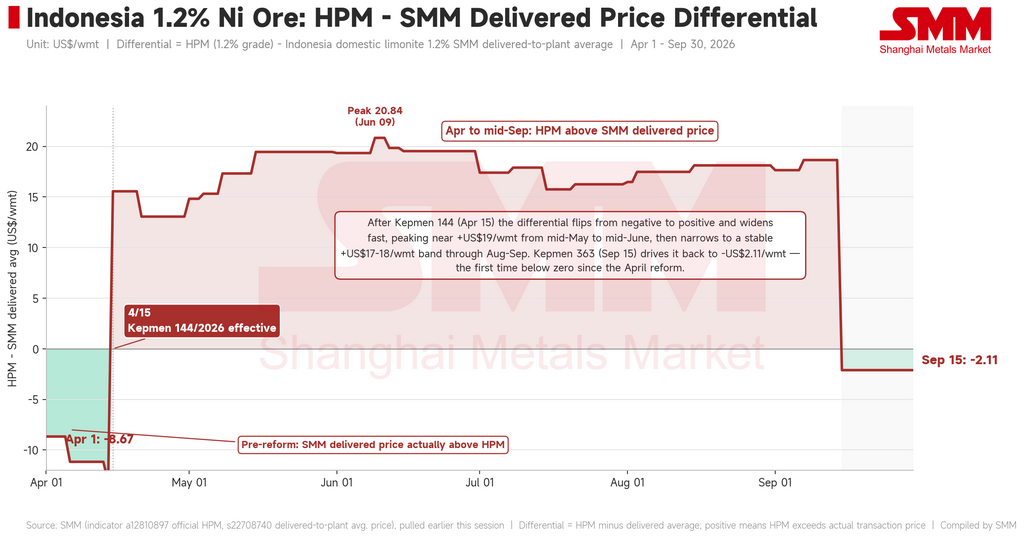
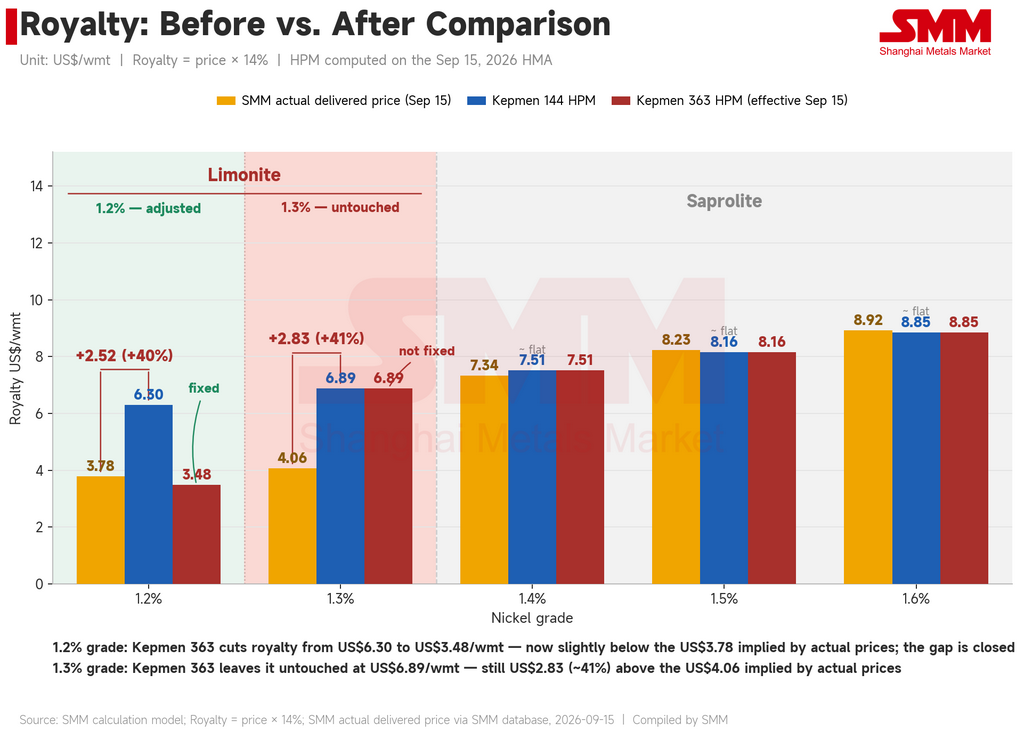
This pricing mismatch resulted in a situation where miners sold ore at market prices but paid taxes based on HPM. Using a 14% royalty rate, the royalty for 1.2% nickel ore based on the April HPM was $6.39/wmt, compared with only $3.78/wmt based on the actual transaction price. Miners therefore incurred an additional burden of $2.61/wmt, or 41%, per tonne of limonite. For 1.3% nickel ore, the additional tax burden was similarly high at $2.93/wmt, or 42%. The higher HPM therefore did not translate into higher sales revenue for miners, but instead increased their actual tax burden.
3. How this revision restores the balance: Bringing the tax benchmark closer to market value
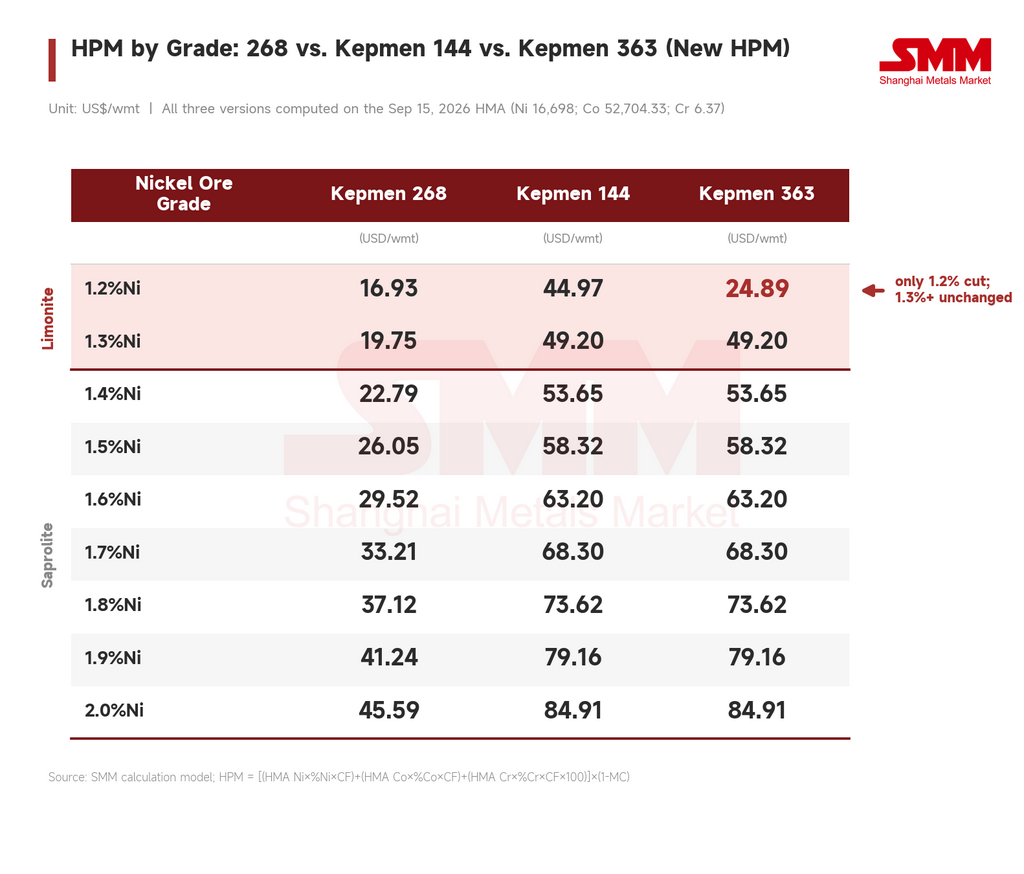
The revised HPM calculations show that the adjusted benchmark is now much closer to market prices:
Taking 1.2% nickel ore as an example, the new HPM of $24.89/wmt is $20.08/wmt, or 45%, lower than the level under Kepmen 144 which is $44.97, and is below SMM’s actual delivered price of $27.00/wmt.
The same can be seen from the royalty perspective: the royalty for 1.2% nickel ore calculated using the new HPM is $3.48/wmt, almost identical to the $3.78/wmt calculated based on the actual transaction price, with a difference of only $0.30/wmt. The previous 41% additional tax burden has therefore been largely eliminated.
For nickel mining companies, the practical impact of this revision can be summarized in four areas:
- Direct reduction in tax burden: The benchmark used to calculate royalties and related taxes has moved back toward market prices. For 1.2% nickel ore, the royalty burden per tonne is reduced by approximately $2.8–2.9/wmt;
- Improved cash flow: Government-related payments are once again more closely aligned with actual sales revenue, easing working-capital pressure;
- Greater pricing transparency: The narrower gap between the official benchmark and actual transaction prices provides a more reasonable pricing anchor for negotiations between miners and downstream HPAL buyers;
- Improved operating sustainability: Against the backdrop of rising mining, transportation, fuel, infrastructure and environmental compliance costs, a more reasonable tax burden provides particular marginal support to the economics of low-grade limonite mining operations.
4. Conclusion: A recalibration toward market prices
1. This revision is a “partial rollback” rather than a “full restoration.” Taking 1.2% nickel ore as an example, the revised nickel CF is 14%, significantly below the 26% under Kepmen 144, but still above the 13% level before April. Similarly, the new HPM of $24.89/wmt remains above the pre-April level of $17.33/wmt. The structural revaluation of resource value introduced by Kepmen 144 — particularly the inclusion of associated cobalt and chromium in the pricing formula — remains fully in place. In other words, the government has not abandoned the “full-element pricing” framework established in April, but has instead adjusted the coefficients that had clearly diverged from market conditions.
2. While miners benefit, HPAL plants may also see some relief in raw material costs, but the impact is likely to be limited. For smelters, the lower new HPM means that the benchmark used for pricing and premium/discount negotiations has moved down, potentially easing some pressure on raw material procurement. Since the revised HPM for limonite has moved below prevailing transaction prices, Whether market prices will move down toward HPM will largely depend on the amount of additional RKAB quota released and HPAL demand. With market rumours pointing to a relatively large number of RKAB revisions, additional limonite supply could enter the market, creating some downside pressure on prices. Therefore, there is potential for limonite market prices to decline, although the magnitude will depend on the actual volume of additional quota approved and the corresponding HPAL demand. Instead, the revision mainly lowers the benchmark used to calculate miners’ tax and royalty obligations. As a result, mining companies are expected to capture the more direct benefit from the HPM revision.
![[SMM Nickel Flash News] Indonesia Update — October 8, 2026](https://imgqn.smm.cn/usercenter/GmHLU20251217171733.jpg)

![[SMM Analysis] Q3 Ex-China Stainless Steel Review: Europe's surcharge fell EUR158/mt, yet CIF prices rose 2.8%](https://imgqn.smm.cn/usercenter/VstiG20251217171732.jpeg)