

Overview and Geology
Stretching through the centre of Zimbabwe, the Great Dyke is one of the world's major mineral-bearing intrusions and the geological foundation of Zimbabwe's Platinum Group Metals (PGM) industry. It extends for more than 550 km from the northeast to the southwest of the country and is generally about 3–12 km wide. Despite its name, it is not a conventional geological dyke — a simple, near-vertical sheet of rock. It is a much larger and more complex body of layered igneous rock formed when molten material entered the ancient Zimbabwe Craton and slowly cooled below the Earth's surface. [1–3]
The Great Dyke is also extremely old. High-precision uranium-lead dating of minerals from the intrusion produced a crystallisation age of 2,575.4 ± 0.7 million years, or approximately 2.58 billion years. NASA commonly rounds this to about 2.5 billion years. The intrusion therefore formed during the late Archean, within rocks of the even older Zimbabwe Craton. [1,2]
Below the surface, the Great Dyke has a deep, trough- or keel-like structure. Geological studies describe a layered system in which different minerals crystallised at different stages as the magma cooled. This separation is central to its economic importance. Chromium became concentrated mainly in chromitite seams while PGMs and metals such as nickel and copper became concentrated at other levels. The Great Dyke therefore contains valuable metals in particular geological layers rather than evenly throughout the entire body of rock. [1,3]
Zimbabwe's international PGM importance is substantial. According to the U.S. Geological Survey (USGS), Zimbabwe was the world's third-largest platinum producer in 2024, accounting for about 10.3% of global mine production, and the fourth-largest palladium producer, with around 7.0%. Its principal PGM mines — Zimplats, Mimosa and Unki — are all located on the Great Dyke. [4]
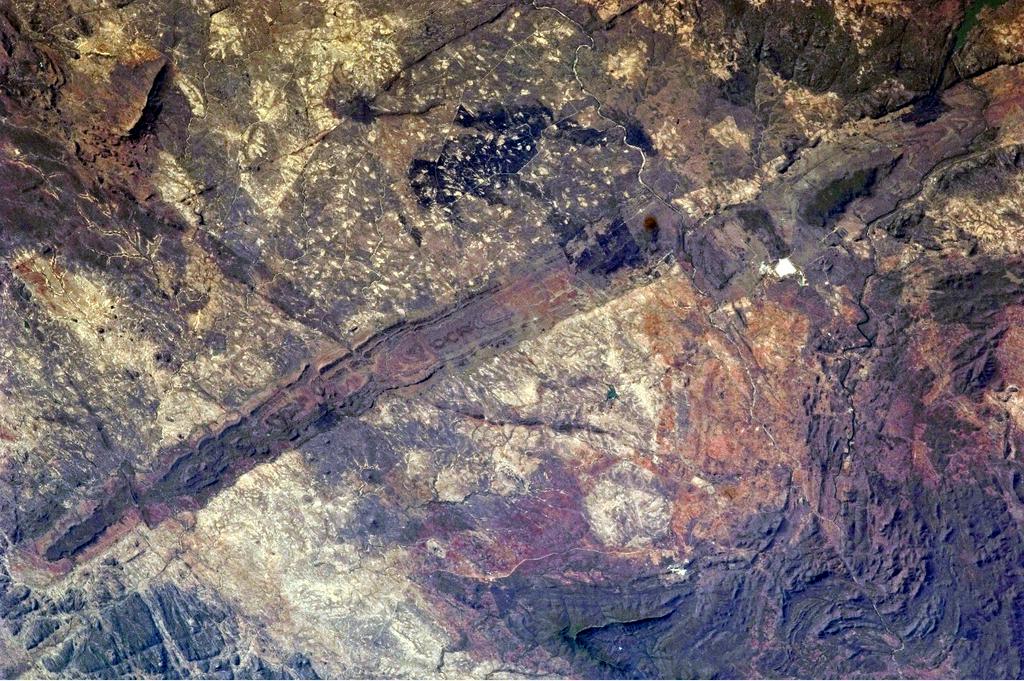
Credit: Aerial of the Great Dyke: ISS Expedition 25 crew / NASA Earth Observatory. Astronaut photograph ISS025-E-5538, acquired September 30, 2010.
Sub-Chambers and Mineralised Zones
The Great Dyke is not one uniform magma chamber. Geological studies divide it into two broad northern and southern magma chambers and five principal sub-chambers. From north to south these are Musengezi, Darwendale, Sebakwe, Selukwe and Wedza. Selukwe is associated with the area now known as Shurugwi. The Musengezi, Darwendale and Sebakwe sub-chambers form the northern part while Selukwe and Wedza form the southern part. [3,5]
This five-part division is important because older simplified descriptions sometimes refer to only four sub-chambers. Current geological literature supports five. The broad sequence of rocks can nevertheless be traced along much of the Great Dyke, making it possible to recognise the same basic geological architecture over hundreds of kilometres. [2,3]
The rock sequence can be simplified into two main divisions. The lower Ultramafic Sequence contains magnesium- and iron-rich rocks such as pyroxenite, harzburgite and dunite together with chromitite layers. Above it lies the Mafic Sequence, dominated by rocks such as norite, gabbronorite and gabbro. For a non-geologist, the main point is simple: as the magma cooled, different minerals formed at different stages, creating a vertically layered mineral system. [5]
For the PGM industry, the most important part is the Main Sulphide Zone (MSZ). The MSZ lies near the top of the Ultramafic Sequence, generally within pyroxenitic rocks about 10–50 m below the contact with the Mafic Sequence. Implats describes the MSZ as typically a 2–10 m zone containing disseminated iron-nickel-copper sulphides, with a narrower precious-metal-rich interval containing platinum, palladium, rhodium and gold. [5]
The MSZ can broadly be understood as two overlapping mineralised components. One is richer in PGEs and gold while the other contains greater amounts of nickel-copper sulphides. Important sulphide minerals include pentlandite, chalcopyrite and pyrrhotite. This explains why nickel and copper can be recovered alongside PGMs from Great Dyke ores. [5,6]
Chrome mineralisation is different. The economically important chromitite seams occur lower in the Ultramafic Sequence, below the principal PGM-bearing MSZ. Chrome and PGMs therefore occur within the same enormous geological intrusion but are generally mined from different horizons. [5,7]
For readers familiar with South Africa's Bushveld Complex, the MSZ can loosely be compared with the Bushveld's major PGM-bearing reefs because both concentrate valuable metals into relatively narrow geological horizons. However, the Great Dyke and Bushveld should not be treated as identical. Their geometry, mineral distribution, metal ratios and metallurgical characteristics differ. [3,7]
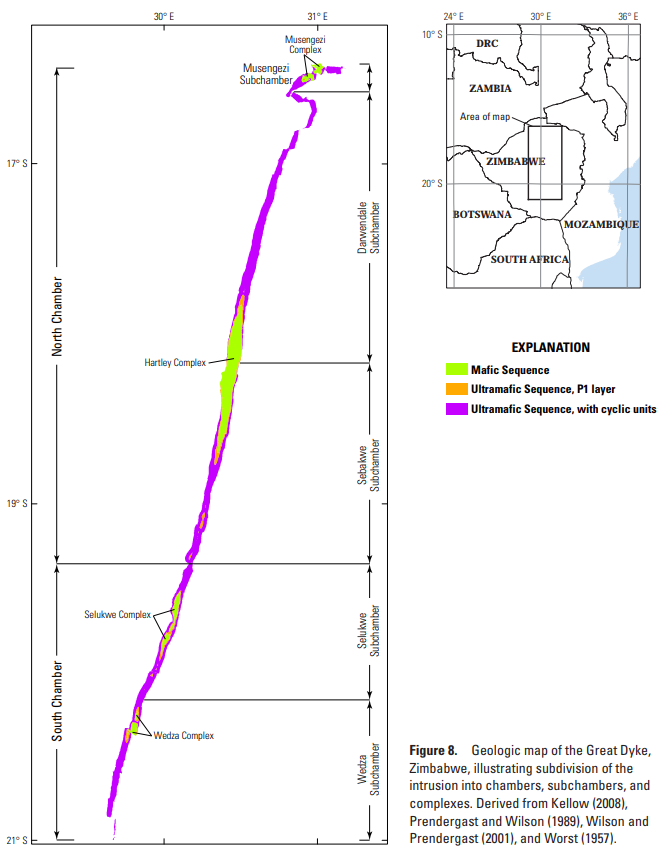
Credit: Great Dyke map; Zientek, M. L., Causey, J. D., Parks, H. L. and Miller, R. J. / U.S. Geological Survey.
Major Mining Operations and Industry Structure
Commercial PGM production from the Great Dyke is dominated by three established operations: Zimplats, Mimosa and Unki. All mine the MSZ but they differ in scale, ownership, mine design and processing arrangements.
Zimplats is the largest established PGM producer in Zimbabwe and is approximately 87% owned by Impala Platinum Holdings (Implats). Its mining operations are centred around Ngezi, southwest of Harare. The operation consists of underground mines and concentrator facilities at Ngezi together with the Selous Metallurgical Complex, where concentrates are processed further. Zimplats has expanded progressively through new mines, additional concentrator capacity and investment in smelting and associated infrastructure. [8]
Mimosa, about 32 km west of Zvishavane, lies in the Wedza sub-chamber and is owned 50:50 by Sibanye-Stillwater and Implats. It is a relatively shallow, mechanised underground operation using bord-and-pillar mining. Current mining is centred on the South Hill orebody through the Wedza and Blore decline shafts. Its concentrator has an operational capacity of about 233,000 tonnes per month and concentrates are transported to South Africa for smelting and refining at Impala's facilities. [9]
At 31 December 2025, Sibanye-Stillwater reported, on its 50% attributable basis, 6.6 million ounces of 4E PGM Mineral Resources and 1.4 million ounces of 4E Mineral Reserves at Mimosa. The current approved life-of-mine extends to 2033. A bankable feasibility study has been completed for the adjacent North Hill deposit, which could extend the operating life by a further 10–15 years, although the joint-venture partners had not approved its development as of the latest company disclosure. [9]
Unki, near Shurugwi, is 100% owned by Valterra Platinum, formerly Anglo American Platinum. Valterra became an independent PGM company following its separation from Anglo American in 2025. Unki is also a mechanised underground operation exploiting the MSZ through bord-and-pillar mining and has its own concentrator. [10]
These operations also illustrate an important issue when interpreting PGM statistics. Companies report output at different stages — for example concentrate, matte or refined metal — and may use different metal baskets such as 4E, 5E+Au or 6E. Figures from Zimplats, Mimosa and Unki should therefore not simply be added together unless the definitions and processing stages are first made comparable. [8–10]
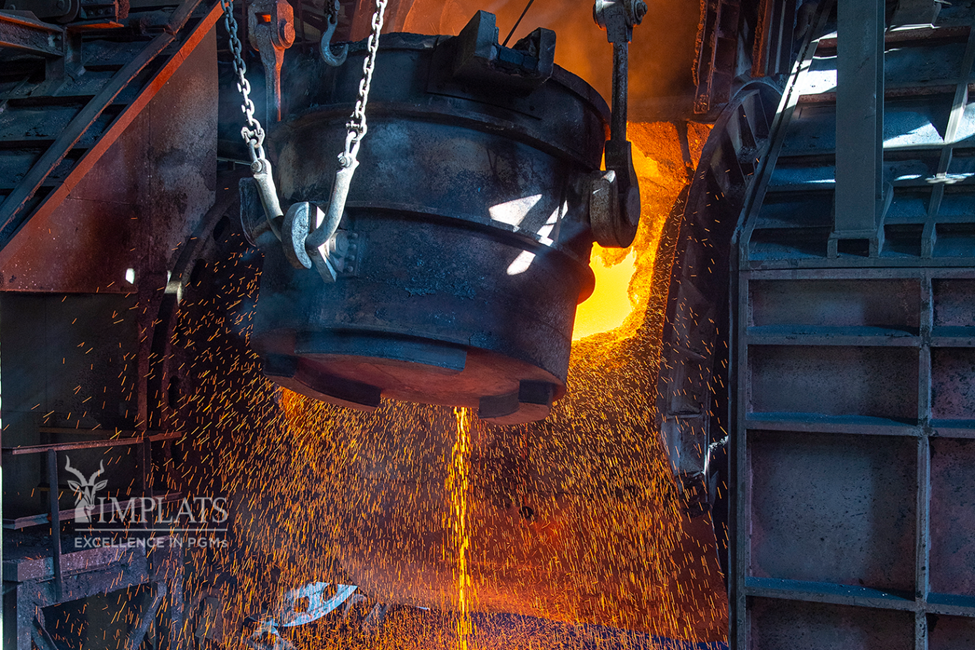
Credit: Impala Platinum Holdings Limited / Zimplats.
Resources and Economic Significance
The Great Dyke's importance comes from both the scale and diversity of its mineral endowment. Its best-known products are PGMs and chrome but the mineralised system also contains nickel, copper, cobalt and gold. These metals do not all occur at the same grades or within exactly the same geological horizons but together they make the Great Dyke one of Zimbabwe's most important mineral provinces. [5,7]
Peer-reviewed literature has long described the Great Dyke as containing the world's second-largest geological PGE resource after South Africa's Bushveld Complex. [3] This should not be confused with currently economic mineral reserves. A resource describes mineralisation with reasonable prospects for eventual economic extraction while a reserve is the economically mineable part of a resource after technical and economic studies. This distinction explains why different sources can report very different figures for the amount of PGMs associated with Zimbabwe or the Great Dyke.
At country level, Natural Resources Canada estimated that Zimbabwe produced approximately 19,000 kg of platinum and 15,000 kg of palladium in 2024. It estimated Zimbabwe's PGM reserves at about 1,200 tonnes, ranking the country third behind South Africa and Russia in its global reserve table. [11] These are national figures, not a separate estimate for the Great Dyke alone.
USGS data provide a similar picture of Zimbabwe's international importance. In 2024 the country accounted for 10.3% of global platinum mine production, 7.0% of palladium production and 3.2% of chromium production. [4]
The Great Dyke also has major economic importance within Zimbabwe, but care is needed when assigning national economic statistics specifically to it. ZIMSTAT reported that mining and quarrying represented 15.9% of Zimbabwe's GDP in 2025, second only to manufacturing at 16.8%, while mining and quarrying grew by 10.4% during the year. These figures cover the entire mining sector, not the Great Dyke alone. [12]
PGMs are also a major source of export earnings. The USGS reports that PGMs represented about 19.4% of Zimbabwe's total goods exports in 2024, compared with 32.3% for gold and 4.3% for ferroalloys. This 19.4% figure comes from the current USGS Zimbabwe country assessment and not from the general USGS PGE fact sheet used in the earlier draft. [4]
The Great Dyke therefore gives Zimbabwe an important position in global PGM supply while also supporting chrome and associated base-metal production. It does not rival South Africa's Bushveld Complex in total scale, but it is one of the few established geological provinces outside South Africa and Russia capable of supplying significant quantities of primary platinum, palladium and rhodium.
Credit: NASA/GSFC/MITI/ERSDAC/JAROS and the U.S./Japan ASTER Science Team.
Development, Production Trends and Outlook
Modern PGM production on the Great Dyke has expanded progressively through the development of Zimplats, Mimosa and later Unki. Of the three, Zimplats has experienced the most visible long-term increase in scale. Implats reported 368,900 oz of PGM in matte from Zimplats in FY2010. [13] By FY2026, Zimplats reported 606,300 oz of 6E metal in matte, while 6E concentrate production reached approximately 660,400 oz. [14] The terminology used in older and newer reports is not perfectly identical, so these figures should be read as an indication of the long-term direction of production rather than as a perfectly like-for-like statistical series.
FY2026 also shows why production growth is not determined by resource size alone. Zimplats milled approximately 8.05 million tonnes, up about 8% year on year, but the milled 6E grade declined to around 3.29 g/t. Its 6E matte production was broadly unchanged at about 606,000 oz. The year included furnace maintenance and inventory movements while mine sequencing introduced lower-grade material into the feed. [14]
At Mimosa, full-year FY2026 production was weaker. Implats reported about 239,100 oz of 6E concentrate, down approximately 6% year on year. Tonnes milled declined modestly and the average grade also weakened. The company cited changing geology and mineralogy together with intermittent electricity interruptions that affected processing stability and recoveries. [14] These factors illustrate an important point: a large geological resource does not guarantee steadily rising annual output. Grade, ground conditions, power supply, mine sequencing, recovery rates and processing availability all matter.
Unki has faced a similar grade challenge. Valterra reported 51,800 oz of 5E+Au metal-in-concentrate in the second quarter of 2026, down 4% year on year, attributing the decline to the anticipated transition into lower-grade parts of the orebody. [15]
The latest market outlook consequently points to relatively stable rather than rapidly expanding near-term Zimbabwean platinum supply. In its Platinum Quarterly released on 9 September 2026, the World Platinum Investment Council forecast Zimbabwean refined platinum mine supply of approximately 508,000 oz in 2026, compared with 515,000 oz in 2025 — a decline of around 1%. [16]
The main potential addition to Great Dyke supply is Karo Platinum, under development southwest of Harare. The project is designed as an open-pit PGM operation. Tharisa's February 2026 project material reported an open-pit 4E resource of about 11.2 Moz and reserve of about 2.1 Moz. [17] During FY2026, Tharisa increased its interest in Karo Mining Holdings to approximately 78.81%. Karo Platinum itself is held 85% by Karo Mining Holdings and 15% by Generation Minerals, a Zimbabwe Government special-purpose vehicle with a free-carried interest. [18,19]
Another important development came in August 2026, when Tharisa announced a binding agreement with a Valterra Platinum subsidiary for the purchase of PGM and base-metal concentrate from Karo. [19] The agreement improves the project's route to market but Karo remains a development project and should not yet be counted as existing Zimbabwean mine supply.
The outlook for the Great Dyke is therefore best viewed in two parts. In the near term, production will remain dominated by Zimplats, Mimosa and Unki, with output influenced by grades, mine sequencing, electricity reliability and processing performance. Over the medium to longer term, the large established resource base leaves room for further development, particularly if projects such as Karo move into sustained production and existing operators continue investing in mine replacement, processing and power infrastructure.
For global PGM markets, the Great Dyke is strategically important without being a substitute for the much larger Bushveld Complex. Zimbabwe is already one of the world's leading platinum producers. The central question is no longer whether the Great Dyke contains significant PGM resources — that has been established over decades of geological study, but how efficiently those resources can be converted into economically sustainable production.
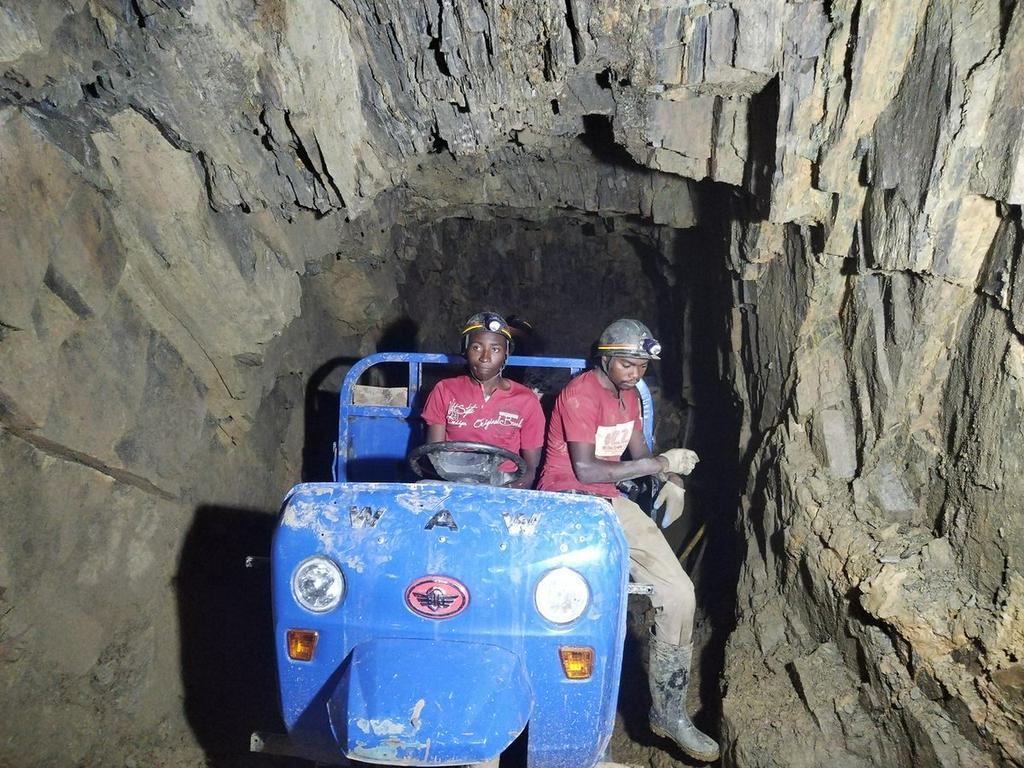
Credit: Tharisa plc / Karo Platinum. The page contains current project and construction photographs.
References
[1] NASA Earth Observatory. (2010, October 11). Great Dyke of Zimbabwe. National Aeronautics and Space Administration. NASA source
[2] Oberthür, T., Davis, D. W., Blenkinsop, T. G., & Höhndorf, A. (2002). Precise U–Pb mineral ages, Rb–Sr and Sm–Nd systematics for the Great Dyke, Zimbabwe—constraints on late Archean events in the Zimbabwe craton and Limpopo belt. Precambrian Research, 113(3–4), 293–305. https://doi.org/10.1016/S0301-9268(01)00215-7
[3] Maier, W. D., Määttä, S., Yang, S.-H., Oberthür, T., Lahaye, Y., Huhma, H., & Barnes, S.-J. (2015). Composition of the ultramafic–mafic contact interval of the Great Dyke of Zimbabwe at Ngezi mine: Comparisons to the Bushveld Complex and implications for the origin of the PGE reefs. Lithos, 238, 207–222. https://doi.org/10.1016/j.lithos.2015.09.007
[4] U.S. Geological Survey, National Minerals Information Center. (2026). Zimbabwe. U.S. Geological Survey. USGS Zimbabwe country assessment
[5] Impala Platinum Holdings Limited. (2015). Mineral resource and mineral reserve statement 2015: The Great Dyke. Implats. Implats Great Dyke geology
[6] Stribrny, B., Wellmer, F.-W., Burgath, K.-P., Oberthür, T., Tarkian, M., & Pfeiffer, T. (2000). Unconventional PGE occurrences and PGE mineralization in the Great Dyke: Metallogenic and economic aspects. Mineralium Deposita, 35, 260–281. https://doi.org/10.1007/s001260050019
[7] Zientek, M. L., Causey, J. D., Parks, H. L., & Miller, R. J. (2014). Platinum-group elements in southern Africa—Mineral inventory and an assessment of undiscovered mineral resources (Scientific Investigations Report 2010–5090–Q). U.S. Geological Survey. https://doi.org/10.3133/sir20105090Q
[8] Impala Platinum Holdings Limited. (2025). Annual Integrated Report for the year ended 30 June 2025. Implats. Implats 2025 Integrated Report
[9] Sibanye-Stillwater Limited. (2026). Mimosa: Zimbabwe. Sibanye-Stillwater. Sibanye-Stillwater Mimosa operation
[10] Valterra Platinum Limited. (2026). Integrated Report 2025. Valterra Platinum. Valterra Platinum reports
[11] Natural Resources Canada. (2026). Platinum facts. Government of Canada. Natural Resources Canada – Platinum facts
[12] Zimbabwe National Statistics Agency. (2026, June 19). ZIMSTAT releases 2025 annual Gross Domestic Product (GDP) figures. Government of Zimbabwe. ZIMSTAT 2025 GDP release
[13] Impala Platinum Holdings Limited. (2010). Integrated Annual Report 2010. Implats. Implats 2010 Integrated Annual Report
[14] Impala Platinum Holdings Limited. (2026, July 31). Production update for the year ended 30 June 2026. Implats.
[15] Valterra Platinum Limited. (2026, July 17). Valterra Platinum Limited production report for the second quarter ending 30 June 2026. Valterra Q2 2026 production report
[16] World Platinum Investment Council. (2026, September 9). Platinum Quarterly: Q2 2026. WPIC. WPIC Platinum Quarterly Q2 2026
[17] Tharisa plc. (2026, February). Karo analyst site visit presentation. Tharisa plc. Tharisa Karo analyst site visit presentation
[18] Tharisa plc. (2026). Interim results for the six months ended 31 March 2026. Tharisa plc. Tharisa FY2026 interim results
[19] Tharisa plc. (2026, August 27). PGM concentrate purchase agreement: Karo Project. Regulatory announcement. Karo concentrate purchase agreement announcement


![Weaker US dollar bolsters precious metals futures; platinum spot market trading sluggish [SMM Daily Review]](https://imgqn.smm.cn/usercenter/nQsOk20251217171736.jpg)