Major international PV module markets continue to move in different directions. Module manufacturers are raising price guidance to repair margins, but project developers remain focused on returns, inventories and financing costs, leaving the market in a familiar pattern: costs support offers, while demand determines transaction prices.
Export demand was still recovering at the start of the week, and most module manufacturers maintained a cautious stance. Some suppliers subsequently made modest concessions to secure orders and accelerate shipments.
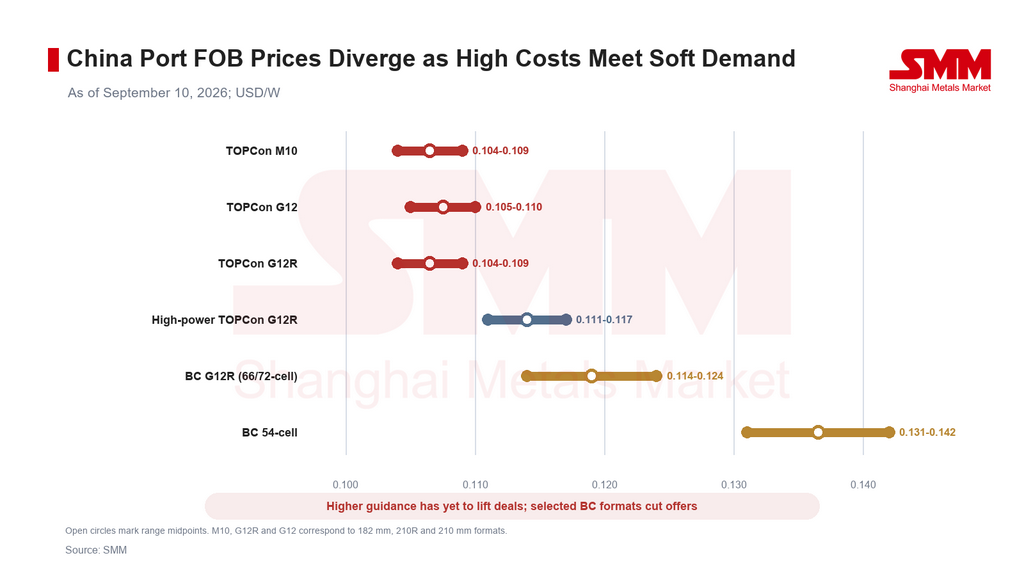
With production costs remaining elevated, margin pressure intensified and several manufacturers raised export price guidance again. However, international buyers showed limited willingness to accept higher prices, and the adjustments were not fully reflected in actual China Port FOB transactions.
Conventional TOPCon module prices were stable to slightly firmer, while high-power products remained unchanged. Price gaps among the mainstream wafer formats stayed narrow.
High-power TOPCon G12R modules retained a premium of about 7.0% over conventional G12R products, reflecting advantages in efficiency, power class and suitability for specific projects. With end-market demand yet to recover broadly, however, there is limited room for that premium to widen further.
BC module pricing became more differentiated. Some manufacturers lowered export offers for G12R formats to support shipments. BC G12R modules in 66-cell and 72-cell formats, and BC 54-cell modules, maintained premiums of approximately 11.7% and 28.2%, respectively, over conventional TOPCon G12R products. The technology premium remains visible, but demand and bargaining power increasingly vary by format.
Southeast Asia: Prices hold steady as Malaysian demand improves at the margin
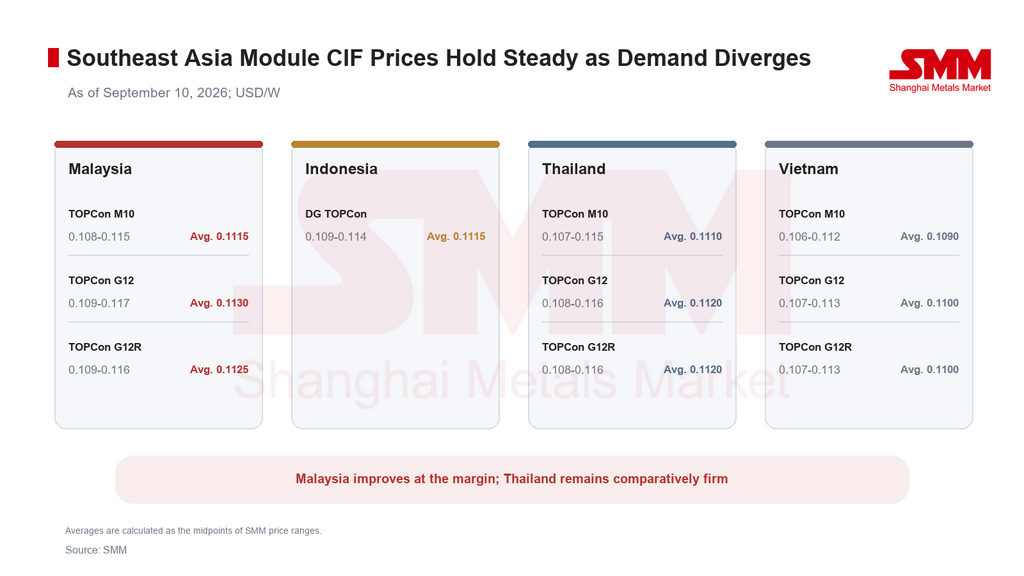
Module price ranges across Southeast Asia were broadly unchanged this week. Market activity improved slightly in some countries, but purchasing remained dominated by immediate project requirements and small-volume orders, with buyers and sellers continuing to negotiate aggressively.
Malaysia is seeing a gradual recovery in demand as the year-end installation window approaches. Some low-priced transactions have emerged, although project scale and procurement volumes remain too limited to drive a broader regional increase.
Thai buyers appear relatively more willing to accept current prices. After adjusting for freight, module pricing in Thailand remains comparatively firm among the region's major markets. Indonesia is still waiting for the release of government project quotas, while the Philippines continues to function mainly as a regional transshipment hub.
Europe: Deferred deliveries resume, but new contracting remains limited
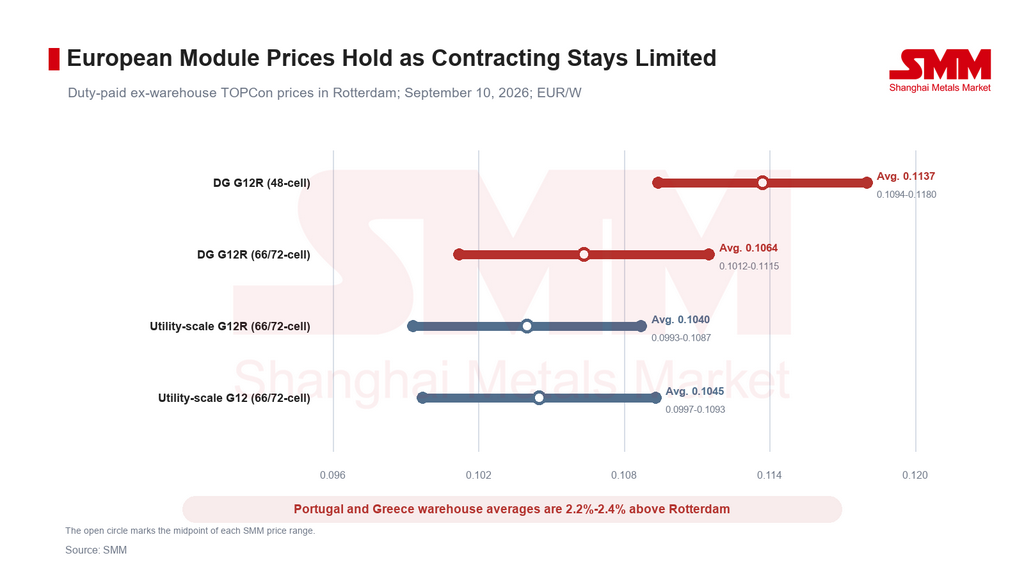
European demand remained subdued, with transactions primarily linked to previously contracted shipments and projects delayed by the summer holiday period. Shipments intended for delivery before Christmas are already under way, but most of this volume relates to existing contracts rather than incremental orders. New utility-scale contracting remained limited, while prices were broadly stable.
Demand continues to face several constraints. First, some awarded projects are tied to relatively low power purchase agreement (PPA) prices. Their return buffers are already thin, and higher module costs would raise upfront capital expenditure and further compress internal rates of return. Developers that have not completed procurement are therefore more likely to negotiate, purchase in smaller batches or delay price fixing than to accept higher offers outright.
Second, repeated periods of negative electricity prices across Europe have weakened investor confidence in solar capture prices and long-term revenue stability. Even where annual average power prices remain supportive, midday price discounts, curtailment risks and greater revenue volatility are prompting developers to demand higher returns and remain cautious on new projects and equipment purchases.
Storage deployment is progressing, but not quickly enough to provide an immediate solution to solar oversupply during peak-generation hours. Grid-connection approvals, revenue models, financing and construction timelines continue to constrain storage projects. As a result, improvements in project economics are not yet sufficient to offset higher module costs.
These factors are keeping the distributed-generation market in a clear buyer-seller standoff. End users have limited tolerance for price increases, and smaller-format distributed-generation modules moved slightly lower this week.
Logistics and local delivery costs continue to create warehouse premiums across Europe. On an average-by-format basis, warehouse prices in Portugal and Greece were approximately 2.2% to 2.4% above Rotterdam. As the summer holiday period ends, enquiries, restocking and fourth-quarter deliveries may recover, but the pace at which interest converts into firm orders will determine whether module prices gain meaningful support.
India: DCR and non-DCR prices hold steady as inventories constrain recovery
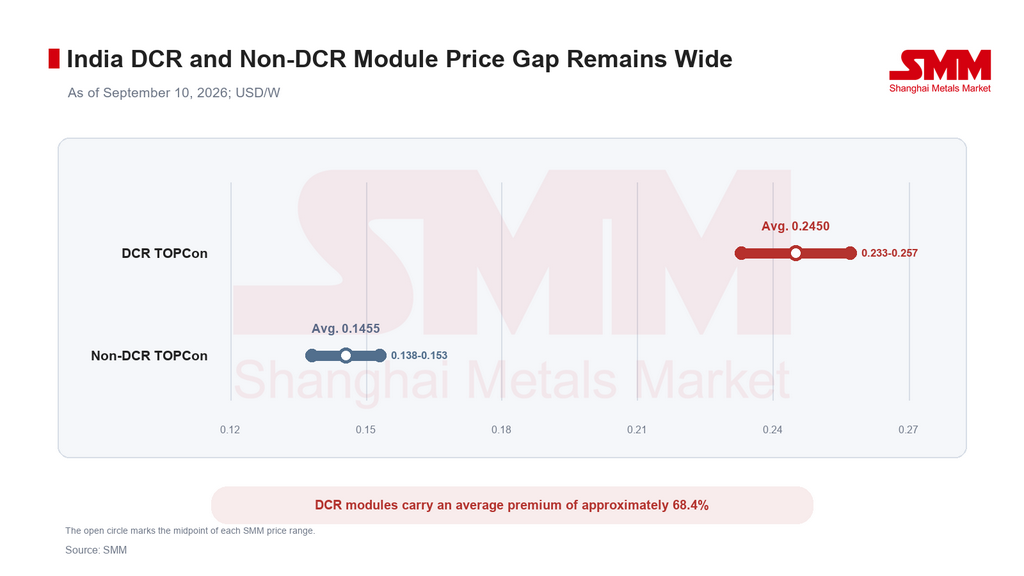
Prices for Domestic Content Requirement (DCR) and non-DCR modules remained stable this week. DCR modules maintained an average premium of about 68.4% over non-DCR products, supported by policy eligibility and domestic manufacturing requirements.
India's non-DCR module market previously experienced concentrated stockpiling linked to the US Section 232 policy window. This kept prices at relatively elevated levels, but buyers remained reluctant to accept higher offers and the market has since moved into a high-level consolidation phase.
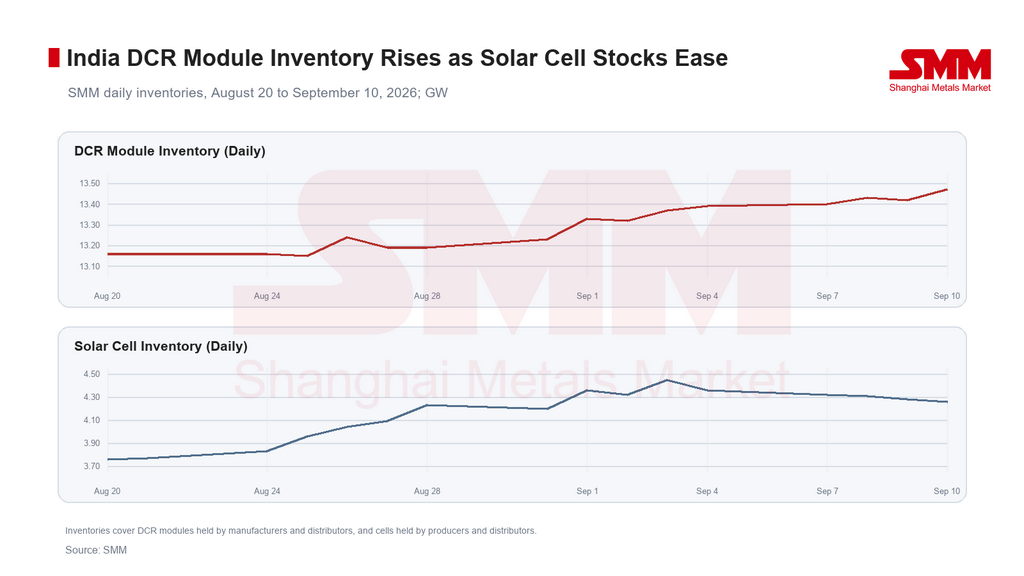
DCR module shipments remained lacklustre. End-market demand improved marginally, but overall market activity has yet to strengthen materially. The durability of price support will depend on project procurement, inventory reduction and the release of policy-driven orders.
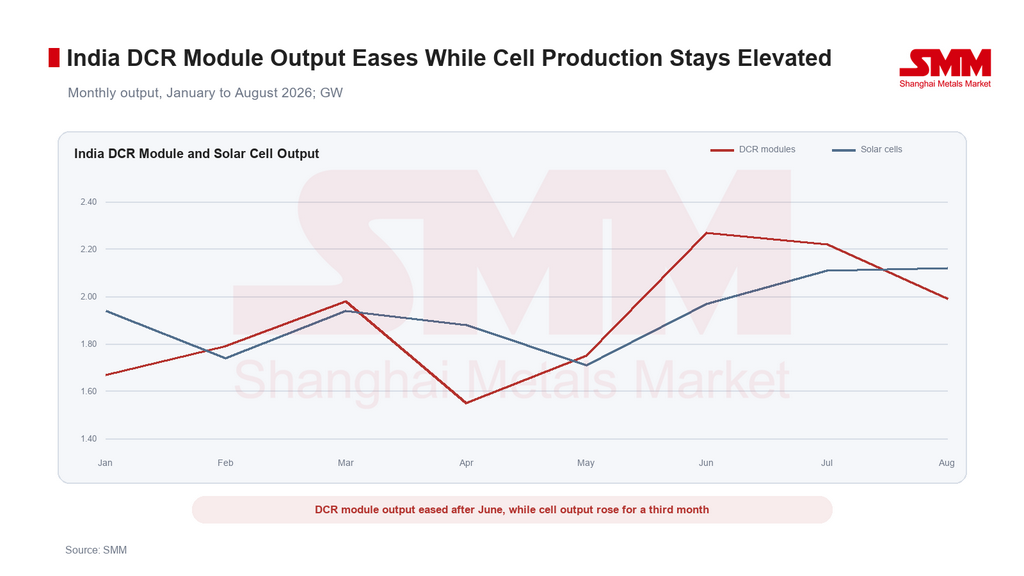
Production data show that Indian DCR module output recovered after falling to 1.55 GW in April. Output rose to 1.75 GW in May and 2.27 GW in June, an increase of approximately 46.5% from the April low. Production remained relatively high at 2.22 GW in July before easing 10.4% month on month to 1.99 GW in August, still 28.4% above April.
Solar cell output recovered for three consecutive months after declining to 1.71 GW in May. Production reached 1.97 GW in June, 2.11 GW in July and 2.12 GW in August, representing cumulative growth of approximately 24.0% from May and leaving August output near its highest level of 2026.
Outlook: Cost support remains, but regional demand will set the direction of transactions
In the near term, elevated production costs in China will continue to encourage manufacturers to raise price guidance and reduce exposure to low-priced orders. Yet international demand has not recovered broadly, and whether higher offers translate into transactions will depend on project returns and delivery schedules. Conventional TOPCon prices are likely to remain rangebound, while high-power and BC products may continue to diverge by format and brand.
In Southeast Asia, the key question is whether year-end installation demand will materialise on schedule. Malaysia's marginal recovery may support regional transactions, and price acceptance in Thailand is relatively healthy. Indonesia and several other markets still lack clear incremental demand, however, and low-priced supply may continue to cap increases if procurement fails to reach scale.
In Europe, the market will be watching whether post-holiday enquiries convert into new contracts. Deferred deliveries, warehouse restocking and fourth-quarter project demand could offer temporary support. If actual demand falls short of expectations, manufacturers and distributors may return to price competition for a limited pool of orders.
Indian module prices are likely to remain stable in the short term, although elevated DCR inventories will continue to constrain recovery. Non-DCR prices will depend on whether underlying purchases can replace earlier stockpiling demand. Overall, international PV module markets are likely to remain defined by cost support, regional divergence and transaction-led price formation.
Written by:
Ryan Tey Tze Yang | SMM PV Analyst
+60 127179370 | ryan.tey@metal.com
![China Proposes Tighter Solar Technology Export Controls: What Next for the Ex-China Region? [SMM Analysis]](https://imgqn.smm.cn/usercenter/lBNjs20251217171740.jpg)
![[SMM Analysis] Silver Down Nearly 20% From Stage High: Why Are Solar Cell Prices Not Following?](https://imgqn.smm.cn/usercenter/FqtWa20251217171742.jpg)
![[SMM PV Flash] Sigenergy Named National-Level Specialized and Sophisticated "Little Giant" Enterprise!](https://imgqn.smm.cn/usercenter/JNxfy20251217171742.jpg)