August 2026 Secondary Aluminum Alloy Producer Operating Rates by Region and Company Size:
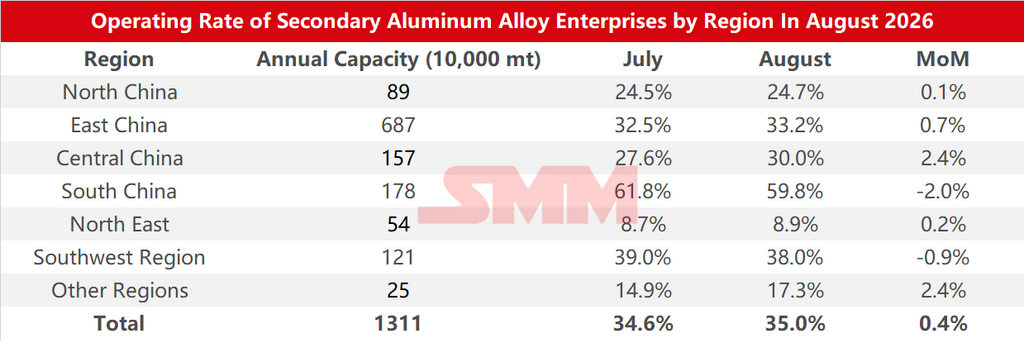
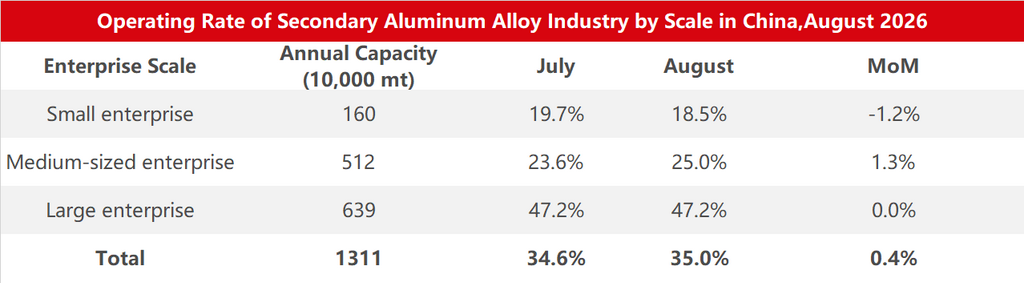
According to SMM research, the operating rate of China’s secondary aluminum industry rose slightly by 0.4 percentage points month-on-month to 35.0% in August 2026, but remained 6.3 percentage points lower year-on-year, indicating a modest recovery in overall production activity, although the improvement remained limited. Regionally, operating rates in Central and East China increased by 2.4 and 0.7 percentage points, respectively, making them the main sources of growth, while South and Southwest China saw declines of 2.0 and 0.9 percentage points, respectively. By company size, the operating rate of medium-sized producers increased by 1.3 percentage points, while that of large producers remained broadly unchanged and that of small producers declined by 1.2 percentage points. Overall, large producers maintained relatively stable production, medium-sized producers showed some recovery, while small producers continued to face pressure.
Two main factors supported the modest recovery in industry operating rates in August. First, some producers reported a slight improvement in downstream orders, while raw material availability also eased somewhat from previous levels, allowing some producers to resume production. Second, changes in the futures-spot market temporarily broadened sales channels for some producers. At the beginning of the month, stronger futures prices and a widening futures premium improved the purchasing interest of arbitrage traders. Some producers opted to deliver directly into the futures market. Against the backdrop of generally weak end-user demand, futures-related purchases and delivery demand temporarily eased finished-goods inventory pressure, providing some room for producers with insufficient orders to resume idle capacity.
However, the overall recovery in August remained constrained by multiple factors. On the one hand, downstream customers in some areas of South, East and Southwest China were still affected by summer shutdowns or seasonal weakness, limiting the release of end-user orders. On the other hand, some producers continued to face tight supplies of compliant aluminum scrap, while stricter environmental controls in certain regions also limited the recovery in production. In addition, tax-invoice compliance risks and related policy constraints have not been fully resolved. Producers therefore remained relatively cautious in raw material procurement and production, further limiting the upside in industry operating rates.
Entering September, as summer shutdowns among downstream customers largely come to an end and the traditional peak season, known as the “Golden September”, gradually gets underway, a marginal improvement in end-user demand is expected to encourage secondary aluminum producers to increase production schedules, leaving room for further recovery in operating rates. Going forward, market attention will focus on the realization of downstream orders, changes in tax-invoice and compliance policies, domestic and overseas aluminum scrap supply, and the impact of holidays on production and procurement schedules.
![August operating rate of secondary aluminum producers recovers slightly, supply-demand repair still faces multiple constraints [SMM analysis]](https://imgqn.smm.cn/usercenter/zlIyw20251217171654.jpg)