Last week (August 31–September 4), SMM refined indium (≥99.99%) spot prices held within the range of 5,300–5,400 yuan/kg, with the weekly average price moving sideways at 5,340–5,350 yuan/kg, basically flat WoW from the previous Friday (0%). At the start of the week (8/31), SMM quoted 5,300–5,400 yuan/kg, with an average price of about 5,350; on Wednesday (9/2), the quote was 5,300–5,380 yuan/kg, with an average price of 5,340, unchanged at 0, and it remained flat through Friday (9/4).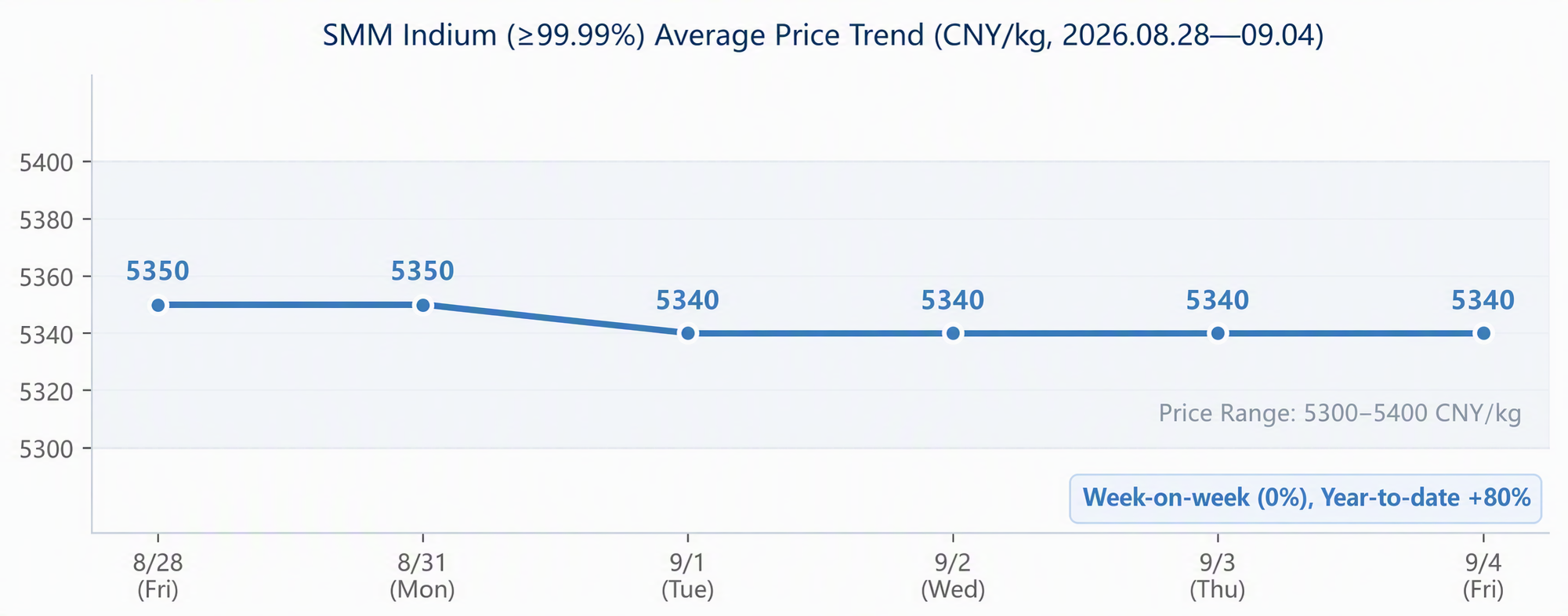
Market characteristics were basically the same as the previous week: sellers mainly held prices steady, while buyers purchased as needed. The indium market was generally stable with subdued activity, limited acceptance of high-priced cargoes, and thin actual transactions; the tug-of-war between sellers and buyers remained in a stalemate, with strong wait-and-see sentiment. Looking back at recent trends: in early August, refined indium briefly tested the 5,400 yuan/kg level, then retreated after the rapid rise and stabilized around 5,300, entering a phase of "high-level consolidation." Since the beginning of the year, the average SMM refined indium price has risen by about +80% cumulatively, nearly doubling compared to the same period last year, with the price center still in the high range of the past decade.
Supply side: rigid primary output + increased secondary output, high upstream inventory
Supply structure: primary indium lacks elasticity, secondary indium contributes marginal growth
Indium has no independently mineable deposits and is mainly associated with zinc, lead, and tin ores, with lead-zinc polymetallic deposits accounting for about 81% of global indium reserves. Global primary indium production is about 1,100 mt per year, with China accounting for about 69%–73%, giving it an absolute resource advantage, but primary indium output is rigidly constrained by zinc smelting operating rates—low zinc concentrate TCs and insufficient willingness of smelters to operate limit the release of primary indium output. Marginal growth mainly comes from the secondary side: on August 31, Feinan Resources announced the mass production of 4N7-grade refined indium (99.997% purity) through a technological transformation project, further improving domestic supply capability for high-purity indium; ST Jinglan produced 75.91 mt of refined indium in H1 (mainly from secondary recovery), ranking among the top publicly listed firms; Yunnan Chihong Zn & Ge Co., Ltd.'s 40 mt/year high-purity indium project is expected to be completed by the end of 2026.
In terms of inventory structure, there was "inventory buildup upstream and destocking downstream." The increase in producer inventories was mainly due to persistently low exports in July and limited domestic sales absorption; meanwhile, ITO target producers currently hold low inventories, which means that once demand picks up, there is considerable flexibility for restocking.
Import and export changes: exports rebounded from extremely low levels but remained sharply lower YoY
According to data from the General Administration of Customs: in July 2026, China's exports of indium-related items (unwrought and wrought indium and its products) were about 20.3 mt, up 4.2 mt MoM (+26.1%), but down 40.8 mt YoY (-66.8%), still within the extremely low range seen since export controls were imposed. Imports in July were only 1.1 mt, flat MoM and -63.3% YoY, almost negligible—China is highly self-sufficient in indium, with extremely low import dependence. 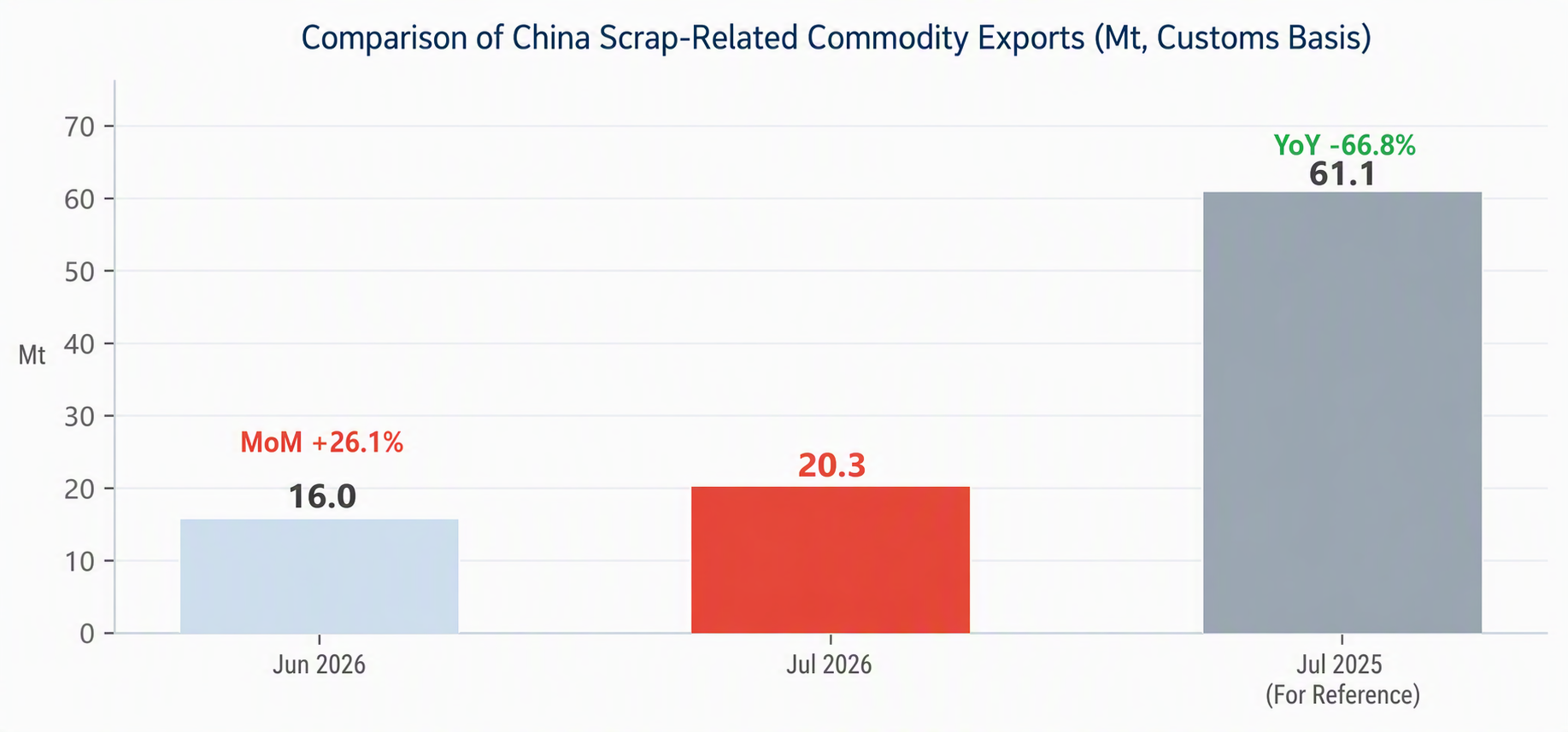
Policy Background
- February 2025: The Ministry of Commerce and the General Administration of Customs placed indium phosphide (InP) and other indium-related dual-use items under export controls, driving overseas indium phosphide substrate prices sharply higher (6-inch wafers up about 250% from pre-control levels);
- February 4, 2026: The scope of export controls was further expanded, with an announcement imposing export controls on tungsten, tellurium, bismuth, molybdenum, and indium-related items, continuously strengthening indium's strategic resource attributes and policy constraints;
- June 26, 2026: The Ministry of Commerce detailed rules for handling reports of violations of export controls on strategic mineral dual-use items (effective July 1), with key coverage of gallium, germanium, tungsten, molybdenum, rare earths, indium, bismuth, and other varieties.
The policy impact is already directly reflected in trade flows: July exports fell 66.8% YoY, and average monthly exports from January to July contracted 57.7% compared to the same period last year, with overseas buyers shifting to diversified procurement (Japan, South Korea, and the US replenishing from channels outside China; Japan's April indium imports rose 69.7% MoM as an example). On September 7, IQE CEO publicly warned that China's indium phosphide export controls are evolving into a "supply security crisis" for the chip industry—tighter controls combined with geopolitical maneuvering have made indium's international pricing and trade flows a focal point.
IV. Demand Side: Structural Boom in AI Optical Communications vs. Stable Traditional ITO
|
Application |
Share/Status |
Latest Developments |
|
ITO Targets (Transparent Conductive for Display Panels) |
About 60%–70% of demand |
Consumption improved YoY (+23.65% in June) but procurement pulled back MoM, with low downstream inventory; about 80% of global target capacity is concentrated in Japan and South Korea, with China mainly exporting raw materials; panel demand is stable, and peak-season stockpiling has not yet clearly started |
|
Indium Phosphide InP (AI Optical Modules/Optical Chips) |
About 10% of demand, with the greatest elasticity and fastest growth |
2026 global demand of 2.6–3 million wafers vs. effective capacity of about 750,000 wafers, a gap exceeding 70%; 4-inch substrates at about 6,500 yuan/piece, up 50% from the start of the year, 6-inch above $2,500/piece (high-end at about $5,000); Yunnan Lincang Xinyuan Germanium Industry disclosed on 9/4 an expansion from 150,000 to 450,000 wafers/year (18-month construction period); Bojie Corporation acquired Dingtai Xinyuan to enter the substrate business; Nvidia requires indium phosphide laser capacity to expand 20-fold by 2030 |
|
PV (CIGS)/Alloys, etc. |
Stable support |
Indium demand for CIGS thin-film batteries is mild; Soochow University and others published in June an "indium-free tandem cell" with over 30% efficiency, creating long-term substitution potential but limited near-term impact |
The core contradiction in one sentence: Indium's traditional base (ITO) is stable, while the new growth story (indium phosphide) sees a continuously widening supply-demand gap. Industry estimates suggest that AI data center demand for indium phosphide is expected to grow from around 600,000 wafers in 2025 to approximately 13 million wafers by 2030, corresponding to indium demand rising from about 19 mt to roughly 419 mt. Given the rigid constraints on primary indium supply, the medium and long-term supply-demand gap is set to widen, providing long-term support for indium prices.
Market Outlook
Short term (1-3 months): Prices are expected to consolidate at highs, with direction pending demand confirmation. Bullish and bearish factors are intertwined—bullish: export controls plus indium phosphide prosperity providing a floor, low downstream inventories, and strong seller willingness to stabilize prices; bearish: elevated upstream producer inventories, ample spot circulation, high prices curbing purchases, and sluggish trading in the traditional off-season. SMM refined indium is expected to continue consolidating within the 5,300-5,400 yuan/kg range. If September-October ITO peak-season stockpiling resonates with new orders for indium phosphide, there is potential for an upside breakout; otherwise, prices are likely to move sideways within a narrow range.
Medium and long term (6-24 months): Under the supply-demand gap logic, the price center is expected to continue shifting upward. Primary indium supply lacks elasticity (constrained by zinc smelting), and refining recycled indium to semiconductor grade (7N) is difficult, making it hard to replace primary supply. Meanwhile, indium phosphide demand driven by AI optical communications remains in the early stages of explosive growth, and the industry holds relatively consistent expectations for a supply-demand shortage in 2027. The indium price center is likely to consolidate and rise in line with the pace of AI capital expenditure. Attention should be paid to cloud providers' capex guidance and the progress of indium phosphide capacity expansion.
Key Points to Watch
- August import and export data: Whether August customs indium import and export data (mid-to-late September) can sustain the low-volume trend;
- Indium phosphide capacity expansion progress: Yunnan Lincang Xinyuan Germanium Industry's 450,000-wafer production line, and the yield and ramp-up pace of overseas Sumitomo/JX/Coherent expansions;
- Export license implementation: Actual export quotas and destination changes after the detailed control rules take effect, as well as overseas restocking behavior;
- Zinc smelting operating rates and primary indium supply: Zinc concentrate TC trends will determine the marginal output of smelter by-product indium;
- ITO peak-season stockpiling: The impact of panel makers' September-October stockpiling pace on indium demand for targets.
![[SMM Flash] Côte d’Ivoire: Atex review highlights near-surface tantalum](https://imgqn.smm.cn/usercenter/EutUV20251217171724.jpeg)