China's stainless steel futures extended their decline this week, breaking to fresh lows barely a week after losing the RMB 14,000/mt level. The benchmark SHFE contract was quoted at RMB 13,870/mt (about $2,064/mt) at Friday's 10:15 close, down RMB 115/mt (roughly $17/mt), or 0.82%, from the prior Friday, with the intraweek low briefly breaking below RMB 13,700/mt (about $2,039/mt). The timing is what matters: China's traditional "Golden September" demand season has formally opened, and the restocking that normally accompanies it has not materialised at all.
A week that gave up its gains twice
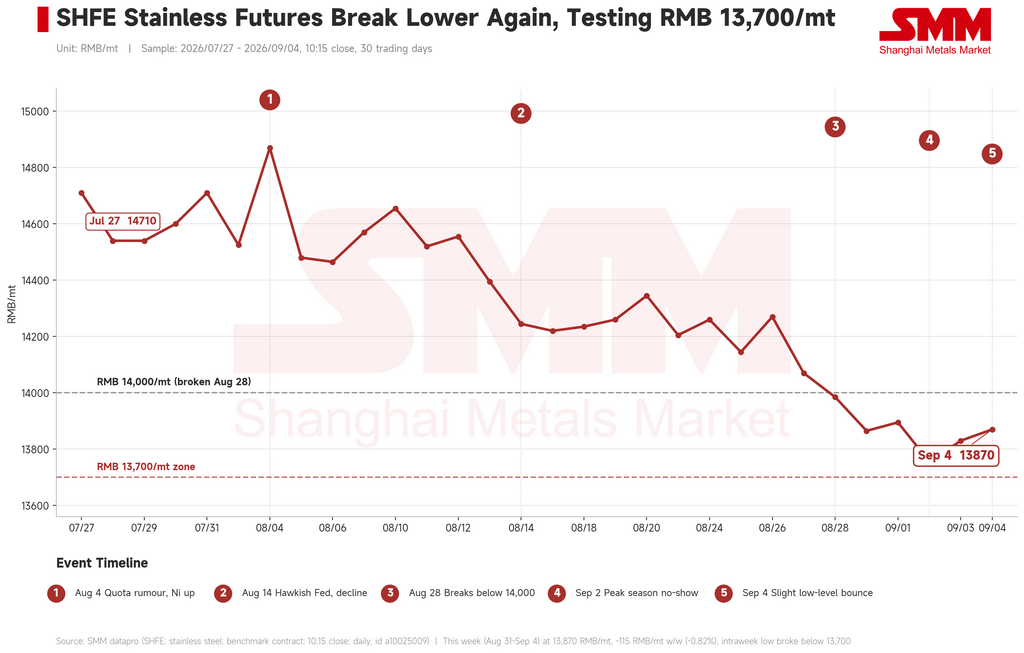
The contract opened Monday at RMB 13,865/mt (about $2,063/mt), ticked up to RMB 13,895/mt (about $2,068/mt) on Tuesday before turning, then fell to RMB 13,755/mt (about $2,047/mt) on Wednesday — the week's low point. Thursday recovered slightly to RMB 13,830/mt (about $2,058/mt), and Friday added RMB 40/mt. Sentiment has turned outright bearish, and the market's valuation centre keeps sliding.
Spot quotations looked deceptively stable. The 304/2B premium in Wuxi, Jiangsu — a major stainless trading centre in eastern China — held in a RMB 450–800/mt ($67–119/mt) range. Cold-rolled 201/2B coil in Wuxi was unchanged; cold-rolled mill-edge 304/2B coil was flat in both Wuxi and Foshan, Guangdong (China's largest stainless processing and distribution hub); cold-rolled 316L/2B and hot-rolled 316L/NO.1 in Wuxi were flat, as was cold-rolled 430/2B in both cities. But guidance prices and trader-agent quotes were cut repeatedly through the week, so actual transaction levels kept drifting lower.
Hawkish Fed rhetoric collided with weak jobs data
Fed Chair Kevin Warsh said inflation data shows no meaningful improvement in trend, that price stability should be the central focus, and that it is difficult to characterise current financial conditions as restrictive. Cleveland's Beth Hammack argued the Fed should hike and that waiting would only bring more pain. Governor Michael Barr said a decisive hike is warranted if inflation fails to cool, and Governor Christopher Waller signalled he would consider a hike if August inflation surprises to the upside. Market pricing now puts a September hike as more likely than a hold.
The labour data pointed the other way. The preliminary benchmark revision to 2026 US non-farm payrolls came in at -79,000, against expectations of +183,000. August ADP private payrolls added just 38,000, also below forecast, and weekly jobless claims at 206,000 exceeded expectations. That divergence — hawkish talk against a visibly softening labour market — widened the uncertainty around the policy path and weighed on base metals valuations broadly.
Hormuz escalated again
US forces struck Iranian airfields and multiple locations along the Strait, with explosions reported at Assaluyeh, a major energy hub; Washington said the targets were radar and missile capabilities Iran was attempting to rebuild. Iran's Revolutionary Guard fired missiles at US bases and said its current priority is deterrence rather than war. Shipping risk persisted: two supertankers were hit by shellfire in the Strait, and a Saudi tanker was intercepted in the southern channel.
Diplomacy went backwards. Oman rejected Iran's proposed transit fee for the Strait, Iranian officials said the "lock" on Hormuz will not open without their consent, and Iran's parliamentary speaker stated the waterway will reopen only once Washington honours its commitments. US Treasury Secretary Bessent said the Strait would be "bypassed" within two years and that sanctions on Iran would continue to expand.
For European stainless producers specifically, the energy picture deserves attention: eurozone inflation moved back above 3%, reinforcing ECB hike expectations, European gas futures reached their highest since 2023, and US diesel prices are approaching record levels.
Chinese policy support landed, but transmission takes time
China's August manufacturing PMI came in at 49.8%, up from July. It remains below the 50 expansion threshold, but the improvement at the margin offers some scope for demand expectations to recover.
Property policy arrived in a cluster. Three ministries issued rules promoting completed-home sales — meaning buyers purchase finished units rather than pre-construction, "what you see is what you get." Two ministries extended the maximum individual mortgage term from 30 to 40 years. The National Financial Regulatory Administration issued five management measures reforming property sector financing. Separately, seven ministries led by MOFCOM published guidance on expanding and upgrading goods consumption, targeting total retail sales of around RMB 60 trillion (about $8.9 trillion) by 2030.
Property and consumption are the two heaviest-weighted end-use sectors for Chinese stainless demand, so these measures matter — but the transmission into actual orders remains to be seen. On the cost side, domestic gasoline and diesel retail price caps rose by RMB 375/mt and RMB 360/mt respectively (about $56 and $54) effective August 28, adding to logistics costs.
Traders stepped back as peak-season buying failed to start
The market has entered the seasonal demand window without the corresponding behaviour. Downstream users made no concentrated restocking moves, rigid demand stayed weak, and transactions were thin throughout.
Traders cooled sharply on purchasing and turned cautious, while simultaneously pushing hard to move existing stock and cut inventory. That combination added to the volume of material circulating in the market and increased the pressure on mill allocations. As pessimism spread, guidance prices and agent quotes were cut in succession, dragging spot levels down alongside the futures market.
Inventory fell — but for the wrong reason
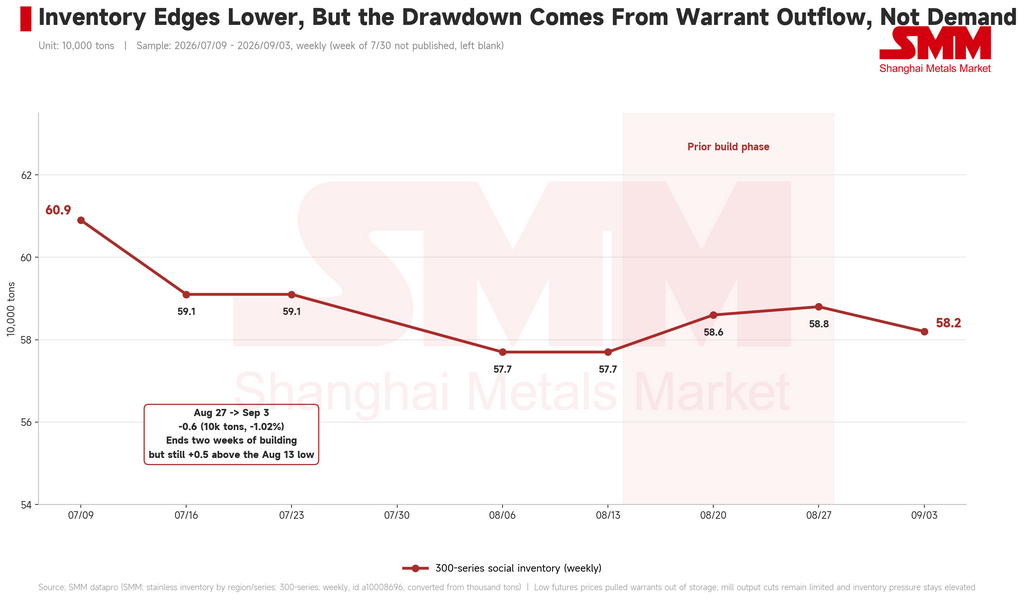
SMM's weekly data showed 300-series social inventory at 582,000 mt on September 3, down 6,000 mt from 588,000 mt the prior week, a 1.02% decline that ends two consecutive weeks of building.
The composition matters more than the direction. This drawdown came from warrant outflow — persistently low futures prices pulled material out of exchange warehouses — not from end-user consumption. Underlying pressure has not eased: mill output cuts remain limited, capacity utilisation stays high, and with rigid demand still absent, material is clearing slowly. Inventory remains elevated and the loose supply-demand balance is intact.
Margins inverted, and mills are pushing the cost onto suppliers
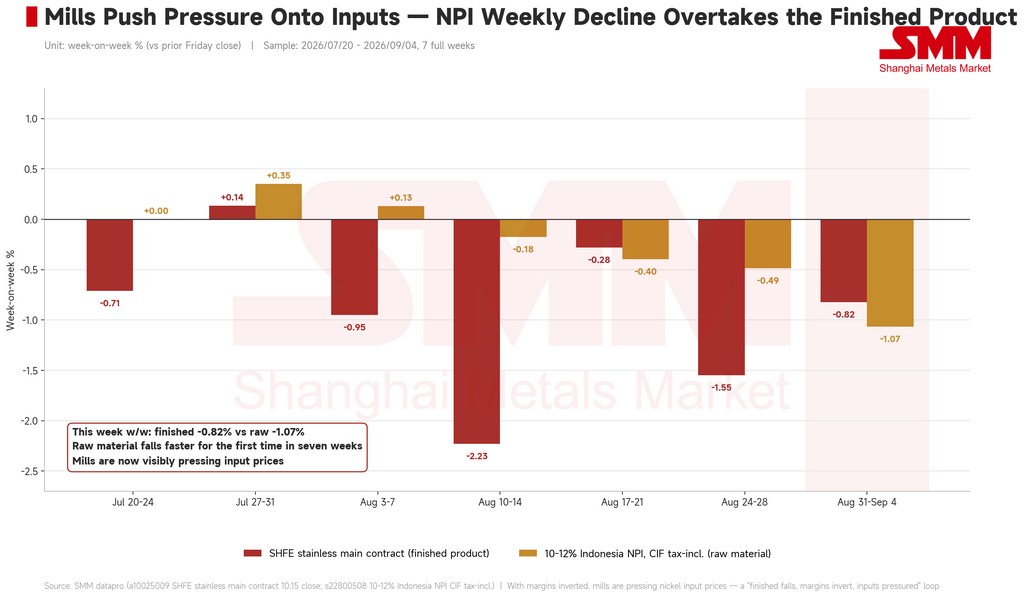
Both finished products and raw materials fell this week, and the industry has now formally entered cost inversion — Chinese mills are running at a loss.
NPI slid from RMB 1,122/nickel point (about $167) on Monday to RMB 1,114/nickel point (about $166) on Friday. On a consistent week-on-week basis, that is a 1.07% decline, against the finished contract's 0.82% — the first week in seven in which raw materials have fallen faster than the finished product. High-carbon ferrochrome's weekly average, last published for the week ended August 28, was RMB 7,910 per 50mt basis ton (about $1,177), down RMB 15 from RMB 7,925 (about $1,179).
That crossover is the week's most telling signal. With margins inverted, mills have moved from absorbing pressure to transmitting it, pressing nickel input prices harder — a self-reinforcing loop in which falling finished prices invert margins, and inverted margins drive mills to push input costs down further.
Outlook
This week's market combined a peak season that failed to arrive, weak rigid demand, a futures breakdown, spot prices following, a structurally misleading inventory drawdown, and mills operating below cost. The inventory decline should not be read as a fundamental improvement — the driver was warrant outflow, not demand.
Near term, the absence of seasonal demand, spreading pessimism, elevated mill output, and bearish control of the futures market are the dominant factors, and weakness looks set to persist. Cost inversion is theoretically a floor, but mills are choosing to pass pressure to raw material suppliers rather than cut production, which makes that floor less reliable than in previous cycles. Worth tracking: the pace of any stabilisation in the futures market, whether peak-season buying eventually lands, adjustments to mill production schedules, movement in the finished-to-raw-material spread, the rate of inventory clearance, and the September FOMC outcome alongside Middle East transmission into costs.
![[SMM Nickel Morning Meeting Summary] Fed Official's Dovish Remarks Ease Macro Pressure, the Most-Traded SHFE Nickel Contract Consolidates and Pulls Back in Early Trading](https://imgqn.smm.cn/usercenter/GmHLU20251217171733.jpg)
![[SMM Stainless Steel Flash] EU Stainless Steel Imports Fall 21% YoY in H1 2026; Outokumpu Warns of Q3 Volume Decline](https://imgqn.smm.cn/usercenter/fzwTi20251217171733.jpg)
![[SMM Nickel Flash] Pure Battery Technologies Advances US$350 Million Batang pCAM Project](https://imgqn.smm.cn/usercenter/yUOUz20251217171732.jpg)