Solar generation records were set across several European markets in July and August 2026, supported by continued capacity additions and prolonged sunny weather.
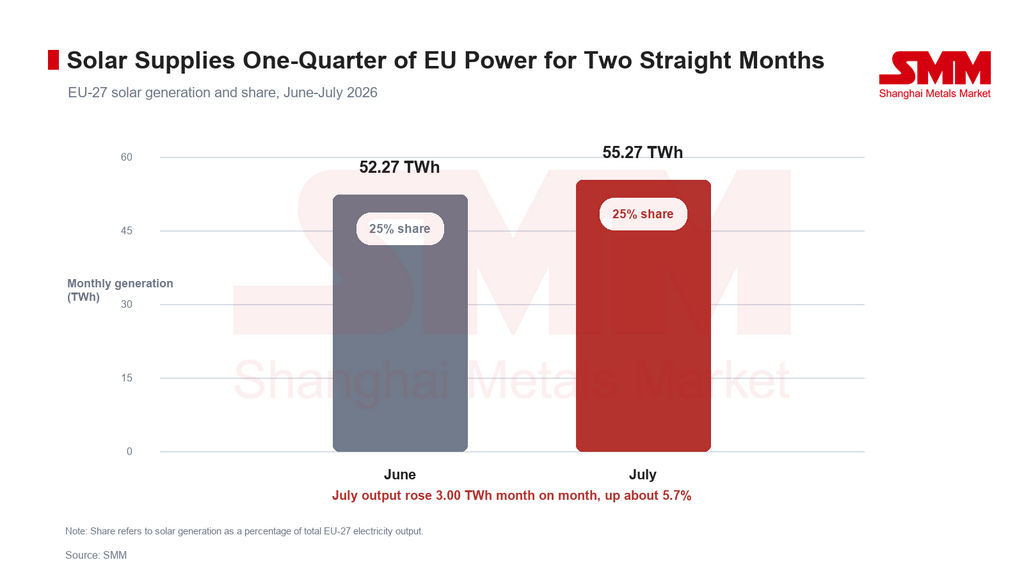
Portugal, France, Spain, Italy, Germany, Great Britain, Ireland and Türkiye reported new highs in instantaneous solar output, daily or monthly generation, or solar's share of the power mix. Across the EU-27, solar generation reached approximately 55.27 TWh in July, up 3.00 TWh, or about 5.7%, from 52.27 TWh in June. Solar supplied roughly 25% of EU electricity generation in both months.
The increase in output without a corresponding rise in solar's generation share suggests that heat-related electricity demand and output from other power sources also changed during the period. Generation volumes alone therefore do not provide a complete picture of how the regional power mix evolved.
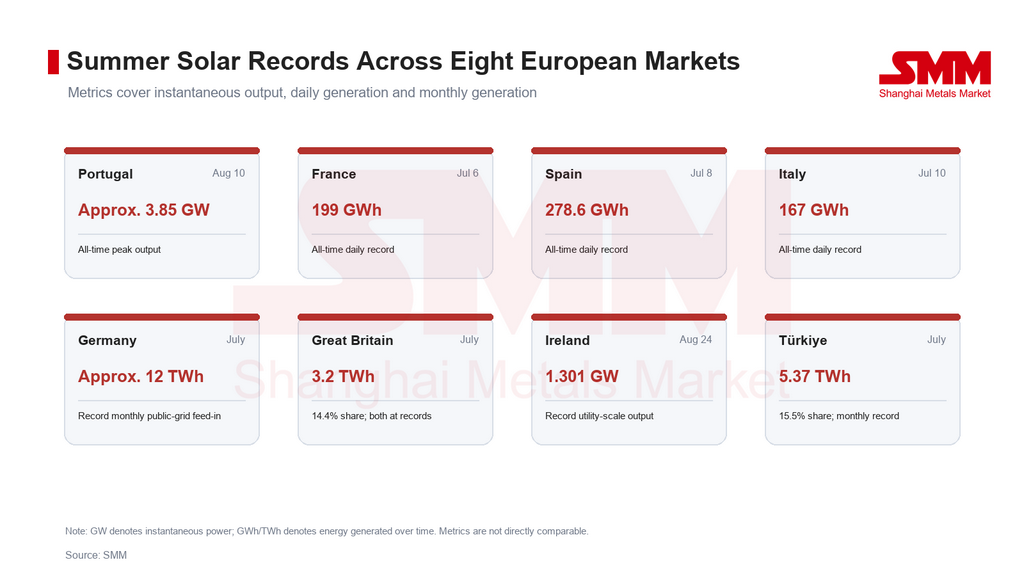
Records spread across eight European markets
France produced approximately 199 GWh of solar power on July 6, setting an all-time daily record. Spain followed with 278.6 GWh on July 8, while Italy reached 167 GWh on July 10, both new national daily highs.
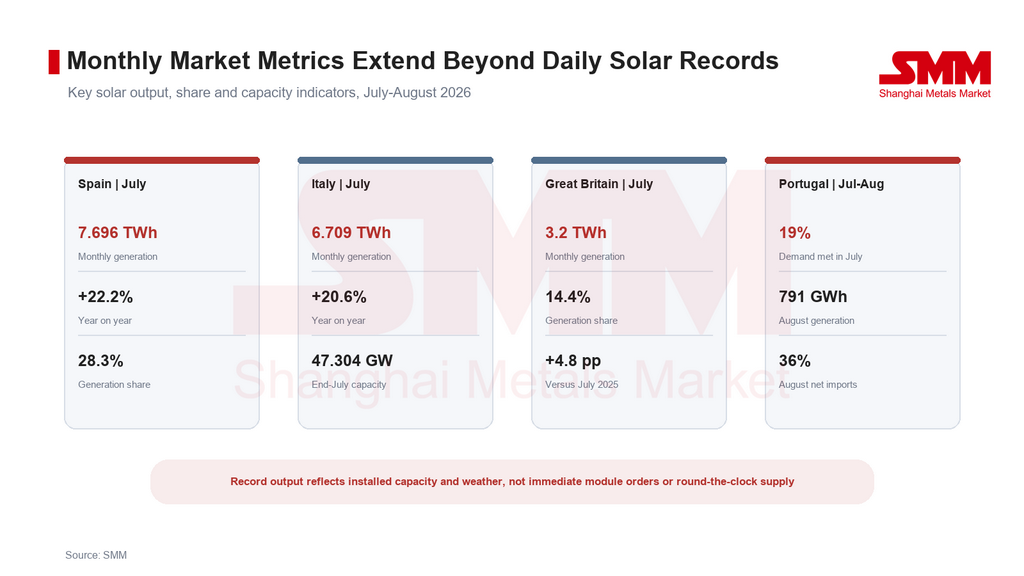
Spain generated 7.696 TWh of solar power in July, up 22.2% year on year. Solar accounted for 28.3% of national electricity generation and remained the country's largest source of power for a fourth consecutive month. Including an estimated 1.654 TWh of behind-the-meter solar generation would raise the renewable share of Spain's electricity mix from 54.1% to 55.7%, highlighting the extent to which public-grid data can understate distributed PV output.
Italy generated approximately 6.709 TWh of solar power in July, an increase of 20.6% year on year. Generation reached 33.003 TWh in the first seven months of 2026, up 19.5%, indicating that the July 10 record reflected both favourable weather and a broader expansion in generating capacity.
Germany fed close to 12 TWh of solar power into the public grid in July, a monthly record, with average public-grid PV feed-in exceeding 40 GW around midday. The figure excludes part of the electricity consumed directly by households and businesses, meaning total PV generation was higher. Germany produced approximately 494 GWh on July 10, its strongest July day and second-highest solar generation day on record.
Great Britain generated around 3.2 TWh of solar power in July. Solar supplied 14.4% of generation, up 4.8 percentage points from 9.6% in July 2025, equivalent to a 50% relative increase. The record covers England, Scotland and Wales rather than the entire United Kingdom.
Türkiye generated 5.37 TWh of solar power in July, representing 15.5% of national electricity generation and setting a monthly record. Renewable sources collectively supplied approximately 58.2% of electricity during the month.
Portugal's instantaneous solar output reached approximately 3.85 GW on August 10, setting a new national high. Solar generation totalled around 791 GWh in August and met approximately 18% of electricity demand. However, net imports still covered about 36% of demand, illustrating why record peak solar output should not be interpreted as round-the-clock power self-sufficiency.
In the Republic of Ireland, utility-scale solar output reached 1.301 GW on August 24. On an all-island basis, output was approximately 1.4 GW, equivalent to around 34% of electricity demand at the time. Ireland's installed solar capacity has grown from roughly 2 MW a decade ago to more than 3 GW.
Spain, France, Italy, Portugal and Germany also set new records for the month of August. These were calendar-month records, however, and should not be confused with all-time daily highs, most of which were recorded in July.
Capacity additions provide the foundation
The concentration of new generation records was not simply a short-term weather event. Europe's growing installed PV base has raised the level from which favourable weather can produce new highs.
Italy's cumulative PV capacity reached approximately 47.30 GW at the end of July after adding around 3.79 GW in the first seven months of 2026, including 699 MW in July. Germany had around 127 GW installed, with July registrations indicating approximately 1.83 GW of additions, although the latest monthly data remain subject to revisions.
Portugal had approximately 7.33 GW of solar capacity, while the United Kingdom was close to 23 GW. France reached around 33 GW at the end of the first quarter after adding approximately 1.5 GW during the quarter. Ireland's installed capacity exceeded 3 GW.
These figures use the latest available national reporting and are not strictly comparable. Reporting dates differ, as does the treatment of direct-current and alternating-current capacity, behind-the-meter systems, off-grid installations and late registrations. Differences between two reporting periods should therefore not automatically be treated as new capacity added during 2026.
Heatwaves increased both generation and demand
Clear skies supported solar production during the July-August heatwaves, but high temperatures also raised air-conditioning and cooling demand.
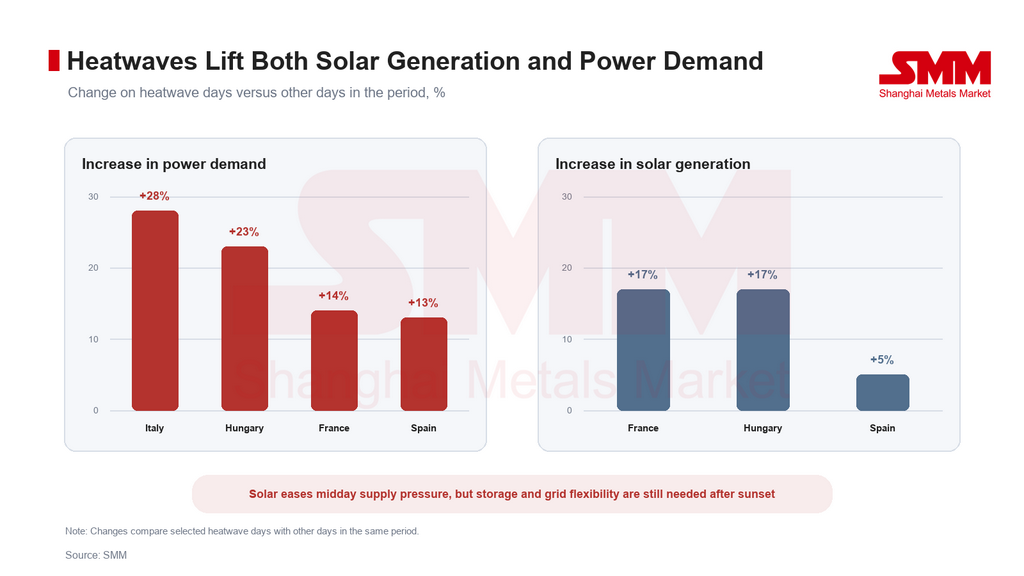
On selected heatwave days, average solar generation was around 17% higher than on other days in the period in France and Hungary, and approximately 5% higher in Spain. Electricity demand increased by as much as 28% in Italy, 23% in Hungary, 14% in France and 13% in Spain.
The comparison shows that solar generation provided meaningful support during daytime demand peaks, but its impact differed by market. In Spain and Hungary, the increase in demand was greater than the reported uplift in solar generation. Solar therefore reduced pressure on the system without eliminating the need for dispatchable generation, cross-border flows and storage.
The value of a generation record depends on three further metrics
The first is the distinction between peak power and energy generated over time. An instantaneous record measured in GW reflects conditions at a specific point in time. Daily or monthly generation measured in GWh or TWh provides a better indication of solar's sustained contribution. Portugal's 3.85 GW peak and Spain's 7.696 TWh monthly output therefore describe different aspects of their markets and should not be compared directly.
The second is captured power prices. As solar generation becomes increasingly concentrated around midday, high output can depress wholesale prices during the same hours. For project owners, the solar-weighted selling price and its discount to the average market price may matter more than gross generation alone. Record output does not necessarily deliver proportionate revenue growth if midday prices continue to weaken.
The third is curtailment and access to flexibility. The system value of additional solar depends on whether the electricity can be absorbed by local demand, exported through interconnectors, stored or shifted through demand response. Negative-price hours, curtailment rates, storage penetration, grid-connection delays and evening ramping requirements are becoming as important as installed capacity and peak output.
Record generation does not translate directly into new module demand
The new records confirm that Europe's installed PV fleet now has a material influence on the power system. They also strengthen the case for battery storage, inverter upgrades, digital operation and maintenance, and grid reinforcement.
Module demand, however, is primarily determined by new project construction rather than generation from the existing fleet. By contrast, a larger installed base can support recurring demand for inverter replacement, repowering, storage retrofits and asset-management services.
New module orders still depend on auction schedules, permitting, financing costs, available grid connections, power-purchase agreements and project returns. As solar penetration rises, developers are increasingly shifting their focus from whether a project can generate electricity to whether that electricity can be sold or consumed at an attractive value.
This is likely to increase interest in co-located storage, higher-efficiency modules, advanced inverter controls and generation profiles that better match commercial and industrial loads. Opportunities may increasingly emerge in solar-plus-storage projects, grid-forming inverter applications, power-plant repowering and digital operations, rather than through module volume alone.
Europe's post-holiday recovery will determine the near-term module price direction
As Europe's summer holiday period ends, project developers, engineering, procurement and construction contractors, and distributors are expected to resume enquiries and purchasing. Deliveries postponed during the holiday period, warehouse restocking and fourth-quarter grid-connection schedules could release some demand from September, supporting module transaction volumes and prices.
Generation records alone will not lift module prices. The direction of the market will still depend on the pace of warehouse destocking, project economics, financing costs and buyers' willingness to accept higher offers. A concentrated restocking cycle and a visible reduction in low-priced inventory could allow prices to firm gradually.
If demand returns only in small, fragmented orders, the market is more likely to see improving enquiry activity alongside divergent transactions and narrow price movements. If the post-holiday recovery falls short of expectations, manufacturers and distributors may again compete aggressively for a limited order pool, returning the market to price-led competition.
Outlook
SMM expects solar to play an increasingly important role in Europe's summer power supply as capacity continues to expand. The next stage of market development, however, will be measured less by generation records alone and more by the ability of grids and storage systems to move midday output into higher-value hours.
For module, inverter and energy-storage suppliers, competition is likely to move beyond equipment prices toward system efficiency, grid compatibility, storage coordination, data management and long-term operation. Solutions that increase usable generation and improve market revenue will be better positioned as solar penetration rises.
Written by:
Ryan Tey Tze Yang | SMM PV Analyst
+60 127179370 | ryan.tey@metal.com
![[Solar: New Jersey passes balcony solar legislation]](https://imgqn.smm.cn/usercenter/GOtTW20251217171740.jpg)
![[Solar: Solar reaches new power generation highs in Portugal in August]](https://imgqn.smm.cn/usercenter/CpbPE20251217171736.jpg)
![[Solar: Brazil's Senate approves data center tax regime tying incentives to renewable energy use]](https://imgqn.smm.cn/usercenter/mfLxa20251217171736.jpg)