SMM, 3 September:
Key points: High pressure (above 20 MPa required) for sulphide all-solid-state batteries is an industry bottleneck. Among the four global pressure-reduction technology pathways, Chinese teams have performed outstandingly: FAW × Eastern Institute of Technology achieved a breakthrough in large-capacity battery cells at 5 MPa, and the team led by Huang Xuejie at the Institute of Physics, Chinese Academy of Sciences, achieved operation with zero external pressure. The core technical approach is to introduce an elastic, self-adaptive interfacial layer at the rigid solid-solid interface, replacing external mechanical pressurisation. As pressure continues to decline from "high pressure" to "low pressure" and "zero pressure", the industrialisation of sulphide all-solid-state batteries is accelerating significantly.
Introduction: On 1 September 2026, China FAW, in collaboration with Eastern Institute of Technology, achieved a major technical breakthrough in low-pressure operation of sulphide all-solid-state batteries. The related results were published in the top international journal Advanced Energy Materials under the title "Ion-Elastomer Interface Enables Low-Pressure, High-Stability Solid-State Batteries". Addressing the industry bottleneck that all-solid-state batteries generally require operating pressures above 20 MPa, the two parties successfully achieved stable cycling of large-capacity sulphide all-solid-state battery cells under a low pressure of 5 MPa through material morphology control, low-pressure cell structure design, and preparation process optimisation. This breakthrough marks a key step forward for China in the core technologies essential for the practical application of sulphide all-solid-state batteries.

1. Why do sulphide all-solid-state batteries require high pressure?
Sulphide solid electrolytes possess high ionic conductivity close to that of liquid electrolytes, with some materials reaching the order of 10⁻² S/cm, but they are inherently brittle materials. During charge and discharge, electrode volume expansion and contraction may cause gaps to form at solid-solid interfaces and contact to deteriorate. To maintain ion and electron transport pathways, relatively high external stack pressure is typically required in laboratory and early engineering validation, commonly in the range of approximately 3–12 MPa, and in some scenarios up to around 20 MPa, equivalent to approximately 200 kg of pressure per square centimetre.
This high-pressure requirement brings a series of engineering challenges: battery packs require heavy pressurisation mechanisms, system energy density is severely reduced, and mass production costs rise sharply. Therefore, how to reduce operating pressure from above 20 MPa to single digits or even zero has become a core proposition in global solid-state battery research.
2. Global technology pathway overview
At present, the technology pathways for reducing the operating pressure of sulphide solid-state batteries worldwide can be summarised into four major directions: interface engineering, electrolyte modification, electrode structure design, and cell structure innovation.
2.1 Interface engineering pathway
This is currently the pathway with the densest results and the most significant breakthroughs. The core idea is to introduce a functional interfacial layer between the electrode and the electrolyte to adaptively compensate for volume changes and maintain contact stability.
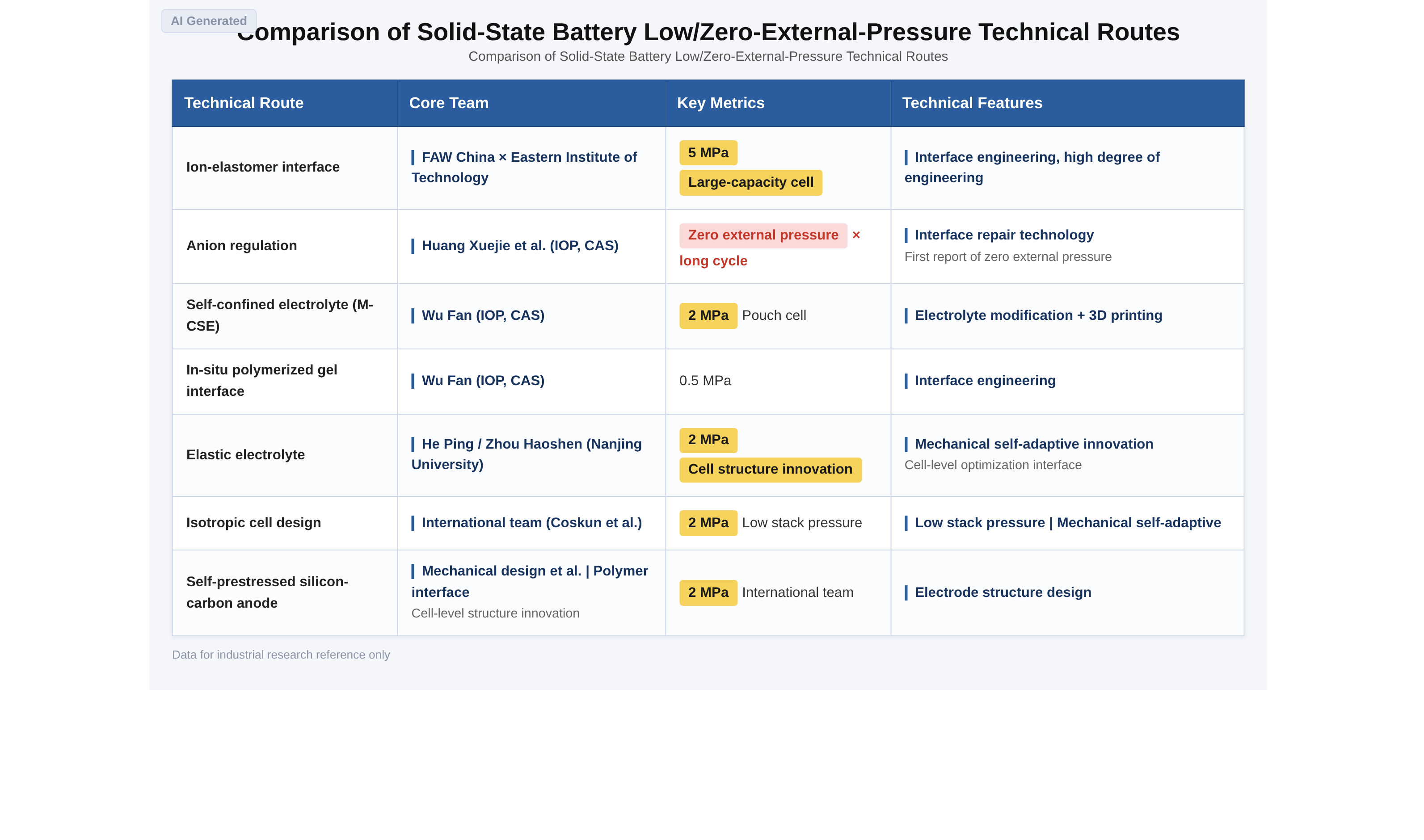
(1) Ion-elastomer interface (China FAW × Eastern Institute of Technology)
Technology name: Ion-Elastomer Interface
Core team: FAW R&D Institute × Eastern Institute of Technology, Ningbo
Technical features: Through material morphology control, low-pressure cell structure design, and preparation process optimization, an interfacial layer with ion-conducting capability and elastic self-adaptive function is constructed at the solid-solid interface. This interface can improve the contact stability of the solid-solid interface during cycling and significantly reduce the cell's dependence on external pressure. Outcome metrics: Large-capacity all-solid-state battery cells cycle stably under a low pressure of 5 MPa.
Industry significance: This is one of the most engineering-feasible breakthroughs at the large-capacity cell level to date, with a clear path toward mass production applications.
(2) Anion regulation technology (Institute of Physics, CAS × Huazhong University of Science and Technology × Ningbo Institute of Materials Technology and Engineering, CAS)
Technology name: Anion Regulation
Core team: Research team of Professor Huang Xuejie at the Institute of Physics, Chinese Academy of Sciences; research team of Professor Zhang Heng at Huazhong University of Science and Technology; research team of Professor Yao Xiayin at the Ningbo Institute of Materials Technology and Engineering, Chinese Academy of Sciences
Technical features: By constructing a layer of "special glue" between the electrolyte and the lithium electrode - a dynamic interfacial layer regulated by iodide ions - it can adapt to the volume changes of the lithium anode and maintain close contact between the "rigid" electrolyte and the lithium anode under low external pressure or even zero pressure. The technology has been likened to "interfacial repair," and it is the first reported zero-external-pressure sulphide-electrolyte all-solid-state lithium metal battery in the world. The related results were published in Nature Sustainability.
Expert evaluation: Professor Wang Chunsheng, a solid-state battery expert at the University of Maryland in the US, commented that this research solves the key bottleneck issue restricting the commercialization of all-solid-state batteries.
Outcome metrics: Stable operation is achieved under zero external pressure.
(3) Mechanically adaptive polyrotaxane interlayers (Coskun Group et al.)
Technology name: Mechanically Adaptive Polyrotaxane Interlayers
Core team: International research team (Jang Wook Choi et al.)
Technical features: A mechanically adaptive anode interface based on an elastic polymer and mechanically interlocked polyrotaxane (PR) was designed. The "pulley" effect of the polyrotaxane enables the interfacial layer to deform adaptively under stress, maintaining stable solid-solid contact. The related results were published in Angewandte Chemie.
Outcome metrics: Stable operation of high-energy-density sulphide all-solid-state batteries is achieved under low stack pressure.
(4) Organic ionic plastic crystal coatings (ScienceDirect)
Technology name: Organic Ionic Plastic Crystal Coatings
Core Team: International research team
Technical Features: Surface modification of a high-nickel cathode (LiNi₀.₉Co₀.₀₅Mn₀.₀₅O₂) with tetramethylammonium bis(trifluoromethanesulfonyl)imide (TMATFSI) reduces the stack pressure required for sulphide all-solid-state batteries.
Performance Indicators: Stable operation under low stack pressure is achieved.
(5) In-situ polymerised gel interlayer (Wu Fan team, Institute of Physics, CAS)
Technology Name: DOL in-situ polymerised gel interlayer
Core Team: Research team led by Professor Wu Fan, Institute of Physics, Chinese Academy of Sciences
Technical Features: A DOL in-situ polymerised gel interlayer is introduced at the cathode interface to improve interfacial contact.
Performance Indicators: The assembled LFP/sulphide electrolyte full battery achieves more than 300 stable cycles at an extremely low external pressure (0.5 MPa) and room temperature at a high C-rate (2C).
2.2 Electrolyte modification route
The core idea is to make the electrolyte itself softer and more deformable, so that it can maintain good contact with the electrodes even under low pressure.
(1) Self-limiting multifunctional composite sulphide electrolyte (Wu Fan team, Institute of Physics, CAS)
Technology Name: Self-limiting electrolyte design / multifunctional composite sulphide electrolyte (M-CSE)
Core Team: Research team led by Professor Wu Fan, Institute of Physics, Chinese Academy of Sciences
Technical Features: A self-limiting electrolyte design concept is proposed, and a multifunctional composite sulphide electrolyte, M-CSE, is developed, successfully addressing the instability of the lithium metal interface and lithium dendrite growth. At the same time, 3D printing technology is combined to prepare low-stack-pressure pouch batteries.
Performance Indicators: The operating stack pressure of the sulphide pouch battery is reduced to 2 MPa, the energy density reaches 219 Wh/kg, and the capacity retention after 500 cycles is 95.04%. In another study, using a PEVA-LiDFOB interfacial adhesive strategy, the pouch battery achieves a capacity retention of 90.6% after 100 cycles at 2 MPa.
(2) Borohydride-substituted sulphide electrolyte
Technology Name: Borohydride-substituted sulphide electrolyte (Li₃PS₄-xLiBH₄, LPSBH)
Core Team: International research team
Technical Features: A sulphide electrolyte with high deformability is synthesised by mechanical milling, enabling stable physical interfacial contact under low stack pressure.
Performance Indicators: Excellent performance under low stack pressure is achieved.
(3) Elastic electrolyte (He Ping/Zhou Haoshen team, Nanjing University)
Technology Name: Elastic Electrolyte
Core team: Professor He Ping and Professor Zhou Haoshen's team from the College of Engineering and Applied Sciences at Nanjing University
Technical features: An elastic electrolyte based on a dual-monomer copolymer and a deep eutectic mixture was designed, with high room-temperature ionic conductivity (2×10⁻³ S/cm).
Achievement indicators: Stable operation of solid-state batteries was achieved under zero externally applied pressure, relying solely on the battery's internal built-up pressure.
2.3 Electrode structure design routes
(1) Self-prestressed silicon carbon anode
Technology name: Self-prestressed silicon carbon anode (Self-Pressure Silicon-Carbon Anode)
Technical features: By introducing a prestress design inside the anode, the electrode spontaneously maintains interfacial contact during cycling.
Achievement indicators: A sulphide solid-state electrolyte half-cell achieved 700 cycles with a capacity retention of 79.2%, and a minimum stack pressure of 2 MPa.
(2) High-nickel cathode structure/interface regulation (review)
Core team: Zhang Yajuan, Li Jinliang, Zhang Xi, Li Yue, Sun Peng, Xu Hao, Pan Likun, et al.
Technical features: For high-nickel layered cathodes, pressure-induced mechanical degradation is mitigated through precise control of particle size, composition-gradient doping, pore structure design, and interfacial coatings. This review was published in Acta Physico-Chimica Sinica.
2.4 Battery cell structure innovation routes
(1) Isotropic battery design
Technology name: Isotropic battery design (Isotropic Cell Design)
Core team: International research team
Technical features: By using a fluid pressurizing medium, the battery is subjected to completely uniform pressure (isotropic pressurization), thereby achieving stable interfacial contact with a smaller total pressure.
Achievement indicators: Lithium metal solid-state pouch batteries achieved excellent ultra-fast charging performance at a low pressure of only 2 MPa.
(2) Strain coordination strategy
Technology name: Strain coordination strategy
Core team: Guangnian Guke (Suzhou) Technology Co., Ltd., et al.
Technical features: Using an FeS₂ cathode and a prelithiated silicon anode as a model system, volume changes are addressed through strain coordination design.
Achievement indicators: Stable long cycling was achieved at 15 MPa, and the pouch battery can cycle stably for more than 500 cycles.
III. Comparative summary of technical routes
At present, low-pressure operation of sulphide solid-state batteries has achieved multi-path breakthroughs in interface engineering, electrolyte modification, and structural design. Chinese teams are internationally leading in key indicators such as zero external pressure (Huang Xuejie et al.) and 5 MPa large-capacity battery cells (FAW × Eastern Institute of Technology). Pressure has been significantly reduced from above 20 MPa to single digits or even zero, and the engineering process has accelerated markedly, laying a solid foundation for the large-scale mass production of all-solid-state batteries.
IV. Industrial implications
From the above technical panorama, it can be seen that reducing the operating pressure of sulphide solid-state batteries has formed a multi-path parallel pattern:
First, China is in a leading position. Among the eight main technical routes mentioned above, Chinese teams lead or participate in more than half, and breakthroughs have been achieved in the two most iconic indicators: zero external pressure (Huang Xuejie's team) and large-capacity battery cells at 5MPa (FAW × Dongfang University of Technology).
Second, interface engineering is currently the most active direction. Whether it is ionic elastomer interfaces, anion regulation, or polyrotaxane interfaces, the core is to make the "rigid" solid-solid interface "elastic" - capable of adapting to volume changes without relying on external pressure.
Third, a stepwise breakthrough from "high pressure" to "low pressure" and then to "zero pressure" is taking place. 5MPa (FAW), 2MPa (Wu Fan's team, isotropic design), 0.5MPa (in-situ polymerisation interface), zero external pressure (Huang Xuejie's team, Nanjing University elastic electrolyte) - the continuous decline in pressure values is pushing all-solid-state batteries from "laboratory luxury goods" to "industrialised products".
Fourth, engineering is the key battleground for the next stage. The reason why FAW's breakthrough has attracted so much attention is not only the 5MPa indicator, but also because it clearly points to large-capacity battery cells and large-scale mass production. From material breakthroughs to battery cell breakthroughs, and then to system integration breakthroughs, the industrialisation of sulphide all-solid-state batteries is accelerating into the fast lane.
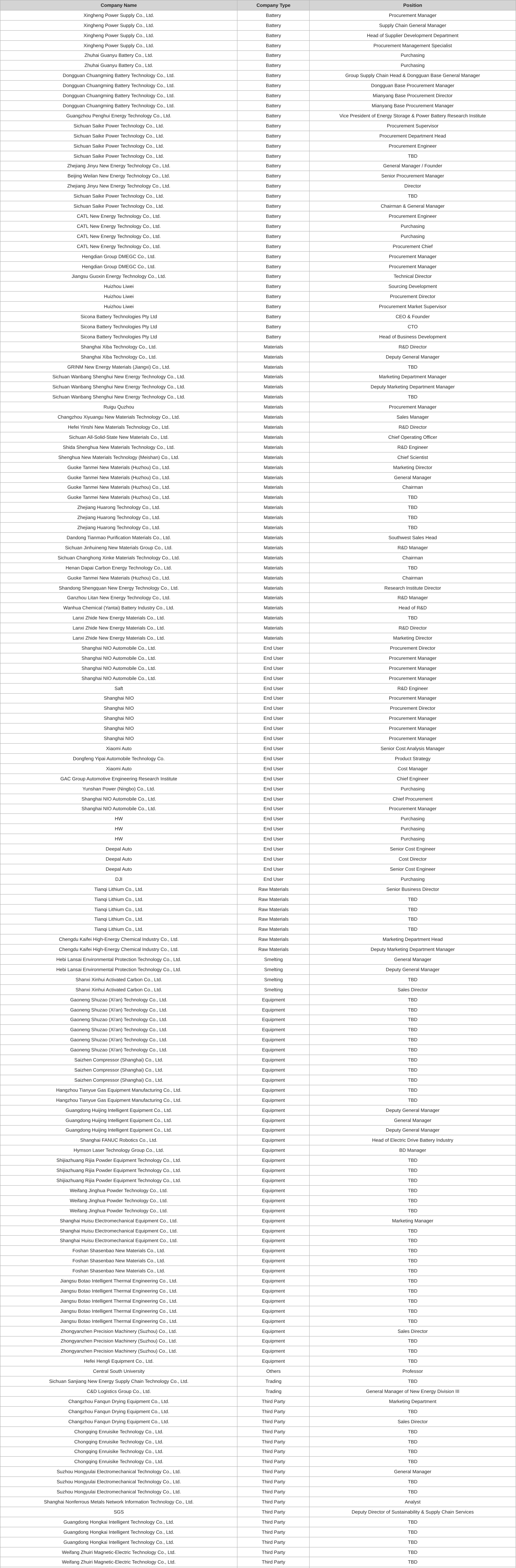
SMM Solid-State Battery Conference Attendee List (Partial)
Note: If you have any additional details to add regarding the points mentioned in this article or are following the development of solid-state batteries, please feel free to contact us at any time. Contact details are as follows:
Tel: 021-20707860 (or add WeChat 13585549799) Yang Chaoxing, thank you!
Related Reading
![[SMM Manganese Ore Weekly Review] Spot Market Recovers, Traders Increasingly Hold Back from Selling](https://imgqn.smm.cn/usercenter/rUQIB20251217171723.jpeg)
![[Changan Automobile: August sales 196,800 units, NEV sales up 12.98% YoY]](https://imgqn.smm.cn/usercenter/QBuyW20251217171726.jpg)