SMM, September 1:
In the metals market:
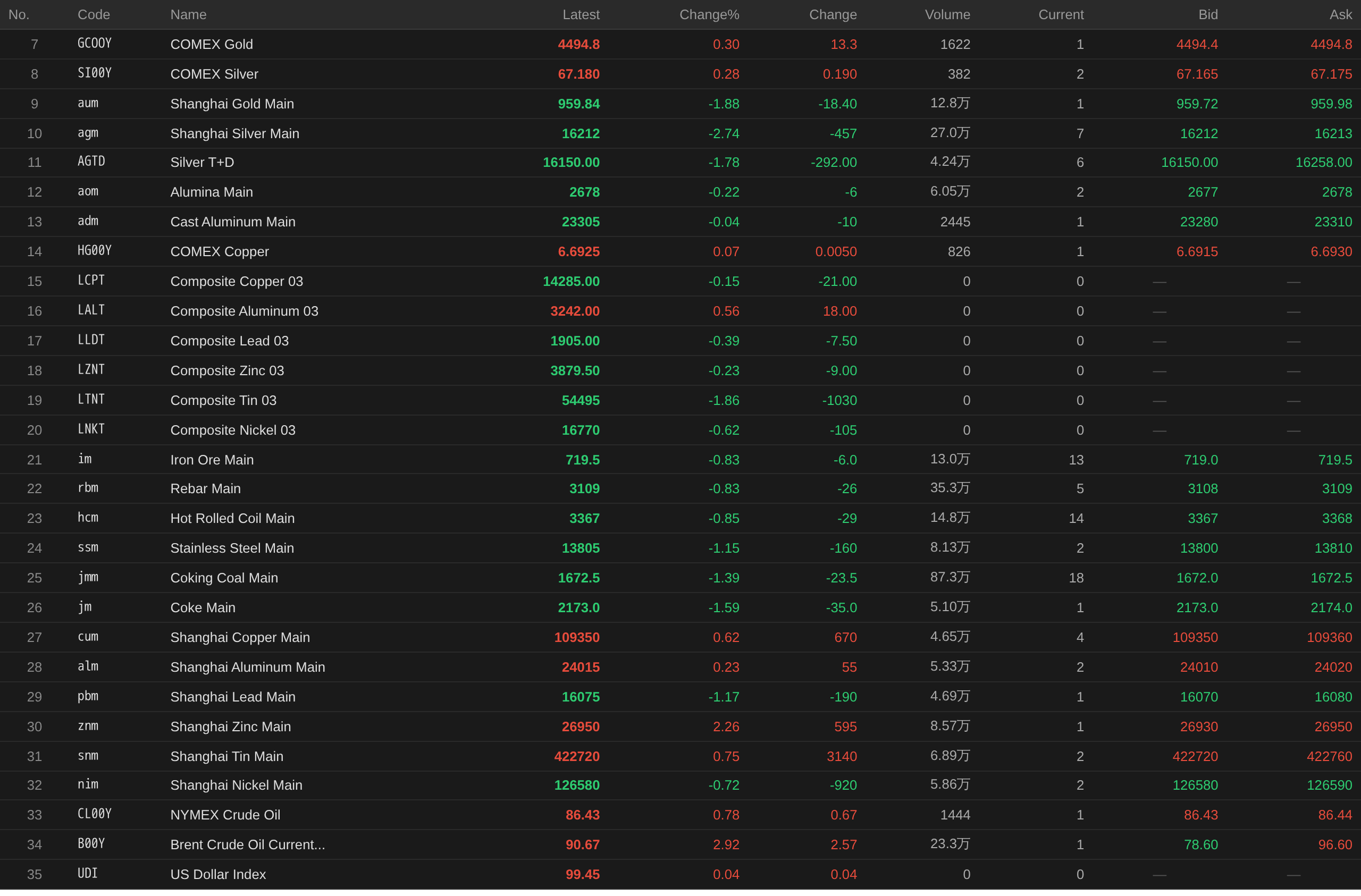
Overnight, base metals in the domestic market mostly rose. SHFE copper gained 0.62%, SHFE aluminum rose 0.23%, and SHFE lead fell 1.17%. SHFE zinc climbed 2.23%, and SHFE tin added 0.75%. SHFE nickel slipped 0.72%. In addition, the most-traded alumina futures contract fell 0.22%, and the most-traded cast aluminum contract edged down 0.04%.
Overnight, ferrous metals all fell. Stainless steel dropped 1.15%. Iron ore and rebar both declined 0.83%, and hot-rolled coil lost 0.85%. In coking coal and coke: the most-traded coking coal contract fell 1.39%, and the most-traded coke contract dropped 1.59%.
Overnight in the overseas metals market, the LME was closed on August 31 (Monday) for the UK Summer Bank Holiday and resumed trading on September 1 (Tuesday).
Overnight in precious metals: COMEX gold fell 0.72%, and COMEX silver dropped 0.86%. Overnight, the most-traded SHFE gold contract fell 1.88%, and the most-traded SHFE silver contract dropped 2.74%.
As of 7:15 on September 1, overnight closing prices:
Macro front
China:
[State Council Executive Meeting: The meeting studied work related to promoting high-quality development of investment attraction] Premier Li Qiang chaired a State Council Executive Meeting on August 31 to study and implement the important guiding principles from General Secretary Xi Jinping's speech at the Politburo meeting on the rescue and relief efforts for the mudslide disaster in Jilong County, Xigaze, Tibet. The meeting studied work related to promoting high-quality development of investment attraction. The meeting noted that standardizing investment attraction is an important part of building a unified national market, and sustained efforts must be made over the long term to clarify specific government behaviors that are encouraged or prohibited in investment attraction, and to refine all work based on practical experience. Local governments' economic promotion behaviors should be further standardized, positive guidance and rigid constraints should be strengthened, and the focus of investment attraction should shift more toward optimizing the business environment, fostering industrial ecosystems, and providing high-quality government services. Communication mechanisms with enterprises should be improved, and proactive efforts should be made to help enterprises resolve practical difficulties and create fairer and more dynamic market conditions for their development. (CCTV)
[Ministry of Commerce and seven other departments: By 2030, total retail sales of consumer goods will reach about 60 trillion yuan] The Ministry of Commerce and seven other departments issued implementation opinions on promoting the expansion and upgrading of commodity consumption. The opinions state that during the 15th Five-Year Plan period, the scale of commodity consumption will steadily expand, its structure will be optimized and upgraded, and the advantages of the ultra-large market will continue to emerge. By 2030, total retail sales of consumer goods will reach about 60 trillion yuan, fostering green consumption, smart consumption, and health consumption markets each worth tens of trillions of yuan, and driving their sustained development and growth. Retail sales of trillion-yuan categories such as automobiles, home appliances, communication equipment, and textiles and apparel will continue to grow, with market size maintaining a global leading position. The guidelines point out that pilot reforms for automobile circulation and consumption should be advanced in depth, unreasonable restrictive measures in the automobile circulation and consumption sector should be removed more quickly, automobile use management models should be innovated, and automobile consumption should be expanded across the entire chain. Relevant regions should be encouraged to optimize car purchase restriction measures to better meet residents' car purchase demand. The automotive aftermarket should be cultivated and expanded, with support for the development of car modification, repair and maintenance, motorsports, and RV camping, and a recognition and management system for traditional classic cars should be established. Inter-departmental information sharing mechanisms should be improved, and an information interaction system covering the entire automobile life cycle, including sales, registration, repair, insurance, and retirement, should be established. The management system for used car circulation should be improved, mutual recognition of unified invoices for used car sales should be advanced, and used car business entities should be subject to tiered and classified management. The guidelines point out that home appliance sales enterprises should be encouraged to carry out sales promotions in partnership with production and recycling enterprises. Support funds for pilot cities in the modern commercial circulation system should be put to good use, professional and standardized home appliance recycling services should be promoted into streets, communities, and villages, and the in-home dismantling and recycling of used home appliances as well as the delivery and installation of new products should be facilitated. Home appliance sales networks, warehousing and distribution centers, and after-sales repair outlets should be upgraded and improved.
US dollar:
Overnight, the US dollar index fell 0.26% to 99.42. On a monthly basis, the US dollar posted two consecutive monthly declines, with the August monthly line down 0.36%.
According to CME "FedWatch": the probability that the US Fed will keep rates unchanged by September is 34.6%, and the probability of a cumulative 25bp hike is 65.4%. The probability that the US Fed will keep rates unchanged by October is 25.4%, the probability of a cumulative 25bp hike is 57.2%, and the probability of a cumulative 50bp hike is 17.4%.
US Treasury Secretary Bessent said he and Fed Chairman Warsh see eye to eye on bond issues, and noted that since US President Trump took office, the 10-year Treasury yield has been basically flat. Bessent stressed that he has never said he was trying to change the bond market trend, also believes the government cannot change the equilibrium price of bonds, and would not speculate on the Fed's next possible move. He said core inflation remains mild, and traditionally the Fed does not hike rates when hit by supply shocks. Bessent also revealed that he has not bought any bonds yet and is working with Budget Director Vought on a fiscal consolidation plan. He said the US could become the world's top bond market due to the bond buyback program, and added that hedge fund managers like to "speed up the process." Regarding investor Stanley Druckenmiller, who recently criticized the US Treasury's bond buyback policy, Bessent said he spoke with him after his op-ed was published, and stated, "I think Druckenmiller lost money on the day that op-ed came out." In addition, Bessent noted that Fitch has reaffirmed the US credit rating. (Jin10 Data APP)
BofA Securities said in a report that after Fed Chairman Kevin Warsh's speech on Friday, market expectations for a September rate hike rose to nearly 60%, but the Fed's future tightening policy may still depend on the upcoming August economic data. Analysts said, "We cannot yet say a rate hike is a done deal, because if the August data is very weak, the situation could still change. But absent a major downside surprise, the burden of a September hike falls on Warsh." The August jobs report will be released this Friday. The July jobs report was notably weaker than analysts expected, leading some economists to question the underlying growth momentum of the US economy.
On the macro front:
Data due today include China's August RatingDog Manufacturing PMI, UK August Nationwide House Price Index m/m, Switzerland July Real Retail Sales y/y, France August Final Manufacturing PMI, Germany August Final Manufacturing PMI, France August Final Manufacturing PMI, Germany August Final Manufacturing PMI, Eurozone August Final Manufacturing PMI, UK August Final Manufacturing PMI, UK July Mortgage Approvals, Eurozone August Flash CPI y/y, Eurozone August Flash CPI m/m, Eurozone July Unemployment Rate, US August Final S&P Global Manufacturing PMI, US August ISM Manufacturing PMI, US July JOLTs Job Openings, and US July Construction Spending m/m.
Also in focus: Fed Governor Barr will speak on the "Economic Outlook and Financial Inclusion"; the G20 Finance Ministers and Central Bank Governors Meeting will be held through September 1; the 2026 SCO Heads of State Council Meeting will take place.
On the crude oil front:
Overnight, both oil futures rose, with WTI up 3.49% and Brent up 2.92%. Renewed US-Iran conflict heightened market concerns over global supply disruptions, supporting oil prices.
US President Trump said in an interview at the White House on Monday local time, "A lot of ships went through the Strait of Hormuz last night, an average of 30 ships per night, and there is a lot of oil flowing out of the Strait of Hormuz." (Jin10 Data APP)
Data released by ship tracking agency Kepler on August 31 showed that the number of visible commercial vessels passing through the Strait of Hormuz over the past weekend had dropped to five per day due to fears of attacks. The data showed that over the weekend of August 29-30, all vessels transiting the strait were small ships, including two LPG carriers. However, the actual number of ships passing through the strait may be higher, as some vessels turned off their automatic identification systems to avoid attacks. (Jin10 Data APP)
Bart Melek, Global Head of Commodity Strategy at TD Securities: Traders reduced their net crude oil open interest this week as uncertainty over the next phase of the Iran conflict persists. We still expect crude oil prices to continue rising, as there are no signs that normal passage through the Strait of Hormuz will resume in the near term. (Jin10 Data APP)
According to energy intelligence firm Rystad Energy, even if a deal with the US prompts a near-term increase in Venezuelan production, it will still take decades for Venezuela's oil output to recover to its peak level of more than 3 million barrels per day. Rystad Energy said in a report that new oil production is expected to initially come from existing wells, rising from about 157,000 barrels per day in 2027 to 680,000 barrels per day by 2030. Output from these existing fields will peak at 740,000 barrels per day in the early-to-mid 2030s. According to Rystad, combining existing and new projects, Venezuela's oil production will rise to 2.3 million barrels per day by 2035 and exceed 3 million barrels per day by 2050. To achieve this goal, approximately $85 billion in investment will be needed from 2027 to 2040. (Jin10 Data APP)
![Guangdong zinc: Zinc prices continue to rise, trading in Guangdong is poor [SMM midday commentary]](https://imgqn.smm.cn/usercenter/VPThK20251217171754.jpg)
![Copper prices and premiums both rose; spot trades were quiet [SMM South China spot copper]](https://imgqn.smm.cn/usercenter/ieria20251217171709.jpg)
![High Prices Curb Demand, Spot Premiums Narrow Slightly [SMM North China Spot Copper]](https://imgqn.smm.cn/usercenter/gCNEi20251217171715.jpeg)