PV Glass Production Cuts Officially Implemented, New Wave of Production Cuts to Drive Subsequent Price Increases [SMM Analysis]

Published: Aug 31, 2026 14:01
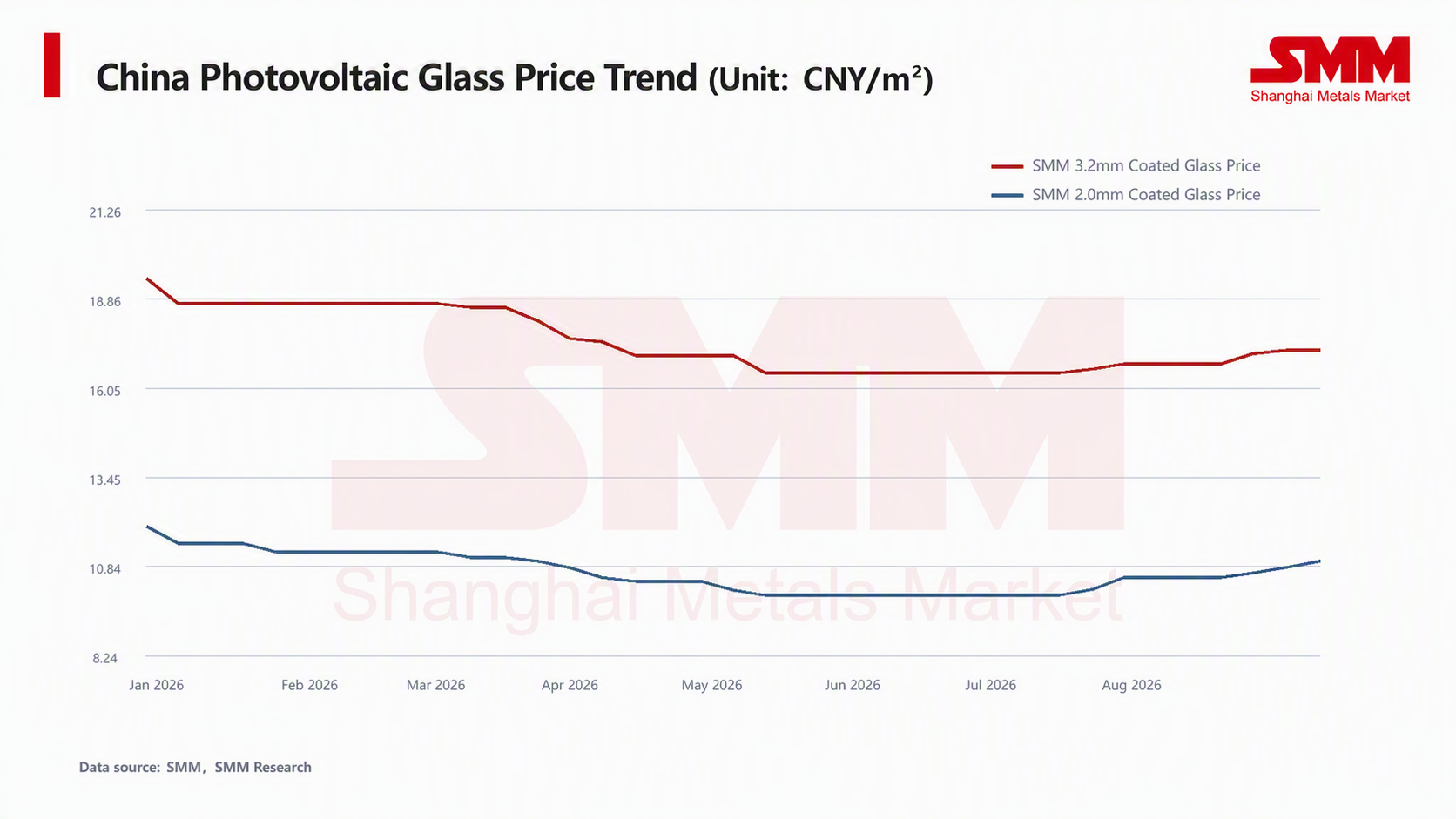
[SMM Analysis: PV Glass Production Cuts Officially Take Effect; New Round of Production Cuts to Drive Subsequent Price Increases] Since August, PV glass prices have ended their previous six-month-long grind lower and completed two rounds of concentrated upward adjustments during the month: as of August 31, the average price of 3.2 mm double-layer coated glass rose to 17.15 yuan/m², a cumulative increase of 0.55 yuan/m² (+3.3%) during the month; the average price of 2.0 mm double-layer coated glass rose to 11 yuan/m². The core driver of this round of increases was not a full demand-side recovery, but industry-wide production cuts forced by deep losses in H1. Looking ahead to September, cold-repair production lines are unlikely to resume production in the short term, and glass prices are still expected to have a basis for upward movement.


SMM, August 31:

August Market Review: Two Consecutive Rounds of Gains After Six Months of Grinding Lower, with Gains Accelerating at Month-End

In August, the inflection point for PV glass prices was formally established. The first round of upward adjustments came in early August: the average price of 3.2mm double-layer coated glass rose from 16.6 yuan/m² to 16.75 yuan/m², and 2.0mm from 10.15 yuan/m² to 10.5 yuan/m², with the single increase for 2.0mm reaching 0.35 yuan/m². The second round of increases was concentrated at month-end: the average price of 3.2mm was raised in two consecutive steps to 17.05 yuan/m² and 17.15 yuan/m²; 2.0mm followed in tandem, rising from 10.5 yuan/m² to 10.65 yuan/m² and then 10.8 yuan/m², and on August 31 it further climbed to 11 yuan/m², with expectations of further gains ahead. Although prices have already rebounded in successive rounds, the two mainstream specifications remain below levels at the start of the year; this round of gains is more of a "bottom repair" than a trend reversal, and whether the uptrend can continue depends on the sustainability of supply contraction.
Key Driver of Price Increases: Industry-Wide Production Cuts Forced by Losses; Supply Contraction Leads the Way

The logical starting point of this round of glass price increases is on the supply side, not the demand side.

In H1, glass prices trended downward and fell below the cost line of some production lines, pushing the industry into losses. Under cash flow pressure, starting in Q2, some top-tier players successively announced cold repairs at production lines, and some small and medium-sized enterprises followed with production cuts and lower operating loads, causing the industry-wide operating rate to pull back notably from high levels.

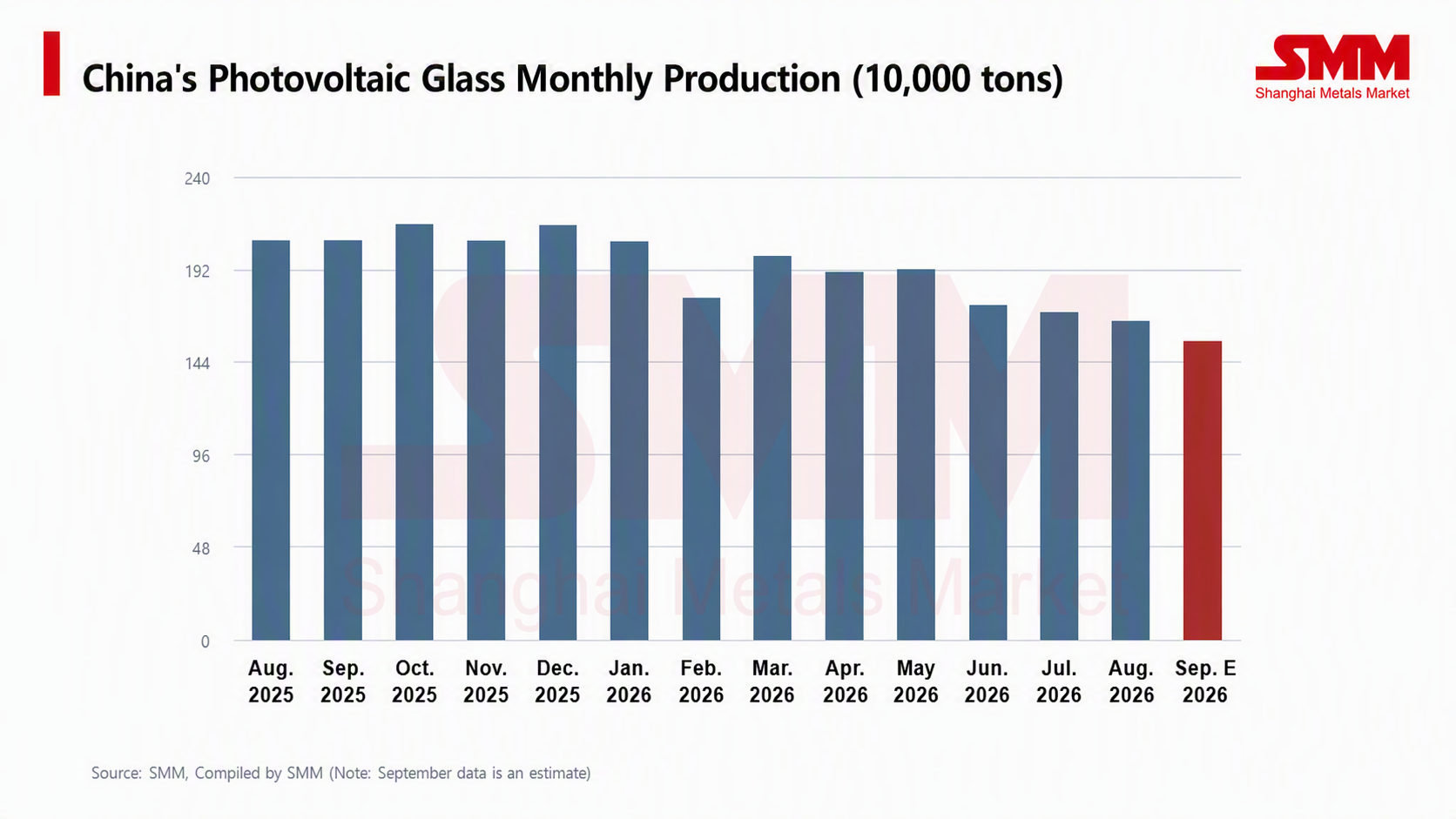
Supply contraction is directly reflected in production data. According to SMM statistics, monthly PV glass production has been pulling back continuously since January: June production fell sharply by 9.7% MoM; July production fell by a further 2.2% MoM; SMM expects September production to decline further, with a cumulative drop of close to 25% from the January peak. Supply contraction is still deepening, and output is now clearly below the roughly 2 million mt-plus level recorded in the same period last year. By thickness, 3.2mm production has fallen by about 29% cumulatively from the start of the year; 2.0mm production has fallen by about 17% cumulatively—thin glass production cuts are relatively smaller, but its demand side has benefited from the continued rise in double-glass module penetration, leading to a more obvious improvement in supply-demand alignment.

According to SMM statistics, starting last Friday, China's top-tier players began production cuts in line with the production cut plans agreed at an earlier joint meeting. In just three days, top-tier players reduced output by a total of 2,200 mt/day through furnace cold repairs, and second-tier enterprises in China also finalised production cut plans today. They will complete furnace cold repairs successively this week, with expected affected capacity of around 3,600 mt/day.

It should be noted that production resumptions after cold repairs of glass production lines are highly rigid: restarting furnaces not only requires a preparation cycle of several months but also entails high restart costs, so enterprises generally lack the incentive to resume production before prices have recovered to a reasonable profit range. This means that even if prices have been raised continuously since August, supply is unlikely to be effectively replenished in the short term, and the process of supply-demand rebalancing will continue to support prices. According to SMM, some module enterprises stepped up glass purchasing and stockpiling in August to lock in auxiliary material supply and prepare for Q3 peak-season production schedules, further amplifying the short-term supply-demand gap.
Market Outlook: Prices Still Have Upside Room in September, with 2.0mm Double-Layer Coated Glass Expected to Reach 11.5 Yuan/m²

Looking ahead to September, SMM believes PV glass prices still have the basis to continue rising, with two core reasons:

First, supply rigidity persists. Industry inventory is currently in a destocking channel overall, while operating capacity has already contracted for several consecutive months. Cold-repaired production lines have limited willingness to resume production in the early stage of price repair, so the supply side is unlikely to suppress price increases.

Second, price increase transmission is smooth. After two rounds of price adjustments in August, downstream acceptance was better than expected. As module stockpiling increased, fear of further price gains provided support, and there were fewer obstacles to price transmission.

Overall, SMM expects PV glass prices may still have room for further upward adjustment in September. However, two risks need to be watched: first, if scheduled module production falls short of expectations, the room for glass price increases will be compressed; second, if prices quickly recover above the profit range, previously cold-repaired production lines could accelerate production resumptions, and supply replenishment would constrain the continued rise in prices. Going forward, the key factors to track are: dynamics of glass furnace cold repairs and production resumptions, actual module production schedules in September, the pace of inventory destocking at glass enterprises, and marginal changes in double-glass module penetration.

Data Source Statement: Except for publicly available information, all other data are processed by SMM based on publicly available information, market communication, and relying on SMM's internal database model. They are for reference only and do not constitute decision-making recommendations.

Images in this article contain AI-translated captions for reference only.

For any inquiries or for more information, please contact: lemonzhao@smm.cn
For more information on how to access our research reports, please contact:service.en@smm.cn
Related News
[Distributed Module Prices Edge Down Again]
3 hours ago
[Distributed Module Prices Edge Down Again]
Read More
[Distributed Module Prices Edge Down Again]
[Distributed Module Prices Edge Down Again]
Today, the high prices of 210 and 183 distributed PV modules in China were reduced by 0.001 yuan/W; traders began to modestly lower their quotes to sell, while module producers' distribution prices also eased somewhat. Downstream purchase willingness remained low, but after the price reduction there was willingness to make price inquiries. In the short term, absent policy-side and cost-implementation requirements, module prices are likely to consolidate mainly at lows.
3 hours ago
[SMM PV News Flash] Huadian’s 200 MW PV Project EIA Public Disclosure!
Aug 28, 2026 16:39
[SMM PV News Flash] Huadian’s 200 MW PV Project EIA Public Disclosure!
Read More
[SMM PV News Flash] Huadian’s 200 MW PV Project EIA Public Disclosure!
[SMM PV News Flash] Huadian’s 200 MW PV Project EIA Public Disclosure!
On August 24, the Ecology and Environment Bureau of Anshun City, Guizhou Province, released the EIA acceptance public notice for the “Guanling County Zhengjie Agricultural PV Power Station Project (Change)”. The notice showed that the Guanling County Zhengjie Agricultural PV Power Station Project is located in Gangwu Town, Guanling County, Anshun City, with a total investment of 786.78 million yuan and a construction period of 8 months. This project was resubmitted for approval due to a major change. Previously, on November 20, 2024, the project obtained the “Reply of the Ecology and Environment Bureau of Anshun City on the Environmental Impact Report Form for the Guanling County Zhengjie Agricultural PV Power Station” (Anhuanbiao Pifu [2024] No. 147), and construction commenced in July 2025. As of January 2026, within Plot No. 4 covered by the original EIA approval, installation of PV array mounting structures was underway (using manual drilling and drone hoisting), while construction had not started in other areas. During the land acquisition process, due to land transfer reasons, it was necessary to reduce the red-line boundary scope of the original EIA and reselect the site outside the original EIA red-line boundary; construction had not started within the land area of the reselected site. After adjustment, the project had an installed capacity of 200 MW (with the DC side at 258.43 MWp), with 416,832 pieces of 620 Wp monocrystalline silicon modules to be installed. The total land area was 301.42 h㎡. It cancelled 62.67 h㎡ of land parcels within the original EIA land acquisition scope that could not be implemented, continued to use 150.72 h㎡ of the land area from the original EIA, and added 150.7 h㎡ of land area for the PV zone. The project developer is Guizhou Huadian Lianxin Energy Co., Ltd., a company under Huadian New Energy.
Aug 28, 2026 16:39
[SMM PV News Flash] Lincang Tea–PV Complementary Digital Innovation Project Wins National Technology Award
Aug 28, 2026 16:33
[SMM PV News Flash] Lincang Tea–PV Complementary Digital Innovation Project Wins National Technology Award
Read More
[SMM PV News Flash] Lincang Tea–PV Complementary Digital Innovation Project Wins National Technology Award
[SMM PV News Flash] Lincang Tea–PV Complementary Digital Innovation Project Wins National Technology Award
Recently, the Yanshuai Town Tea–PV Complementary Power Generation Project in Lincang City stood out in the 7th BIM Competition of the Engineering Construction Industry, winning the Special Prize in the Industrial and Energy Engineering category. The project’s full title is “PV Tea Plantation ‘Two Mountains’ Transformation—Digital Application of BIM Technology Empowering the Yanshuai Town Tea–PV Complementary Power Generation Project.” It was jointly submitted by PowerChina Kunming Engineering Co., Ltd. and Huaneng Lancang River New Energy. Centered on BIM technology, the team integrated GIS, aerial survey and remote sensing, artificial intelligence, and parametric design, connecting the entire process from planning, design, and construction to acceptance, and driving “tea–PV complementarity” from concept to large-scale practice. As a major energy project in Yunnan Province for 2025, the Yanshuai Town project covers 15,487 mu, with a total installed capacity of 585 MW. Since commissioning, it has generated annual direct economic benefits of more than 251 million yuan, delivered over 10 million yuan in additional income to farmers through land leasing, and increased tea output by about 124,000 jin. On the ecological front, it saves 296,100 mt of standard coal annually and reduces carbon dioxide emissions by 797,100 mt. In response to construction challenges such as significant mountainous terrain undulations and multi-process overlaps, the project established a full life cycle digital system, advancing mountainous PV from an extensive model to refined management, significantly reducing construction costs and improving site selection and acceptance efficiency. At present, this achievement has been promoted to more than 40 new energy projects in China and overseas, and will support the high-quality implementation of tea–PV complementary projects across Yunnan Province with a total capacity exceeding 20 million kW.
Aug 28, 2026 16:33
Register to Continue Reading
Gain access to the latest insights in metals and new energy
Already have an account?Sign in here
PV Glass Production Cuts Officially Implemented, New Wave of Production Cuts to Drive Subsequent Price Increases [SMM Analysis] - Shanghai Metals Market (SMM)