Indonesia's steel market presents two contrasting narratives depending on the metric applied. Production-side data point to a maturing, structurally growing industry; utilization and import-dependency data reveal a sector under sustained external pressure. The analysis below examines the core demand and policy drivers before assessing capacity, trade flows, and near-term price dynamics.
Core Demand Drivers
National Strategic Projects (PSN)
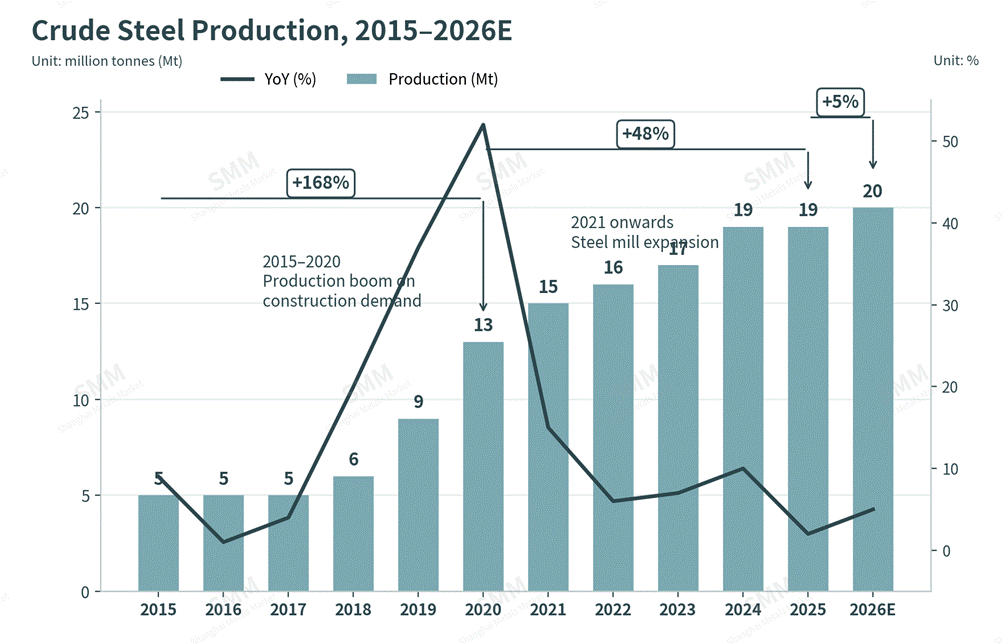
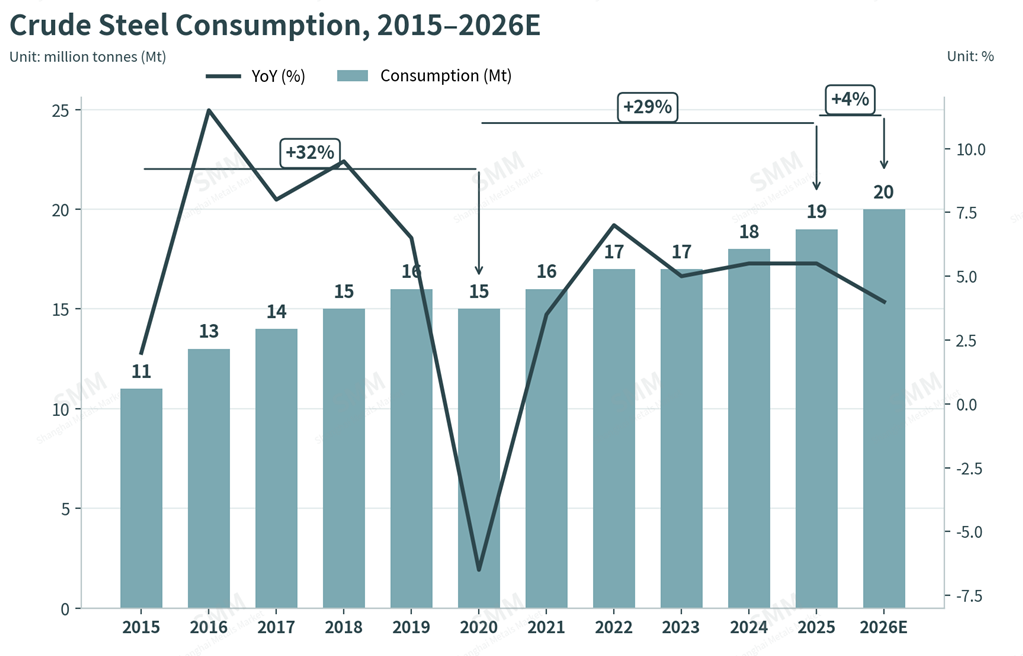
PSN remain the single largest structural driver of domestic steel demand, though momentum has eased from the peak of the previous administration. Under President Joko Widodo, roughly 190 national strategic projects reached completion or active construction, driving a 32% increase in steel consumption between 2015 and 2020 and underpinning a 168% expansion in crude steel production over the same period. Under President Prabowo Subianto, fiscal priorities have shifted toward social programs such as the free-meals initiative, tempering — though not eliminating — the PSN pipeline. For 2026, 219 projects remain active, of which only 7 are newly initiated; 74 falls under roads and transportation, including Sections 2 and 3 of the Serang–Panimbang Toll Road (underway since 2016, targeted for completion in 2027). Newer programs, including the Public School Project and the Red-and-White Village Cooperative initiative, are emerging as incremental demand drivers, though both face implementation delays and public scrutiny, with disbursement potentially deferred until November.
Foreign direct investment
This continues to shape the structure of Indonesia's steel mill base, with capital from Japan (Nippon Steel), South Korea (POSCO), China (Tsingshan, Dexin), and India (Ispat) typically deployed through joint ventures with domestic producers such as PT Krakatau Steel and PT Gunung Raja Paksi — for example, Krakatau POSCO and Krakatau Nippon Steel Synergy. Additional joint-venture capacity is expected to enter the market as foreign partners continue to expand their Indonesian footprint.
Technical & Operations
Technically, the industry remains heavily exposed to carbon-intensive production. Approximately 80% of Indonesian steel mills still operate on the BF-BOF route, a structural liability as the EU's Carbon Border Adjustment Mechanism (CBAM) begins pricing high-carbon steel out of that market. Despite national climate commitments — a 31.9% emissions reduction target by 2030 and net-zero by 2060 — limited experience with green technology and thin policy infrastructure makes these targets difficult to reach; current projections put national steel-sector emissions at 24.9 million tonnes of CO₂ by 2030. Electric arc furnace (EAF) adoption remains limited to a small set of operators such as PT Garuda Yamato Steel, though Krakatau Steel, Gunung Raja Paksi, and others are evaluating EAF, direct reduced iron (DRI), and CCS/CCUS pathways. The capital intensity of EAF conversion — roughly 2–3x that of BF-BOF — means such projects are typically feasible only through joint ventures between large producers, with a wave of new EAF capacity not expected before 2030.
Local & Foreign Policies
Four regulatory instruments currently frame Indonesia's steel supply-demand balance:
SNI (Mandatory National Standard)
Products including rebar (SNI 2052:2024) and steel pipe (SNI 39:2024) are now subject to mandatory domestic technical and safety specifications. On May 20, 2026, two additional rules took effect: Kemenperin No. 344/2026, establishing a local standard for steel wire rod, and Permendag No. 18/2026, mandating digital certification of imported steel to curb low-cost, non-compliant imports. As a non-tariff barrier, SNI compliance primarily raises the administrative burden and lead time for importers, which should incrementally support domestic utilization over the medium term; effects to date remain limited given the rules' recent implementation.
PMK No. 31/2026
This regulation updates PMK No. 103/2024 governing imported hot-rolled coil (HRC) and related alloy products. Following an anti-dumping investigation confirming that Wuhan Iron and Steel Co. Ltd. (WISCO) had caused material injury to the domestic industry, a provisional additional duty of 17.5% on WISCO's CIF price (BMADS) was imposed — subsequently revised to 4.87% under PMK No. 32/2026 — alongside differentiated duty rates for other exporting countries. The measure took effect on 27 May 2026 as a six-month provisional measure. The rule functions as a direct tariff barrier, raising landed import costs and supporting a shift in demand toward domestic supply.
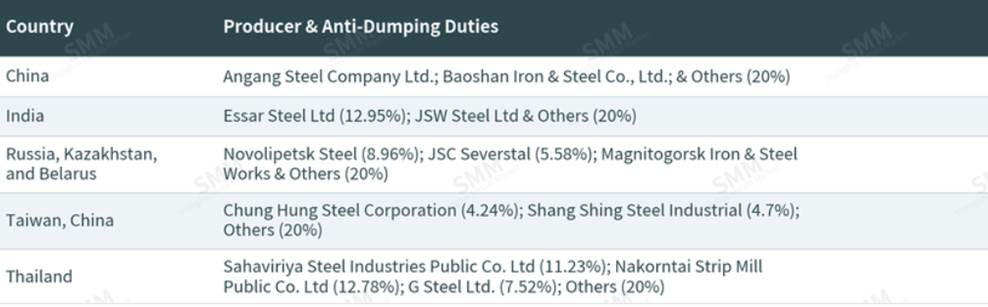
Source: PMK No.31/2026, SMM
U.S. Section 232 Tariffs
In effect since March 12, 2018 at a 25% rate on steel products, raised to 50% on core steel and aluminium articles in June 2025, and expanded in April 2026 to apply 50% to primary steel articles and 25% to derivative products, U.S. tariffs do not apply directly to Indonesian exports but exert a material indirect effect: U.S. steel import volumes fell approximately 26% between January and May 2026, displacing that volume — much of it Chinese-origin — toward alternative markets, including Indonesia. The net effect is a re-routing of Chinese export flows into the Indonesian market rather than a direct constraint on Indonesian producers.
CBAM (Carbon Border Adjustment Mechanism)
Effective January 1, 2026, CBAM prices imports based on embedded carbon content, referenced to EU ETS carbon pricing. Indonesia ranks 7th among the European Union's largest steel suppliers by volume; one study estimates that, based on 2023 trade volumes, the mechanism would raise the cost of iron and steel imports into the EU by approximately USD 226 million (Nam Do et al., 2026). The Ministry of Industry (Kemenperin) has outlined a three-part response: accelerating low-emission production technology, adopting net-zero-aligned processes, and establishing transparent, auditable emissions-tracking infrastructure. Absent complementary fiscal or non-fiscal support, however, these measures are unlikely to fully offset the competitiveness loss in the EU market, and a secondary risk has emerged as non-CBAM-exposed Chinese product is redirected toward open markets such as Indonesia.
Anti-dumping duties (broader application)
Beyond PMK No. 31/2026, Indonesia maintains a wider set of anti-dumping measures targeting Chinese-origin product, generally raising import prices and reducing import volumes while redirecting trade toward non-targeted origin countries — a dynamic that, on balance, supports domestic industry economics. Details are summarized in the table below.
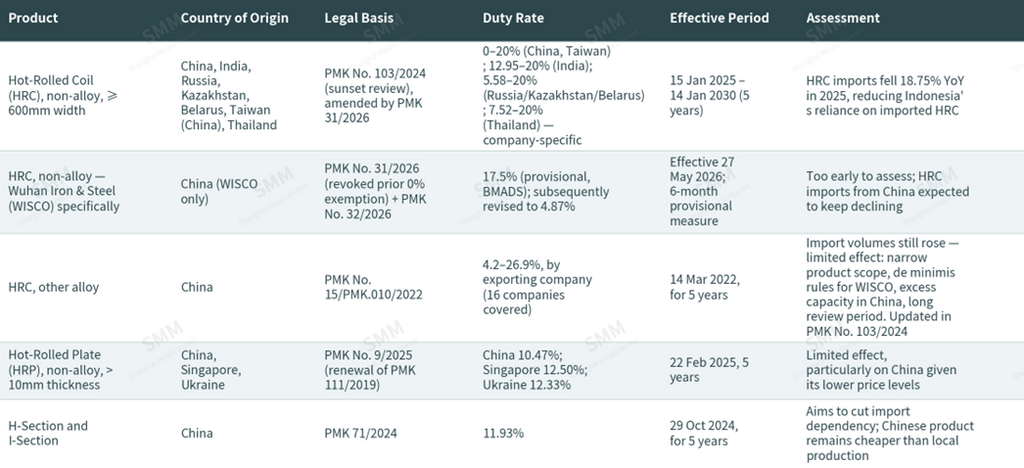
Source: SMM, GTT
Capacity, Utilization, and Planned Expansion
Installed steel mill capacity stood at approximately 25 Mt in 2025 — already reaching the National Industry Development Master Plan's 2035 target of 25 Mt a decade ahead of schedule — a trajectory that raises the risk of structural overcapacity if not actively managed, with downside implications for domestic pricing and mill profitability. More pressing is the utilization rate, which remains at just 50–52% versus the 80% threshold generally required for sustained profitability. Three structural factors explain this gap: aging production machinery that undermines cost and emissions competitiveness (per Deputy Minister of Industry Faisol Riza); a product mix concentrated in lower-value construction-grade steel, with minimal diversification into alloy or specialty grades; and sustained oversupply of Chinese product, which — per Kimron Manik, Director of Construction Sustainability at the Ministry of Public Works and Public Housing (PUPR) — continues to undercut domestic pricing owing to Chinese producers' scale economies and weak domestic Chinese demand.
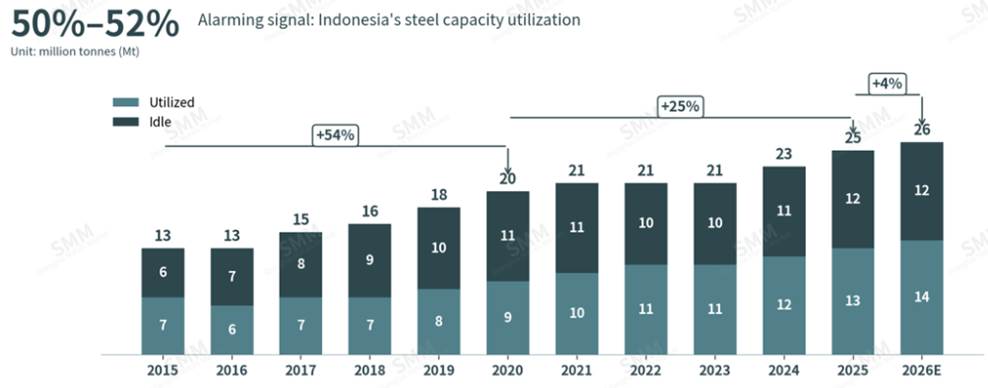
Source: Miani, 2025; GRP Annual Report; GTT, SMM
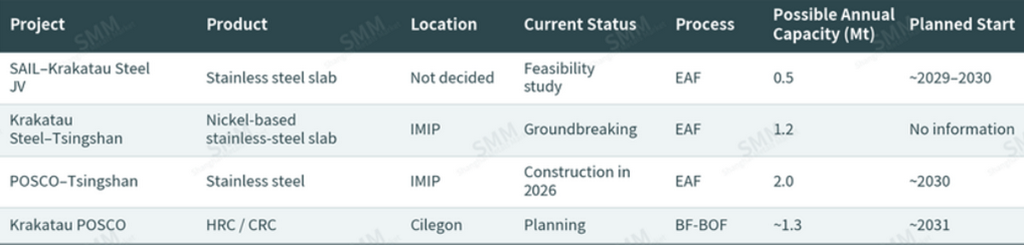
Future capacity additions remain concentrated around the two established industrial ecosystems of Cilegon (West Java) and IMIP (Indonesia Morowali Industrial Park, Central Sulawesi), with new EAF-based projects — largely structured as joint ventures given the elevated capital cost relative to BF-BOF — targeted for commissioning around 2030.
Source: SMM
Supply Side
Crude steel production expanded sharply between 2015 and 2020 on the back of major mill commissioning, including Dexin Steel (2020) and Krakatau POSCO (2014), and the 2019 expansion of Krakatau Steel's Hot Strip Mill #2, alongside PSN-driven demand growth. Growth decelerated over 2021–2025 amid the pandemic and a smaller pipeline of new capacity. Production remains concentrated at Cilegon (the historical hub for carbon steel and western Indonesia) and IMIP (integrated with stainless steel production, serving eastern Indonesia), with secondary sites including PT New Asia International in East Java for carbon steel production.
Source: StatBase, SMM
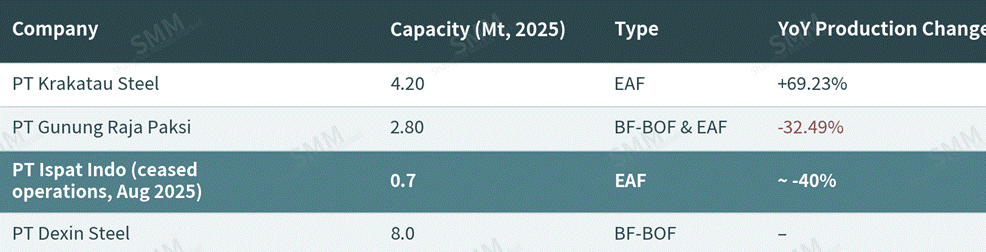
At the mill level, performance in 2025 was highly divergent. Krakatau Steel posted a 69.2% YoY increase in output following the January 2025 restart of Hot Strip Mill 1, which had been offline since May 2023 due to power supply issues. By contrast, PT Gunung Raja Paksi and PT Ispat Indo both recorded YoY production declines under sustained pressure from low-cost imports: GRP reported a loss of approximately USD 36.83 million in 2025, while Ispat Indo ceased operations in August 2025 after determining that importing finished steel was more economical than domestic production — its terminal utilization rate had fallen to just 40%. Krakatau Osaka Steel — which has likewise halted production — represents the most recent casualty of import pressure. The pattern underscores that headline production growth masks acute, mill-level financial distress driven by import competition.
Source: SMM
Demand Side
Source: Miani, 2025; SMM
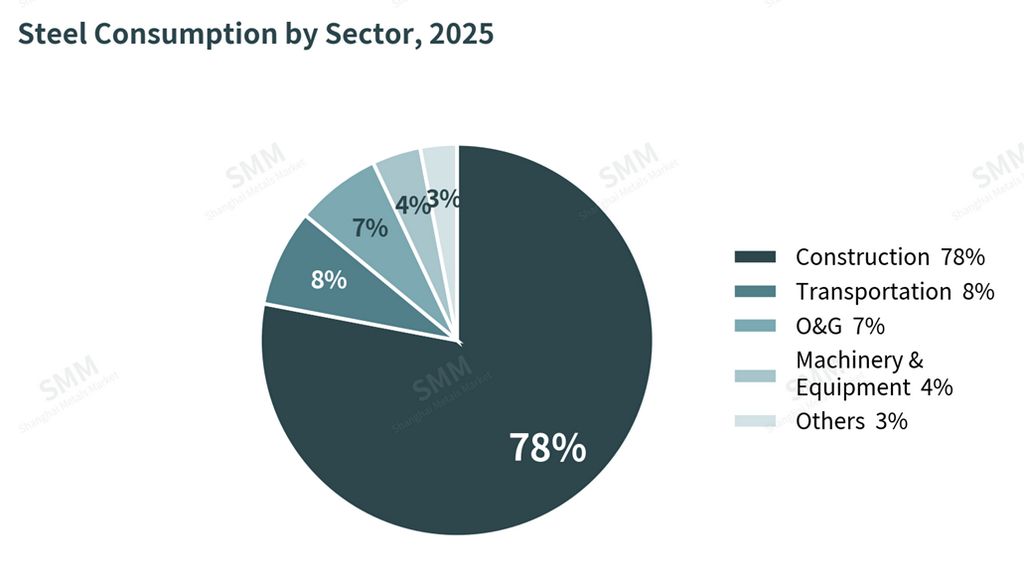
Construction accounts for 78% of domestic steel consumption as of 2025, followed by transportation (8%), with oil and gas, machinery, and other sectors comprising the remainder. Crude steel consumption has grown far more modestly than headline production: consumption rose 32% between 2015 and 2020 and 29% between 2021 and 2026E, versus production growth of 168% and 48% over the same periods — pointing to a structural mismatch between an increasingly supply-driven, export-oriented output base and genuine domestic end-use demand.
Source: Customs data for Indonesia, SMM
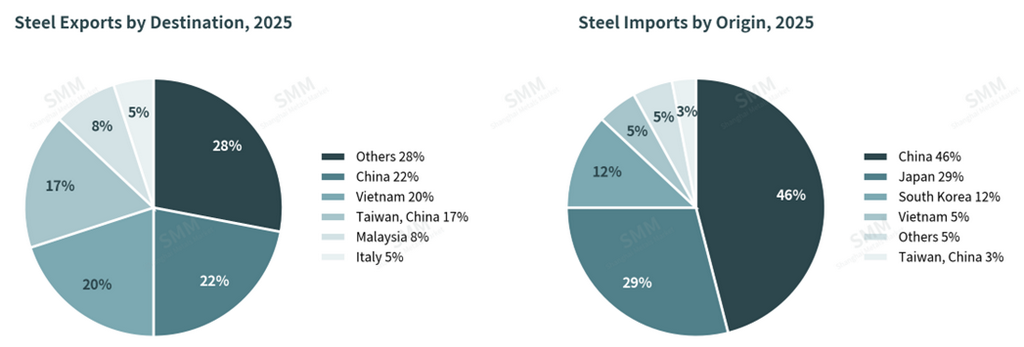
Compounding the pressure on domestic mills, import dependency remains high: in 2025, imports supplied 55% of domestic finished-steel consumption, with China alone accounting for 46% of import volumes. This influx of low-cost Chinese product reflects a confluence of factors — a prolonged Chinese real estate slump, scale-driven cost advantages, state-linked financing support, cooling domestic construction activity in China, and a comparatively slow Indonesian policy response. Indonesia does produce substantial volumes of construction steel — H-beams, I-beams and similar sections from mills such as Garuda Yamato Steel — but these products are not price-competitive against imports, while the categories that are price-competitive, such as rebar, remain low-value-added commodity grades.
Measures introduced to date — mandatory SNI certification, tightened import licensing (lartas), targeted natural gas pricing (HGBT), and zero-duty treatment for raw material inputs such as billets — arrived too late to prevent the closure of producers such as Krakatau Osaka Steel. Looking to 2026, crude steel consumption is expected to grow but at a decelerating pace, reflecting a contraction in infrastructure investment, a fiscal pivot toward non-infrastructure priorities such as the free-meals program, and unfavorable public sentiment toward newer initiatives including the Red-and-White Village Cooperative and Public-School projects.
Trade Flows
By Volume
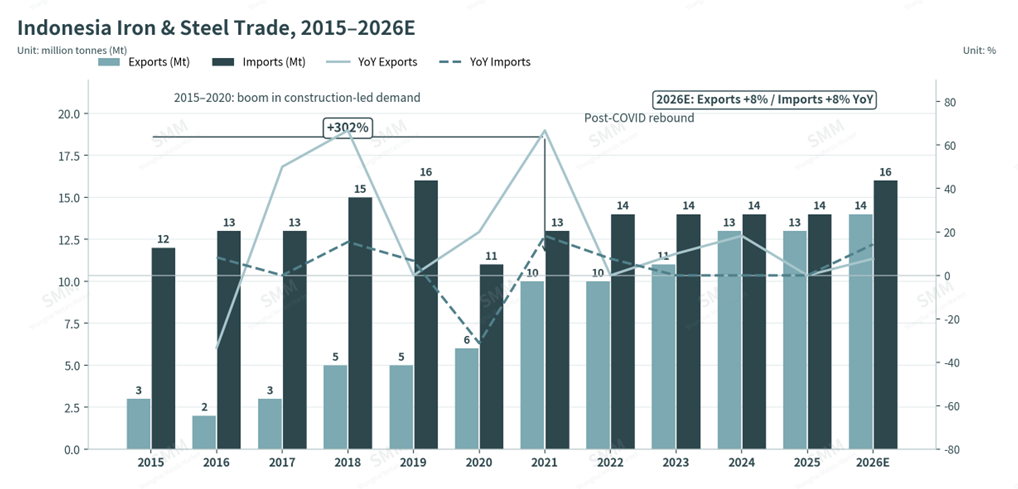
Export and import volumes have historically tracked Indonesia's shifting policy priorities, with a pronounced boom during 2015–2020 driven by construction demand and aggressive downstreaming policy, a COVID-era disruption through 2020–2021, and a return to trend growth from 2022 onward. For 2026, both export and import volumes are projected to increase, albeit at a slower YoY pace. On the export side, growth is supported by continued production gains and by anti-dumping measures imposed by other markets — notably against Chinese product entering Vietnam — which stand to benefit Indonesian suppliers given Indonesia's price competitiveness relative to Vietnam. On the import side, continued reliance on lower-cost, low-value-added Chinese product is expected to persist, though growth should be constrained by SNI compliance requirements and existing anti-dumping measures.
Source: Statistics Indonesia, SMM
By Product
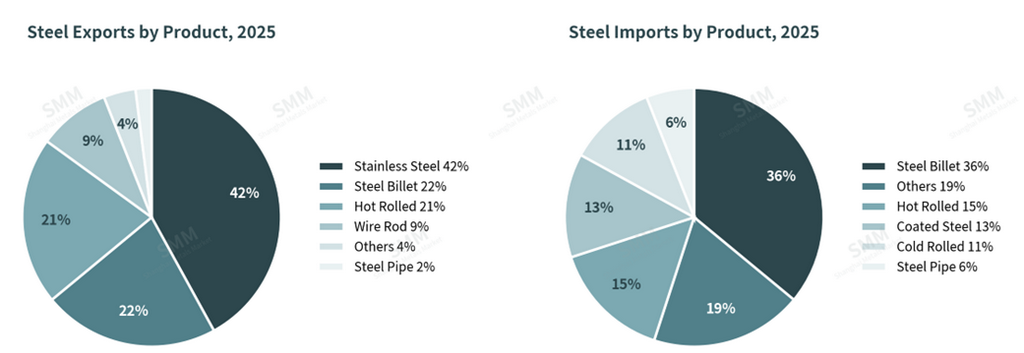
Stainless steel represents close to half of Indonesian steel exports, followed by billet and HRC — a composition driven by Indonesia's nickel ore export ban, which requires nickel to be processed domestically into semi-finished stainless product before export, leveraging the country's substantial nickel reserves. On the import side, billet remains the dominant category, reflecting continued reliance on construction-sector demand and limited domestic availability of scrap feedstock, followed by HRC and coated steel products.
Source: Customs data for Indonesia, SMM
By Country
China is the leading trade partner on both sides of the ledger. On exports, Chinese steelmakers operating semi-finished stainless facilities in Indonesia — a structure necessitated by the nickel ore export ban — account for a substantial share of outbound shipments to China. On imports, Chinese oversupply, driven by soft domestic real estate demand and trade diversion linked to U.S. and EU tariff measures, continues to position Indonesia as a preferred outlet market.
Source: Customs data for Indonesia, SMM
ASEAN Competitiveness: HRC Pricing
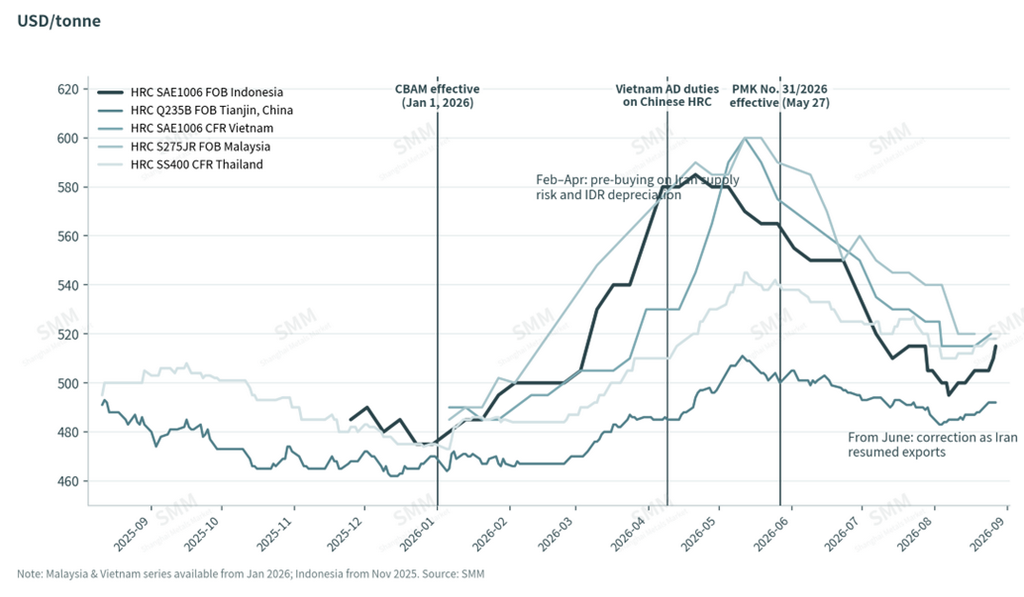
Regional HRC pricing across China, Thailand, Malaysia, Indonesia, and Vietnam over the twelve months to August 2026 has closely tracked Chinese price movements, underscoring China's continued price-setting influence across ASEAN. Average Chinese HRC pricing over the period stood at approximately USD 481/tonne versus an ASEAN average of USD 520/tonne — a spread of roughly USD 39/tonne.
Source: SMM
Prices across the region rose sharply between February and April 2026 amid escalating Middle East tensions, given Iran's role as a major slab supplier to ASEAN (ASEAN imported 3.9 Mt of iron and steel products from the Middle East in 2025); Indonesian HRC pricing peaked on April 21, 2026, as buyers pre-purchased amid supply uncertainty. The period also coincided with material Indonesian rupiah depreciation — the rupiah weakened by approximately IDR 600 against the USD between January and April 2026, and by roughly IDR 1,000 at its weakest 2026 level (IDR 18,336/USD in July 2026). Prices began correcting from June onward as Iran lifted export restrictions on May 30, 2026 and regional inventories normalized. As of August 27, 2026, HRC FOB Indonesia stood at approximately USD 515/tonne — still the lowest among ASEAN peers — suggesting that, absent renewed currency or geopolitical pressure, Indonesian pricing remains the most competitive within ASEAN.
Regional Balance Sheet
Comparing crude steel production, exports, and imports across Indonesia, Vietnam, Thailand, and other ASEAN peers, Indonesia and Vietnam remain the region's two dominant producers through 2026. All three Indonesian metrics — production, exports, and imports — are projected positive for 2026. Export growth is supported by resilient finished-product demand and by Chinese producers' limited room to cut prices further — Chinese mills have in fact begun raising offers — with H1 2026 exports up 18.41% YoY. Import growth, while moderating amid softer domestic demand, remains supported by an active PSN pipeline (77 projects targeted for completion between 2025 and 2029, within the broader portfolio of 219 active projects), with potential downside if regulatory measures compress import volumes faster than currently anticipated. Vietnam continues to outperform Indonesia on regional market share, supported by robust public investment and rising exports alongside declining imports tied to strong domestic absorption. Thailand remains the weakest of the three, constrained by high import dependency stemming from elevated domestic production costs. Despite Middle East-related disruption to slab supply, the broader ASEAN steel market has demonstrated notable resilience through 2026.

Source: SMM
Current Market Conditions and Operational Risks
Domestic steel prices advanced by at least USD 5/tonne on August 27, 2026, with wire rod rising from USD 490 to 495/tonne, slab from USD 475 to 480/tonne, HRC from USD 510 to 515/tonne, and billet from USD 470 to 475/tonne. The increase reflects sustained restocking demand alongside scheduled mill maintenance. On the export side, since mid-August Chinese prices have stopped declining and are now firming on stronger domestic Chinese demand, effectively removing downward price pressure on Indonesian product. Provided underlying fundamentals hold, these dynamic favors continued near-term price appreciation in the Indonesian market.
A separate operational risk is emerging around the IMIP (Indonesia Morowali Industrial Park) ecosystem, where water shortages are affecting both production and logistics. Water is a critical input to the cooling process in steelmaking, so a prolonged shortage could constrain output, while reduced water levels are complicating vessel docking, with knock-on risk to transportation costs and demurrage charges. Separately, one major mill is scheduled for routine maintenance in September 2026; as a routine event, this is not expected to trigger significant near-term volatility, but it remains a variable worth monitoring for its potential effect on Indonesian pricing.
Key variables to monitor: (1) PSN disbursement pace and the fate of politically contested projects (Red-and-White Village Cooperative, Public School Project); (2) enforcement intensity of PMK No. 31/2026 and SNI certification on Chinese import volumes; (3) CBAM cost pass-through and Kemenperin's decarbonization roadmap execution; (4) the timing and scale of any Chinese production recovery, which remains the dominant swing factor for ASEAN HRC pricing and Indonesian mill utilization; (5) water availability at IMIP and the September 2026 mill maintenance schedule, both of which carry near-term supply-side risk.
Data Source Statement: Analysis compiled from company disclosures, Ministry of Industry (Kemenperin) and Ministry of Public Works and Housing (PUPR) statements, and market pricing data. Figures are for reference only and do not constitute investment or trading recommendations.
![[SMM Steel]](https://imgqn.smm.cn/usercenter/GGaSo20251217171716.jpg)