Regarding the issuance of the “Management Measures for the Standardized Recycling and Utilization of Industrial Renewable Resources in Shandong Province (Trial)” (hereinafter referred to as the “Management Measures”), SMM learned that the Management Measures implemented in Shandong Province this time are a “local implementation version” of a series of central policy requirements, but they are not a simple translation of any single central document; rather, they are the first provincial full-chain comprehensive management measures formed by integrating the multi-ministry and multi-dimensional policy lines of the central government over the past year or more.
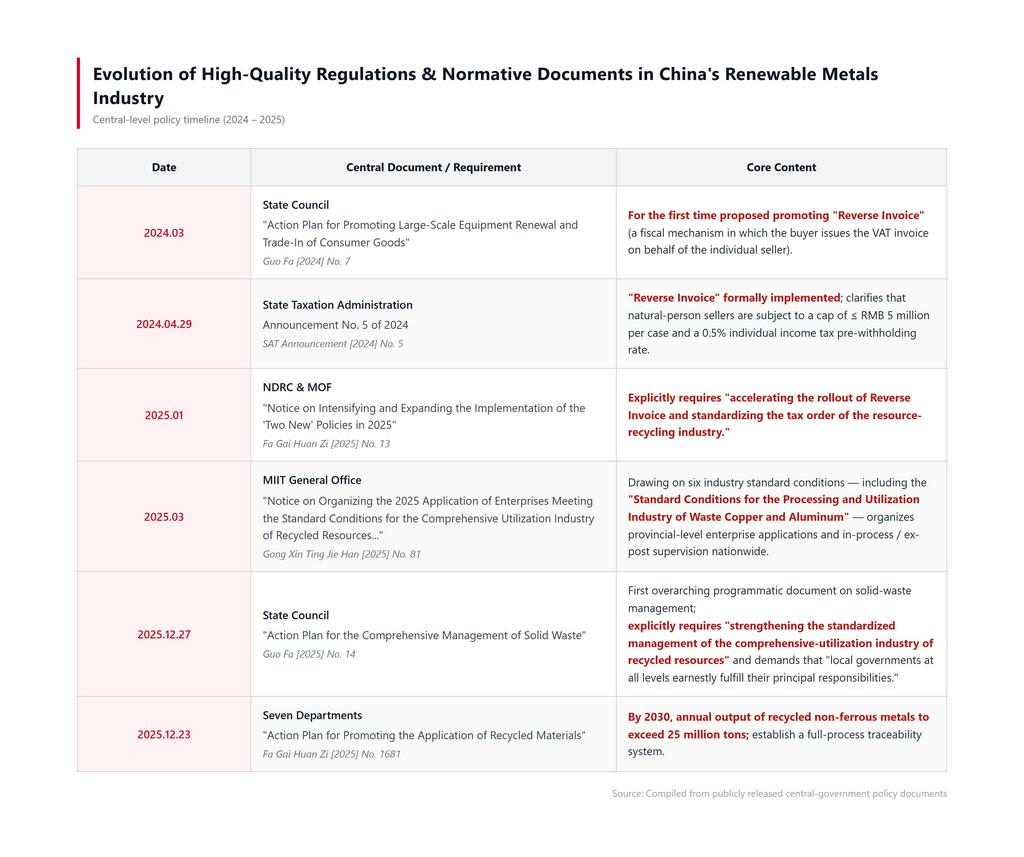
I. At the Central Level, Not “One Document at the Start of the Year” but a Progressive Layering of Multiple Policy Lines
II. The "Integrated Innovation" of the Shandong Measures
1. Upgrading from "Three Flows in One" to "Five Flows in One"
In the rollout of reverse invoicing, the State Taxation Administration requires the "three flows in one" (invoice flow, fund flow, and personnel flow) — a July 2025 reply letter from the Ma'anshan Taxation Bureau explicitly states that it is piloting the "three flows in one." Building on this, the Shandong Measures add "contract flow" and "goods flow," forming a more complete digital supervision chain: contract flow + goods flow + invoice flow + fund flow + information flow = "five flows in one." This extends and strengthens the central government's "three flows in one" approach.
2. Building a Provincial Smart Monitoring Platform
At the central level, MIIT relies on the "Industrial Energy Conservation and Green Development Management Platform" (green.miit.gov.cn) to manage enterprises under industry standards. Shandong, by contrast, has built a dedicated Shandong Provincial Industrial Renewable Resources Recycling and Processing Smart Monitoring Platform, turning platform registration, information filing, and data reporting into management requirements for enterprises.
3. First Systematic Coverage of the Entire "Waste Generation–Recycling–Processing–Waste Utilization" Chain
Previously, central policies were fragmented: MIIT managed market access for enterprises under the standard conditions, tax authorities managed reverse invoicing, and the NDRC managed the circular economy. Through a joint document issued by eight departments (led by the Department of Industry and Information Technology + NDRC + Department of Public Security + Department of Finance + Department of Ecology and Environment + Department of Commerce + Market Regulation Administration + Taxation Bureau), the Shandong Measures have bridged regulatory gaps between departments.
III. Summary
1. Policy intensity is increasing at an accelerating pace: from March 2024 to September 2026, in less than two years, central and local governments have already formed a complete chain of "action plan → reverse invoicing → standard conditions → solid waste action plan → provincial comprehensive management measures," and the high-pressure policy posture is clear.
2. "Five flows in one" is stricter than "three flows in one": for the secondary copper industry, this means the survival space of purely trade-based intermediate links (with no actual logistics and no contract trail) will be further compressed, accelerating the industry's transformation toward entity-based and clustered operations. 3. As the country's core hub for industrial recycled resources, Shandong took the lead in introducing measures, serving as a bellwether—other provinces are highly likely to follow suit, leading to nationwide regulatory convergence.
4. Tax supervision is the key lever: the measures explicitly focus on "tax-related risks such as fraudulent invoicing and fictitious circular transactions." This echoes the data released by the State Taxation Administration in 2025, which showed "a reverse invoicing amount of nearly 900 billion yuan" and 14,800 recycling enterprises, indicating that regulators' attention to tax compliance in the recycled resources industry has reached an unprecedented level.