SMM August 20 News:
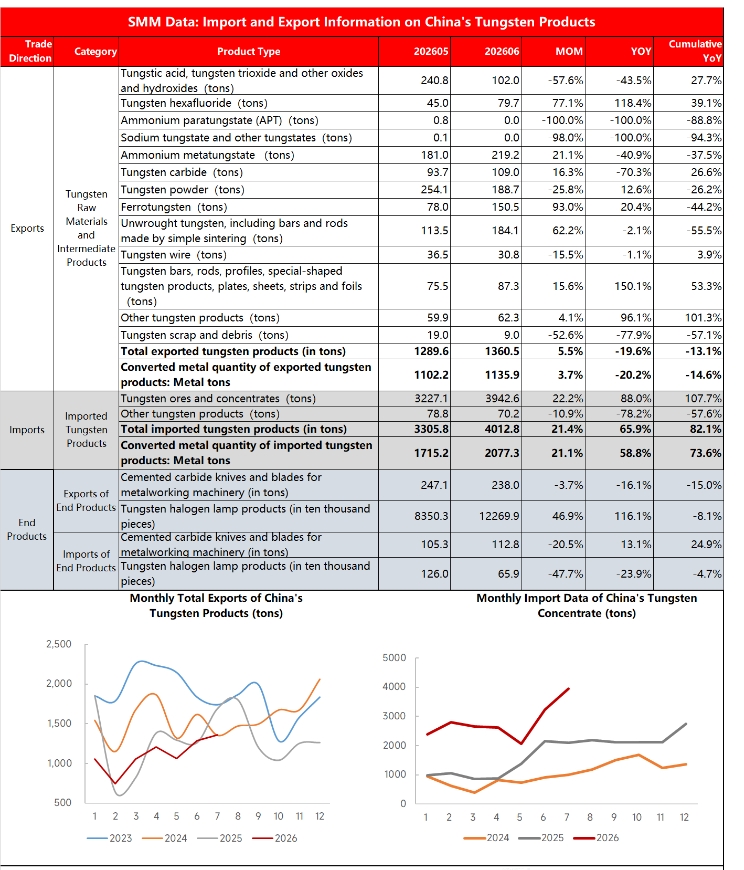
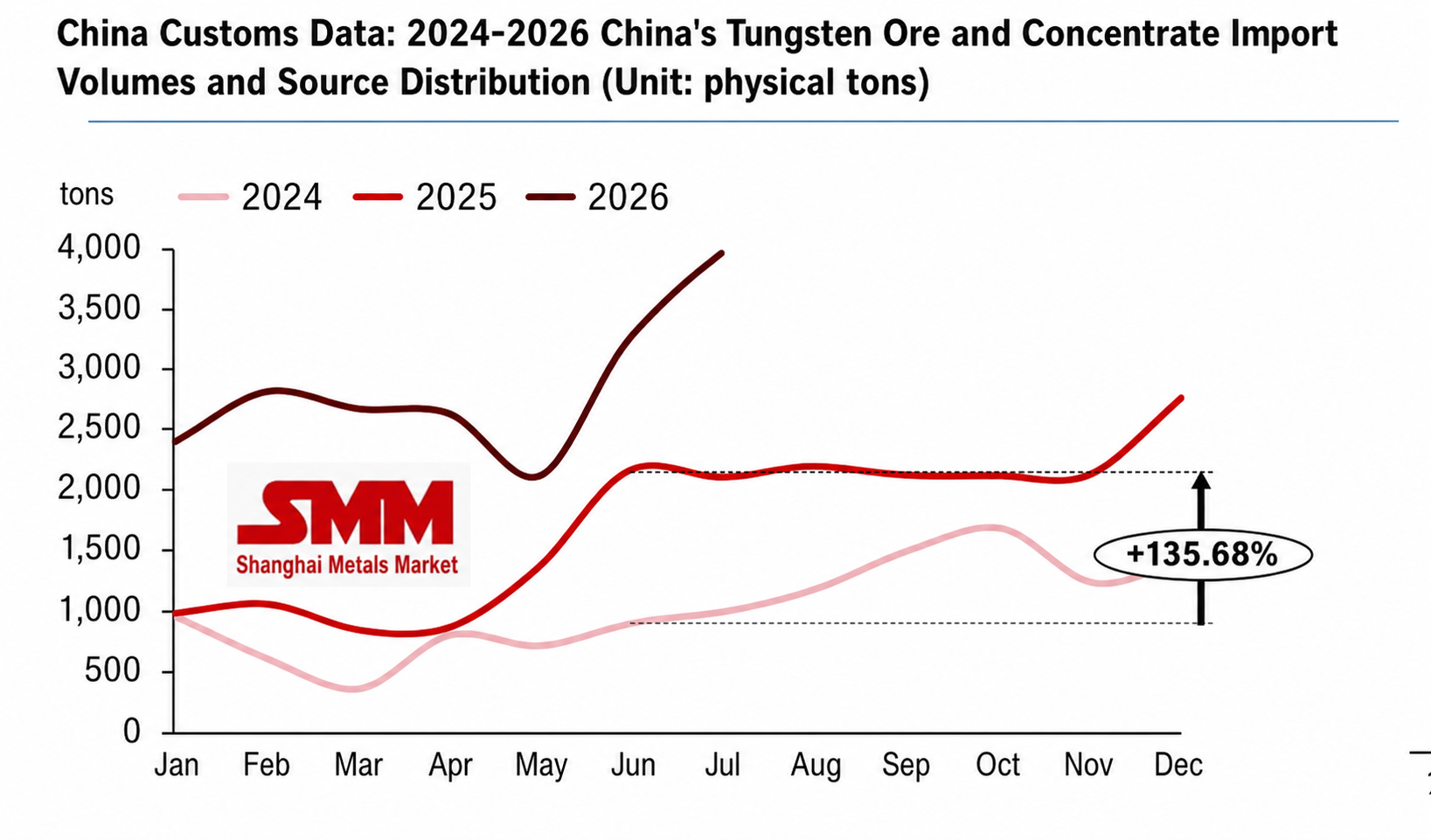
According to customs data, China's tungsten product imports and exports in July continued the trend of rising raw material imports and falling exports. Imports of tungsten concentrates from countries such as Myanmar and Kazakhstan saw significant growth, driving the total cumulative imports of China's tungsten concentrates up 107.7% YoY to 19,400 mt. Meanwhile, total exports of tungsten smelting products and tungsten materials decreased 13% YoY to around 7,781 mt.
On the import market side:
From January to July 2026, China's total tungsten product imports were approximately 20,200 mt, up 82.1% YoY, equivalent to about 10,500 mt in metal content, up 74% YoY. Among them, total tungsten concentrate imports were 19,400 mt, up 107.7% YoY. Total imports surged: China's tungsten concentrate imports in 2026 increased significantly, mainly from Kazakhstan, Myanmar, and North Korea. Additionally, small amounts of crude smelting products such as sodium tungstate and calcium tungstate were also imported.
Export market: With strict controls, China's tungsten product exports are gradually shifting toward deep processing. In July, China's tungsten product exports increased5.5% MoM to around 1,360 mt, with major growth coming from non-dual-use items such as tungsten hexafluoride, ammonium metatungstate, and ferrotungsten. From January to July, total China's tungsten product exports were7,781 mt, down13% YoY. Among them, APT, tungsten powder, unwrought tungsten bar and rod and other products saw the largest YoY declines. Tungstic acid, tungsten hexafluoride, tungsten bar and rod and other products saw the largest export growth.
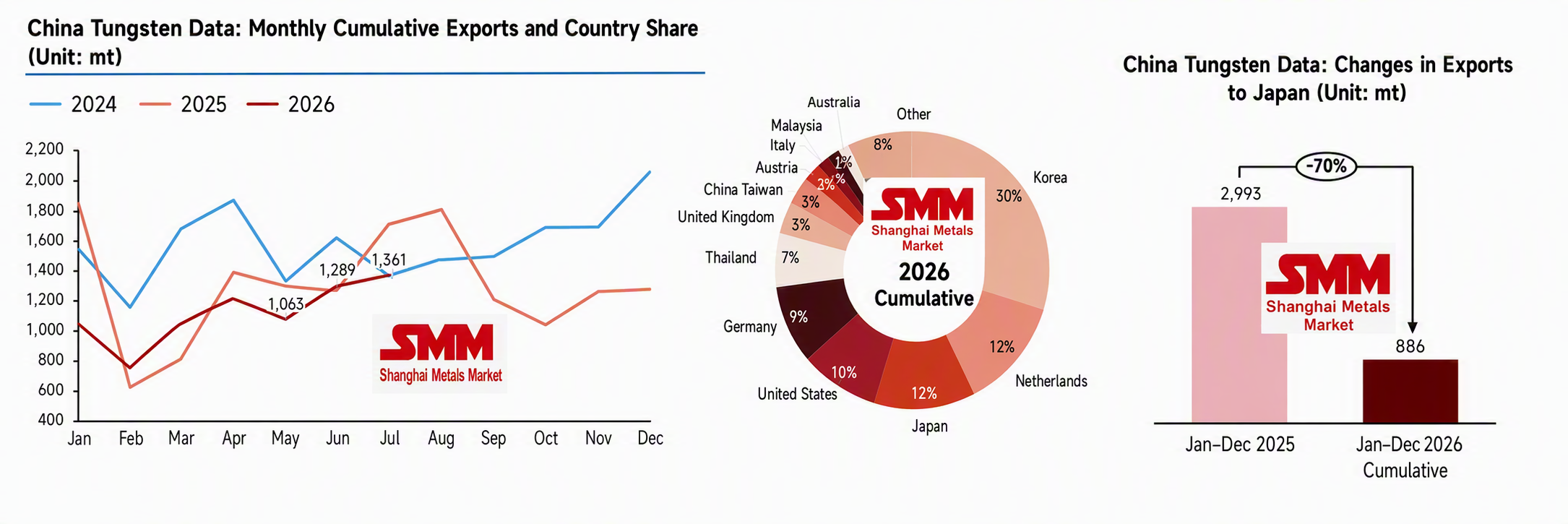
By product, major products showed divergence:
- APT : July exports were 0 mt, compared with 0.8 mt in June, with nearly no external shipments for two consecutive months; Cumulative exports for Jan-Jul were 22.8 mt, down 88.8% YoY. APT falls under the category of dual-use items control, with each order requiring separate review. The stricter license approval has directly led to a near halt in exports of primary smelting products, making it significantly more difficult for overseas clients to source China's APT raw materials.
- Tungsten powder : July exports were 188.7 mt, down 25.8% MoM and up 12.6% YoY; Cumulative exports for Jan-Jul were 610.3 mt, down 26.2% YoY. Due to export constraints from licensing approval under controls, the review of export orders in the tungsen powder market is slow, and there is a certain lag between customs data and actual order placement. According to customs data, the export unit price of tungsen powder in July reached $260/kg, mainly executing orders placed before May. At that time, the domestic FOB price of tungsen powder was roughly around $230-260/kg. Calculated at the overseas APT price of $3,000/mtu, the production cost of overseas tungsen powder enterprises was about $300/mt, and China's tungsen powder and tungsen carbide products offered great cost-effectiveness overseas from a price perspective.
- Tungsen carbide (unsintered, controlled item) : July exports were 1,090.0 mt, up 16.3% MoM and down 70.3% YoY; Cumulative exports for Jan-Jul were 1,209.7 mt, up 26.6% YoY. July's MoM recovery came from concentrated deliveries of some approved license orders, mainly shipped to South Korea and other countries and regions.
- Tungsen bar, rod, profiles and special profiles : July exports were 87.3 mt, up 15.6% MoM and up 150.1% YoY; Cumulative exports for Jan-Jul were 354.3 mt, up 53.3% YoY. Only tungsen profiles of specific sizes and specifications are included in the dual-use items control; ordinary specifications of tungsen bars are not controlled. The release of demand for overseas superalloys and special smelting has become the biggest highlight of intermediate product exports.
- Ferrotungsen : July exports were 150.5 mt, up 93.0% MoM and up 20.4% YoY; Cumulative exports for Jan-Jul were 841.4 mt, down 44.2% YoY. Ferrotungsen is not included in this round of tungsen dual-use items list. The MoM rebound in July came from phased restocking by overseas special steel enterprises, but low orders in some months of H1 dragged down the cumulative performance.
- Tungsten scrap: July exports of 9 mt, down 52.6% MoM and down 77.9% YoY; cumulative January-July exports of 102.9 mt, down 57.1% YoY, as demand for overseas recycled raw materials remained weak.
- Tungsten hexafluoride: July exports of 79.7 mt, up 77.1% MoM and up 118.4% YoY; cumulative January-July exports of 335.6 mt, up 39.1% YoY. Two top-tier players in Japan permanently exited the global market in July for tungsten hexafluoride capacity, shrinking global supply, while China's tungsten hexafluoride exports benefited from order transfers from overseas, coupled with a sustained rise in customs declaration average prices; July unit price was approximately 1.57 million yuan/mt.
For terminal cemented carbide inserts, China's total exports of such products in January-July fell 15% YoY to 1,724 mt, while total imports rose 25% YoY to 874 mt. The decline in exports was mainly driven by two factors: first, weak overseas manufacturing activity curbed external demand orders; second, higher domestic tungsten raw material costs pushed up domestic insert prices, undermining price competitiveness in overseas markets, while export controls on tungsten-related dual-use items indirectly constrained mid-stream product outflows. Notably, despite lower export volumes, unit prices rose significantly, reflecting cost pass-through to overseas markets and a shift toward higher value-added product mixes. The sharp YoY increase in imports indicated continued heavy reliance on overseas inserts for high-end processing applications, with imported brands still dominating aerospace, precision molds, and other sectors. Overseas tool makers lagged in price adjustments versus domestic ones, creating a temporary price advantage and boosting domestic enterprises' willingness to restock imported inserts. This presented a divergence of falling exports and rising imports, with low and mid-end domestic inserts under pressure in going global, while domestic substitution in high-end segments still has ample space. Key areas to monitor ahead include changing price competitiveness from sustained price hikes by overseas tool makers and recovery in domestic and foreign insert orders as China's manufacturing season picks up.
Overall, China's tungsten industry in January-July 2026 showed a distinct trade pattern of significantly expanded raw material imports, constrained primary exports, breakout of high-end processed exports, and diverging terminal product structures. On the import side, China diversified import channels, relying on incremental mine supply from Kazakhstan and Myanmar to effectively fill domestic tungsten concentrate supply gaps, offsetting pressure from domestic raw material production cuts, and gradually optimizing the import source mix. On the export side, strict controls on dual-use items led to a sharp contraction in exports of primary smelted products such as APT and tungsten powder, prompting continued exits of low-end raw material export capacity and accelerating industry transformation and upgrading; meanwhile, exports of unresticted tungsten profiles, ferrotungsten, and high-end electronic-grade tungsten hexafluoride surged against the trend, boosted by order transfers from overseas capacity exits, highlighting China's growing global competitiveness in high-end tungsten processing products and a clear trend of export structure optimization. The divergent trend of opposite movements in imports and exports of end-use cemented carbide blades clearly reflects the current situation of China's tungsten industry chain: "low-end capacity involution and high-end undersupply." Low and mid-end products face pressure in going global, while high-end precision products still rely on imports, leaving ample room for substitution. In the medium and long term, as China's export control on tungsten products becomes normalized, the industry will continue to focus on deep processing sectors with high added value and high technical barriers. The supplementary imports of raw materials will continue to ensure the stability of China's industry chain supply. Meanwhile, the domestic substitution of high-end cemented carbide and fine tungsten products, along with market expansion outside China, will become the core theme for improving quality and efficiency and unlocking growth space for China's tungsten industry.