1.0 Southeast Asia Coal Import and Export Policies
Introduction:
Southeast Asia has emerged as one of the faster-growing regions in the global economy in recent years. Strong capital inflows have supported the expansion of its industrial base, while continued industrialisation has driven rapid growth in electricity demand. In the coal market, the region plays a dual role: it is home to some of the world’s major thermal coal exporters while also containing several rapidly expanding coal-importing markets. In resource-exporting countries such as Indonesia, raw material exports have long been an important source of foreign exchange and fiscal revenue. However, when resources are exported in unprocessed form, domestic power generation, smelting and downstream processing industries may struggle to secure a stable and predictable supply of raw materials, repeatedly delaying the process of industrial upgrading. This tension is particularly evident in Indonesia. As the region’s largest coal producer, Indonesia needs to maintain its export volumes while seeking to move its downstream industries beyond a long-term role centred primarily on supplying raw materials.
In response to this tension, policy frameworks across the region have gradually evolved towards retaining a larger share of resources for domestic use. Governments have adopted measures such as export duties, export quotas, production quotas, Domestic Market Obligations (DMO), and benchmark export prices to manage the volume of production available for overseas markets while safeguarding raw material supply for domestic industries. This policy approach was first demonstrated more clearly in mineral sectors such as nickel and bauxite and has subsequently, although with varying degrees of intensity, extended to coal. In the coal sector, however, policy intervention is generally focused on securing domestic supply and maintaining price stability rather than imposing an outright ban on exports.
At the other end of the regional market, electricity demand in countries such as Vietnam, the Philippines and Thailand continues to grow rapidly, with coal-fired power generation still playing an important role in their power systems and supporting continued demand for imported coal. At the same time, global decarbonisation targets, national energy-transition plans and tighter restrictions on approvals for new coal-fired power projects are gradually reshaping the policy environment, while clean-energy targets are being progressively implemented. As a result, coal-importing countries face a fundamental supply-demand policy tension: in the short term, they need to secure sufficient coal supplies to maintain power-system reliability, while over the medium to long term, they aim to gradually reduce their dependence on coal and create room for the energy transition. These competing objectives create a clear tension in the pace and trajectory of future coal imports.
Southeast Asia also lacks substantial reserves of high-quality coking coal, leaving its steel industry heavily dependent on imported raw materials from suppliers such as Australia. Thermal coal trade and coking coal procurement therefore operate as largely separate market systems, each shaped by different pricing mechanisms and policy environments. Analysing them together can obscure their underlying market drivers. The following analysis therefore focuses on two parallel trade flows: first, how regulatory measures on the export side affect regional supply patterns; and second, how energy-transition pressures on the import side are reshaping the pace and structure of coal demand.
1.1 Indonesia’s Coal Export Policies
Domestic Market Obligation (DMO)
Under Indonesia’s DMO, coal producers are required to allocate 25% of their actual annual production to the domestic market. These supplies are used for public and captive power generation, as well as for the raw material and fuel requirements of domestic industries. The government also assigns specific supply obligations based on the actual coal requirements of PT Perusahaan Listrik Negara (PLN), coal quality, and the production plans approved under each company’s Rencana Kerja dan Anggaran Biaya (RKAB). In 2026, PLN’s coal demand was estimated at around 154 Mt, while the government assigned a combined domestic supply obligation of approximately 212 Mt to mining companies holding approved RKABs, providing a larger supply buffer to improve the likelihood that contracted and delivered volumes would fully cover power plant requirements.
Alongside the DMO, Indonesia’s Domestic Price Obligation (DPO) continues to cap the benchmark price of coal supplied to PLN for public power generation at a maximum of US$70/t, subject to adjustments for actual coal quality. In practice, the DMO controls the volume of coal that producers can freely export, while the DPO limits the cost of coal supplied to the domestic power sector. Both policies are designed to prevent mining companies from prioritising exports when international coal prices rise, which could otherwise lead to domestic coal shortages, higher electricity costs, or increased government power subsidies.
The framework supports domestic energy security but also increases the opportunity cost for mining companies supplying the local market. The higher international coal prices rise, the wider the gap between export prices and the DPO benchmark becomes, increasing the financial burden of meeting DMO requirements. Companies that fail to fulfil their DMO obligations are first required to pay compensation. If the payment remains outstanding, penalties may then escalate sequentially to an export ban of up to 30 days, a production suspension of up to 60 days, and ultimately the revocation of the mining licence. The DMO therefore not only reduces the theoretical volume available for export, but also directly links a producer’s ability to export coal with its performance in meeting domestic supply obligations.
Harga Batubara Acuan (HBA)
HBA is the coal reference price periodically published by the Indonesian government. The Coal Benchmark Price (Harga Patokan Batubara, HPB) is derived from the HBA and adjusted according to the actual coal quality, including calorific value, moisture, sulphur and ash content. In other words, the HBA serves as the standard reference price, while the HPB represents the specific pricing benchmark applicable to coal of different qualities.
Under the current Kepmen ESDM No. 268.K/MB.01/MEM.B/2025, the HPB continues to be described as the minimum benchmark for coal sales, while contracts concluded below the HPB may still be recognised. Where the actual transaction price is lower than the HPB, the producer records its revenue based on the contractual sales price, but the relevant tax obligations and production royalties continue to be calculated using the HPB. The HPB therefore does not completely prohibit transactions below the benchmark price; instead, it ensures that companies cannot reduce the government’s tax and royalty base simply by entering into lower-priced sales contracts.
The policy is primarily intended to prevent under-invoicing of coal exports and transfer pricing practices that could reduce government revenue. Unlike the DMO, it does not directly restrict export volumes, but it can reduce the profitability of low-priced exports. When international market prices fall below the HPB, producers may seek to renegotiate contract prices, postpone sales, or reduce exports that offer insufficient margins. When market prices are above the HPB, however, the policy generally has a more limited impact on export decisions.
Indonesian Minister of Trade Regulation (Peraturan Menteri Perdagangan, Permendag) No. 15 Tahun 2026
Permendag No. 15 of 2026 was issued on 29 May 2026 and came into effect on 1 June 2026. The period from 1 June to 31 December 2026 serves as a transition period, during which existing registered coal exporters may continue to export, but are required to submit export contracts, customs documents and transaction records to the state-owned export entity PT Danantara Sumberdaya Indonesia (DSI). From 1 January 2027, DSI is expected, in principle, to assume responsibility for the pre-customs, customs clearance and post-customs processes for coal exports.
By centralising export activities and transaction data, the policy strengthens government oversight of coal export prices, contracts and foreign-exchange earnings. Its primary objectives are likewise to reduce export under-invoicing, transfer pricing practices and the retention of export proceeds offshore. The key distinction from the HBA/HPB framework is that HBA and HPB determine the pricing basis used by the government for revenue calculations, whereas the DSI framework determines who is responsible for handling exports and how the government obtains and monitors transaction data.
As 2026 remains a transition period, the clearest impact so far is an increase in reporting and compliance requirements; this alone does not provide sufficient basis to conclude that coal export volumes have already declined. Once the framework is fully implemented in 2027, export volumes may not necessarily fall significantly if DSI can smoothly take over existing contracts while maintaining efficient payment, customs clearance and vessel-loading processes. However, if delays arise in system approvals or contract transfers, loading efficiency could deteriorate and temporarily tighten Indonesia’s export coal supply.
Natural Resource Export Proceeds Policy (Devisa Hasil Ekspor Sumber Daya Alam, DHE SDA)
The DHE SDA policy primarily regulates foreign-exchange proceeds generated from natural resource exports, including revenue from coal exports, rather than directly restricting export volumes. The current framework was established under Government Regulation (PP) No. 36 Tahun 2023 and subsequently amended by PP No. 8 Tahun 2025, PP No. 2 Tahun 2026 and PP No. 21 Tahun 2026. For non-oil and gas mining exports where the value of a single export customs declaration reaches US$250,000 or more, exporters are generally required to repatriate 100% of the export proceeds into Indonesia’s financial system and retain the funds domestically for at least 12 months.
Retention does not mean that the funds are completely frozen. The proceeds may still be used for purposes such as tax payments, foreign-currency dividend payments, purchases of raw materials and capital equipment, service expenses, and eligible loan repayments. Exporters may also convert up to 50% of the declared export value into Indonesian rupiah. As a general rule, the relevant accounts must be maintained with state-owned foreign-exchange banks. However, qualifying bilateral trade arrangements may be subject to more flexible conditions, under which exporters are required to retain at least 30% of the proceeds for a minimum of three months and may use other foreign-exchange banks designated by Bank Indonesia.
The policy is intended to increase onshore foreign-exchange liquidity, support Indonesia’s foreign-exchange reserves, and help maintain stability in the rupiah exchange rate. For coal producers, its main effect is to restrict the ability to freely transfer export earnings offshore, while potentially increasing working-capital, financing and compliance costs. If an exporter fails to repatriate or retain the required foreign-exchange proceeds in accordance with the rules, the government may suspend its export services. Therefore, although the DHE SDA framework does not directly impose an export quota, it can still indirectly affect coal exports through foreign-exchange compliance requirements.
1.2 Vietnam’s Coal Import and Export Policies
1.2.1 Import Policies
National Energy Planning and Coal Import Strategy
Decision No. 55 and Decision No. 363 both call for Vietnam to strengthen domestic coal development while securing energy supply through appropriate imports and greater diversification of supply sources. They also emphasise the development of supporting infrastructure for coal imports, storage, transportation, coal blending and port handling. The focus of Vietnam’s import policy is therefore not to restrict coal inflows, but to establish a stable, long-term and price-competitive supply system.
This reflects the structural mismatch between Vietnam’s domestic coal production and the volume and quality of coal required by its power and industrial sectors. Imported coal has consequently evolved from a supplementary source into an integral part of the country’s energy supply system. Vietnam’s procurement strategy is therefore increasingly shaped by factors such as supplier concentration, long-term contracts, transportation routes and the compatibility of imported coal with domestic end-user requirements.
Import Tariffs and Value-Added Tax
Vietnam’s Most-Favored-Nation (MFN) tariff on coal under HS 2701 is currently generally set at 2%, rather than 0%. Indonesian coal that meets the applicable rules of origin and is supported by the required documentation may qualify for a 0% tariff under the ASEAN Trade in Goods Agreement (ATIGA), giving it a 2-percentage-point tariff advantage over the MFN rate. However, coal imported under certain other free trade agreements may also qualify for preferential tariff treatment, meaning that zero-duty access is not an advantage exclusive to Indonesian coal.
Under Decree No. 174/2025/ND-CP, the Value-Added Tax (VAT) rate on eligible coal was reduced from 10% to 8% for the period from 1 July 2025 to 31 December 2026. The reduced rate applies across import, production, processing and commercial sales activities. Since businesses are generally able to claim input VAT credits, the reduction from 10% to 8% does not translate directly into a 2% decline in the final landed cost of imported coal. Its more immediate effect is to reduce the amount of working capital tied up in VAT payments during the import and trading process.
Special Mechanism Allowing Coal Mines to Exceed Licensed Output by Up to 15%
Resolution No. 28/2026/NQ-CP allows eligible coal mines that meet technical, safety and environmental requirements and continue to hold valid mining licences to increase production by up to 15% above their licensed capacity without formally amending the approved capacity. The mechanism applies from 9 June 2026 to 31 December 2027. Any additional production must remain within approved reserve limits and can only be supplied for power generation.
The policy is designed to quickly unlock additional output from existing mines when thermal coal supply becomes tight, avoiding delays that would otherwise arise from lengthy licence-amendment procedures. The additional domestic supply may reduce part of Vietnam’s marginal import requirement. However, its impact is constrained by coal quality, mine-level production capacity and the restriction that incremental output can only be used for power generation. The mechanism therefore strengthens Vietnam’s domestic supply buffer, but does not eliminate the country’s structural dependence on imported coal.
1.2.2 Export Policies
Coal Export Regulatory Framework
Circular No. 15/2013/TT-BCT remains part of Vietnam’s regulatory framework specifically governing coal exports, although only certain provisions remain in force. The Circular originally required exported coal to meet prescribed quality standards, originate from lawful sources, and be accompanied by documentation such as coal-quality analysis reports and proof of origin. However, Circular No. 13/2020/TT-BCT repealed Clause 2 of Article 4 and Article 5 of Circular No. 15/2013/TT-BCT. It is therefore no longer appropriate to describe these documents as mandatory specialised customs documentation under the current regime.
The current framework primarily retains provisions governing the categories and quality specifications of coal permitted for export, together with the regulatory basis for government oversight. Individual export transactions must still comply with Vietnam’s general customs procedures, mineral-resource regulations and other applicable requirements. The underlying policy objective is to give the government flexibility to adjust the types of coal eligible for export according to domestic supply and demand conditions, while preventing coal grades that are in short supply domestically from being exported in excessive volumes. For coal companies, exports are therefore not entirely unrestricted, but the current framework places greater emphasis on managing eligible coal categories and annual government controls rather than maintaining the full set of specialised documentary requirements introduced in 2013.
TKV Coal Export Plan for 2026–2030
Under the export plan approved in 2025, TKV may export up to around 3 Mt of coal annually between 2026 and 2030. This is an annual export limit applied specifically to TKV, rather than a national quota for Vietnam’s total coal exports.
Vietnam’s coal exports mainly consist of higher-quality anthracite grades for which domestic demand is relatively limited but overseas market value remains attractive. The policy allows Vietnam to continue earning export revenue from premium coal that is not fully absorbed by the domestic market, while using annual volume controls to ensure that coal demand from the power and industrial sectors takes priority.
Vietnam’s approach can therefore be better described as a selective coal export policy: exports remain permitted for certain coal grades, but only within controlled volumes and without compromising domestic supply security.
Coal Export Tariff
Under Decree No. 26/2023/ND-CP, the export tariff on anthracite, coking coal and other coal products classified under HS 2701 is generally set at 10%. Decree No. 201/2026/ND-CP, which came into effect in 2026, did not revise the export tariff rates applicable to HS 2701.
The export tariff serves two main purposes: generating fiscal revenue for the government and increasing the cost of exporting coal directly without first being utilised in the domestic market. When the price difference between domestic and international markets is relatively narrow, a 10% tariff can materially reduce the attractiveness of exports. Producers are therefore more likely to export only when international prices, coal-quality premiums and expected net proceeds are sufficient to offset the tariff and associated logistics costs.
Together with TKV’s export plan, the export tariff acts as an additional mechanism for managing coal export volumes while giving priority to domestic supply.
1.2.3 Long-Term Impact of the Energy Transition
The Just Energy Transition Partnership (JETP) was established in 2022 with the aim of mobilising at least US$15.5 billion in public and private financing for Vietnam’s energy transition during its initial implementation phase. Funding is primarily directed towards areas such as renewable energy, grid development, energy storage and energy efficiency. JETP does not constitute a restriction on coal imports, nor does it prohibit banks from providing letters of credit for ordinary coal trade.
Its main impact is on the long-term demand outlook. As government policy and international capital increasingly shift towards low-carbon projects, financing and approval conditions for new coal-fired power projects may become more restrictive, limiting the growth of future coal demand. However, as existing coal-fired power plants continue to provide baseload and peak-balancing power, Vietnam is still expected to rely on imported coal in the short to medium term to maintain adequate fuel supply for power generation.
1.3 The Philippines’ Coal Import and Export Policies
The Philippines is a net coal importer, as domestic production is insufficient to meet both power-generation and industrial demand. Its policy focus is therefore not on restricting coal import volumes, but on securing supply, tracing coal origins and regulating transactions. On the demand side, the government has sought to constrain future growth in coal consumption by suspending approvals for new coal-fired power projects.
Overall, the Philippines’ coal policy can be summarised as follows: imports remain broadly open, coal transactions are regulated on a shipment-by-shipment basis, coal is subject to a uniform tax regime, and long-term growth in coal demand is being constrained through limits on new coal-fired power development.
1.3.1 Import Policies
Coal Trading and Shipment-Specific Import Certification
Under the same regulatory framework, coal traders, end-users and logistics service providers are required to obtain accreditation from the DOE before conducting coal-related activities. In addition, traders and end-users must obtain a Certificate of Compliance for Coal Importation (CoC-CI) for each shipment of imported coal. Rather than restricting total import volumes, the system combines accreditation of market participants with shipment-specific approval requirements, allowing the government to track the origin, quality, transportation and end use of imported coal.
Coal imports into the Philippines therefore remain open, although the compliance process has become more centralised. Companies need to prepare supply contracts, coal-quality information and logistics documentation in advance, while allowing sufficient time for regulatory approval. Incomplete documentation or delays in obtaining approval may therefore result not only in higher administrative costs, but also in vessel scheduling disruptions, longer port waiting times and higher landed coal costs.
Coal Import Tax Policy
The Philippines currently applies a 0% Most-Favored-Nation (MFN) tariff to the main categories of imported coal. Executive Order (EO) No. 10 extended the zero-tariff treatment for coal beyond 2023, while EO No. 62 established the country’s broader tariff framework for 2024–2028. The policy rationale behind the zero tariff is to reduce import barriers, diversify supply sources and contain fuel costs for power generation, reflecting the Philippines’ continued reliance on overseas coal supplies due to insufficient domestic production.
However, a zero import tariff does not mean that imported coal is tax-free. Under the Tax Reform for Acceleration and Inclusion Act (TRAIN; RA No. 10963), both domestically produced and imported coal and coke have been subject to an excise tax of ₱150 per metric tonne since 2020. Imported coal is also generally subject to 12% VAT. Certain transactions under specific Coal Operating Contracts (COCs) may retain special tax treatment, but such treatment must be explicitly provided for under the relevant contract and should not be interpreted as an automatic tax exemption for all domestically produced coal or all COC operators.
These taxes mean that importers need to assess the full landed, duty-paid cost of coal rather than focusing only on the FOB coal price and the 0% import tariff. The excise tax directly increases the unit cost of coal purchases, while VAT may create a working-capital burden. However, where businesses are eligible to claim input VAT credits, their ultimate tax burden may be lower than 12% of the import value.
1.3.2 Export Policies
Coal Export Compliance Certification
The Guidelines on Coal Trading and Utilization, Department Circular No. DC2025-11-0027, published on 27 November 2025, are currently in force. Under these rules, operators holding a Coal Operating Contract (COC) that has reached the development or production stage must apply to the Energy Resource Development Bureau (ERDB) under the Department of Energy (DOE) for a Certificate of Compliance for Coal Exportation (CoC-CE) before each export shipment.
The certification system is intended to verify that exported coal originates from legally authorised production operations and to enable the DOE to track coal quality, buyers and sellers, transportation arrangements and the final destination of each shipment. It does not impose a nationwide export quota, nor does it designate a single state-owned company to handle coal exports. Philippine coal exports are therefore better characterised as permitted subject to shipment-specific compliance certification, rather than being generally prohibited.
The main practical impact is additional documentation and approval time. If exporters do not incorporate the certification process into their vessel scheduling, approval delays may result in postponed loading and potentially higher demurrage costs.
1.3.3 Energy Policies Indirectly Affecting Coal Import Demand
Moratorium on New Coal-Fired Power Plant Approvals
Since 27 October 2020, the DOE has maintained a moratorium on government endorsements for new greenfield coal-fired power projects, and the policy was reaffirmed in May 2026. The moratorium does not require the closure of existing coal-fired power plants, nor does it apply to projects that had already secured exemptions, made firm commitments or achieved substantial progress before the policy took effect. Certain projects, including off-grid power facilities and those supporting critical mineral processing, may also qualify for exemptions under subsequent clarification mechanisms.
The policy is intended to reduce the power sector’s long-term dependence on additional coal-fired generation and create more room for renewable energy, energy storage and flexible power sources. It therefore does not immediately reduce coal import demand from existing power plants, but it limits future additions of coal-fired capacity and gradually narrows the potential for further growth in Philippine thermal coal demand. In the short term, coal imports will continue to be driven mainly by electricity demand, utilisation rates at existing coal-fired plants, domestic coal supply and international coal prices.
1.4 Malaysia’s Coal Import and Export Policies
Malaysia’s coal trade regime is relatively straightforward. On the import side, there is no nationwide import quota or coal-specific import licensing requirement for coal classified under HS 2701; the main regulatory considerations are sales tax and standard customs procedures. Coal exports, by contrast, are subject to licensing requirements. At the same time, the National Energy Transition Roadmap (NETR) and subsequent coal phase-out targets are expected to place long-term constraints on coal demand for power generation.
Overall, Malaysia’s coal policy can be summarised as follows: maintaining reliable import supply in the short term, applying licensing controls to exports, and gradually phasing out coal-fired power generation over the long term.
1.4.1 Import Policies
Coal Import Tariff and Sales Tax Policy
Under the current Customs Duties Order 2025 (P.U. (A) 384/2025), which came into effect on 1 November 2025, the import duty on major coal products classified under HS 2701 is set at 0%. This rate forms part of Malaysia’s national customs tariff structure rather than a subsidy specifically introduced for coal imports, although in practice it reduces trade barriers for coal sourced from overseas markets.
At the same time, the Sales Tax (Rate of Sales Tax) Order 2025 (P.U. (A) 170/2025) brought coal under HS 2701 within the scope of a 5% sales tax from 1 July 2025. This adjustment was part of the broader expansion of the Sales and Service Tax (SST) base and was primarily intended to increase government revenue, rather than to restrict imports from any particular coal-supplying country.
Malaysia’s imported coal therefore currently falls under a 0% import duty and 5% statutory sales tax structure. The sales tax increases the tax-related cost of coal after importation, although importers that qualify for exemptions based on specific entities or end uses may face a lower effective burden than the statutory rate. Coal procurement decisions therefore still need to compare the full landed cost, including the FOB price, ocean freight, sales tax, port charges and coal-quality compatibility.
Import Licensing and Import Quotas
Under the current Customs (Prohibition of Imports) Order 2023 (P.U. (A) 117/2023) and its publicly available amendments, coal classified under HS 2701 is not subject to a nationwide coal-specific import licensing requirement or quantitative restriction. Malaysia therefore does not currently impose coal import quotas, special import approvals, or annual volume controls comparable to Indonesia’s DMO.
This does not mean that coal can be imported without completing regulatory procedures. Importers must still comply with standard customs requirements, including customs declarations, product classification, payment of applicable SST and other relevant procedures. These requirements, however, do not amount to coal-specific quantitative restrictions.
1.4.2 Export Policies
Coal Export Licensing and Export Duty Regime
Under the Customs (Prohibition of Exports) Order 2023 (P.U. (A) 122/2023), coal classified under HS 2701 is treated as a conditionally prohibited export, meaning that an export licence must be obtained before shipments can be made to any destination. From 1 February 2026, responsibility for permits covering the export of relevant minerals and rocks was transferred to the Department of Minerals and Geoscience Malaysia (JMG).
The purpose of the licensing regime is to allow the government to monitor exporters, exported products and the movement of mineral resources, rather than to control exports through fixed quotas or government-administered pricing. At the same time, the current tariff schedule maintains a 0% export duty on coal under HS 2701. Malaysia’s coal export regime can therefore be summarised as follows: no export duty is imposed, but an export licence is required.
1.4.3 Energy Policies Indirectly Affecting Coal Import Demand
NETR and the 2044 Coal Phase-Out Target
Malaysia’s NETR was introduced in 2023, after which the government further clarified its direction of travel for coal-fired power generation. The policy framework includes no new coal-fired power plants, a reduction of roughly half of the existing coal-fired generation capacity by 2035, and a target to phase out coal-fired power generation by 2044. Malaysia is also seeking to raise the share of renewable energy in installed power capacity to 70% by 2050. The 2044 date should be understood as a policy target rather than a requirement for all existing coal-fired power plants to shut down simultaneously in the near term.
In the short term, existing coal-fired power plants will continue to require imported thermal coal to maintain operations, while Malaysia must also preserve power-system reliability and affordability during the energy transition. Over the longer term, thermal coal imports are expected to decline structurally as coal-fired units are progressively retired. However, the pace of this decline will depend on whether renewable energy, grid infrastructure, energy storage and replacement gas-fired capacity can be brought online in time. If alternative generation develops more slowly than planned, the decline in coal demand could be delayed, while Malaysia may gradually shift from dependence on imported coal towards greater reliance on natural gas and imported liquefied natural gas (LNG).
2.0 Southeast Asia Coal Trade Flows
2.1 Indonesia-Centred Regional Coal Supply System
Southeast Asia’s coal trade shows a clear concentration of both supply and demand. Although Vietnam, the Philippines, Thailand and Malaysia all have varying levels of domestic coal production, Indonesia remains the main country capable of supplying large volumes of seaborne thermal coal to the regional market on a sustained basis.
Indonesia’s coal production is concentrated mainly in East Kalimantan, South Kalimantan and South Sumatra, with output dominated by medium- and low-calorific-value thermal coal. Kalimantan is geographically close to the Philippines, Malaysia and Vietnam, giving Indonesian coal a relatively strong advantage in terms of shipping distance and landed cost. However, Indonesia is also one of the largest coal-consuming markets in the region. Rising demand from coal-fired power generation, nickel smelting and other industrial sectors reduces the volume of coal available for export.
 Data Source: Badan Pusat Statistik (BPS)
2.2 Major Import Markets and Trade Routes
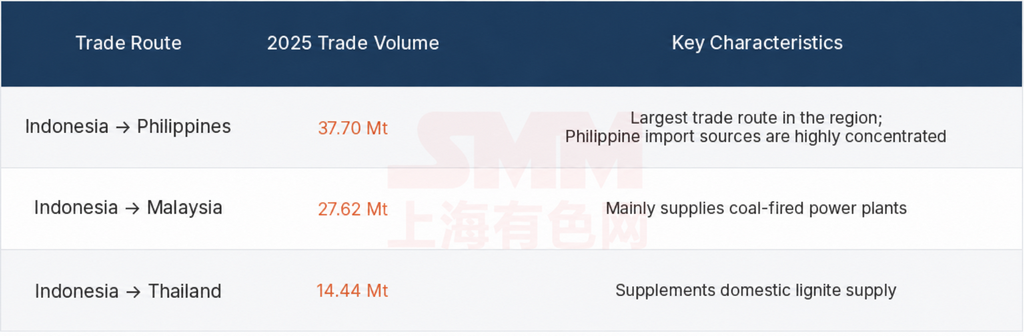
The Philippines’ coal supply consists of a combination of domestic production from Semirara Mining and Power Corporation (SMPC) and imported coal. SMPC mainly produces sub-bituminous coal, but individual power plants have different requirements for calorific value, ash, moisture and sulphur content. Domestic coal therefore cannot fully substitute for imports. In 2025, approximately 37.70 Mt of the Philippines’ coal imports came from Indonesia, indicating a highly concentrated import structure. As a result, production cuts, export restrictions or disruptions to port loading in Indonesia can generally be transmitted relatively quickly to the Philippine market.
Malaysia has limited domestic coal production, and its coal-fired power plants rely primarily on imports. In 2025, Malaysia imported approximately 36.32 Mt of thermal coal, of which 27.62 Mt, or 76%, came from Indonesia. Australia and Russia served as supplementary sources. The Indonesia–Malaysia trade route is therefore not the largest in the region by volume, but it remains one of Southeast Asia’s most stable thermal coal supply routes.
Vietnam has domestic anthracite resources concentrated in Quang Ninh Province, but the structure and quality of domestic coal supply do not fully match the requirements of its power plants. The country has therefore developed a supply model combining domestic production with large-scale imports. Vietnam’s total coal imports reached 65.43 Mt in 2025, including thermal coal, coking coal and other coal products; this figure should therefore not be treated as equivalent to thermal coal imports alone. Available interim data show that Vietnam imported approximately 6.98 Mt of coal from Indonesia in the first quarter of 2025 and around 19.71 Mt during the first nine months. Based on full-year export statistics from Statistics Indonesia (BPS), Indonesia exported approximately 26.15 Mt of coal to Vietnam in 2025. Interim figures should not be simply extrapolated to estimate full-year trade volumes.
Thailand has domestic lignite resources centred around the Mae Moh Mine, but domestic production and coal quality remain insufficient to meet all power-generation and industrial requirements. In 2025, Thailand imported approximately 17.74 Mt of coal, of which around 17.65 Mt was thermal coal, accounting for the vast majority of total imports. Indonesia is one of Thailand’s largest sources of imported coal, with BPS export statistics showing approximately 14.44 Mt of Indonesian coal exports to Thailand in 2025. Compared with Vietnam, Malaysia and the Philippines, Thailand has a noticeably smaller seaborne coal import market and can therefore be regarded as a second-tier coal importer within Southeast Asia.
2.3 Secondary and Emerging Trade Routes
The Philippines also has some coal export capacity. SMPC’s coal exports are directed mainly to China, with smaller volumes shipped to Vietnam and Brunei. The Philippines can therefore be characterised as a coal-producing country, a major importer, and a secondary exporter at the same time.
The Laos–Vietnam route is an emerging supplementary supply channel. The two countries have previously proposed increasing bilateral coal trade to as much as 20 Mt per year, but this figure represents a cooperation target rather than an already realised annual trade volume. In 2025, TKV continued to advance coal supply agreements with Lao companies, while its planned coal imports from Laos for 2026 are around 2.5 Mt. This indicates that the route is beginning to move from policy-level cooperation towards actual commercial supply, although its scale remains far below that of Indonesia–Vietnam trade.
Australia and Russia are also important external coal suppliers to Vietnam, Malaysia and Thailand, mainly providing higher-calorific-value thermal coal. Vietnam’s steel industry additionally relies on imported coking coal. Southeast Asia’s coal trade is therefore not purely an intra-regional flow, but is also significantly influenced by suppliers outside the region, particularly Australia and Russia.
2.4 Coal Quality and Supply Risks
Coal trade in Southeast Asia is determined not only by production volumes, but also by factors such as calorific value, volatile matter, moisture, ash, sulphur content and boiler compatibility. Vietnam’s domestic anthracite cannot fully substitute for imported thermal coal and coking coal, while coal produced from the Semirara mine in the Philippines is also unable to meet the quality requirements of all power plants. Buyers therefore do not assess coal solely on a per-tonne price basis, but instead compare the overall landed cost after taking into account ocean freight, energy content and coal-blending requirements.
Overall, the Indonesia–Philippines, Indonesia–Malaysia and Indonesia–Vietnam routes represent the most important coal trade flows in Southeast Asia, while Thailand can be regarded as a second-tier import market. The Philippines–Vietnam, Philippines–Brunei and Laos–Vietnam routes are smaller or still emerging. Changes in Indonesian coal production, domestic demand, export policy and loading conditions at Kalimantan ports therefore remain among the key factors affecting regional coal availability and import costs.
![[SMM Steel]](https://imgqn.smm.cn/usercenter/GGaSo20251217171716.jpg)
![[SMM Steel]](https://imgqn.smm.cn/usercenter/rKOND20251217171716.jpg)