Thailand is moving crystalline-silicon photovoltaic modules from a voluntary industrial standard to a mandatory market-access regime. Consultations, industry training and certification preparations are under way, but the final ministerial regulation and legally binding effective date had not been officially published as of August 27, 2026.
The distinction matters for China-based module manufacturers and Thai importers. The measure is not a new tariff: it introduces product testing, factory-site inspections, importer licensing, model-scope controls and ongoing surveillance. Because certification is generally tied to the actual manufacturing site, a regulatory start date that precedes approval of major supply bases could create a temporary gap in compliant supply.
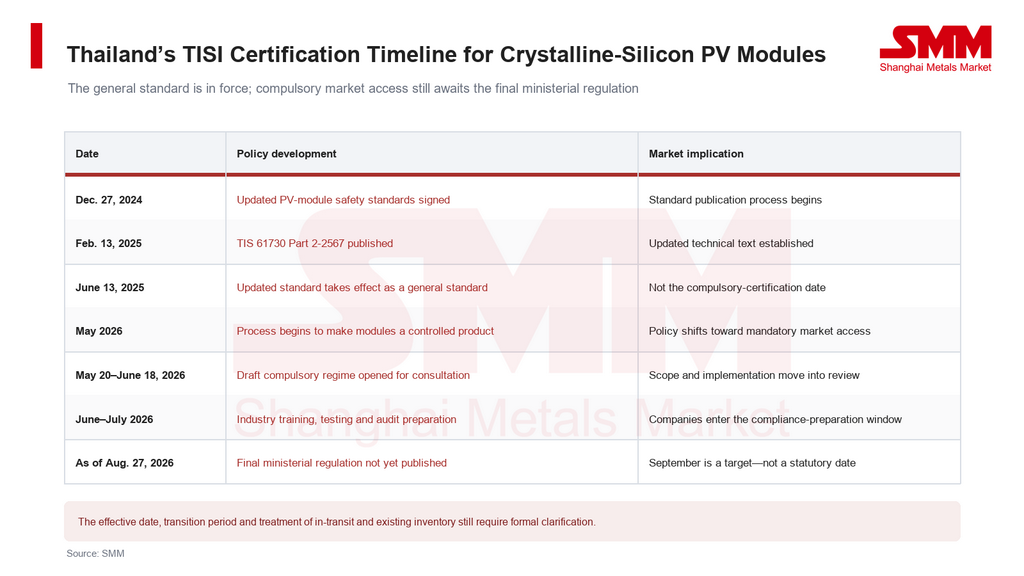
Mandatory market access has not yet taken effect
Thailand introduced the updated TIS 61730 Part 2-2567 standard in 2025. It took effect as a general industrial standard on June 13, 2025, but that date did not require every module imported into or sold in Thailand to hold a TISI license.
Mandatory status requires a ministerial regulation and related implementation procedures. The policy direction is clear, and September 2026 has been identified as the target window, but it should not be presented as a confirmed statutory date until the final regulation is published.
Companies therefore need to keep two dates separate. June 13, 2025 marked the implementation of the updated technical standard; September 2026 is the government’s target window for compulsory market access. The final effective date, any transition period, and treatment of goods already imported or in transit remain open questions.
The proposed rule targets safety—not tariffs or module performance
The proposed compulsory regime centres on TIS 61730 Part 2-2567, which is aligned with IEC 61730-2:2023. It addresses safety risks involving electric shock, fire, mechanical and environmental stress, component failure and personal injury.
TIS 61215 serves a different purpose. It focuses on design qualification, performance retention and environmental reliability, while TIS 61730 covers electrical, mechanical and fire safety. Earlier policy discussions referenced both standards, but the latest compulsory-control process focuses on TIS 61730 Part 2-2567. It would be inaccurate to state that both standards are already mandatory.
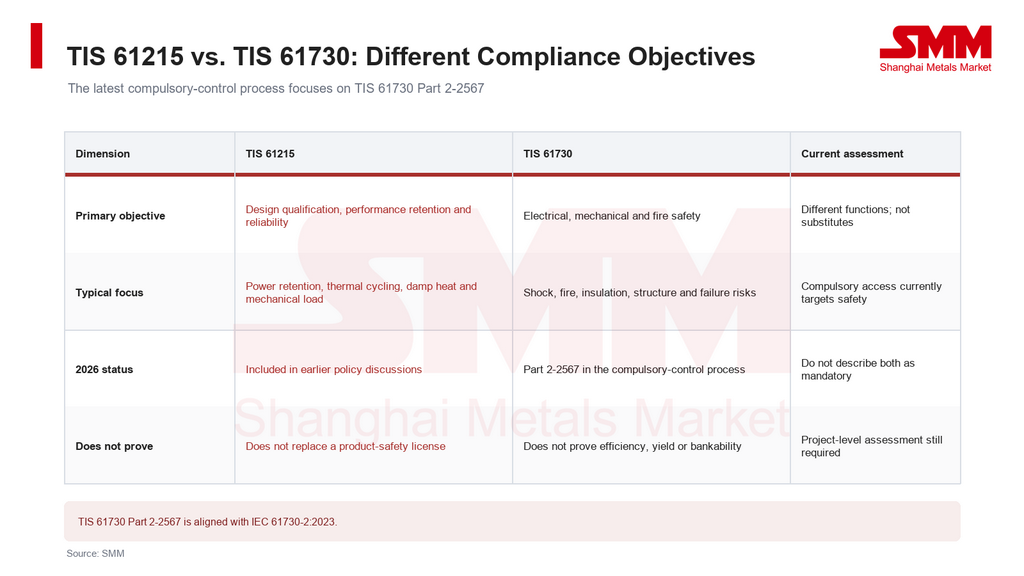
The measure is a safety and quality market-access requirement, not an anti-dumping duty, import tariff or local-content rule. Certification can raise the minimum threshold for product safety and traceability, but it does not by itself establish module efficiency, lifetime energy yield, long-term degradation or project bankability.
The current draft primarily covers crystalline-silicon PV modules. Modules incorporated into other industrial products are outside the draft’s direct scope. The treatment of thin-film, building-integrated, floating, offshore, vehicle-mounted and other specialised modules will depend on the final regulation and subsequent implementation guidance.
Factory-by-factory audits are likely to be the main bottleneck
For imported products, the Thai importer will generally act as the license applicant. The manufacturer must provide technical files, test reports and quality-management documentation, and must support on-site factory inspections and subsequent surveillance.
The process normally covers application preparation, product-family definition, testing or assessment of existing IEC reports, factory inspection, corrective action, technical and administrative review, import and marking controls, and post-approval surveillance. A license is not linked to a brand name alone; it is associated with the applicant, production site, product family, technical construction, bill of materials and declared power range.
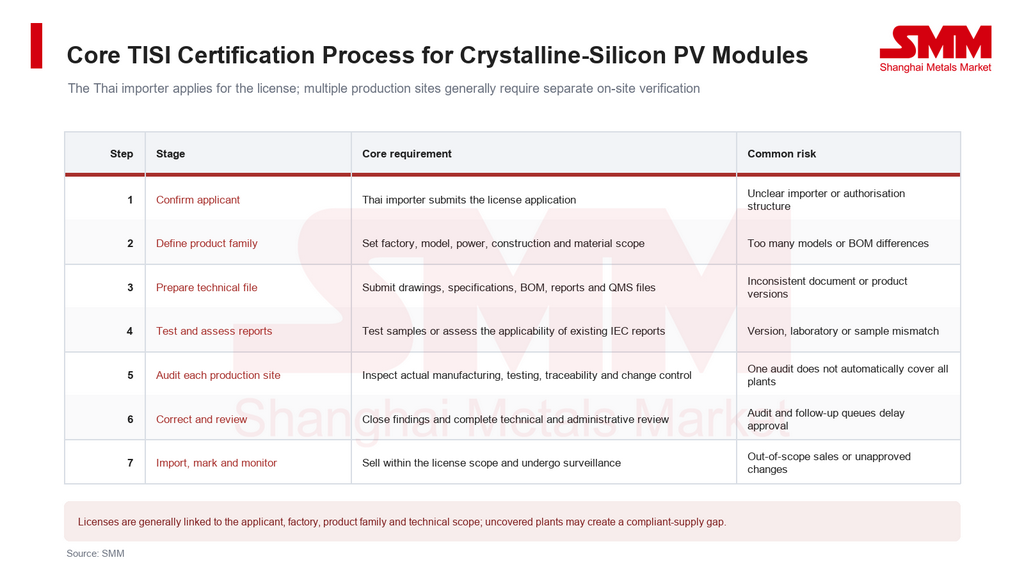
The factory inspection is the most easily underestimated timing variable. Inspectors need to verify the actual production site rather than only the corporate headquarters or brand owner. If one supplier intends to serve Thailand from several factories, those sites will generally need to be included separately within the approved scope. Approval of one plant should not be assumed to cover every facility within the same group.
Site inspections typically review production processes, incoming-material controls, in-process and final inspection, key materials and suppliers, equipment calibration, non-conforming product controls, model and BOM changes, traceability records, insulation testing and ground-continuity checks. An ISO 9001 certificate or group-wide quality manual may support the application, but it does not replace verification of the operating factory.
For manufacturers with plants in China and other jurisdictions, travel coordination, inspector availability, factory scheduling, corrective actions and follow-up reviews can extend the process. A surge in applications around the implementation date could create a queue for both testing and factory inspections. Even with a valid IEC report, modules from a production site that has not completed the required inspection and license coverage may be unable to enter the Thai market under the new regime.
IEC reports can shorten the process, but they do not become TISI licenses automatically
An IEC 61730-2:2023 report can form an important part of the application, but it cannot be converted automatically into a Thai license. The report must meet requirements relating to the applicable standard version, age, laboratory competence and product consistency, and it must cover the factory, model, materials and power range included in the application.
Reports are generally expected to be issued by a qualified ISO/IEC 17025 laboratory and, under current preparation practices, to remain within the accepted validity window. A version mismatch, an older report, a laboratory-scope issue, or differences between the tested sample and the product to be supplied may trigger supplementary testing or a new sample submission.
A valid factory-inspection report may be reusable for another Thai importer when the plant and product scope are identical and the report remains valid. The importer’s license itself is not transferable, however: each importer must complete its own licensing and import-control requirements.
There is also no official fixed “six-to-eight-month” certification period. Some companies use that range for planning a first full application because it may involve test scheduling, a foreign-site inspection, corrective action, document translation and a concentrated review queue. A well-prepared plant with current reports, stable product families and an experienced importer may complete the process faster; a first-time applicant with complex models or factory remediation may take longer.
A compliant-supply gap could affect deliveries before it affects underlying demand
The current draft does not clearly provide a statutory three-, six- or twelve-month transition period. If the regulation takes effect before some production sites complete inspection, corrective action and licensing, Thailand could face a period in which project demand remains intact but the range of products legally available for import and sale is temporarily limited.
The size and duration of that gap would depend on the number of factories approved in the first wave, the power ranges covered, the progress of Thai importer licenses and the amount of compliant inventory already in the country. It would not be determined by a single standard certification timeline.
Mandatory certification will also add costs for testing or retesting, samples and international freight, factory inspections and travel, importer applications, document preparation, ongoing surveillance and model extensions. These are primarily market-access costs. They become manufacturing costs only where the supplier must change module design, critical materials, testing equipment or factory controls.
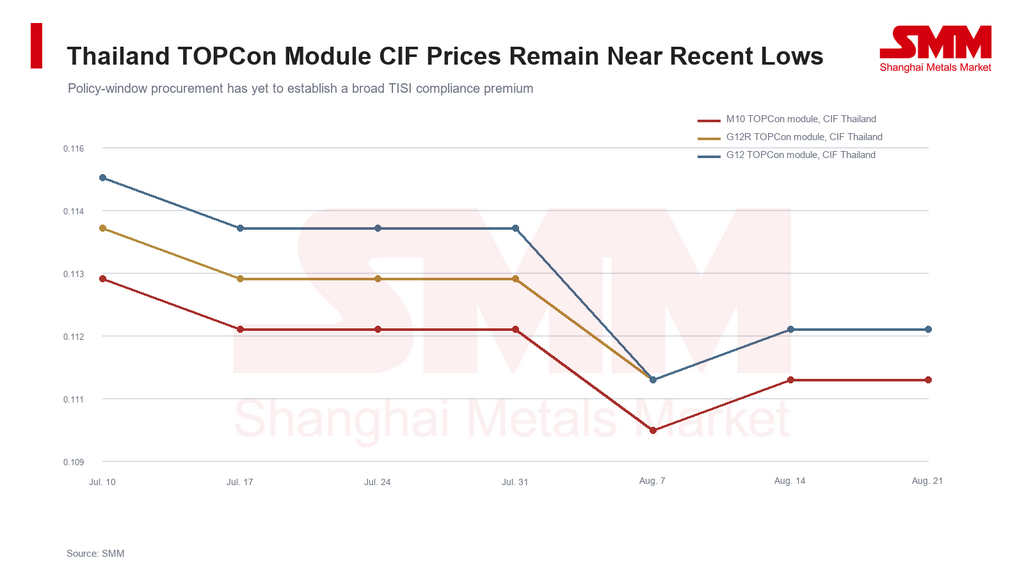
As of August 21, SMM assessed the weekly average CIF Thailand prices for M10, G12 and G12R TOPCon modules at $0.111/W, $0.112/W and $0.112/W, respectively. The three benchmarks remained about 1.8%, 2.6% and 1.8% below their July 10 levels. Prices recovered slightly from early-August lows, but the market had not yet established a clear, broad-based TISI compliance premium.
SMM data also show that China’s module exports to Thailand fell to 0.37 GW in July from 0.58 GW in June, a month-on-month decline of about 36.2%. This means the ability to pass certification costs through to buyers will still depend on project procurement, local inventory and supplier competition.
If several approved suppliers enter the market at the same time, compliance expenses may not translate fully into higher module prices. If factory inspections and testing queues restrict the range of approved models, however, a temporary premium could emerge. In that case, the price effect would come not only from certification expenses but also from a short-term contraction in compliant supply.
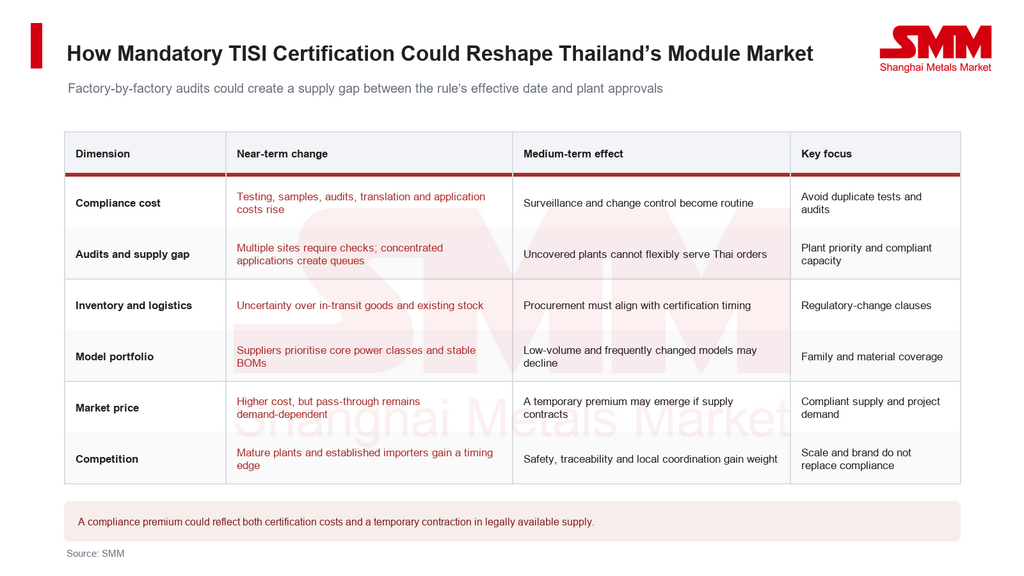
Manufacturers with several production bases will need to prioritise which plants should be approved first. Certifying every factory simultaneously may increase coordination and remediation complexity; certifying only selected plants requires enough compliant capacity to cover Thailand’s core demand. Switching an order to another factory without confirming that the site is included in the license scope could delay an otherwise valid contract.
Outlook: execution details will matter more than the headline date
Thailand is also preparing standards and compulsory controls for inverters and power-conversion equipment, low-voltage circuit breakers and switchgear, PV fuses, 1.5 kV DC PV cables and lithium batteries used in energy-storage systems. These products are not all at the same procedural stage, and the September target should not be interpreted as a single automatic effective date for every category.
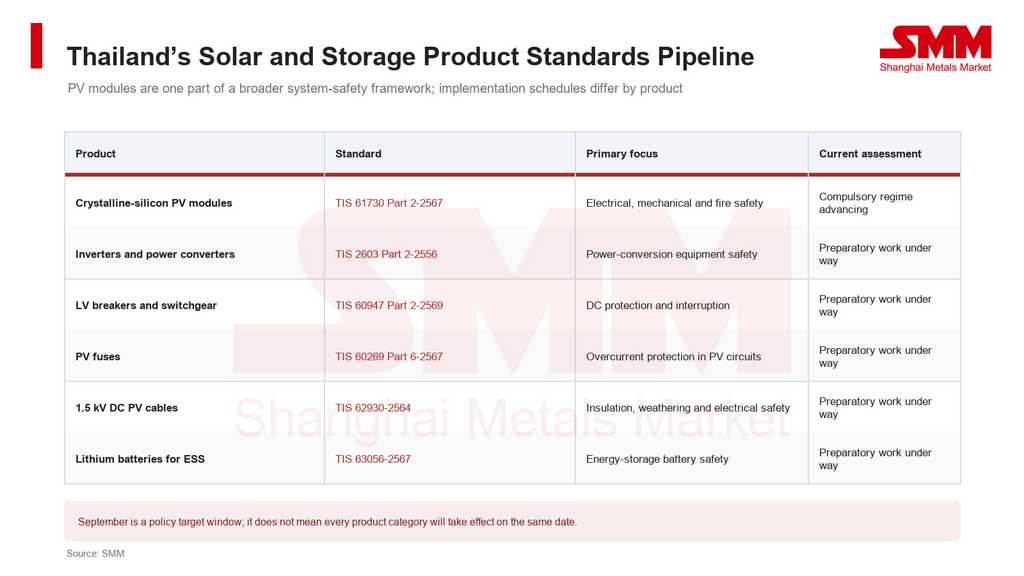
References to early 2027 relate to a broader solar-system standards roadmap covering equipment, design, installation, testing and storage. They do not constitute a fixed transition period for crystalline-silicon modules.
SMM will monitor seven implementation issues: publication and effective date of the final ministerial regulation; transition arrangements for imported, in-transit and contracted goods; final product scope; acceptance criteria for IEC reports and product-family grouping; factory-by-factory inspection schedules and report reuse; treatment of model and critical-material changes; and coordination with standards for inverters, cables, fuses and storage batteries.
In the near term, suppliers with approved factories, disciplined product-family management and strong coordination with Thai importers will have a timing advantage. If major production bases remain in the inspection queue when the regulation takes effect, the resulting compliant-supply gap could amplify delivery and price volatility. Whether that produces a lasting premium will still depend on demand, inventory and the pace of project procurement.
SMM will continue to track the final TISI regulation, implementation dates, testing and factory-inspection practices, and their effects on Chinese module exports, product availability and pricing in Thailand.
Written by:
Ryan Tey Tze Yang | SMM PV Analyst
+60 127179370 | ryan.tey@metal.com
![[SMM PV Flash] Indian PV Component Maker Vishakha Renewables Files for IPO to Raise INR 12.5 Billion](https://imgqn.smm.cn/usercenter/HKFoG20251217171742.jpg)
![[SMM PV Flash] US Energy Permitting Reform Bill Sparks Mixed Reactions from Clean Energy Sector](https://imgqn.smm.cn/usercenter/qQwIB20251217171741.jpg)
![[SMM PV Flash] South Korea to Overhaul National Power Grid, Aiming to Integrate Over 100GW of Renewables](https://imgqn.smm.cn/usercenter/rnXTf20251217171741.jpg)