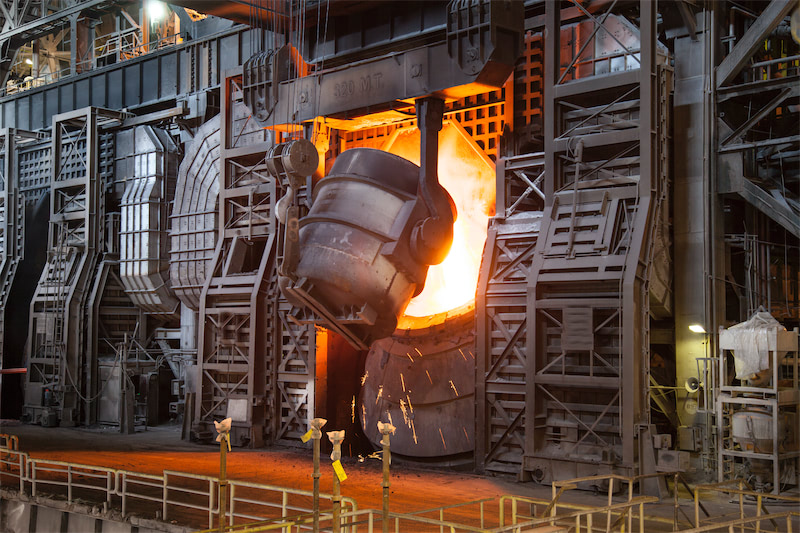
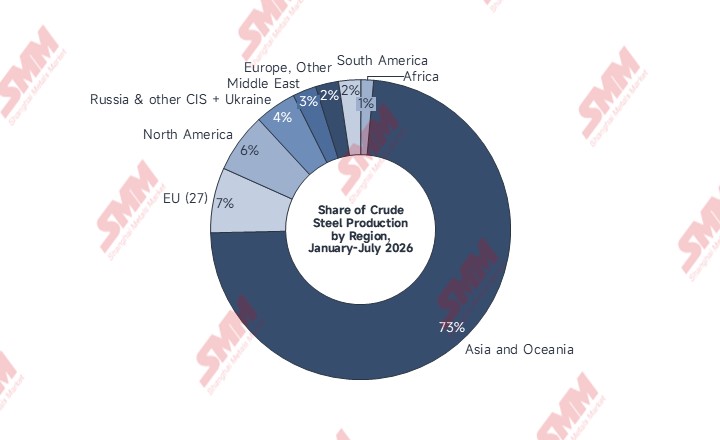
Global crude steel production recorded 149.2 million tonnes (Mt) in July 2026, down marginally by 0.3% year-on-year (YoY). Global daily average output contracted by 7.3% month-on-month (MoM) during the month. However, a structural breakdown reveals that this contraction was almost entirely driven by the Chinese market, where daily crude steel output dropped significantly by 11.1% (falling to 2.48 Mt/day)—marking the first genuine monthly contraction of the year. Excluding China, overseas crude steel production reached approximately 72.3 Mt in July, representing a strong YoY increase of 3.5%, while daily output eased by just 2.8% MoM. This minor dip was purely a normal seasonal fluctuation associated with the Northern Hemisphere summer maintenance cycle and signals no further deterioration in fundamental demand. Notably, because July has 31 days compared to June's 30, absolute MoM figures in data tables are naturally inflated by roughly 3.3 percentage points; thus, daily average metrics provide a clearer reflection of true production momentum. Over the first seven months of 2026, cumulative overseas crude steel output reached 504 Mt, reflecting an estimated YoY increase of ~2.4% and an annualized rate of 864 Mt, which comfortably exceeds the 2025 full-year total of 843 Mt. The 0.6% YoY decline in global crude steel output during January–July 2026 was entirely dragged down by China's 3.1% cumulative decline, while overseas markets maintained a steady, modest growth trajectory. In terms of regional distribution, Asia & Oceania accounted for 73% of global output in January–July 2026, followed by the EU (7%), North America (6%), Russia & Other CIS + Ukraine (4%), Middle East (3%), Other Europe (2%), South America (2%), and Africa (1%), maintaining overall structural stability compared to 2025, with only the Middle East seeing a slight contraction due to conflict-related disruptions.
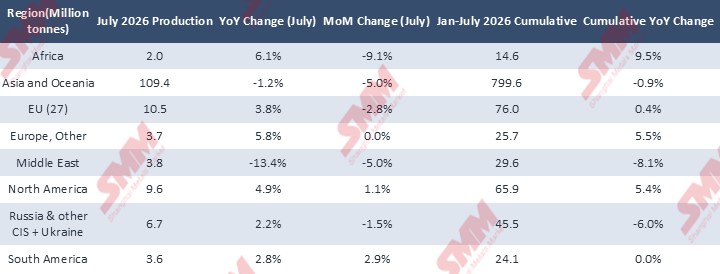
The core growth in overseas markets was primarily driven by trade protection policies and subsequent domestic market share recovery. Crude steel output across the EU (27) recorded 10.5 Mt in July, up 3.8% YoY, with German output rising to 2.8 Mt (+3.0% YoY), extending its upward momentum from June (+4.6% YoY). Against a backdrop of sluggish end-use demand in Europe, this domestic output growth was largely fueled by the new safeguard measures that took effect on July 1: duty-free quotas were slashed by 47% to 18.3 Mt/year, out-of-quota tariffs were raised from 25% to 50%, and covered product categories expanded from 28 to 30, successfully squeezing out low-cost imports and forcing domestic mills to reclaim market share. The 5.9% MoM decline in EU daily output was purely seasonal maintenance; key variables to monitor moving forward include the Q3 quota burn rate and the October 1 implementation of "melt-and-pour" rules of origin, which will reshape transshipment trade flows. In Asia, Vietnam and South Korea both posted YoY growth, but under vastly different dynamics. Vietnam produced 2.7 Mt in July (+34.7% YoY), bringing cumulative output to 17.9 Mt (+28.0% YoY). However, this surge was driven entirely by a low base effect (Hoa Phat Dung Quat 2's No. 2 blast furnace was only commissioned in September 2025); its daily output rose just 0.5% MoM, indicating full-capacity, steady-state operations. Conversely, South Korea produced 5.7 Mt (+6.4% YoY), with daily output jumping 4.1% MoM (absolute MoM +7.5%), making it the only major steel-producing nation showing genuine daily production acceleration. This was propelled by anti-dumping duties on imported hot-rolled coil (HRC), which allowed POSCO and Hyundai Steel to repeatedly hike ex-factory prices and restore domestic market share and pricing power.
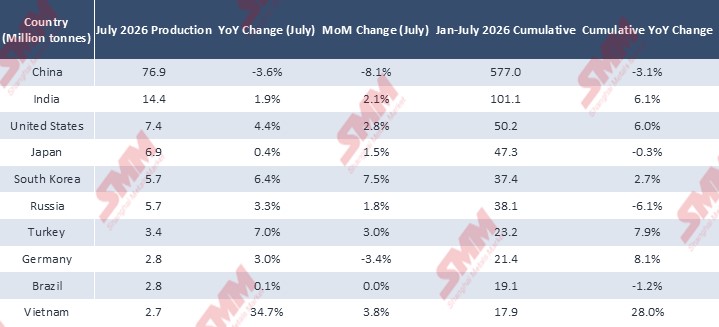
The Middle East and CIS regions remain caught between post-conflict recovery and base-effect distortions. Middle East crude steel output stood at 3.8 Mt in July (-13.4% YoY), narrowing its decline from April (-27.6%) and May (-19.4%), bringing January–July cumulative output to -8.1% YoY. Operational recovery in Iran progressed: Hormuzgan Steel Company (HOSCO, 1.5 Mt/yr) and Kish South Kaveh Steel (SKS, 2.4 Mt/yr) resumed production, Esfahan Steel Company (ESCO) operated at half capacity, and Mobarakeh Steel Company (MSC, pre-war market leader, ~30% facilities damaged) completed meltshop roof repairs in July, though full site restoration remains 6–12 months away. However, constrained by summer power shortages and volatile supply chains, Middle East daily output fell 8.1% MoM, demonstrating that post-war recovery will be non-linear. Russian crude steel production reached 5.7 Mt in July, turning positive at +3.3% YoY (vs. -3.4% in June); however, daily output fell 1.5% MoM. This YoY rebound was purely an optical artifact from last year's depressed H2 base, as H1 Russian domestic steel consumption fell 7.5% YoY, confirming that underlying end-use demand has not recovered. In China, daily output plunged 11.1% in July under the triple pressure of widening mill losses, summer heat/rainfall, and environmental curtailments in Tangshan. China's contraction transmitted through two main channels overseas: first, cheap Chinese steel exports continued to depress Asian scrap prices (e.g., CFR Taiwan containerized scrap hovered around 325 USD/tonne) and Southeast Asian finished steel prices; second, declining hot metal production pushed iron ore port stocks to three-year highs and capped ore prices, granting overseas EAF/BF producers marginal cost relief on the raw material front.
Looking ahead, overseas crude steel markets have not decoupled into a synchronized decline with China, maintaining a resilient yet range-bound pattern; four core marginal variables warrant close tracking. First, the burn rate of EU Q3 import quotas and the compliance cost increase stemming from the October 1 "melt-and-pour" origin rule, which will restructure origin-wise trade flows. Second, global scrap price bottoming: CFR Turkey HMS 80:20 scrap has stabilized around $370/mt (rebounding to 371–375 USD/tonne in early August), whereas Asian scrap remains muted due to cheap Chinese steel exports. Third, the slope of post-conflict energy/logistics recovery in the Middle East and Russia's true daily run-rate verification beneath low base figures. Fourth, the timing of China's production resumption as an exogenous variable: Chinese blast furnace operating rates remained low in early/mid-August (82.7% in week 2). If production resumes in September alongside "Gold September" peak demand, China's marginal uptick will anchor iron ore and scrap prices, providing a catalyst and timing window for Asian scrap and Southeast Asian steel price re-pricing.
![[SMM Steel] Shipping and Payment Bottlenecks Freeze Exports as Iranian Flat Steel Markets Diverge](https://imgqn.smm.cn/usercenter/fljuJ20251217171715.jpg)
![[JTL Engineering to Double Narrow-Width HRC Capacity to 120,000 Tonnes Annually]](https://imgqn.smm.cn/usercenter/nzckS20251217171747.jpg)