[SMM Analysis] Steel billet export growth continues, with ASEAN taking over and the Middle East weakening.
In Jan–Jul 2026 China exported roughly 77.15 Mt of steel products and billet combined, up about 2.2% from 75.48 Mt in the same period of 2025. Almost all of that growth, however, came from billet — finished steel products fell overall. On monthly cadence, export volumes climbed steadily through Jan–Jul, peaking at 13.16 Mt in June before easing to 12.65 Mt in July, −3.9% MoM — still historically high.
- By product:
Growth: Billet was the largest driver of export growth in Jan–Jul, and the only product whose gain exceeded 4 Mt. The rise still stems mainly from the earlier geopolitical conflict: after Middle East supply was disrupted, Chinese billet became the substitute source for Southeast Asia and other markets on the strength of its supply reliability, and local steel buyers kept purchasing it; at the same time Chinese billet remains price-competitive internationally, and the "lowest price wins" purchasing logic also underpinned the export surge. That momentum is, however, shifting at the margin — spreads in some markets (China vs India, for one) are converging, and overseas buyers have clearly slowed their billet purchasing. At the regional level, SMM surveys show most Southeast Asian traders are already sitting on high billet inventories, leaving little room for near-term purchase growth; they are expected to stay on the sidelines and work down stocks. Combined with SMM's order-cycle data, total billet exports should hold at around 2 Mt in August, but given the already elevated base a pullback is still expected next month — though not, we think, a sharp one.
Reduction: HRC: posted the largest cumulative decline and the steepest YoY drop of any product in Jan–Jul, in line with market expectations. The core reason remains the impact of anti-dumping and other trade-remedy measures.
Coated: exports fell YoY, yet month-on-month movement stayed narrow — July exports were 2,370.3 kt, just 0.6% below June's 2,384.7 kt. That suggests coated-steel export fundamentals remain relatively stable, supported by overseas home-appliance and automotive demand. Per SMM surveys, with downstream home-appliance makers in China's near-sea neighbouring markets restocking early for the peak season, coated exports have some room to rise next month. But if overseas domestic mills restore capacity or trade barriers rise, the rebound may be capped.
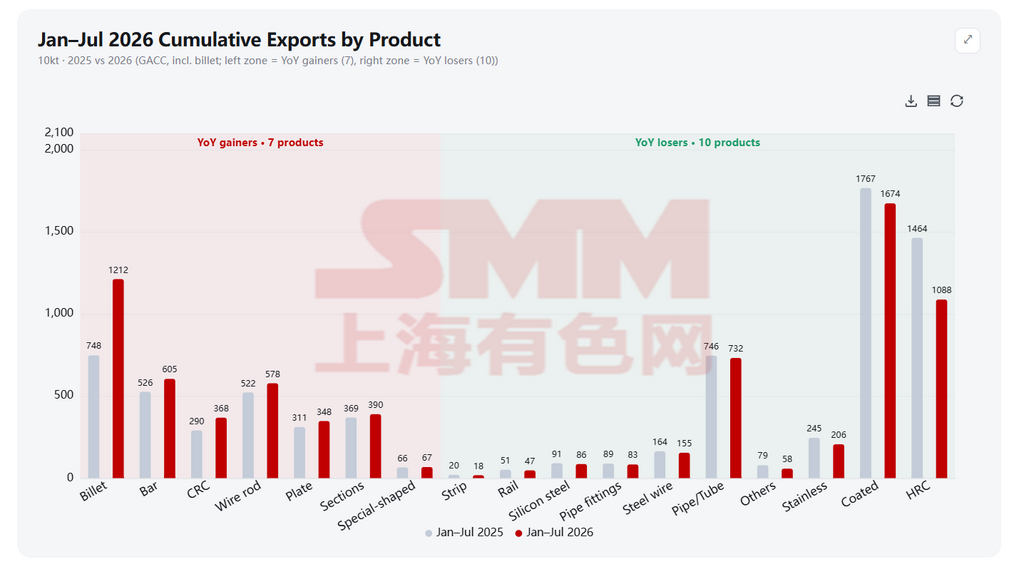
Data Source: SMM, General Administration of Customs
- By country:
From the country breakdown of YoY growth, the increase was mainly concentrated in two blocs: ASEAN and Africa. ASEAN was the most concentrated region for growth—Indonesia (+1.4 million mt), Thailand (+540,000 mt), Malaysia (+380,000 mt), and Singapore (+350,000 mt) together contributed an increase of about 2.67 million mt. The core product driving Indonesia’s sharp YoY surge remained steel billet: after Iran’s supply was cut off, the semi-finished products gap in Indonesia and other ASEAN countries was filled by China, coupled with steady local demand for steel used in infrastructure, automobiles, and manufacturing; China’s low-priced resources were highly competitive. In Africa, Djibouti (+570,000 mt), as an East African transshipment hub, absorbed regional demand from Ethiopia, Somalia, and others, with infrastructure and port projects continuing to provide a boost; Nigeria (+560,000 mt) and Kenya (+180,000 mt), among others, also benefited from steel demand for oil and gas, infrastructure, and urbanization, while local undersupply created import dependence.
The decline was concentrated in two directions. First, geopolitical conflict: the UAE (-1.42 million mt) was the single largest destination for the reduction in China’s steel exports, and the core reason was not trade remedies, but rather heightened tensions around the Red Sea and the Strait of Hormuz that led shipping companies to detour or raise risk premiums, significantly worsening the cost and timeliness of cargo arriving at main ports such as Jebel Ali and Khalifa; the UAE’s role as a Middle East–Africa transshipment hub was impacted. Over the same period, Oman increased by 380,000 mt YoY, corroborating signs of cargo rerouting in the Middle East, which can also be seen in SMM shipping data. Second, anti-dumping: Brazil (-1.25 million mt) imposed hefty final anti-dumping duties on Chinese cold-rolled, coated, and color-coated products in early 2026, with rates generally reaching or exceeding the price of the Chinese products themselves, effectively blocking import channels; South Korea (-660,000 mt) implemented anti-dumping measures on Chinese HRC (final recommendation 28.16%–33.10%) and medium-thickness plates (27.91%–34.10%, with price undertakings by nine enterprises). HRC accounts for more than 60% of China’s steel exports to South Korea, and exports contracted markedly after the restrictions.
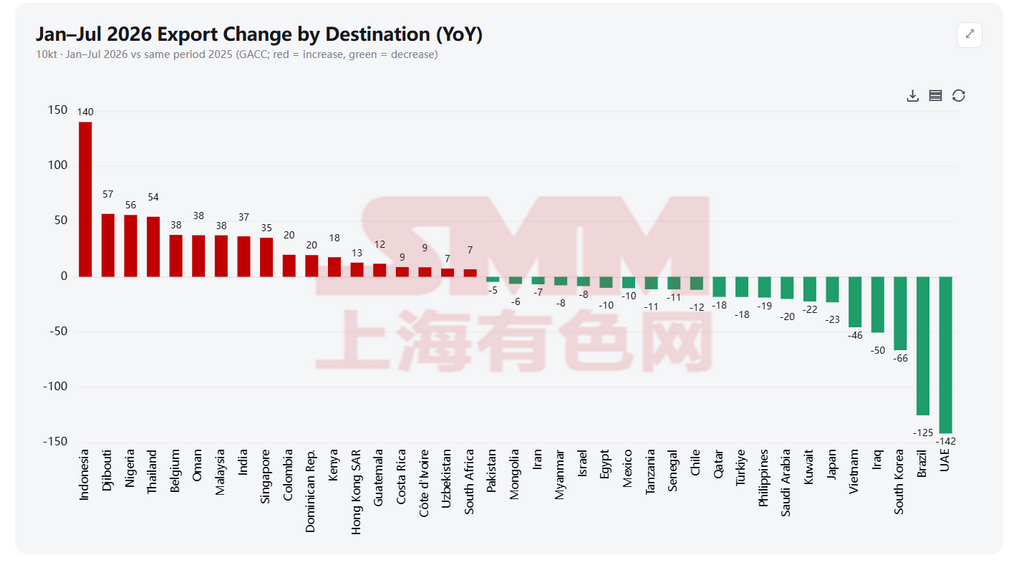
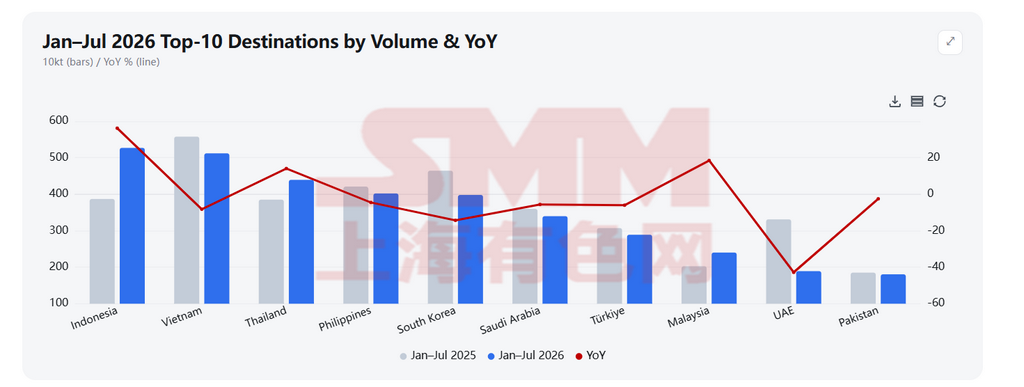
Data Source: SMM, General Administration of Customs
Copyright and Intellectual Property Statement:
This report is independently created or compiled by SMM Information & Technology Co., Ltd. (hereinafter referred to as "SMM"), and SMM legally enjoys complete copyright and related intellectual property rights.
The copyright, trademark rights, domain name rights, commercial data information property rights, and other related intellectual property rights of all content contained in this report (including but not limited to information, articles, data, charts, pictures, audio, video, logos, advertisements, trademarks, trade names, domain names, layout designs, etc.) are owned or held by SMM or its related right holders.
The above rights are strictly protected by relevant laws and regulations of the People's Republic of China, such as the Copyright Law of the People's Republic of China, the Trademark Law of the People's Republic of China, and the Anti-Unfair Competition Law of the People's Republic of China, as well as applicable international treaties.
Without prior written authorization from SMM, no institution or individual may:
1. Use all or part of this report in any form (including but not limited to reprinting, modifying, selling, transferring, displaying, translating, compiling, disseminating);
2. Disclose the content of this report to any third party;
3. License or authorize any third party to use the content of this report;
4. For any unauthorized use, SMM will legally pursue the legal responsibilities of the infringer, demanding that they bear legal responsibilities including but not limited to contractual breach liability, returning unjust enrichment, and compensating for direct and indirect economic losses.
Data Source Statement:
(Except for publicly available information, other data in this report are derived from publicly available information (including but not limited to industry news, seminars, exhibitions, corporate financial reports, brokerage reports, data from the National Bureau of Statistics, customs import and export data, various data published by major associations and institutions, etc.), market exchanges, and comprehensive analysis and reasonable inferences made by the research team based on SMM's internal database models. This information is for reference only and does not constitute decision-making advice.
SMM reserves the final interpretation right of the terms in this statement and the right to adjust and modify the content of the statement according to actual circumstances.
![[SMM Daily Sheets & Plates Comment] HRC Prices Move Sideways, Inventories Still Accumulating in Multiple Regions](https://imgqn.smm.cn/usercenter/SduBz20251217171716.jpg)