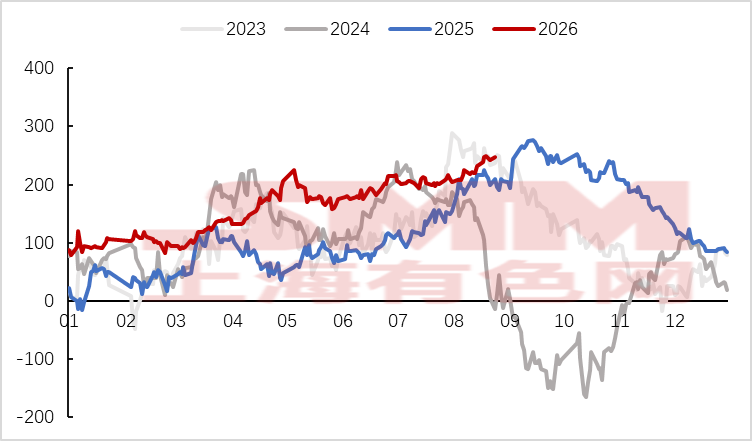
- In 2026, the spot price spread between hot-rolled coil (HRC) and rebar drifted higher, significantly above the level of the same period last year
From the start of 2026 to date, the HRC-rebar price spread for spot prices rose from 80 yuan/mt at the beginning of the year to 250 yuan/mt, averaging 160 yuan/mt, notably higher than the average of 88 yuan/mt in the same period of 2025.
SMM HRC-rebar spot price spread chart
Source: SMM
From January to August 2026, the HRC-rebar price spread generally drifted higher, with the price spread center being the highest in nearly four years. HRC maintained a positive premium over rebar, without the deep inversion seen in 2024. The spread started around 80 yuan/mt at the beginning of the year, steadily rose in Q2, stayed high in the 4‑8 month period, and approached 250 yuan/mt by August. This round of spread strengthening was driven mainly by supply-demand structure divergence: HRC received dual support from automotive and engineering machinery manufacturing demand and sheet & plate exports, showing strong demand resilience; rebar was dragged by the weaker-than-expected recovery in the real estate sector, with a slower pace of building material demand recovery, thus pushing up the HRC-rebar spread.
- In the second half of 2026, the HRC-rebar price spread is unlikely to see an unexpected trend
The current spread is already at a historically high level, facing mean-reversion pressure. The H2 trend will mainly depend on the tug-of-war between sheet & plate exports and China's domestic building material demand during the peak season. Entering the September peak season in September, rebar and HRC will see the traditional seasonal peak. If real estate and infrastructure demand materialize, rebar prices will receive a boost, and the HRC-rebar spread may retreat from highs. However, given the difficulty of a sharp short-term improvement in the construction sector, the spread is unlikely to narrow significantly, with the range expected at 140‑230 yuan/mt. If outside China sheet & plate exports remain strong and manufacturing demand exceeds expectations, the spread could still shoot up to 230‑280 yuan, but this level is historically high with limited sustainability.
Entering October‑November, China's domestic building material demand will gradually turn to the off-season, seasonal support for rebar fades, and HRC relies on exports and manufacturing relative advantages, creating opportunities for the HRC-rebar spread to widen again. By December during the winter stockpiling cycle, rebar enters the traditional off-season, while HRC demand still has external demand support, and the HRC-rebar spread is likely to maintain a positive premium, expected in the 80‑170 yuan/mt range, with a low probability of deep inversion within the year.
Data source statement:
(In this report, data other than publicly available information are all derived from public information (including but not limited to industry news, seminars, exhibitions, corporate financial reports, broker reports, National Bureau of Statistics (NBS) data, customs import/export data, various data published by major associations and institutions, etc.), market communication, and reliance on the SMM internal database model, comprehensively analyzed and reasonably inferred by the research team. This is for reference only and does not constitute decision-making advice.
SMM reserves the right to final interpretation of the terms of this statement and reserves the right to adjust and modify the content of the statement according to actual circumstances.
![[SMM Steel] VND Depreciation Lowers USD-Denominated Steel Prices as Peak-Season Demand Expectations Strengthen](https://imgqn.smm.cn/usercenter/mpffV20251217171715.jpg)
![[SMM Coking Coal and Coke Daily Review] 20260825](https://imgqn.smm.cn/usercenter/crVox20251217171717.jpg)
![[Welspun Corp Secures Record 1.8 Billion USD US Pipe Order]](https://imgqn.smm.cn/usercenter/JSngP20251217171719.jpg)