Aluminum Alloy Most-Traded Contract Retreats After Rapid Rise, Spot Market Mainly Stabilizes Prices [ADC12 Price Daily]

Published: Aug 25, 2026 11:44 (GMT+8)
[ADC12 Price Daily Review: Aluminum Alloy Most-Traded Contract Retreats After Rapid Rise, Spot Market Remains Stable] Today, the aluminum alloy 2610 contract opened at 23,195 yuan/mt, briefly shot up to 23,200 yuan/mt in early trading, but then the bulls failed to sustain the rally, and prices consolidated and pulled back gradually, eventually closing at 23,050 yuan/mt at noon, down 0.63%.

Futures side: Today, the aluminum alloy 2610 contract opened at 23,195 yuan/mt, briefly shot up to 23,200 yuan/mt in early trading, but lacked follow-through from bulls, and prices consolidated and gradually pulled back, closing at 23,050 yuan/mt at midday, a decline of 0.63%. The rebound at the 4-hour level met resistance and pulled back under pressure, with resistance appearing, open interest declining somewhat, and short-term rebound momentum fading, turning the market back into a consolidation pattern on a weak note.

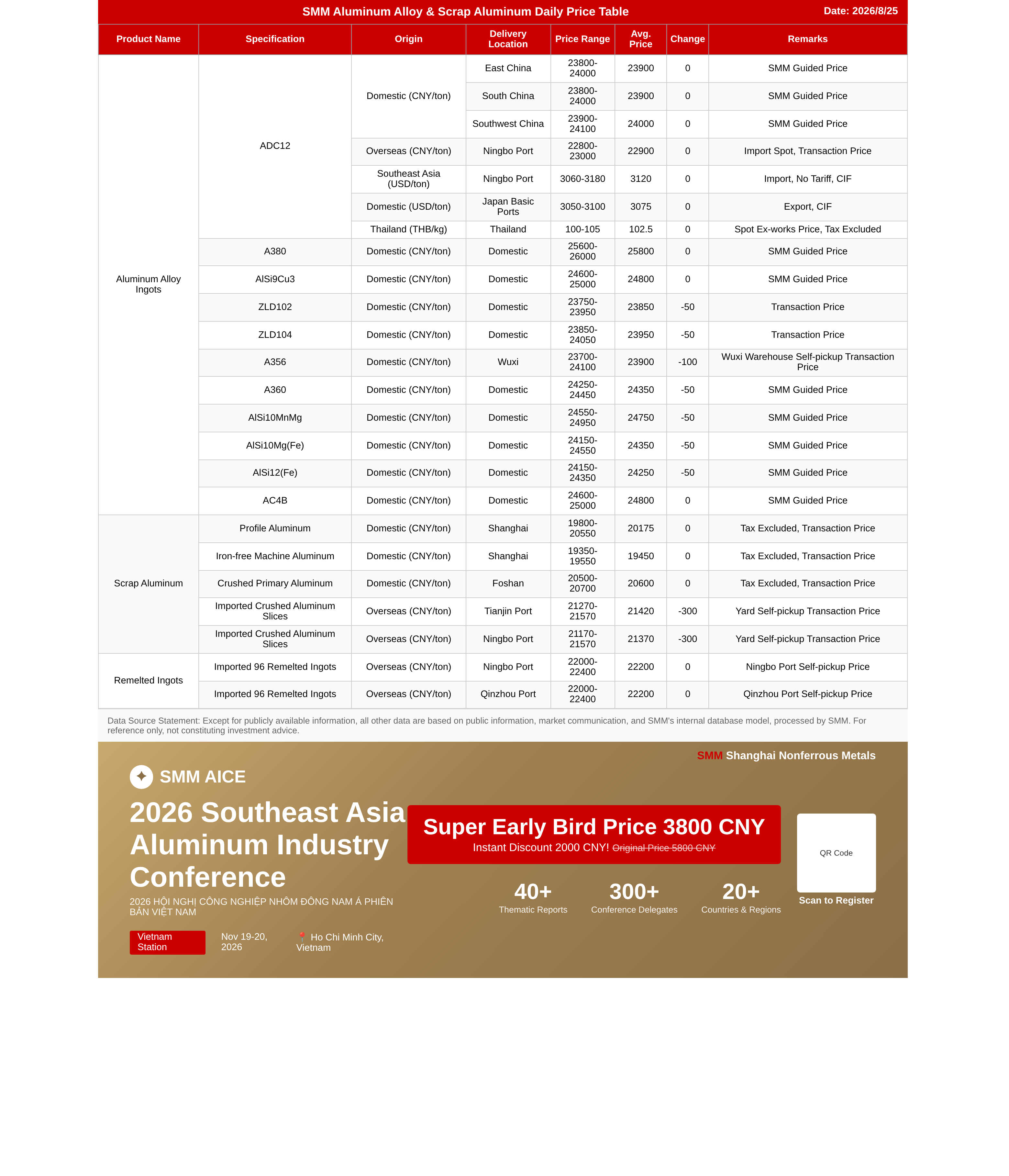
Spot side: Today, ADC12 market quotes were broadly stable, with SMM ADC12 prices unchanged from the previous trading day at 23,900 yuan/mt. On the demand side, there has been no significant improvement yet, and price increases still lack sufficient transaction support; meanwhile, the cost side still provides some support, limiting further downside, and the market is in a state where it is difficult to rise or fall, with a strong wait-and-see sentiment. However, as the traditional peak demand season gradually approaches, some enterprises have reported marginal improvements in orders recently, and expectations for subsequent demand recovery have risen. In the short term, ADC12 prices are expected to maintain a narrow sideways consolidation pattern, with subsequent focus on changes in the cost side and improvement in terminal demand.

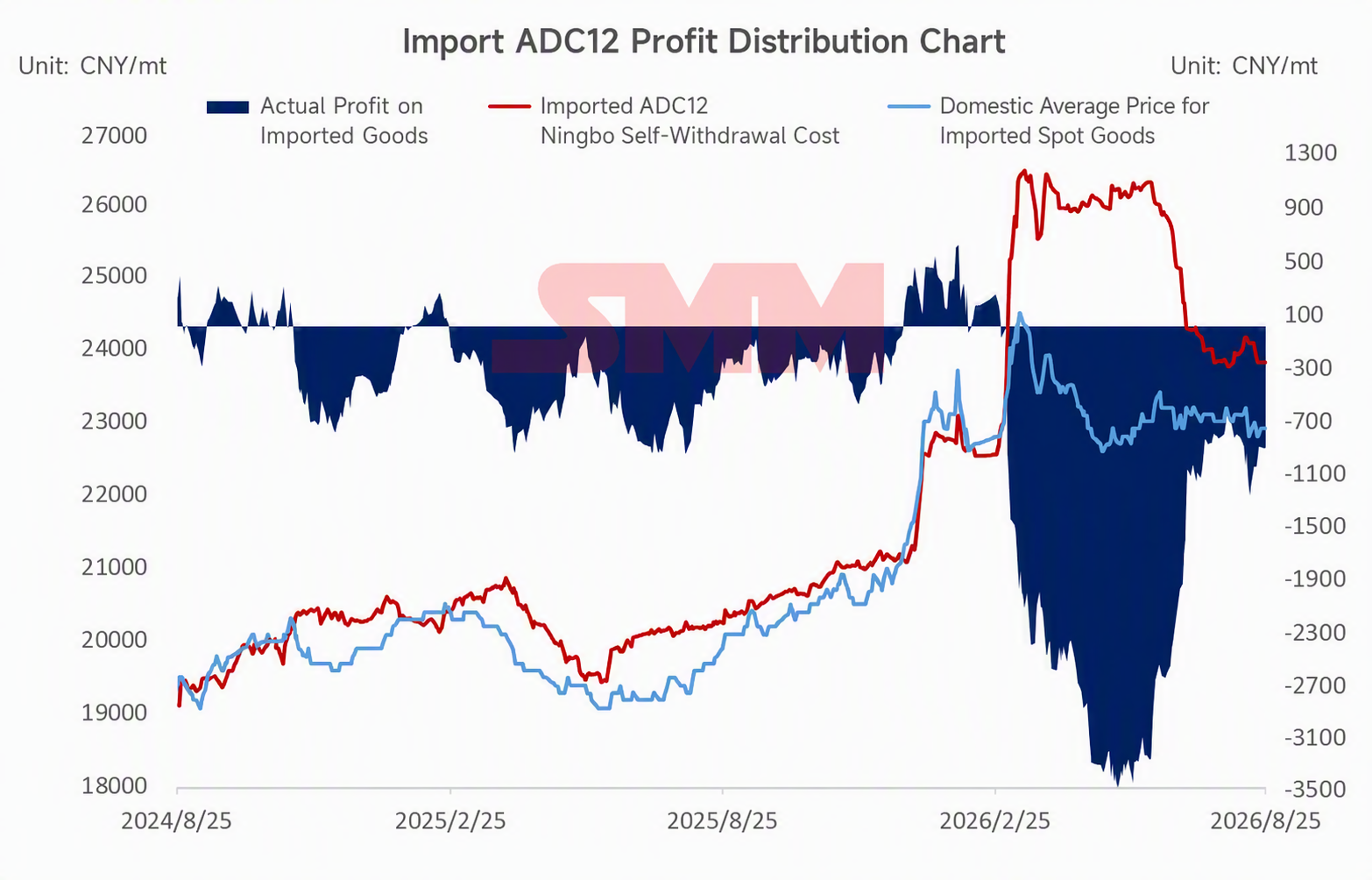
Import side, overseas ADC12 quotes were temporarily stable at $3,050-3,190/mt, with the import loss remaining small at around 900 yuan/mt, the import window still not opened, and overseas supply replenishment limited.


Data Source Statement: Except for publicly available information, all other data are processed by SMM based on publicly available information, market communication, and relying on SMM's internal database model. They are for reference only and do not constitute decision-making recommendations.

Images in this article contain AI-translated captions for reference only.

For any inquiries or for more information, please contact: lemonzhao@smm.cn
For more information on how to access our research reports, please contact:service.en@smm.cn
Related News
[SMM Chromium Flash] Zimbabwe's Mines Ministry Inspects Alluvial Chrome Operations in Nationwide Compliance Sweep
1 hour ago
[SMM Chromium Flash] Zimbabwe's Mines Ministry Inspects Alluvial Chrome Operations in Nationwide Compliance Sweep
Read More
[SMM Chromium Flash] Zimbabwe's Mines Ministry Inspects Alluvial Chrome Operations in Nationwide Compliance Sweep
[SMM Chromium Flash] Zimbabwe's Mines Ministry Inspects Alluvial Chrome Operations in Nationwide Compliance Sweep
Zimbabwe's Ministry of Mines and Mining Development has launched nationwide blitz inspections of alluvial chrome mining operations and processing plants, effective September 25, 2026, to enforce compliance with the country's mining laws. The inspections are initially targeting operations in Mashonaland Central, Mashonaland West and Midlands provinces, before being extended to other parts of the country. Permanent Secretary in the Ministry of Mines and Mining Development Dr Thomas Utete Wushe said the exercise is aimed at ensuring chrome mining activities are conducted within the legal framework. The ministry cited Section 222 of the Mines and Minerals Act [Chapter 21:05], which classifies chromite as a designated mineral, and Section 225, which requires anyone seeking to work an alluvial or eluvial chromite deposit to obtain an order from the Mining Affairs Board. Dr Wushe warned that mining operations found in breach of the regulations could face suspension and other penalties, and said the inspections will also cover chrome processing plants to assess compliance with relevant regulatory requirements. The government has appealed to members of the public to assist authorities by reporting suspected illegal alluvial chrome mining activities. The inspections come amid wider efforts by Zimbabwean authorities to regulate mining activities and ensure mineral resources are extracted and processed in accordance with the law, following earlier findings that the country's chrome output fell sharply in the first quarter of 2026 as more accessible alluvial deposits became depleted, pushing producers toward costlier hard-rock extraction methods.
1 hour ago
[SMM Chromium Flash] China's Zero-Tariff Scheme Drives Chrome Volumes Through South Africa's Port of Ngqura
1 hour ago
[SMM Chromium Flash] China's Zero-Tariff Scheme Drives Chrome Volumes Through South Africa's Port of Ngqura
Read More
[SMM Chromium Flash] China's Zero-Tariff Scheme Drives Chrome Volumes Through South Africa's Port of Ngqura
[SMM Chromium Flash] China's Zero-Tariff Scheme Drives Chrome Volumes Through South Africa's Port of Ngqura
China's zero-tariff policy for qualifying South African exports has significantly boosted demand for dry bulk commodities moving through South Africa's Port of Ngqura, including chrome, magnetite, iron ore and corn, port business strategy manager Xola Mkontwana said. Speaking during a media tour of the adjacent Coega Special Economic Zone in South Africa's Eastern Cape Province, Mkontwana described "exponential growth" in commodity throughput destined for the Chinese market since the policy took effect, saying the zero-tariff treatment has assisted bulk throughput across the port system specifically for commodities including chrome and magnetite alongside iron ore and corn. The zero-tariff treatment applies to qualifying exports from South Africa and 19 other non-least-developed African countries, and officially took effect on May 1, 2026. The framework runs as a two-year, non-reciprocal arrangement through April 30, 2028, expanding duty-free access to the Chinese market for African goods, provided exporters comply with rules of origin and standard customs regulations. The initiative fulfils commitments made under the Forum on China-Africa Cooperation (FOCAC) framework aimed at promoting more balanced bilateral trade and supporting industrialization across the African continent. Mkontwana attributed the surge in Chinese orders to expanding industrial and infrastructure activity in China combined with favorable price realizations for South African mining and agricultural producers. Port of Ngqura, located roughly 20 km northeast of Gqeberha, is South Africa's newest deep-water commercial port and serves as a logistics gateway connecting Eastern Cape minerals, agricultural produce and automotive manufacturing to global shipping lines, offering an additional export route for South African chrome alongside the Richards Bay and Maputo corridors more commonly associated with the country's chrome trade. No specific chrome tonnage or volume figures for Port of Ngqura were disclosed in the report.
1 hour ago
Greenland approves Tanbreez mining and closure plans
1 hour ago
Greenland approves Tanbreez mining and closure plans
Read More
Greenland approves Tanbreez mining and closure plans
[SMM Tantalum/ Niobioum Flash] Critical Metals said on 5 October 2026 that Greenland had approved the Mining Plan and Closure Plan for Tanbreez, with the documents signed on 29 September. The approvals run under exploitation licence 2020-54 to 8 September 2050 and specify 19 extractable elements, including tantalum and niobium, alongside zirconium, hafnium and rare earths. This advances Tanbreez from a planning and permitting standpoint, but it is not permission to begin construction immediately. The company still needs activity-specific operating permits covering matters such as environmental management, marine transport, health and safety, and mineral exports, as well as the required financial security. No mining or commercial output has been achieved
1 hour ago