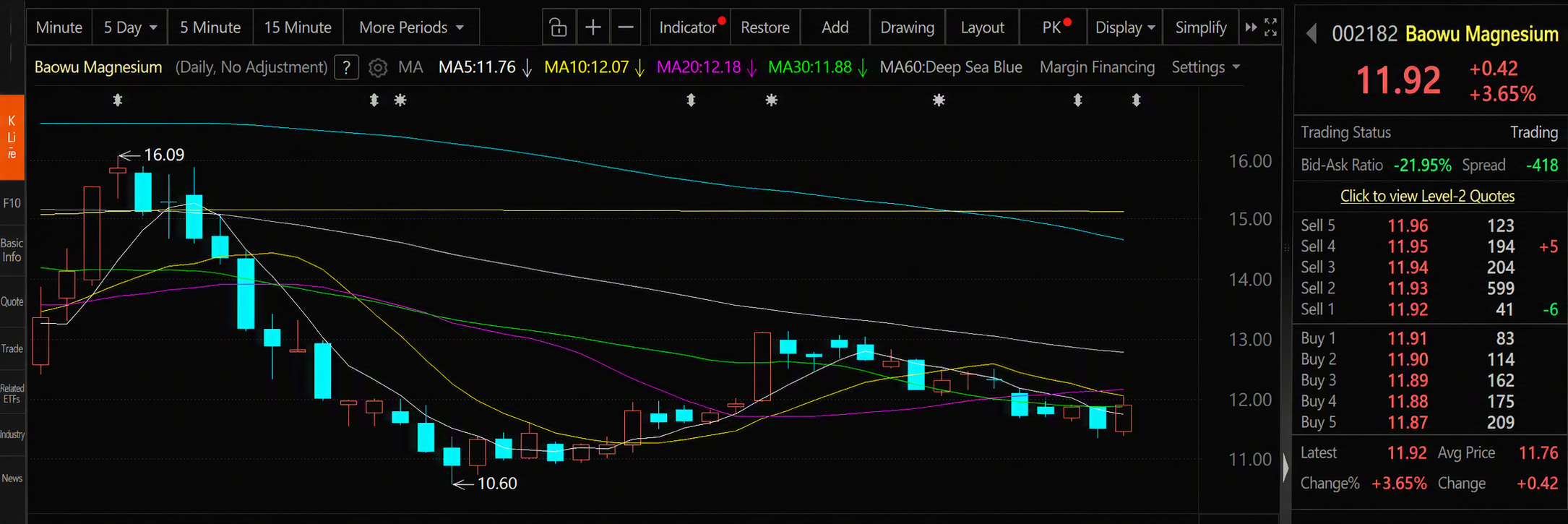
On August 25, the share price of Baowu Magnesium Industry saw a notable increase. As of around 10:23 on August 25, Baowu Magnesium Industry rose 3.65% to RMB 11.92 per share.
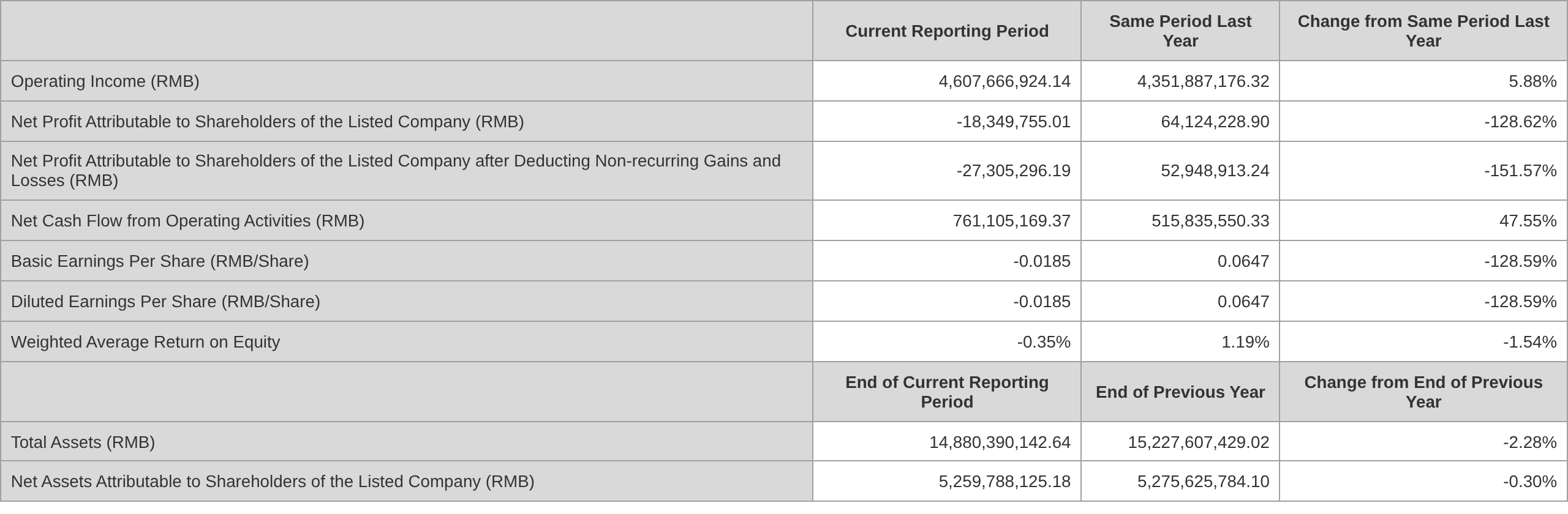
In terms of news: The semi-annual report released by Baowu Magnesium Industry showed that in H1 2026, the company achieved operating revenue of RMB 4.608 billion, up 5.88% YoY. Net profit attributable to shareholders of the publicly listed firm was RMB -18 million, down 128.62% compared to the same period last year.Due to a slight YoY increase in magnesium prices, the profitability of the company's magnesium material segment was basically stable YoY. The main reasons for the YoY decline in the company's semi-annual performance include: affected by fluctuations in aluminum prices and lower aluminum product sales compared to the same period last year, the profitability of the aluminum product business declined; the newly built ferrosilicon project of subsidiary Gansu Baowu was just put into production in May, with consumption indicators not yet stable, leading to relatively high product costs; the company's associate Anhui Baowu is still in the capacity ramp-up stage, with crude magnesium and alloy production significantly higher than the same period last year, and various production technical indicators gradually improving, but products are still in a loss-making state, affecting the company's investment income which decreased YoY; due to the appreciation of RMB against the US dollar and the euro, the company's exchange losses from export business increased YoY, etc.
Regarding the company's main business during the reporting period, Baowu Magnesium Industry introduced in its semi-annual report: The company has built a complete magnesium industry chain covering dolomite mining – primary magnesium smelting – magnesium alloy melting – magnesium alloy deep processing – secondary magnesium recovery and utilization. At the same time, it has deployed high-performance aluminum alloys and aluminum extrusion deep processing businesses, making it a global industry leader in light metal materials with full-chain operational capabilities. The company's products include primary magnesium, magnesium alloys, magnesium alloy automotive structural parts, aluminum alloy extrusions, metal strontium, etc., which are widely used in lightweight fields such as NEVs, light mobility equipment, 3C electronics, high-end equipment, humanoid robots, and rail transit. The company continues to improve its industrial layout in Chongqing, Jiangsu, Hubei, Anhui, Shanxi and other places; relies on large vertical tank low-carbon smelting and closed-loop secondary magnesium recycling processes to ensure stable supply; participates in the construction of a carbon footprint standard system for magnesium products, helping downstream clients achieve the dual goals of lightweight and low-carbon development. The company's main business includes magnesium material business, magnesium product business, aluminum product business, mine business, construction formwork, etc.; the company's main products include magnesium alloys, magnesium alloy deep-processed products, aluminum alloys, aluminum alloy deep-processed products, master alloys, metal strontium, and mineral products.
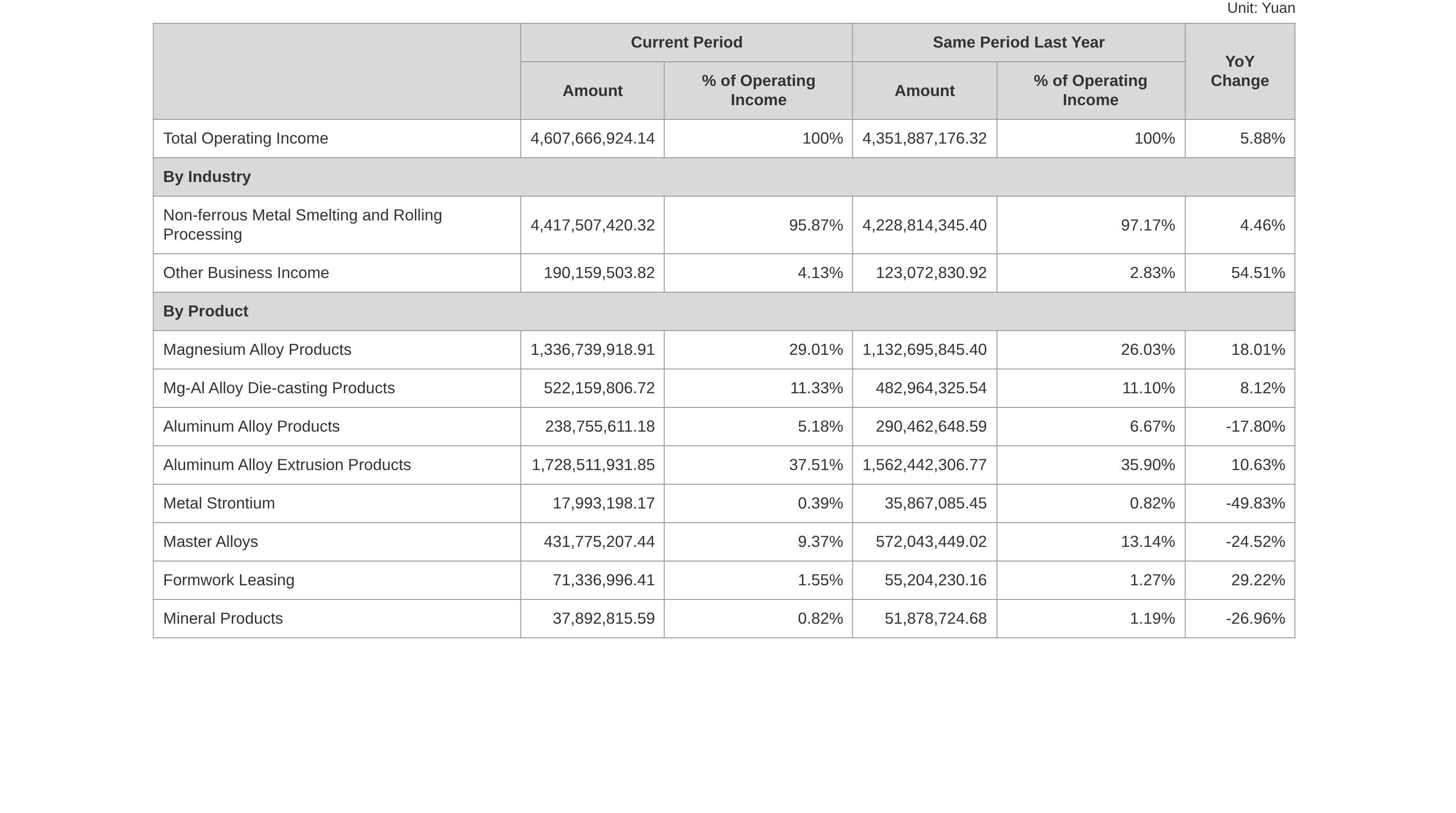
The composition of Baowu Magnesium Industry's H1 operating revenue is as follows:

Addressing the risks the company faces and the countermeasures, Baowu Magnesium Industry announced in its semi-annual report:1. Risk of fluctuations in major raw material prices The company's main business is magnesium and aluminum alloys and deep processing, with main raw materials being magnesium and aluminum metals. Magnesium and aluminum prices are affected by factors such as supply and demand, the global economy, and China's economic conditions, and are also closely related to the lightweighting of automobiles and demand from the 3C industry. If magnesium and aluminum prices experience wild swings in the future, it will have a certain impact on the company's cost control and profitability. The company increases the self-sufficiency ratio of raw materials, adjusts its product structure, increases the proportion of deep-processed products, and reduces the impact of raw material price fluctuations. 2 Risk of Market Demand Fluctuation The company's magnesium and aluminum lightweight alloy products are mainly used in automotive, consumer electronics and other fields. Currently, the company seizes the opportunity of automotive lightweighting development. On the basis of stabilizing the supply of basic magnesium and aluminum alloy materials, it focuses on expanding downstream deep-processing businesses such as magnesium alloy automotive die-castings, magnesium alloy building formwork, and aluminum alloy extruded products. The market demand for automotive lightweighting and 3C electronics consumption is affected by many factors such as macroeconomy, industrial policies, and process technology innovation. If downstream market demand falls short of expectations, it will affect the company's operating performance. The company expands product applications in various fields, increases penetration rates in various application fields, and reduces the risk of market demand fluctuation.
Regarding the company's future development outlook, Baowu Magnesium stated in its 2025 annual report: 2026 is the first year of the company's 15th Five-Year Plan, and the industry will usher in an important period of opportunities for high-end and large-scale development. The company's board of directors will lead the management team, with the core positioning of "building a lightweight solution supplier and becoming the main force of China Baowu's new materials," focusing on the main business, working intensively and meticulously, promoting the entire industry chain upgrade, technological innovation, market expansion, and green development, achieving continuous improvement in operating performance and significant enhancement of core competitiveness. 1 Strengthen the strategic leading role, cultivate the foundation of new quality productive forces in the magnesium industry Accelerate the construction of an entire industry chain development pattern covering primary magnesium, alloys, deep processing, and end-use applications, focus on key technologies for green smelting and stable production with cost reduction, and accelerate the large-scale promotion of key products. 2 Coordinate the construction of key projects, synergistically improve overall operational efficiency Accelerate the construction and comprehensive acceptance of the Huayuan Wujia mine of the Qingyang project, orderly promote the construction of the main plant area and optimization of production indicators, and orderly promote the construction of key projects in Gansu Baowu Magnesium, Wutai Baowu Magnesium, and Chaohu Baowu Magnesium. 3 Deepen reform and innovation in the magnesium industry, promote the modernization of the enterprise governance system Steadily promote business development transformation and innovation, promote asset integration, further optimize governance and control, and optimize business management models. 4 Accelerate the layout of smart development, comprehensively promote the construction of information systems Complete the full coverage of Baowu's standard financial system and the update and launch of the cost systems of subsidiaries, create a sample project of full-process informationization for the magnesium business, and further enhance Baowu Magnesium's operational management, cost-based operation, compliance operation, and risk prevention capabilities. 5. Pool Efforts to Tackle Primary Magnesium Cost Challenges and Continuously Enhance Market Competitiveness Reduce the manufacturing costs of the three core components—reduction retorts, central tubes, and cones; optimize and improve steel grades to extend the service life of reduction retorts; and reduce auxiliary energy consumption and the material-to-magnesium ratio. 6. Implement Accounting-Based Operations and Systematically Build a High-Quality Development Operating Model Deepen comprehensive benchmarking to identify gaps, systematically tackle the “four major costs” of primary magnesium, energy, logistics, and quality, and improve the operating management and control system. 7. Build a Strong Safety and Environmental Protection Fortress and Systematically Enhance Green Development Continuously strengthen rectification for safety and environmental protection compliance. Highlight risk control in key areas and intrinsic safety enhancement. Accelerate the development of green factories and low-carbon capabilities.
Baowu Magnesium mentioned the risk of raw material price fluctuations, including magnesium and aluminum, in its semi-annual report:
Magnesium market: Reviewing the price performance of 99.90% magnesium ingot (Fugu, Shenmu) in H1 this year shows that the average price of 99.90% magnesium ingot (Fugu, Shenmu) on June 30 this year was 15,850 yuan/mt. Compared with the average price of 17,950 yuan/mt on December 31, 2025, the average price fell by 2,100 yuan/mt in H1 this year, a decline of 11.7%. The daily average price in H1 this year was 16,607.33 yuan/mt. Compared with the daily average price of 16,241.45 yuan/mt in H1 2025, the daily average price rose by 365.88 yuan/mt YoY, an increase of 2.25%.
According to SMM quotations: the price of 99.90% magnesium ingot (Fugu, Shenmu) on August 25 was 15,800-15,900 yuan/mt, with an average price of 1,585 yuan/mt, flat from the previous trading day. From the transaction perspective, the magnesium market saw widespread transactions at 15,800 yuan/mt on the morning of August 25, with good transaction performance. Primary magnesium producers that successfully concluded deals at 15,800 yuan/mt raised their offers and stopped selling externally. Overall, high-quality cargo at 15,800 yuan/mt was relatively tight, and magnesium prices showed signs of bottoming out and stabilizing. Specifically, primary magnesium smelters that underwent maintenance in July had basically all resumed production, and overall spot supply in the market increased significantly from earlier levels. Primary magnesium producers faced relatively high shipment pressure, while downstream traders restocked to meet rigid demand; market procurement was relatively rational. Overall, the market shifted again to a pattern of strong supply and weak demand, but supported by the cost side, magnesium prices had relatively limited downside room in the short term.
Aluminum market: In H1 2026, SHFE aluminum prices showed a “high first, then low” pattern. In Q1, expectations for US Fed interest rate cuts intertwined with Middle East geopolitical conflicts, pushing aluminum prices to record highs; entering Q2, as the US strong-dollar policy stance was confirmed, Middle East supply disruptions marginally eased, and downstream consumption in China entered the off-season, the price center of aluminum continued to move lower. In Q1 2026, SHFE aluminum price movements were mainly driven by the macro front and disruptions on the overseas supply side, while the seasonal weakness on the fundamentals side instead became a secondary contradiction. In Q2, as high aluminum prices spurred an increase in China’s capacity utilization rate and the impact of overseas aluminum smelter production cuts was gradually digested at the margin, market attention gradually returned to China’s fundamentals. The center of SHFE aluminum pulled back from about 24,665 yuan/mt in April to about 23,769 yuan/mt in June; in late June, it once dipped to around 22,665 yuan/mt, setting a new low for the year.
On the spot market: The average price of SMM A00 aluminum on August 25 fell 0.25% from the previous trading day. At present, macro sentiment has been repeatedly shifting, and the Middle East situation has entered a “neither war nor peace” state, frequently disrupting aluminum prices in China and overseas; on the fundamentals side, the destocking trend in China’s aluminum ingot inventory continued, providing bottom support for aluminum prices; however, outside China, daily average aluminum production is expected to continue rebounding, driven by newly commissioned and resumed capacity; as the domestic-to-overseas price spread is repaired and orders on hand are digested, export demand is expected to gradually weaken; in addition, China’s end-user domestic demand performance has been average, the period for the transition between the off-season and peak season has yet to become clear, and the market has expressed some concerns about peak-season demand. In the short term, aluminum prices are expected to continue consolidating on a subdued note.
Recommended reading:
![[SMM Steel] Steady Demand and Specification Shortages Push Turkish Rebar Prices to New High Since Early June](https://imgqn.smm.cn/usercenter/JAnHq20251217171716.jpg)
![[SMM Sheets & Plates Daily Comment] HRC futures surged alongside costs, with production still expected to edge down](https://imgqn.smm.cn/usercenter/ntiFA20251217171719.jpg)